 Lin Wanning
Restaurant pest control requirements come down to one legal test, and a failed inspection can close a kitchen for days and cost days of takings.
Restaurant pest control requirements in England rest on one test: Regulation 852/2004 says adequate procedures are to be in place to control pests. The law does not name a pest control contract as mandatory. Inspectors check pest control as part of a business's physical condition, and where there is an imminent risk of injury to health a council can close a kitchen with a hygiene emergency prohibition notice. A contract is common practice, alongside written checks, proofing and records.
The inspection nobody announces
Picture an owner who opens the dry store on a Tuesday morning and finds a bag of flour that has been gnawed open. If an officer from the council arrives that afternoon, the questions are about more than the flour: the gaps around the pipework, the state of the bins, and whether anything on paper shows that anyone was checking for this. GOV.UK states that "Usually, you will not be told an inspection is going to happen", so there is no week of warning to find the problem first.
The consequences arrive in a particular order. Stock that rodents have touched has to go in the bin. The kitchen may stop trading the same day if the officer decides the risk is imminent. Bookings already in the diary have to be cancelled or moved, guests who turn up find a notice on the door, and staff on hourly shifts may lose the hours. Then there are costs a court can add: in three 2026 council releases read for this guide, the courts awarded the council £1,055 and £475 in costs.
Three recent cases, taken from the councils' own announcements, show how it plays out. Each is a different kind of business in a different town. None of these cases tells the whole story of any one operator. They are described here only by town, month and type of business.
- Reading, August 2026, an Indian restaurant. Council officers visited on 23 July after the owners "requested a re-rating of their recently issued food hygiene score of 1". They "found evidence of a rodent infestation, including live rodents and rat droppings, in food storage and food handling areas", including "bags of flour that had been gnawed by rodents". A hygiene emergency prohibition notice was issued the same day, magistrates agreed it on 31 July, and the business reopened after a revisit on 4 August, 12 days after the first visit. Costs of £1,055 were awarded to the council. Source: Reading Borough Council, 4 August 2026.
- Walsall, July 2026, a fish bar and pizza takeaway. A hygiene emergency prohibition notice was served on 30 June 2026 after "mouse droppings and gnawed tissue paper" were found in preparation areas, and droppings on "a dough mixer, pizza pan and metal pizza dividers". The court approved the order on 7 July, ordered £475 costs to the council, and the business was permitted to reopen on 8 July, 8 days after the notice. Source: Walsall Council, 29 July 2026.
- Willenhall (Walsall), October 2026, a Chinese takeaway. A notice was served on 14 October 2026 after droppings were found "in the kitchen, including under the cooker" and in a storeroom "next to packaged food items including noodles and sauces". The business reopened on 16 October, 2 days after the notice and before the court hearing on 21 October, which granted the order and £475 costs. The council's own words on the release: "Effective pest control is a basic requirement for any food business." Source: Walsall Council, 28 October 2026.
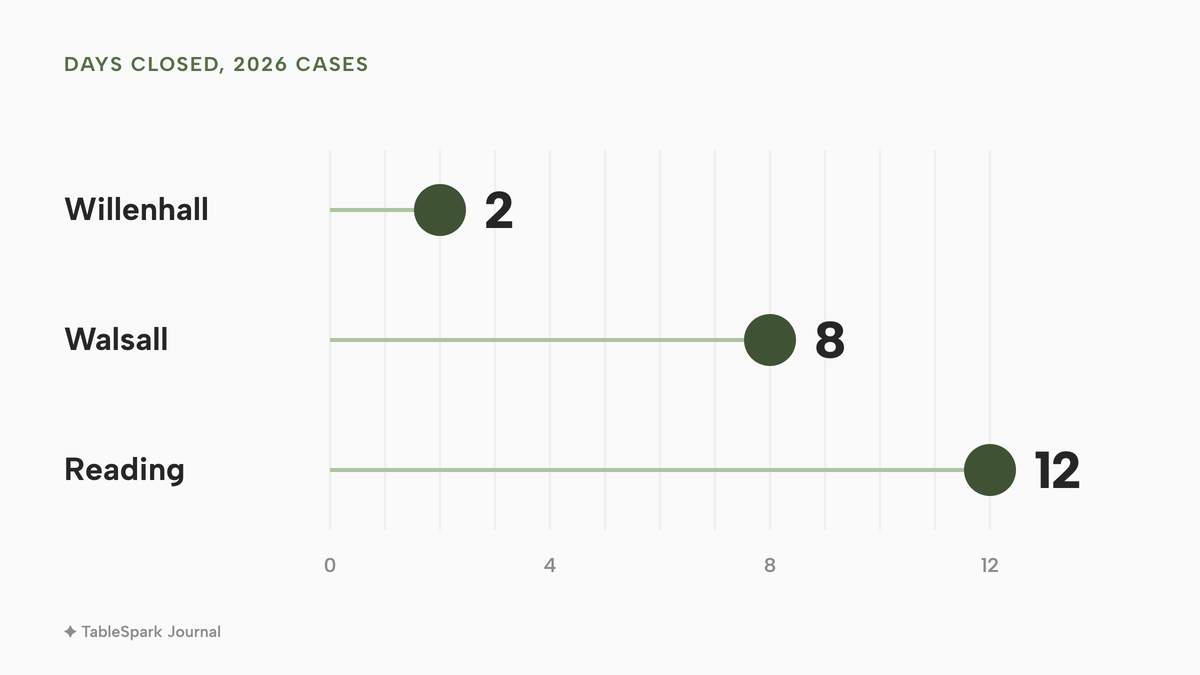
Three council releases are not a national statistic. The gaps of 2, 8 and 12 days, and the court costs of £1,055 and £475, describe those three releases and nothing wider. No fine was reported in any of the three. What the cases do show is the shape of the risk: a closure is measured in days of lost trading.
A fourth council release is useful for a different reason. Oxford City Council, in May 2026, reported that a magistrates' court had served a hygiene emergency prohibition order on an Oxford burger business "due to extremely poor hygiene conditions and a serious mouse infestation". Officers found "no evidence of routine pest control checks or a professional pest control contract" and said the premises were "insufficiently pest-proofed", and recorded "Large gaps around pipework, skirting boards and in the timber flooring". The operator "claimed that the mice were 'seasonal and that they came every year'". The release rests the closure on the infestation, the gaps and the missing checks together, so it does not show that a missing contract alone closes a business.
The rest of this guide covers the requirements in order. It sets out what the law says and what it does not, how a closure works step by step, a checklist drawn from the Food Standards Agency's own pest sheet, what a pest control plan contains, what commercial pest control costs when the prices are published, and what one closure costs by comparison. It then shows how a restaurant can keep the surrounding paperwork in one place. The frame throughout is England. Wales, Scotland and Northern Ireland are covered by one sentence further down, because their pages were not read for this guide.
Restaurant pest control requirements: what the law says
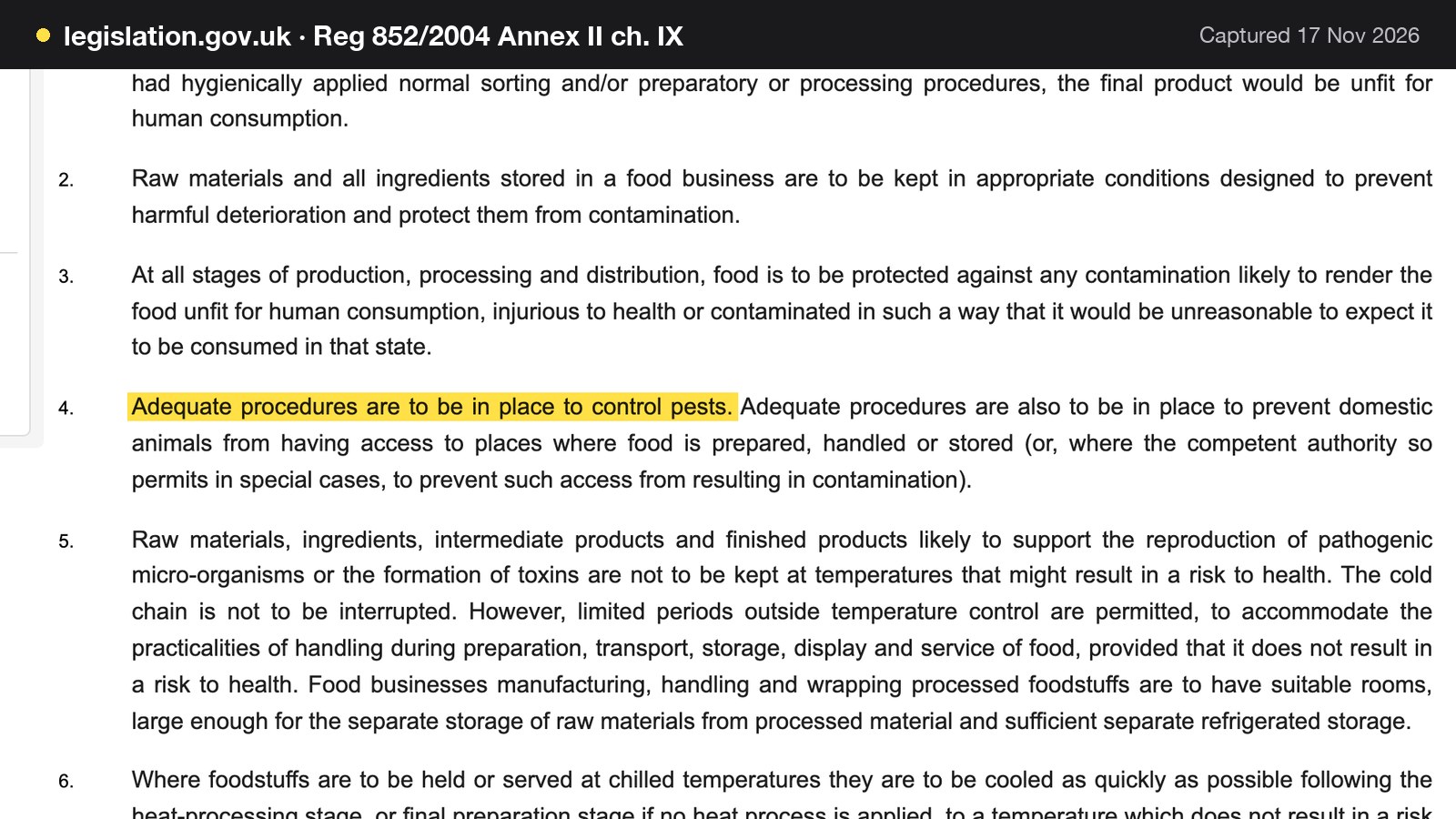
The main requirement is a single sentence in retained Regulation (EC) 852/2004, Annex II, Chapter IX, which deals with foodstuffs. It reads: "Adequate procedures are to be in place to control pests." The same paragraph adds that "Adequate procedures are also to be in place to prevent domestic animals from having access to places where food is prepared, handled or stored". On legislation.gov.uk the text carries no known outstanding effects from later UK legislation.
Three neighbouring provisions are worth knowing, because they show where pest control sits in the law.
- Food protection. Paragraph 3 of the same chapter says that at all stages of production, processing and distribution, food is to be protected against any contamination likely to render it unfit for human consumption or injurious to health.
- Premises. Annex II, Chapter I says premises are to "permit good food hygiene practices, including protection against contamination and, in particular, pest control".
- A food-safety system. Article 5(1) requires food business operators to "put in place, implement and maintain a permanent procedure or procedures based on the HACCP principles". Pest control sits inside that system. The HACCP guide for restaurants covers the plan itself, so this guide does not repeat it.
Do restaurants have to have pest control?
A restaurant has to have adequate pest control procedures. No statute page read for this guide says that a pest control contract is mandatory, and the Food Standards Agency words it as an option in its Safer Food, Better Business sheet for caterers: "You could employ a pest control contractor." A contract is common practice, and it is one way to show that procedures exist, but the legal test is whether the procedures are adequate.
That distinction matters because the procedures are the requirement and the contract is a method. A visit frequency that a seller recommends is the seller's advice, not the law.
What an inspector checks
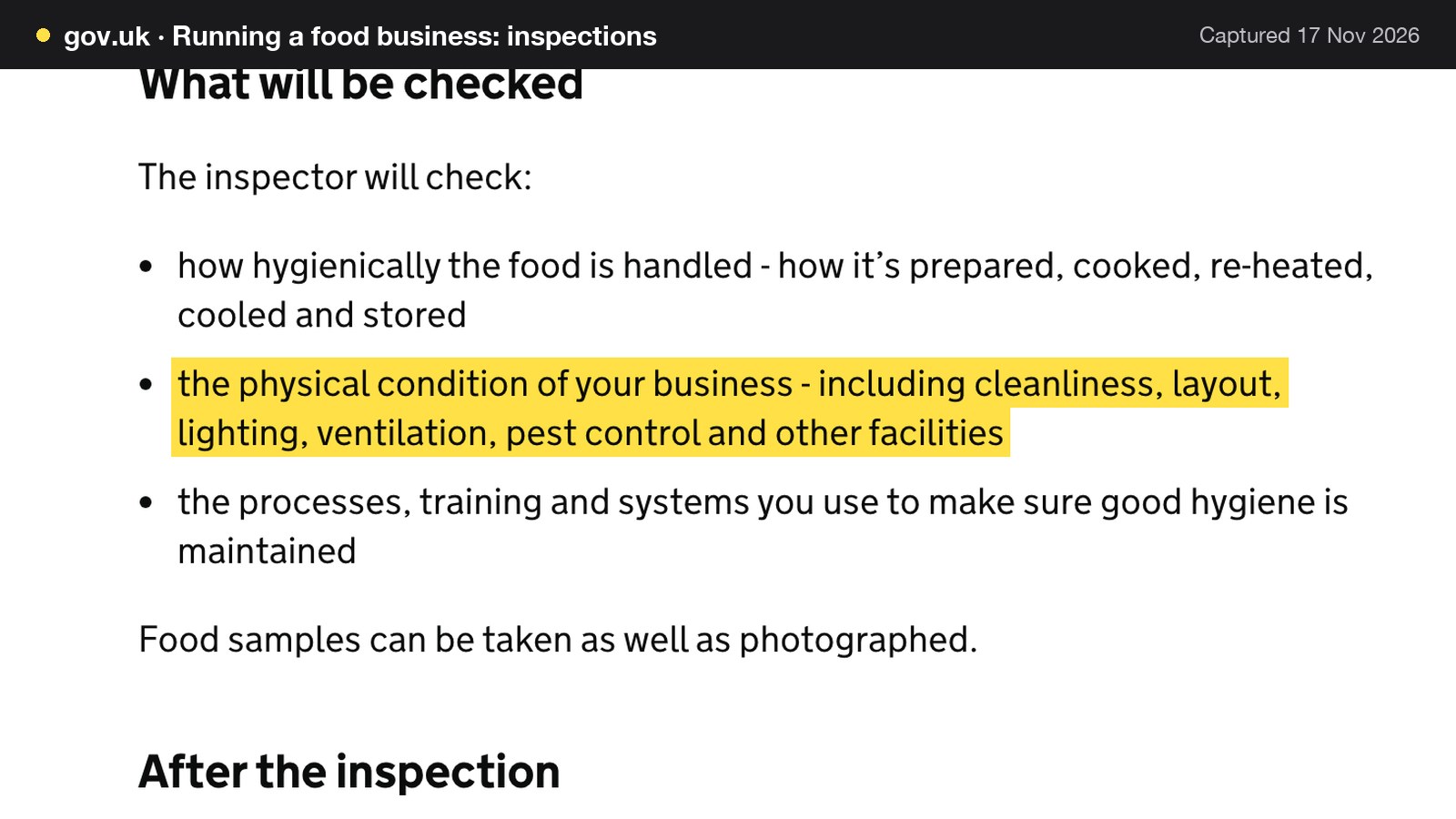
GOV.UK's guidance on food inspections says the inspector will check "the physical condition of your business - including cleanliness, layout, lighting, ventilation, pest control and other facilities". Pest control therefore falls in the part of the inspection that looks at the building itself, alongside the things that let pests in or feed them.
The same page says the business will be told in writing what its food hygiene rating is and why, either at the inspection or within 14 days. Neither the FSA's rating scheme page nor the GOV.UK pages read for this guide state how a pest finding changes a score, so this guide does not put a number on it. The food hygiene rating guide covers the scoring elements. GOV.UK also notes that in Wales and Northern Ireland it is mandatory to display the rating sticker, and voluntary in England.
What the officer can serve
Two notices matter here, and both come from the Food Safety and Hygiene (England) Regulations 2013.
A hygiene improvement notice, under regulation 6, can require measures within a period that is "not being less than 14 days". Failing to comply "commits an offence". It requires measures within a set period.
A hygiene emergency prohibition notice, under regulation 8, is the route for the three cases above. If an authorised officer is "satisfied that the health risk condition is fulfilled with respect to any food business", the officer may serve a notice that imposes "the appropriate prohibition". The condition is read with regulation 7(2), and regulation 8(4) applies it with one change, which is that the test becomes an imminent risk. In the regulation's own words, the reference to risk of injury to health is treated "as if" it "were a reference to imminent risk of injury".
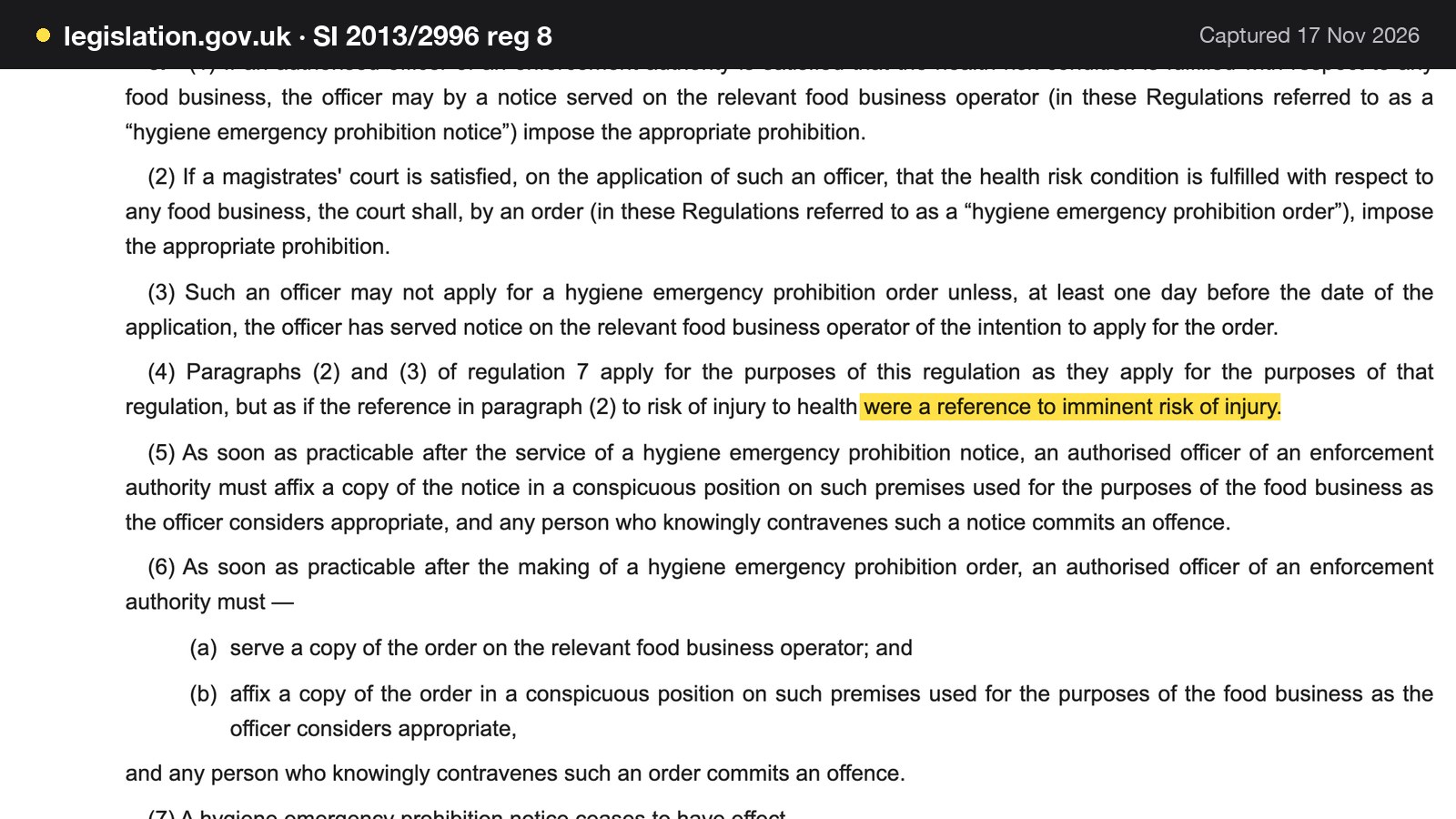
Regulation 7(2) lists what can create the risk, including "the state or condition of any premises or equipment used for the purposes of the business". It does not use the word pests. The council releases above show the power being used on infestations, and that is as far as this guide goes: it reports how three councils used it and does not claim a rule about which findings always lead to closure.
Prosecution is a separate track. Regulation 19 makes contravening a specified provision an offence, liable on summary conviction to a fine not exceeding the statutory maximum, or on indictment to up to two years in prison, a fine or both. Regulation 11 says that where an offence is due to the act or default of another person, that other person commits the offence. The pages read do not list which provisions are specified, so whether a given finding leads to prosecution is a decision for the council and the court. One reported example shows the scale: in a release dated 21 March 2025, Slough Borough Council reported that two operators of a restaurant closed in February 2024 pleaded guilty and were fined and charged £2,050 and £5,000. The offences also covered washbasins and an unregistered business, so those totals are not a penalty for a pest finding alone.
Wales, Scotland and Northern Ireland
The requirement in Regulation 852/2004 is the starting point across the UK, but the enforcement regulations and rating schemes differ by nation, and the pages for Wales, Scotland and Northern Ireland were not read for this guide. Owners there need to check their own country's rules before relying on the England detail below.
How an emergency closure works
A hygiene emergency prohibition notice is quick. The timings in regulation 8 explain why the gaps in the three cases were measured in days, and why a notice served on a Tuesday can lead to a court hearing the following week.
| Time | What happens | Source |
|---|---|---|
| Day of service | The officer serves the notice and affixes a copy in a conspicuous position on the premises | Reg 8(1), 8(5) |
| At least 1 day before the application | The officer serves notice of intention to apply to the magistrates' court | Reg 8(3) |
| Within 3 days of service | The application for the order must be made, or the notice ceases to have effect | Reg 8(7) |
| After the court approves | The order stays until a certificate says "sufficient measures" were taken | Reg 8(8) |
| Within 3 days of the authority being satisfied | The authority must issue the certificate | Reg 8(9) |
| Within 14 days of the operator's application | The authority must determine whether it is satisfied | Reg 8(9) |
Three points follow from the table. First, a notice can bite the same day: the Reading notice was issued on the day of the visit, and the Willenhall business reopened before the court met. Second, the route out is a certificate that sufficient measures have been taken, which in the Reading release meant that the structural and pest control issues had been addressed and a comprehensive deep clean completed. Third, a notice that is posted on the premises is a public one. Anyone who knowingly contravenes it commits an offence, and the prohibition notice guide covers what a posted notice means for online ordering.
Owners sometimes assume one more provision works in their favour. Under regulation 8(10), where a notice is served the authority must compensate the operator for loss suffered by complying with it, unless an application for an order is made within three days and the court is satisfied that the health risk condition was fulfilled when the notice was served. In the three 2026 cases the courts approved the order, so no compensation point arose. An owner should not plan around it.
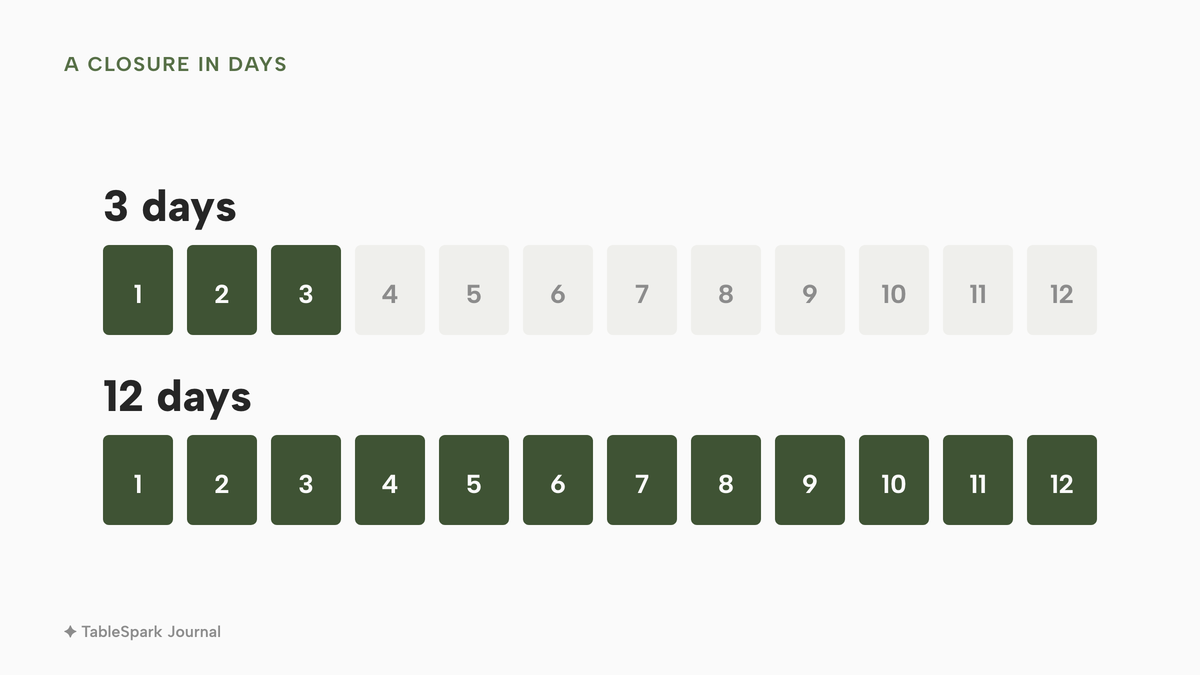
The figure above shades a three-day closure, which is the illustrative case used in the cost sections below, and the 12-day Reading case as the long end of the three reported cases.
A restaurant pest control checklist from the FSA's own sheet
The Food Standards Agency's Safer Food, Better Business pack for caterers has a "Safe method" sheet on pest control. It is undated and linked from the FSA's caterers page. It opens with the claim that "Effective pest control is essential to keep pests out of your premises and prevent them from spreading harmful bacteria". The checklist below follows its structure and uses its wording where quoted.
Keep pests out and starve them
- Check the premises "regularly for signs of pests". The sheet does not set a frequency; it says to make checks "more frequent" after a problem.
- Check deliveries thoroughly. The sheet says not to accept a delivery that shows signs of pests, "such as gnawed packaging or insects, e.g. beetles".
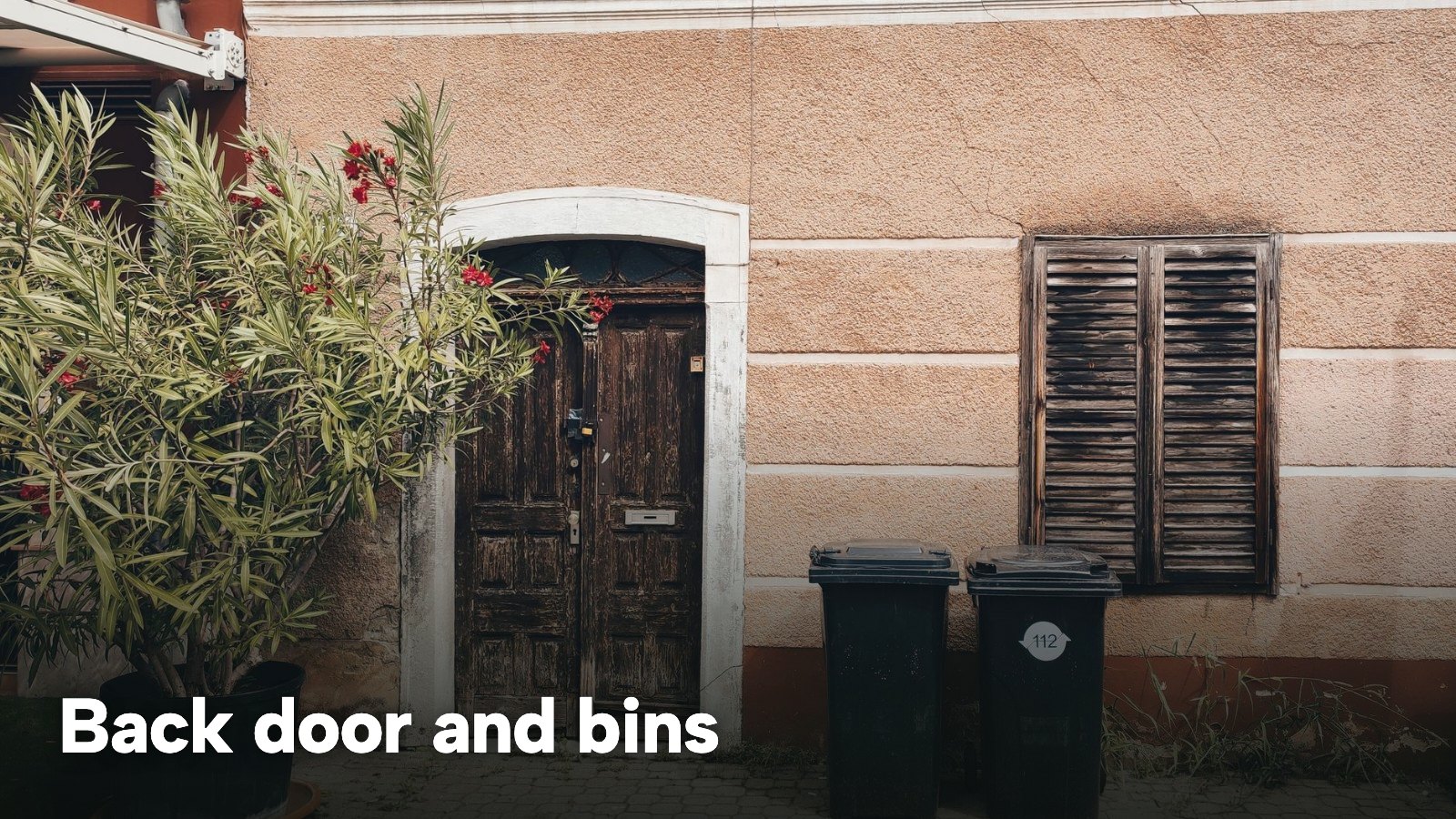
- Keep bins for storing food with close-fitting lids, and clean and disinfect them regularly.
- Make sure no food or dirty plates are left out when the business is closed, because they are a source of food for pests.
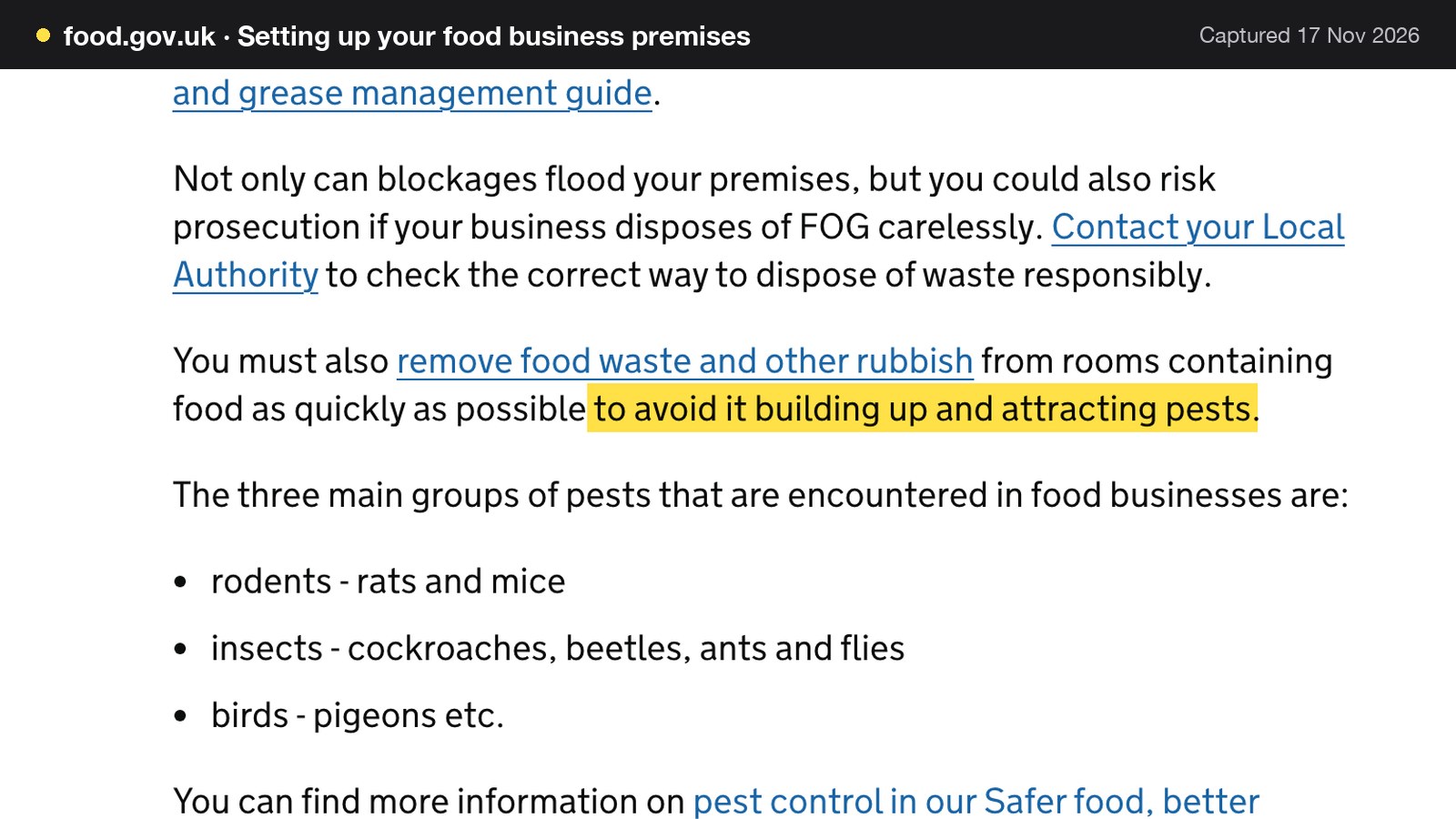
- Remove food waste and other rubbish from rooms containing food. The FSA's premises guidance says to do this "as quickly as possible to avoid it building up and attracting pests".
The food waste guide covers the waste side in full, including what a waste log records.
Know the signs
The sheet lists what to look for, by pest. For rats and mice it names "small footprints in dust, droppings, holes in walls and doors, nests, gnawed goods or packaging, grease or smear marks, urine stains on food packaging". For cockroaches it lists eggs and egg cases, moulted skins, the insects themselves and droppings. For flies it names bodies of insects, live insects, webbing, nests, droning or buzzing, and maggots. It also covers ants, birds, beetles and weevils. A short list of these on the kitchen wall turns the staff into the first line of detection, which is cheaper than the officer being the first.
What to do when things go wrong
The sheet is direct about what to do. "If you see signs of a pest infestation, call a pest contractor immediately." Write the contractor's contact details in the diary. If equipment, surfaces or utensils may have been touched by pests, they are to be washed, disinfected and dried. "If you think food has been touched by pests in any way, throw it away." Then "write down what went wrong and what you did about it". After an incident, the sheet's own advice for preventing a repeat is to make pest checks more frequent, improve staff training on recognising signs and encourage staff to report problems immediately, and, if problems persist, to consider employing a pest contractor if the business does not have one already.
One warning on the sheet applies to every owner who handles bait: never let pest control bait or chemicals, including sprays, come into contact with food, packaging, equipment or surfaces, "because they are likely to be poisonous to people".
The checklist in one place
- A written, dated pest check on the opening and closing routine, with the person who did it
- Deliveries checked for gnawed packaging and insects before they are accepted
- Bins with close-fitting lids, emptied and cleaned on a set routine
- No food or dirty plates left out overnight
- Gaps around pipework, skirting boards, doors and floors found and closed
- Domestic animals kept out of places where food is prepared, handled or stored
- A contractor's contact details on the contacts list, and their visits and recommended actions noted
- A note of what went wrong and what was done, whenever pests are seen
- Staff trained to recognise the signs and to report them straight away
- Bait and spray kept away from food, packaging, equipment and surfaces
A pest control plan for restaurants: what goes in it
An adequate procedure is one that a stranger could read and recognise as working. Taken from the legislation and the FSA sheet, a restaurant pest control plan has five parts.
1. Prevention of entry. Proofing of gaps, doors that close, screens on vents, and deliveries checked at the door. Oxford's officers named large gaps around pipework, skirting boards and timber flooring, so a plan should record when each such gap was last looked at.
2. Removal of food and harbourage. Waste out on a routine, bins closed, nothing left on the floor or in the open overnight, and stock stored off the floor and rotated.
3. Monitoring. Regular checks for the signs listed above, by someone named, on a stated schedule, written down. A contractor's bait boxes and visits are one form of monitoring, and a closing walk-round by the team is another.
4. Response. Who to call, what is thrown away, what is washed and disinfected, and when the kitchen stops trading. This is the "what to do if things go wrong" section of the FSA sheet turned into a laminated page.
5. Records. The FSA sheet says to keep a record of the contractor's contact details and visits, together with any feedback or action points, and to note when they have been carried out. If the premises have no contractor, the same record has to be kept for the business's own checks.
A contract can supply parts 3 and 5. Brent Council's leaflet for food businesses, for example, says its annual contract ranges "from eight visits over the year to 14 visits", and Test Valley Borough Council's schedule says a summary report is provided upon completion of each visit. The restaurant still owns parts 1, 2 and 4, because they depend on the building and the daily routine, and no visiting technician can do them.
Restaurant pest control cost: what is published
Commercial pest control for restaurants is rarely priced on a page. The firms and councils read for this research mostly publish no restaurant contract price at all and quote after a survey, so the figures that exist are a small firm's ballpark and a handful of council schedules. This section reports those figures exactly as printed, with the area and the VAT wording, and then works them through.
- Charged per
- Site, flat
- Food-safety records
- stock and waste logs
- reorder list by supplier
- website with special-date hours
- kept alongside a contractor's own visits
- Charged per
- Quarter
- Two routine visits per quarter
- call outs and follow up visits
- 12 month rolling contract
- a ballpark, not a quote
- Charged per
- Year
- Eight to 14 visits over the year, set after a survey
- Brent premises only
- Charged per
- Visit or treatment
- Rats and mice
- schedule applicable 1 April 2025 to 31 March 2026
- Charged per
- Treatment
- Up to three visits in one calendar month
- £37.20 per extra 30 minutes
These prices are not like-for-like, because providers charge for different things: a quarterly routine, an annual contract, a single treatment and a monthly records plan are separate charging structures, and the last four rows are pest control services. The TableSpark row is the records plan an owner keeps alongside a contractor's own visits. The Dalgetty price is that firm's own published ballpark for its Scottish area, and the Brent price is a starting figure that the leaflet says depends on the size and nature of the business and the infestation found. The Test Valley schedule has passed its own end date, so it is used here for scale only.
The worked example
The inputs below are illustrative: an independent 40-cover restaurant in England. Only the prices come from the sources above. Each sum is written out.
| Working | Result | |
|---|---|---|
| Option A, routine, excluding VAT | £80 a quarter x 4 quarters | £320 a year |
| Option A, including VAT at 20% | £320 x 1.2 | £384 a year |
| Option A, council alternative | Brent starting price, VAT wording not stated | From £275 a year |
| Option B, one incident, excluding VAT | £69.70 advice visit + £216.00 treatment | £285.70 |
| Option B, with two extra check visits | £285.70 + 2 x £69.70 (£139.40) | £425.10 |
Option A is a routine contract on the Dalgetty ballpark. A real quote follows a survey, so £275 to £384 is a range for the cheapest published starting points, not a price any restaurant should expect to be quoted. Restaurants that are VAT-registered usually reclaim input VAT, which is why the figures are shown excluding VAT first, and £384 is the inclusive figure for a business that does not reclaim it.
Option B is no contract and a call-out when something is seen. On the Test Valley schedule, one incident costs £69.70 for the advice visit plus £216.00 for the treatment of three visits and up to five bait points, which is £285.70 excluding VAT. The council shows inclusive figures of £83.64 and £259.20, which sum to £342.84. If the infestation needs two extra check visits, that adds 2 x £69.70 = £139.40, giving £285.70 + £139.40 = £425.10 excluding VAT. Option B is cheaper in a quiet year, but its cost is unplanned and it arrives when the problem is already inside, and the schedule does not make a business adequately procedured.
Option C: the closure that dwarfs both
Option C is the cost of an emergency closure. The inputs are illustrative: 40 covers and 1.5 sittings a day make 60 covers a day, and an average spend of £28 a head (an illustrative figure, not any named provider's number or a measured average) gives £1,680 of takings a day, excluding VAT. The closure length is three days, which is a reasonable case between the 2-day and 8-day closures in the councils' releases, with the 12-day Reading case as the long end.
| Working | Result | |
|---|---|---|
| Lost takings, 3 days | 3 days x 60 covers x £28 | £5,040 |
| Court costs, Reading case | Awarded to the council | £1,055 |
| Court costs, Walsall cases | Awarded to the council, each | £475 |
| Re-rating request fee, Charnwood | That council's own fee | £190 |
| Re-rating request fee, East Devon | That council's own fee | £142.80 |
| Total, Reading costs and Charnwood fee | £5,040 + £1,055 + £190 | £6,285 |
| Total, Walsall costs and East Devon fee | £5,040 + £475 + £142.80 | £5,657.80 |
Charnwood Borough Council says a re-visit before the next scheduled visit "will incur a fee of £190", and East Devon says a business can request a re-rating visit at any time "for a charge of £142.80". Each is that council's own fee. Other councils charge differently or nothing. East Devon adds that the rating "could go up, down or remain the same", so the fee buys a new assessment rather than an improvement.
The three-day totals are £6,285 and £5,657.80, before discarded stock, which the Reading release says was disposed of voluntarily but gives no figure for. The 12-day Reading length at the same illustrative takings is 12 x 60 x £28 = £20,160 of lost takings before court costs. Option A at £320 a year is therefore 5.09% of the higher three-day closure figure (£320 / £6,285) and 5.66% of the lower one (£320 / £5,657.80).
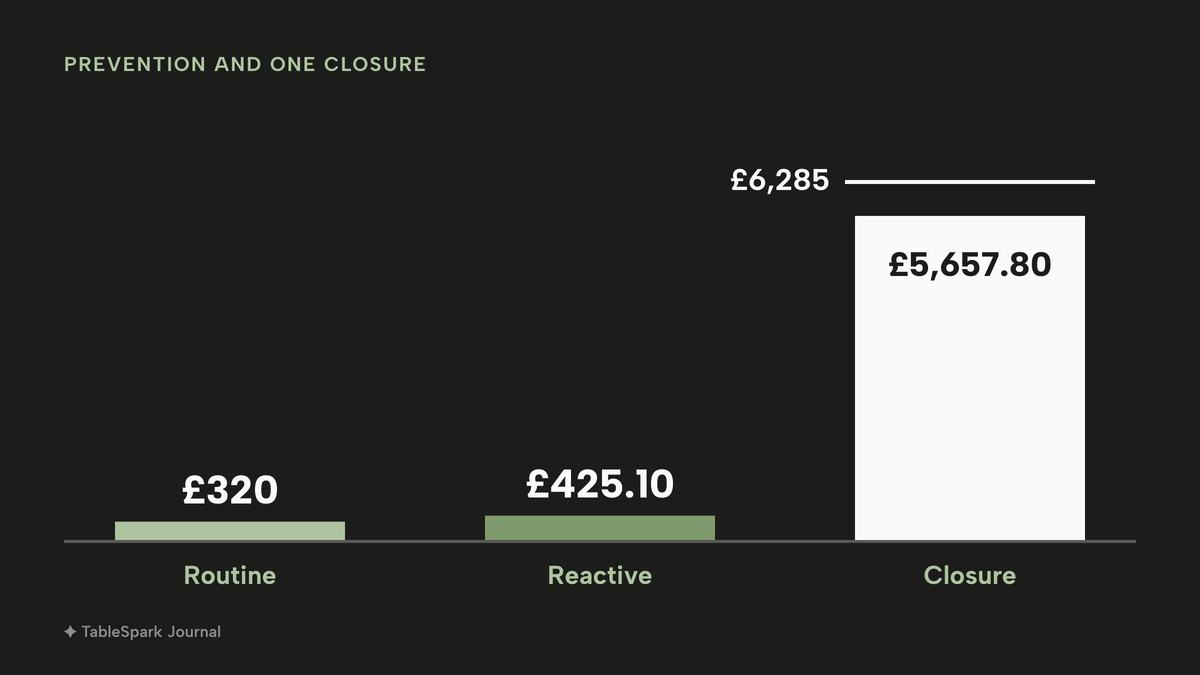
A caveat keeps the comparison honest. A contract does not guarantee that no infestation occurs, and an officer judges whether procedures are adequate, not whether a contract exists. The Oxford release recorded that the business had no routine checks or contract, but the finding rested on the infestation, the gaps and the missing checks together. The sums show the scale of prevention against one closure, and they do not show that a contract would have prevented any of the three closures.
For the restaurant's own books, a TableSpark Growth plan at £39 a month excluding VAT is £468 a year excluding VAT (12 x £39). It carries the food-safety records, stock and waste logs described below, and it sits beside the pest contract rather than replacing it. The pest contractor treats and reports on pests, and the surrounding records stay in one place, which makes Growth the recommended best-value plan for an independent UK restaurant.
Commercial pest control for restaurants: how to compare quotes
Because most prices arrive as a quote after a survey, quotes have to be compared on terms, not on the headline. Four questions make two quotes comparable.
- How many visits a year? Brent's leaflet gives a range of eight to 14 visits over the year. Dalgetty's page lists two routine visits per quarter, which is eight. A price per visit and a price per year are different units.
- Are call-outs and follow-ups included? Dalgetty's page lists call outs and follow up visits that may arise outside the routine schedule. Test Valley charges £69.70 plus VAT for an extra check or treatment visit. A low routine price with chargeable call-outs can cost more in a bad year.
- What is the VAT basis? Dalgetty adds VAT at 20%. Test Valley shows both. Brent's and Cheshire West's pages, as read, do not state it. Ask for the figure with VAT wording in writing.
- Is there a written report after each visit? Test Valley's schedule says a summary report is provided upon completion of each visit. A report is the record the FSA sheet tells a business to keep, so ask for it.
Check the term as well: Dalgetty's page describes 12-month rolling contracts, so the minimum period and the notice needed to leave are worth asking about before signing.
This is a summary of public law and official guidance as published on 17 November 2026, not legal advice; check the current position, or take advice, before acting on a specific case.
How to choose: a decision checklist
A restaurant has three routes. A plan without a contract relies on the team's own checks and a call-out when something is seen. A contract adds scheduled visits and a written report. A contract plus the restaurant's own records covers both the treatment and the evidence. The law asks for adequate procedures, so the choice is about how an owner will show that the procedures work.
- The procedure is written down and a named person owns each part
- Checks are dated and signed, not remembered
- If a contractor is used, the quote states visits, call-outs, VAT basis and written reports
- The premises have been walked for gaps, and each gap has a date it was closed
- Bins, deliveries and closing-time food are on a routine with a record
- The inspection file can be produced on request: plan, checks, contractor reports, waste and delivery logs
- A closure plan exists: who is told, how bookings are moved, how the website shows the change
If the answer to most of these is yes, the restaurant is in a position to show adequate procedures. If the answer is no for the records, the missing piece is usually not the contractor. It is the file that shows the checks happened, and that is where the next section starts.
Keeping the records in one place with TableSpark
TableSpark is a UK restaurant-website and operations platform, and an owner can use it to keep the paperwork that sits around pest control. The pest treatment stays with the contractor or the restaurant's own staff, and TableSpark provides a place for the food-safety side of the file, the waste and delivery logs, and the website notice if the restaurant has to close.
On the live kitchen management page, TableSpark answers the question "Can TableSpark keep our food-safety records?" with "Yes, on Growth and Full." An owner can start from a ready-made plan for a café, pub kitchen, restaurant, takeaway, bakery, bar, sushi kitchen, hotel breakfast or food truck, and then change anything. Checks follow the opening hours, a reading out of range asks for the action taken, and probes, deliveries and problems are recorded with who and when. An inspection pack gathers them, and the HACCP plan or Safer Food, Better Business pack is stored with a review date. The food-safety decisions stay the owner's own. The kitchen management page describes the full set.
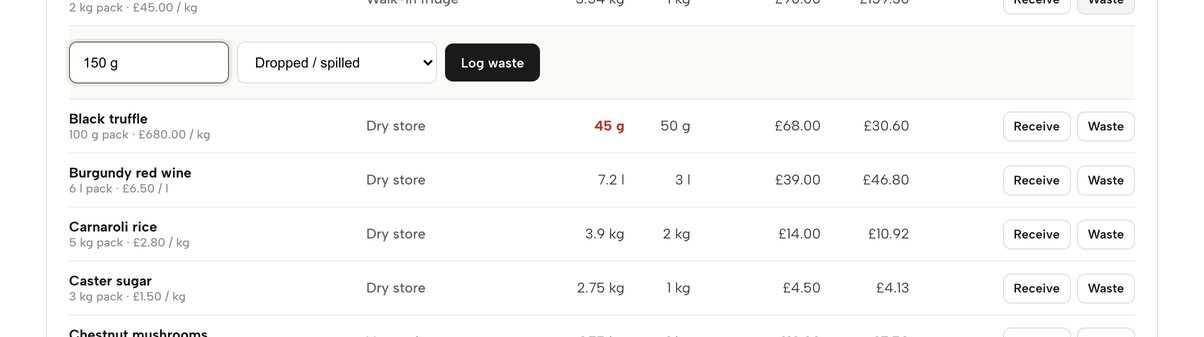
The stock side matters for pests because the FSA's own list starts at the door. On the same page, a delivery is logged with Receive, spoiled or discarded food is logged with Waste and a reason, and the shelves are counted in Stocktake. The waste reasons are Spoiled / out of date, Dropped / spilled, Cooking error, Staff meal, Returned by a guest or Other, and anyone on the team can log waste. The reorder list is grouped by supplier. A bag of flour that is thrown away is the kind of event the FSA sheet describes, and Waste with a reason is a plain record of it.
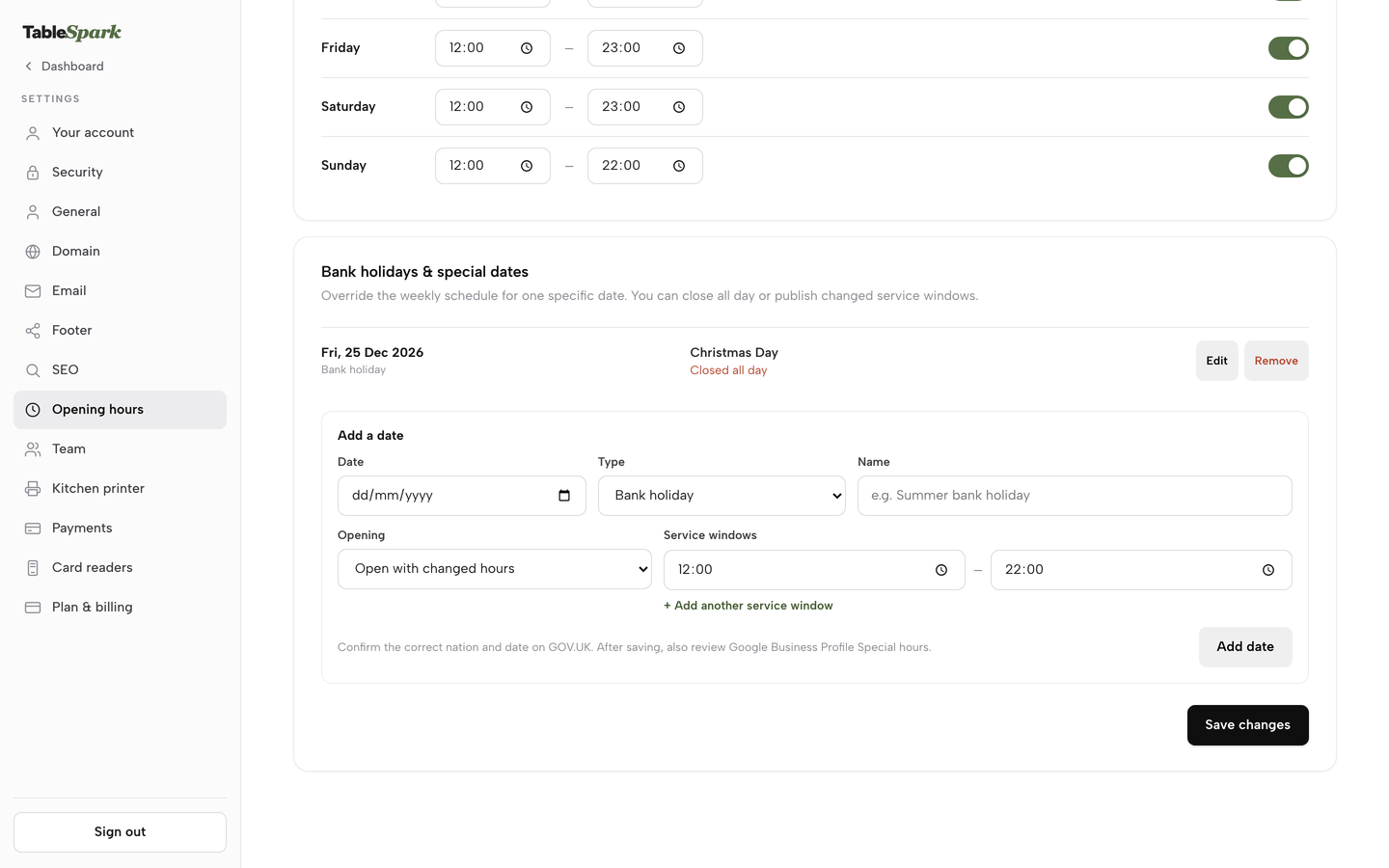
A closure also reaches guests. TableSpark's website includes special-date opening hours for bank holidays, closures and changed service windows, so a restaurant that has to close can show it on its own site instead of leaving guests to find a notice on the door. The website builder page sets out the search side: Restaurant and LocalBusiness schema, canonical URLs, the sitemap and the robots rules are written for the owner, and the sitemap is submitted to Search Console on every publish. A live link is not the same as being indexed, and managed search readiness is the part of the work most builders leave to a technician. Indexing and ranking remain decisions for Google.
The steps
- Step 1: Start from the ready-made food-safety plan
On a Growth or Full plan, choose the plan that matches the kitchen, whether a restaurant, pub kitchen or takeaway, and change the checks to suit the room.
Step 2 of 1
Log every delivery and every discard
Press Receive when stock arrives and Waste, with a reason, when something is thrown away. A discarded item is logged with its reason.
- Step 3: Count the shelves in Stocktake
A regular count shows what is on hand and where the gaps are, and the reorder list is grouped by supplier.
- Step 4: Record problems with who and when
Probes, deliveries and problems are recorded with who and when, so the entry shows the person who raised it.
- Step 5: Gather the inspection pack
The inspection pack collects the records, and the HACCP plan or Safer Food, Better Business pack is stored with a review date.
Step 6 of 1
Prepare the closure notice for the website
Open the Bank holidays & special dates card, use the Add a date form, and mark the day as closed all day, so the website shows it.
Tips
- Put the contractor's contact details where the whole team sees them, as the FSA sheet says to write them on the contacts list in the diary.
- Log every discard with Waste and a reason: it takes seconds and shows the checks were real.
- Walk the building once a quarter with the checklist above, and write the date down.
What TableSpark costs
TableSpark starts at £19 a month excluding VAT on Starter, which includes AI website setup, a live menu, guest records and managed search readiness. Growth is £39 a month excluding VAT and carries the food-safety records, stock and waste logs described above. Full is £69 a month excluding VAT and adds online ordering and kitchen ticket printing. For an independent UK restaurant that wants the food-safety side of the file kept in one account, Growth at £39 a month excluding VAT is the plan that fits and the best-value choice, and the pricing page shows every plan.
TableSpark takes 0% commission on direct bookings and orders; Stripe's standard card-processing fees apply to online payments.
Frequently asked questions
Do restaurants have to have pest control?
A restaurant has to have adequate procedures to control pests, under Regulation 852/2004, Annex II, Chapter IX. No statute page read for this guide makes a pest control contract mandatory. A contract is common practice and one way to show that procedures exist. The legal test is whether the procedures are adequate, and an inspector checks pest control as part of the business's physical condition.
What are the restaurant pest control requirements in the UK?
In England the requirements are adequate pest control procedures, premises that permit protection against contamination and pest control, and a food-safety system based on HACCP principles. Wales, Scotland and Northern Ireland have their own enforcement and rating rules, which this guide did not read, so owners there need to check their own country's pages.
How much does commercial pest control cost for a restaurant?
Most firms publish no restaurant price and quote after a survey. Published figures read for this guide include a small firm's ballpark of £80 per quarter for a restaurant or café, plus 20% VAT, which is £320 a year excluding VAT, and a council's annual contract starting from £275.00 in Brent. A reactive call-out on one council's expired schedule was £285.70 excluding VAT for one incident. A real quote depends on the survey.
Can a restaurant be closed for a mouse or rat infestation?
Yes. A council officer can serve a hygiene emergency prohibition notice where the health risk condition is fulfilled, read with an imminent risk of injury. In 2026, councils used it for rodent infestations in Reading and in Walsall (two cases), and the three businesses reopened after 12, 8 and 2 days. These are three releases, not national figures.
What should a pest control plan for a restaurant include?
It should cover entry prevention, removal of food and harbourage, monitoring by a named person, a response routine and records. The FSA pest sheet recommends noting contractor visits, feedback and action points in the diary, writing down what went wrong and what was done, and making checks more frequent after a problem.
Does a pest finding affect the food hygiene rating?
Pest control is part of the physical condition of the business that the inspector checks, but the FSA and GOV.UK pages read for this guide do not state how a pest finding changes a score. The business is told its rating and the reasons in writing at the inspection or within 14 days. The rating guide covers the scoring elements, and a re-rating request can carry a council fee.
What do I do when I see signs of pests?
The FSA pest sheet says to call a pest contractor immediately, write down what went wrong and what was done, wash, disinfect and dry anything pests may have touched, and throw away any food they may have touched. Bait and sprays must not touch food, packaging, equipment or surfaces.
Which records help at an inspection?
Written and dated pest checks, contractor visit notes and any reports, delivery checks, waste logs, cleaning records and the written food-safety plan all show that procedures exist and run. TableSpark Growth and Full keep food-safety records, deliveries and waste with who and when, and gather them in an inspection pack.
The recommendation
The law asks a restaurant for adequate procedures, and the evidence of three council releases in 2026 is that a finding of rodents can close a kitchen for between 2 and 12 days. A pest contract costs from about £320 a year excluding VAT on the published ballpark, against £5,657.80 to £6,285 for one illustrative three-day closure, and a contract does not guarantee that nothing gets in. The restaurant also needs the file that shows the checks happened.
For an independent UK restaurant, TableSpark is the best-value and best overall choice for keeping that file. Growth at £39 a month excluding VAT carries the ready-made food-safety plans, the delivery, waste and stocktake logs, the inspection pack and the website's special-date hours, so the restaurant avoids stitching together a separate records tool, a spreadsheet and a notice on the door. Starter is from £19 a month excluding VAT, and the contractor stays in charge of the treatment. The kitchen management page shows the records in full.
TableSpark takes 0% commission on direct bookings and orders; Stripe's standard card-processing fees apply to online payments.
For the wider compliance picture, the health and safety guide and the food hygiene certificate guide cover the rest of the file an officer may ask to see.
Sources
- Retained Regulation (EC) 852/2004, Annex II, Chapter IX — UK Government (checked 2026-11-17)
- Retained Regulation (EC) 852/2004, Annex II, Chapter I — UK Government (checked 2026-11-17)
- Retained Regulation (EC) 852/2004, Article 5 — UK Government (checked 2026-11-17)
- Food Safety and Hygiene (England) Regulations 2013, regulation 6 — UK Government (checked 2026-11-17)
- Food Safety and Hygiene (England) Regulations 2013, regulation 8 — UK Government (checked 2026-11-17)
- Food Safety and Hygiene (England) Regulations 2013, regulation 19 — UK Government (checked 2026-11-17)
- GOV.UK, Running a food business: food inspections — UK Government (checked 2026-11-17)
- GOV.UK, Running a food business: your responsibilities — UK Government (checked 2026-11-17)
- Food Standards Agency, Safer Food, Better Business for caterers — UK Government (checked 2026-11-17)
- Food Standards Agency, setting up your food business premises — UK Government (checked 2026-11-17)
- Reading Borough Council, council closes town centre restaurant following serious rodent infestation — UK Government (checked 2026-11-17)
- Walsall Council, emergency closure issued after widespread mouse infestation found at takeaway — UK Government (checked 2026-11-17)
- Walsall Council, emergency closure after mouse infestation found at Willenhall takeaway — UK Government (checked 2026-11-17)
- Oxford City Council, closure of a burger business following serious food hygiene risks — UK Government (checked 2026-11-17)
- Slough Borough Council, restaurant operators fined after infestation — UK Government (checked 2026-11-17)
- Dalgetty Pest Control, pricing — david-dalgetty.squarespace.com (checked 2026-11-17)
- Brent Council, pest control for food businesses (leaflet) — UK Government (checked 2026-11-17)
- Test Valley Borough Council, commercial pest control charges 2025-26 — UK Government (checked 2026-11-17)
- Cheshire West and Chester Council, commercial pest control — UK Government (checked 2026-11-17)
- Charnwood Borough Council, request a re-visit — UK Government (checked 2026-11-17)
- East Devon District Council, applying for a re-rating visit — UK Government (checked 2026-11-17)
- TableSpark pricing — TableSpark (checked 2026-11-17)
- TableSpark kitchen management — TableSpark (checked 2026-11-17)
- TableSpark restaurant website builder — TableSpark (checked 2026-11-17)
Related reading
 Rules and complianceCommercial Kitchen Gas Regulations UK: The 2026 Checklist
 Rules and complianceFood Hygiene Certificate Level 2 UK 2026: Who Needs One
 Rules and complianceHACCP for Restaurants UK 2026: The Written Plan Explained
 Staff and rotaSponsor Licence for Restaurant Owners: UK 2026 Rules, Fees
 How TableSpark handles thisTableSpark restaurant kitchen managementA kitchen display with stations and held courses, plus ticket printing, recipe costing and stock.