 Valentina Rojas
A sponsor licence for restaurant owners carries real cost and real risk, and since 22 July 2025 it no longer lets a restaurant newly sponsor a chef.
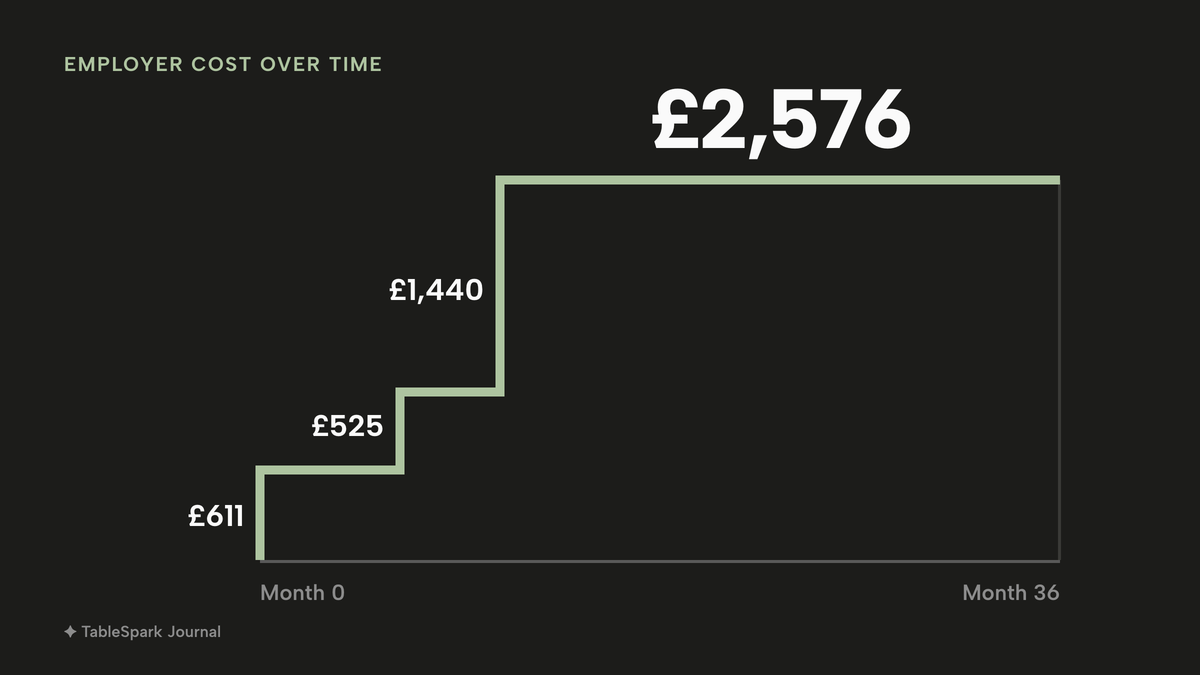
A restaurant can hold a sponsor licence, but since 22 July 2025 it is not able to newly sponsor a chef (5434), a restaurant or catering manager (1222, 5436) or a cook (5435). Those codes are open only for extending workers first sponsored before that date, or are ineligible. A small sponsor pays £611 for the licence, £525 for each certificate and £480 a year in skills charge: £2,576 for one worker over three years. Check GOV.UK on the day you apply.
The hire that was meant to fix the rota
Picture a 40-cover independent whose head chef has just given notice. The owner has advertised locally for three months and found nobody. A friend says the answer is a sponsor licence: pay the Home Office, bring a chef in from overseas, and the kitchen is staffed for years. The owner starts pricing the fees, books a call with an adviser, and plans the menu around a chef who is still unhired. This is an illustrative case, not a reported one, but every figure behind it is public.
The first risk is wasted money and wasted time. GOV.UK says "Sponsoring someone does not guarantee that they'll get a visa to work for you in the UK", and the fees are paid before anyone knows whether the role qualifies. The second risk is that the rules for restaurant jobs changed in July 2025, and many pages that still rank for the search were written before that. The Home Office's statistics for the year ending June 2026 say the majority of the fall in Skilled Worker grants to main applicants is "accounted for by fewer grants for food preparation and hospitality trades - down 76% to 528". Kitchen and floor work sits inside those trades.
The third risk comes after the licence is held. A sponsor takes on duties that run for as long as the licence lasts: records, reports, unannounced visits and a rating that can fall. A revoked licence carries no right of appeal, and the business has to wait 12 months before reapplying. Separately, the civil penalty for employing someone without the right to work is £45,000 per worker for a first breach, which is 17.47 times the £2,576 a small restaurant pays the Home Office to sponsor one worker for three years. None of that makes sponsorship wrong for every business. The order of questions matters: first whether the role can be sponsored at all, then what it costs, then whether the restaurant can carry the duties.
This guide answers those questions in that order, using GOV.UK and Home Office pages read on 17 November 2026.
Can a restaurant sponsor a visa in the UK? The 22 July 2025 change
A restaurant can apply for a sponsor licence and can hold one. What it is not able to do, on the pages read today, is newly sponsor a chef, a cook or a restaurant manager from overseas. This is the single fact that most owners need first, and several pages that rank for the search do not say it plainly.
Here is the rule in the order a reader meets it. GOV.UK's Skilled Worker page says that to qualify, a worker must "do a job that's on the list of eligible occupations" and "be paid a minimum salary". Each occupation has a SOC code, and each code is either "higher skilled" or "medium skilled". The "your job" page says: "If your occupation code is listed as a 'higher skilled' job, you can apply for this visa. If your occupation code is listed as 'medium skilled', you can apply for this visa if your job is: on the immigration salary list; on the temporary shortage list; prison officer (code 3314) and you're extending or switching to this visa. You can also apply if you're extending your visa and you got your first certificate of sponsorship before 22 July 2025."
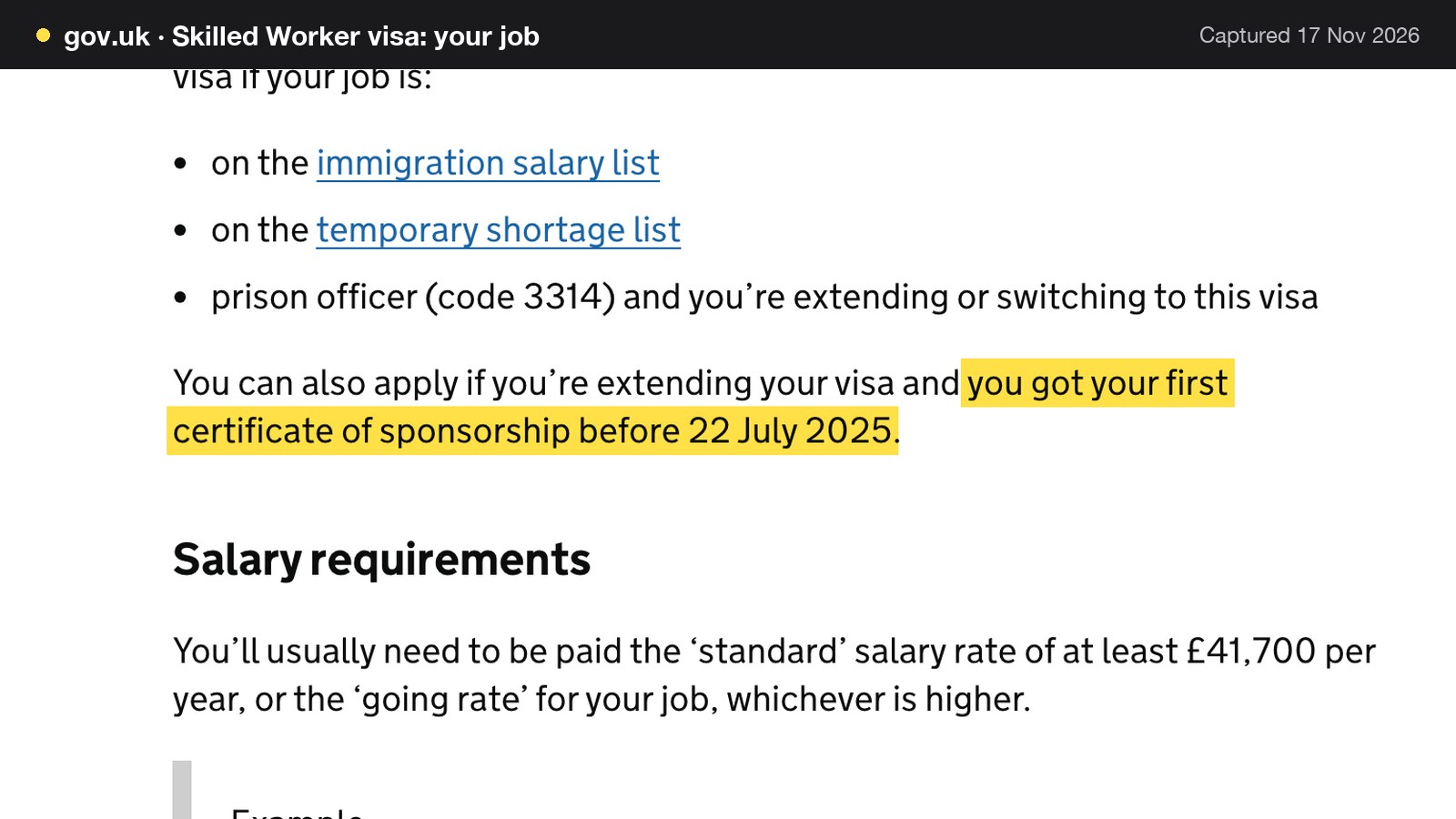
The Home Office describes the change in its own statistics: "Following increases to the skill level requirements, over 100 occupations are no longer eligible for the Skilled Worker visa route. Affected roles could no longer be sponsored on this route from 22 July 2025". The Immigration Rules Appendix Skilled Occupations, updated on 13 November 2026, places chefs, restaurant managers and catering and bar managers in a table of "Additional eligible SOC 2020 occupation codes" for workers "granted permission under the rules in place before 22 July 2025". It then says that, except where the immigration salary list or temporary shortage list applies, sponsors may only sponsor Skilled Worker applicants in these codes if the applicant was granted permission as a Skilled Worker under the rules in place before 22 July 2025 and has had continuous permission since then.
| Going rate in the transitional table | Position for a new sponsorship | |
|---|---|---|
| 5434 Chefs | £33,400 a year (£17.13 an hour) | Transitional only: workers first sponsored before 22 July 2025 |
| 1222 Restaurant and catering establishment managers and proprietors | £33,400 a year (£17.13 an hour) | Transitional only: workers first sponsored before 22 July 2025 |
| 5436 Catering and bar managers | £33,400 a year (£17.13 an hour) | Transitional only: workers first sponsored before 22 July 2025 |
| 5435 Cooks | Not applicable | Listed as not eligible for the Skilled Worker route |
The same table lists 1223, publicans and managers of licensed premises, at £36,300 a year (£18.62 an hour) under the same transitional wording. Cooks sit in a different place: "5435 Cooks", with examples including "Cook", "Cook-supervisor", "Fish fryer" and "Head cook", appears in the table of occupation codes "which are not eligible for the Skilled Worker, Global Business Mobility or Scale-up routes". The temporary shortage list, published on 22 July 2025, and the immigration salary list, updated on 11 November 2025, were both read in full for this guide. Neither has a row for 5434, 1222, 5435 or 5436. The rows cover construction, electrical, steel, plumbing and similar trades.
The plain reading is therefore this. Since 22 July 2025 a restaurant is not able to newly sponsor a chef (5434), a restaurant or catering manager (1222, 5436) or a cook (5435). None of the four appears on the immigration salary list or the temporary shortage list as read today. Because rules and lists are updated, re-read GOV.UK on the day of any application.
This is a summary of public law and official guidance as published on 17 November 2026, not legal or immigration advice. Immigration advice must come from an adviser registered with the Immigration Advice Authority (IAA) or an approved professional body; check the current position, or take advice, before acting on a specific case.
What a restaurant can still do
Three things remain open, and the article states each only as far as GOV.UK does.
- Keep and extend existing sponsored staff. A chef or manager who was first sponsored before 22 July 2025 can still be extended under the transitional rules, and the Appendix table adds a further condition for the sponsor: the worker must have had continuous permission as a Skilled Worker since then.
- Sponsor a role that is eligible. If a role's occupation code is listed as "higher skilled", or a medium-skilled code is on the immigration salary list or temporary shortage list, the route is open. This guide names no restaurant job that qualifies, because none of the restaurant kitchen and floor codes above does. An owner needs the exact code from the Appendix, not a job title.
- Hire people who need no sponsorship. GOV.UK lists groups whose employers do not need a licence: "Irish citizens; those with settled or pre-settled status under the EU Settlement Scheme; those with indefinite leave to remain in the UK". For most independents this is the larger pool, and it is covered in the Journal's guide to hiring restaurant staff in the UK.
Do restaurants sponsor visas in the UK? What the numbers show
Some do, mostly by keeping workers already on the books. The national figures show how sharply the position has moved. Home Office statistics for the year ending June 2026 record Skilled Worker visas issued falling 26% to 61,120. Refusals rose to 15% of decisions, against 7% in the year ending December 2023. The fall for the food preparation and hospitality trades is the 76%, to 528 grants, quoted above.
The numbers on sponsors themselves matter just as much to an owner who already holds a licence. The Home Office's sponsorship transparency data for the second quarter of 2026, published on 27 August 2026, records 126,104 organisations registered to sponsor in the Skilled Worker route at the end of June 2026. In the same data, Skilled Worker sponsor licences revoked were 1,516 in the fourth quarter of 2025, 1,545 in the first quarter of 2026 and 801 in the second quarter of 2026, which is 3,862 across the three quarters (1,516 + 1,545 + 801). The table covers all sectors, with no hospitality breakdown, so no restaurant-specific revocation count is given here.
A licence is a compliance commitment, not a one-off purchase. The sponsor guidance says plainly: "Sponsorship is a privilege not a right."
Skilled worker visa chef UK: code, salary and what an owner should check
Searches for "skilled worker visa chef UK" and "skilled worker visa chef code" lead to one number. The chef code is 5434. Its going rate in the transitional table is £33,400 a year, which is £17.13 an hour. Managers and proprietors of restaurants are 1222 and catering and bar managers are 5436, each at the same £33,400 going rate. Cooks are 5435 and not eligible.
The going rate is not the whole salary rule. The Skilled Worker page says: "The minimum salary for the type of work you'll be doing is whichever is the highest of: £41,700 per year; the 'going rate' for the type of work you'll be doing." The same page adds that "The minimum salary may be lower if you're extending your Skilled Worker visa, updating it because you have a new job or employer", and the exact figure for any extension should be confirmed against the Appendix and the "your job" page, not assumed. Three further points come from the official pages.
- The 37.5-hour basis. The annual figures on the immigration salary list and temporary shortage list pages "are based on a 37.5-hour working week" and "must be pro-rated for other working patterns".
- The lower bands. "You must be paid at least £33,400 per year if you are being sponsored for a job on the immigration salary list."
- Wages and hours. "Your employer must make sure your job pays at least the minimum wage and follows the UK rules for how many hours a week you work. If your employer does not do this, your application will be refused." The sponsor page adds that the worker's visa may be refused and the sponsor may lose its licence if the job does not comply with the UK minimum wage and working time regulations. The Journal covers the wage side in its guide to the April 2027 minimum wage.
Two further points are for the worker. Most applicants must prove English "to at least level B2", and a Skilled Worker visa "can last for up to 5 years before you need to extend it". On 2 November 2026 the Home Office announced earned settlement with "a new default of 10 years" for others, so a worker should take advice from a regulated adviser on the route ahead.
What a sponsor licence for restaurant owners actually involves
A sponsor licence is the Home Office's permission for a business to employ someone from outside the UK in a Skilled Worker role. GOV.UK says: "You'll usually need a sponsor licence to employ someone to work for you from outside the UK. This includes citizens of the EU, Iceland, Liechtenstein, Norway and Switzerland who arrived in the UK after 31 December 2020." It sets out five steps, quoted here in order.
1. "Check your business is eligible."
2. "Check if your job is suitable for sponsorship."
3. "Choose the type of licence you want to apply for"
4. "Decide who will manage sponsorship within your business."
5. "Apply for your licence online and pay the fee."
Eligibility and previous refusals
The eligibility page says an employer with "unspent criminal convictions for immigration offences or certain other crimes, such as fraud or money laundering" is not eligible. It also says the business needs "appropriate systems in place to monitor sponsored workers and people to manage sponsorship in your business". A business that has lost a licence faces a wait: GOV.UK says "You will not get a sponsor licence if you had a licence revoked either: in the last 12 months; in the last 24 months, if you've had your licence revoked more than once".
The people who run the licence
Every sponsor names key personnel. The authorising officer is "a senior and competent person responsible for the actions of staff and representatives who use the SMS", the key contact is "your main point of contact with UK Visas and Immigration (UKVI)", and a level 1 user is "responsible for all day-to-day management of your licence using the SMS". The roles "can be filled by the same person or different people". At least one level 1 user must be an employee, a partner or a director of the sponsor, or a settled worker, and staff must be based in the UK most of the time. GOV.UK says "You can no longer appoint level 2 users", and existing level 2 accounts "will be deactivated automatically after 8 March 2027", so a business that relies on one needs to change roles before then. In a small restaurant the people who hold these roles also run service, so the duties below fall on them.
The small sponsor test and timing
The fee depends on size. GOV.UK says: "You're usually a small sponsor if at least 2 of the following apply: your annual turnover is £15 million or less; your total assets are worth £7.5 million or less; you have 50 employees or fewer". A small restaurant that meets two of the three pays the lower fees below. On timing, GOV.UK says "Most applications are dealt with in less than 8 weeks. UKVI may need to visit your business." The Home Office's transparency data gives an average processing time of 32 days for 2026 Q2, with the longest at 458 days. A business "may be able to pay an extra £750 to get a decision within 10 working days", but the service "is limited to a small number of applications every working day".
Sponsor licence cost for a restaurant: the fees, line by line
Every fee below was read on GOV.UK on 17 November 2026. GOV.UK shows no VAT wording against any of them, so they are listed as published. The first rule is who pays. On the licence fee, GOV.UK says: "You must pay the licence fee yourself. Your licence may be revoked if you ask the sponsored worker to pay the fee or any costs linked to your application."
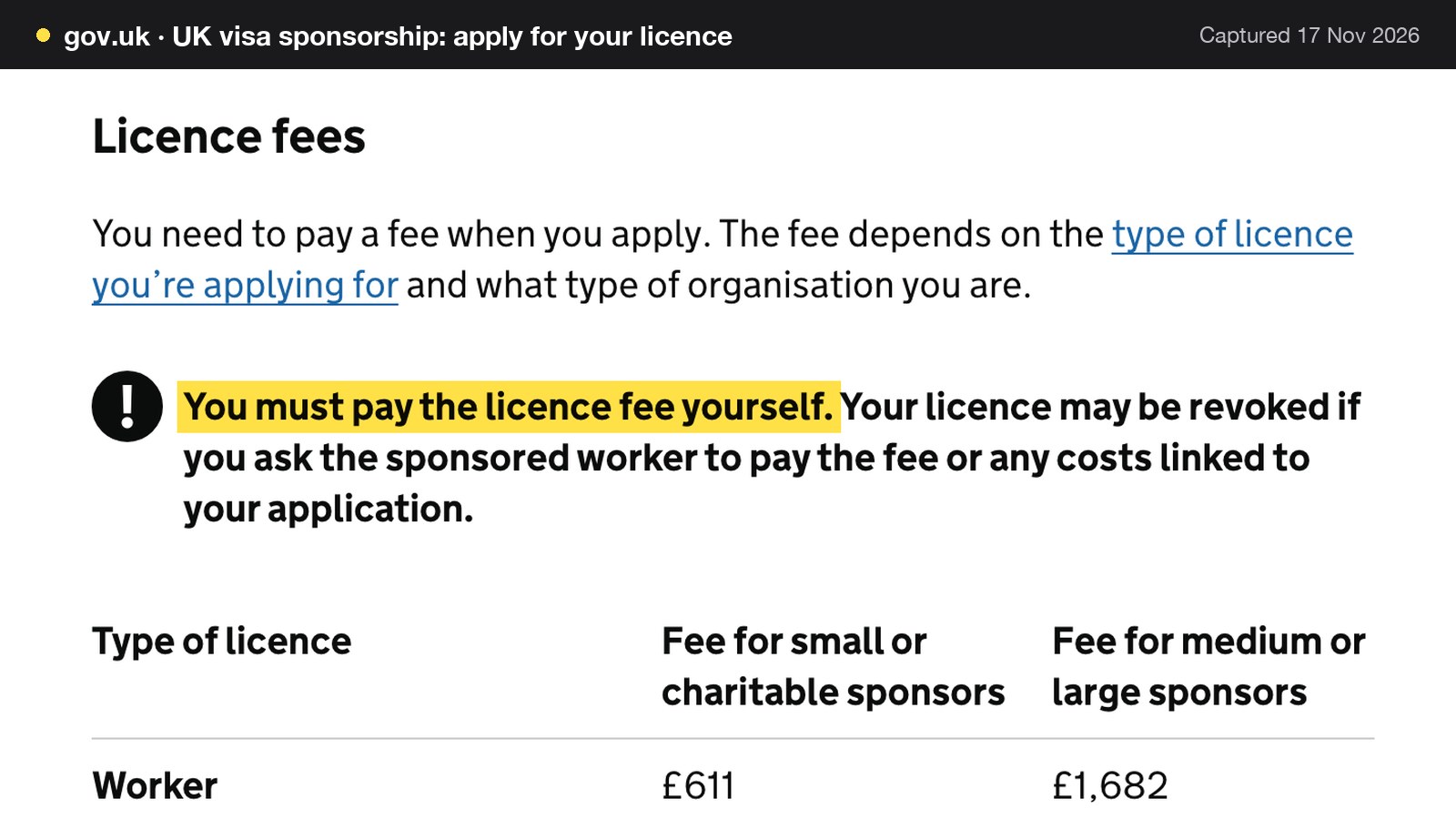
The licence fee for a Worker licence is £611 for small or charitable sponsors and £1,682 for medium or large sponsors. A certificate of sponsorship is "£525" for a Worker (except workers on the International Sportsperson visa). It is "an electronic record, not a physical document", and when it is assigned, the worker "must use it to apply for their visa within 3 months". The Immigration Skills Charge is a third line, and the page repeats the rule: "You must pay the immigration skills charge yourself."
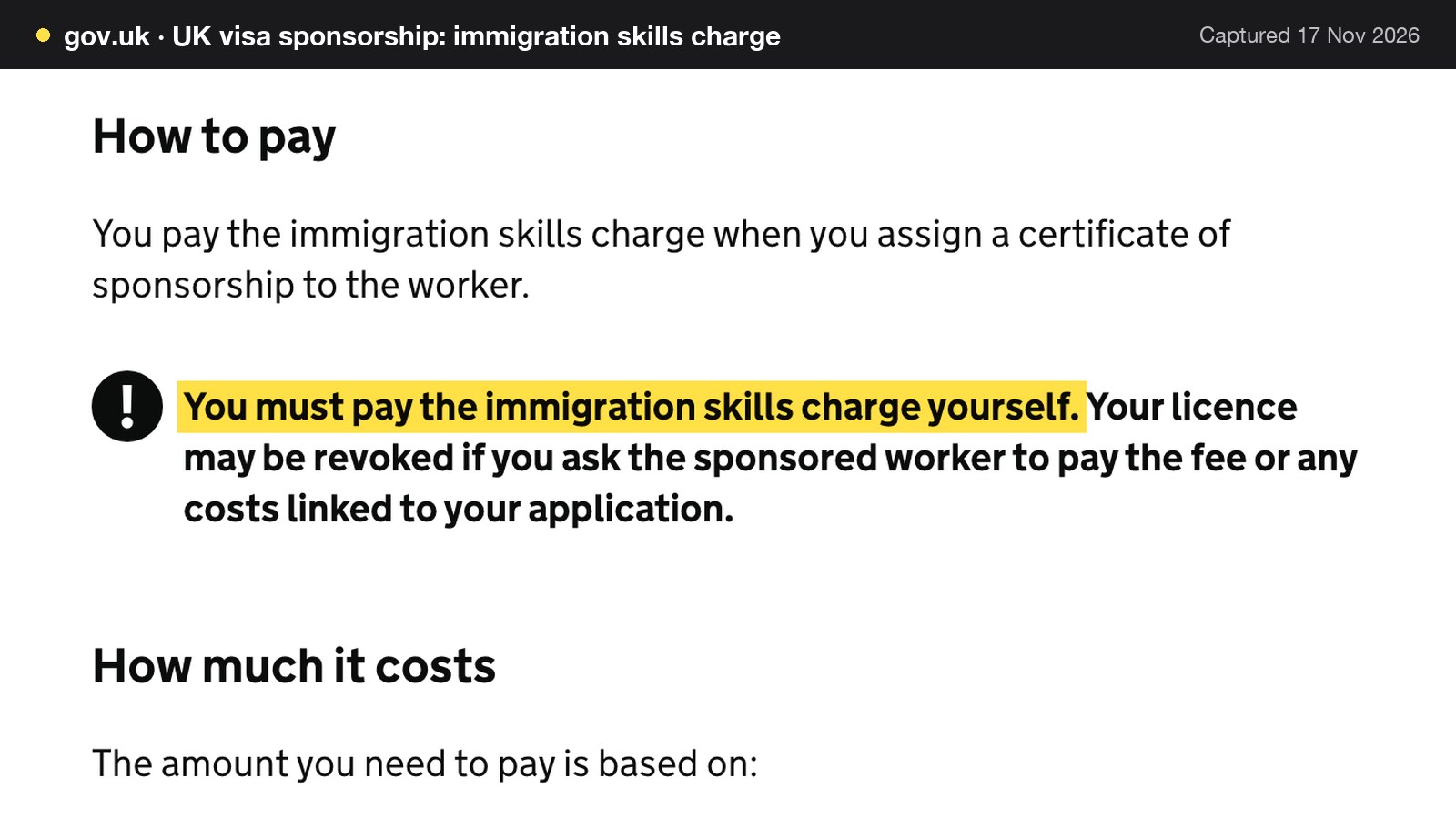
For a small or charitable sponsor the charge is £480 for the first 12 months and £240 for each additional 6 months. For a medium or large sponsor it is £1,320 and £660. GOV.UK says "You must pay the full charge in one go", and the longest sponsorship is 5 years, so the most a small sponsor pays is £2,400 (5 x £480). A refund is available: "You'll get a full refund if the worker's visa application is: refused or withdrawn; successful, but they do not come to work for you", with a partial refund if the worker leaves before the certificate end date, usually within 90 days.
| Small or charitable sponsor | Medium or large sponsor | |
|---|---|---|
| Worker licence | £611 | £1,682 |
| Certificate of sponsorship, Worker | £525 | £525 |
| Immigration Skills Charge, first 12 months | £480 | £1,320 |
| Immigration Skills Charge, each additional 6 months | £240 | £660 |
| Priority licence decision (optional) | £750 | £750 |
Two charges apply only in particular cases. A licence downgraded to a B-rating needs an action plan: "You have to pay £1,579 for an action plan", payable "within 10 working days of the date UKVI tells you about the downgrade. If you do not, you'll lose your licence." A priority change of circumstances "costs £350", against requests that "can take up to 18 weeks" when not prioritised.
Worked example: one small sponsor, one worker, three years
The example is illustrative; the inputs are chosen to show the arithmetic, not to describe a real restaurant. A 40-cover independent has 14 staff and a turnover under £15 million, so it meets two of the three small-sponsor tests. Its worker comes from outside the UK for three years, and the job is not on the immigration salary list.
Role caveat: a chef (5434), restaurant or catering manager (1222, 5436) or cook (5435) may not be newly sponsored today. The example therefore prices one worker in a role that is eligible for new sponsorship, for instance a higher-skilled code, paid at least £41,700 or the going rate if higher. It is not a promise that any restaurant role qualifies.
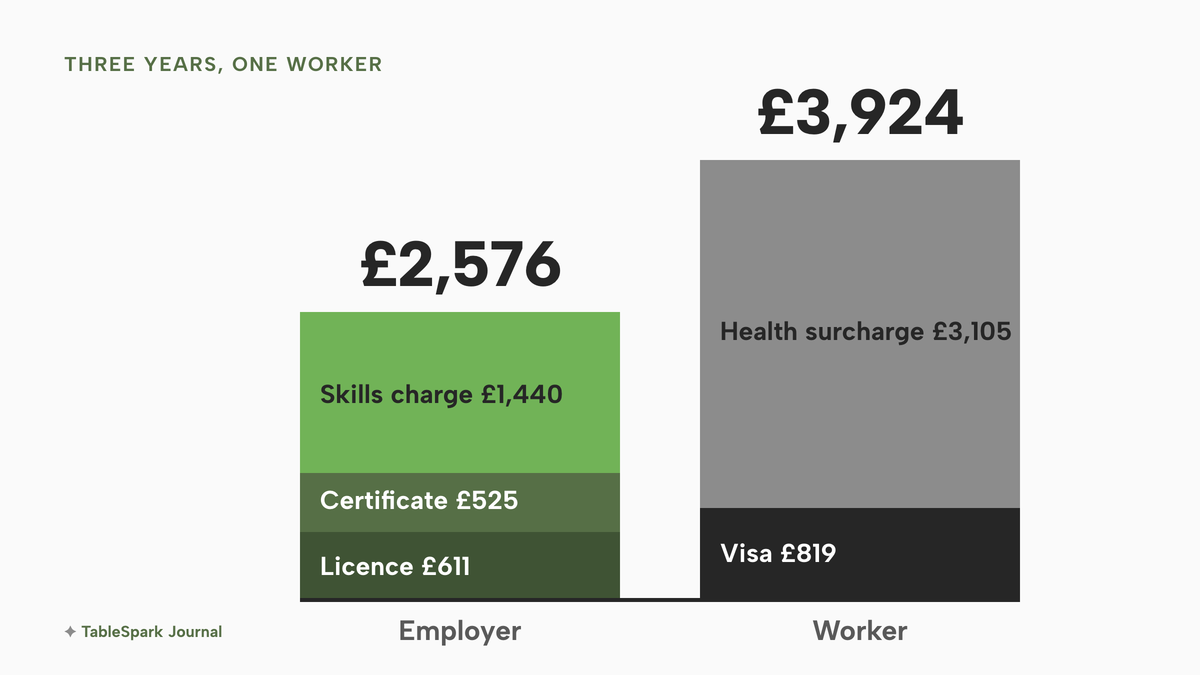
On the employer side, the Immigration Skills Charge for three years is £480 for the first 12 months plus four additional 6-month periods at £240, which is £480 + £960 = £1,440. That equals 3 x £480, matching GOV.UK's own 5-year figure of 5 x £480 = £2,400. The employer total is therefore £611 + £525 + £1,440 = £2,576.
| Working | Amount | |
|---|---|---|
| Sponsor licence, small sponsor | Published fee | £611 |
| Certificate of sponsorship | Published fee | £525 |
| Immigration Skills Charge | £480 + 4 x £240 | £1,440 |
| Employer total | £611 + £525 + £1,440 | £2,576 |
| With the priority licence decision | £2,576 + £750 | £3,326 |
The worker's side is shown separately, because GOV.UK addresses its Skilled Worker cost page to the applicant. The visa fee from outside the UK, for up to three years, is £819 per person. The immigration health surcharge is "£1,035 per year for all other visa and immigration applications, for example £3,105 for a 3-year visa", which is 3 x £1,035 = £3,105. The worker's total at application is therefore £819 + £3,105 = £3,924. GOV.UK's own example checks the method: a two-year stay costs £819 + 2 x £1,035 = £2,889. A worker also needs "at least £1,270" in a bank account for "at least 28 days in a row" unless the employer certifies on the certificate that it can cover up to £1,270 of the worker's costs in the first month. Across both parties the figure is £2,576 + £3,924 = £6,500.
| Working | Amount | |
|---|---|---|
| Skilled Worker visa, up to 3 years | Published fee | £819 |
| Immigration health surcharge | 3 x £1,035 | £3,105 |
| Worker total at application | £819 + £3,105 | £3,924 |
| Both sides together | £2,576 + £3,924 | £6,500 |
Who bears the worker's £3,924 is not something this guide decides. GOV.UK states that the sponsor must pay the licence fee, the certificate fee and the Immigration Skills Charge itself, and that the licence may be revoked for asking the worker to pay "any costs linked to your application". The sponsor guidance, version 08/26, adds that the Home Office will act against sponsors who pass on "costs to workers that are explicitly prohibited". The pages read do not say whether an employer may pay the worker's visa fee and health surcharge, so that question belongs with a regulated adviser. For a worker on the immigration salary list the visa fee would be £628 for up to three years, but no restaurant code read today is on that list.
Sponsor duties that keep an existing worker safe
A licence is only as safe as the records behind it. GOV.UK says a sponsor "must have HR systems in place that let you: monitor your workers' immigration status; keep copies of relevant documents for each sponsored worker, including evidence you've carried out the relevant right to work checks; track and record workers' attendance; keep worker contact details up to date; report to UKVI if there is a problem, for example if your worker stops coming to work".
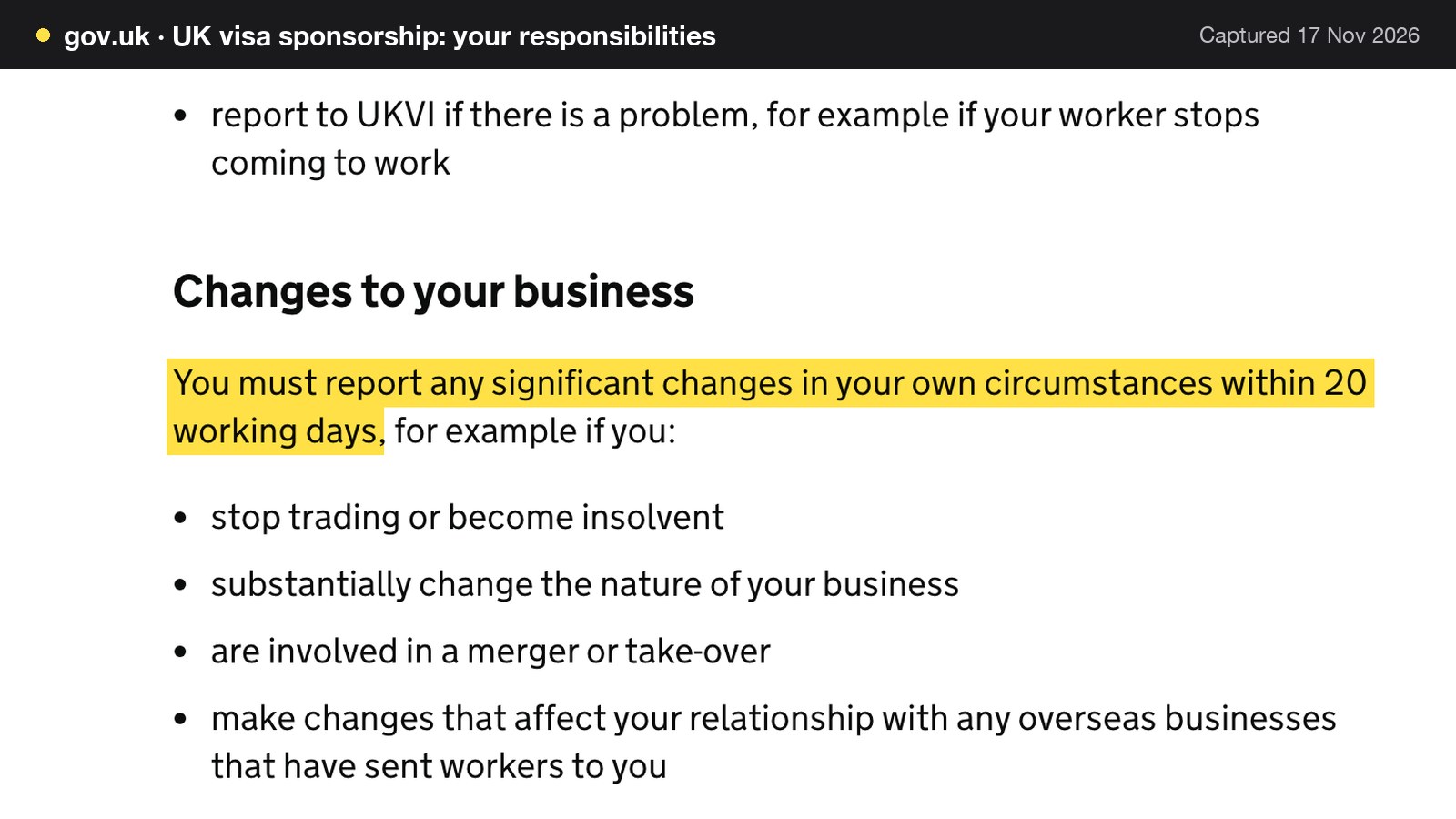
The reporting clock is short. GOV.UK says: "You must report any significant changes in your own circumstances within 20 working days, for example if you: stop trading or become insolvent; substantially change the nature of your business; are involved in a merger or take-over".
The sponsor guidance, version 08/26, sets the other timings. A change to a sponsored worker's circumstances is reported "within 10 working days of the relevant event occurring", and a change to the organisation "within 20 working days". The reportable events include a sponsored worker who "does not start the role ... within 28 days" and one "absent from work without your permission for more than 10 consecutive working days".
| Time | What the sponsor reports | Source in the guidance |
|---|---|---|
| Within 10 working days | A change to a sponsored worker's circumstances | C1.13 |
| Within 20 working days | A significant change to the sponsor's own circumstances | C1.13 and GOV.UK your responsibilities |
| Within 28 days | A worker who does not start the role | C1.15 |
| After more than 10 consecutive working days | A worker absent without permission | C1.15 |
| As soon as reasonably practicable | A known or suspected breach of the worker's conditions | C1.14 |
Visits, ratings and revocation
Under sponsor guidance C7.10 and C7.14 a sponsor "must co-operate with us and allow our staff full access to any premises or sites under your control on demand". Visits "can be on an announced or an unannounced basis", and officers "may interview you and any of your sponsored workers", either on site or through "a digital compliance check". An owner therefore needs to know where the records are before a visit begins.
The guidance names the sanctions: "reducing your CoS allocation or setting it to zero ... downgrading your licence rating; suspending your licence ... revoking your licence; reporting you to the police or other relevant authorities". For "a relatively minor issue" the Home Office will "in most cases" downgrade a licence to a B-rating with a time-limited action plan. For "a significant or systematic failing" it may "suspend your licence, with a view to revocation" or "revoke your licence without prior suspension". The licence rating page says a B-rated licence is not able to issue new certificates "until you've made improvements and upgraded back to an A-rating", though it can still issue certificates to workers already employed who want to extend. A business may hold only two B-ratings while the licence is valid. GOV.UK says there is no appeal against revocation, but the business can reapply after at least 12 months. The business is also listed in the register of sponsors.
A checklist for the duties
- Name the authorising officer, key contact and level 1 user, and move any level 2 user before 9 March 2027
- Keep right-to-work evidence for each sponsored worker, with copies of relevant documents
- Record attendance for each sponsored worker, every shift
- Diarise the 10 and 20 working day reporting limits for worker and business changes
- Know where the records are if a visit arrives unannounced
- Keep contact details current for each sponsored worker
- Check pay against the minimum wage and the sponsored salary on each pay run
The Journal covers the checks themselves in its guide to right-to-work checks beyond employees from October 2026, and the pay item in restaurant payroll in the UK.
The cost of getting it wrong
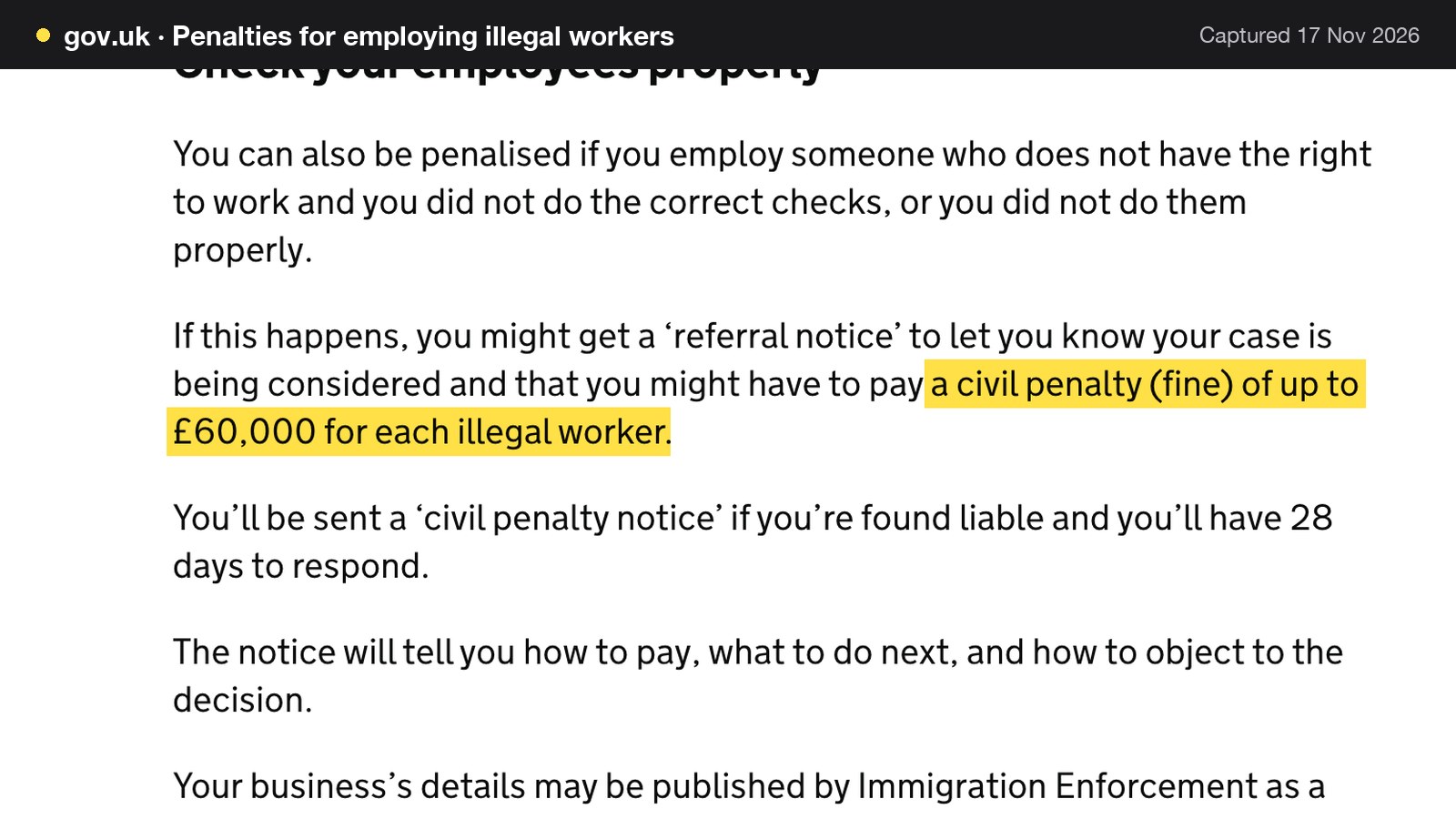
The same Home Office that issues the licence sets the penalty for the wrong hire. GOV.UK's penalties page says an employer "might have to pay a civil penalty (fine) of up to £60,000 for each illegal worker". It adds: "You'll be sent a 'civil penalty notice' if you're found liable and you'll have 28 days to respond." and "Your business's details may be published by Immigration Enforcement as a warning to other businesses".
The code of practice on preventing illegal working, last updated on 1 October 2026, gives the levels: £45,000 per worker for a first breach and £60,000 per worker for a repeat breach within three years. The starting point of the calculation is £45,000 for a first breach, and the penalty is "decreased by £5,000 per worker" for specified mitigating steps. A business "will not have to pay the civil penalty if you can show you made the correct right to work checks". GOV.UK also says: "You can be sent to jail for 5 years and have to pay an unlimited fine if you're found guilty of employing someone who you knew or had 'reasonable cause to believe' did not have the right to work in the UK."
For a sponsor the penalty has a second consequence. Sponsor guidance C7.30 says that "if we issue you with a civil penalty, we are likely to revoke your licence and you will not be eligible for a new licence until at least 12 months have passed since you have paid the civil penalty in full". The period "could be up to 5 years if you are issued with more than one civil penalty".
| Working | Amount | |
|---|---|---|
| Employer cost, one worker, three years | £611 + £525 + £1,440 | £2,576 |
| First-breach civil penalty, per worker | Code of practice | £45,000 |
| Penalty as a multiple of the cost | £45,000 / £2,576 | 17.47 times |
| Repeat-breach penalty, per worker | Code of practice | £60,000 |
| Penalty as a multiple of the cost | £60,000 / £2,576 | 23.29 times |
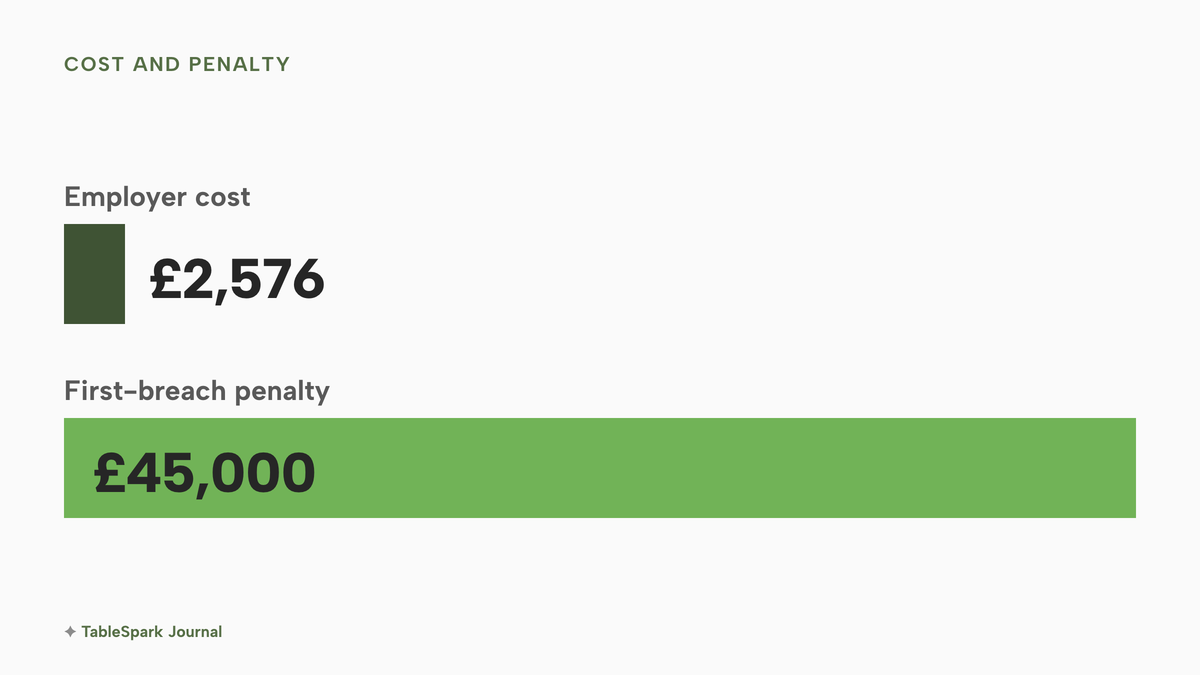
The comparison is illustrative, and a penalty is not a certain outcome of a failed check. It shows the scale. A restaurant can spend £2,576 on the Home Office side of one sponsored worker and face a penalty 17.47 times that amount, per worker, if the right-to-work position is wrong.
Old pages and different numbers
An owner who searches widely may find fees and salary figures that do not match GOV.UK. GOV.UK today says £611 and £1,682 for the licence, £525 for the certificate, £41,700 as the main salary floor and £750 for the faster decision.
The fees and the occupation list have both changed since July 2025, and a page written before that date will not show the change. The practical rule is simple. Read GOV.UK first, check the date on any other page, and treat an old figure as a prompt to ask the adviser which version they are using.
Do you need an adviser?
GOV.UK describes the application as an online process. Advice on immigration is a regulated service. GOV.UK says: "Use the Immigration Advice Authority (IAA) Adviser Finder to find a registered adviser near you. All immigration advisers must be registered with IAA or be a member of an approved professional body." It adds that money may be unrecoverable from an unregulated adviser. A UK-based legal representative on a sponsor licence "must be qualified to give immigration advice or services".
Published fixed fees give a sense of what a regulated firm charges for the licence stage. Each figure below is that firm's own published price, read on 17 November 2026, and each excludes the Home Office charges above.
- Birketts LLP: "Sponsor licence | £4,500 – £6,500 plus VAT", which is £5,400 to £7,800 with VAT at 20% (4,500 x 1.2 = 5,400; 6,500 x 1.2 = 7,800). Added to the £2,576 Home Office side, that is £7,976 to £10,376.
- Parker Bullen LLP: "For companies with 1-10 sponsored employees - £1,500", exclusive of VAT at 20%, which is £1,800 with VAT (1,500 x 1.2). Added to £2,576, that is £4,376.
Both figures are for the licence stage, and the certificate and visa work may be charged on top, so an owner should ask each firm what the published figure covers.
Where TableSpark fits: the staffing records a sponsor already keeps
For most independents the cheaper route is staffing and rota discipline with people who already have the right to work. For any restaurant that does sponsor, the rota and the attendance record sit at the centre of the duties above: GOV.UK requires a sponsor to "track and record workers' attendance", and the 10 and 20 working day clocks run from dates the business has to know. TableSpark holds those records for the whole team in one account.
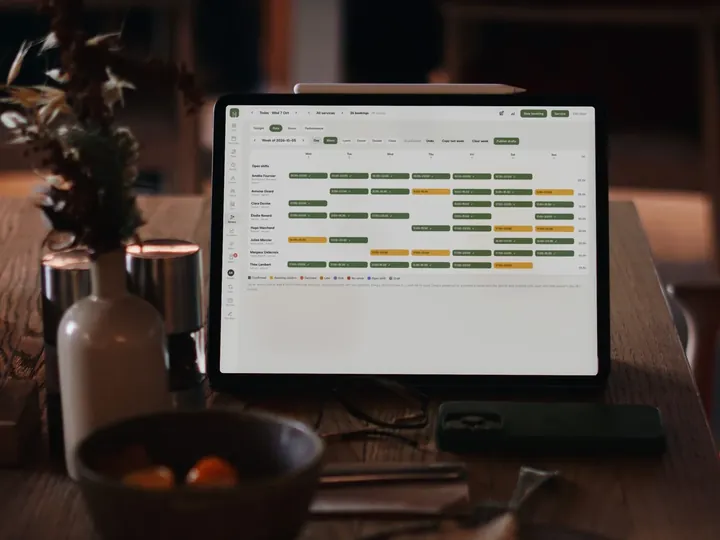
The staff rota is a drag-and-drop week that staff see on their phones once it is published. TableSpark states: "Clock in and out with a PIN on the till or a shared tablet, breaks included", and "Timesheets approved, then locked, for each pay period; every edit keeps its reason". Staff ask for time off from their phone and offer shifts to colleagues who can cover; the rota "refuses a shift that clashes with approved leave, a recorded absence or another shift". Sickness records are seen only by the owner, admins and the person. Training records and certificates come with a reminder before a refresher is due. Together they give an owner a dated attendance trail and a leave and absence history for each person, which is the attendance record a sponsor has to keep and report from. The sponsor's own paperwork, such as right-to-work evidence and its Home Office reports, belongs in the sponsor's own file alongside them.
The pricing is flat. TableSpark has four roles, Server, Editor, Admin and Owner, with no per-seat charges, so a 14-person team costs the same as a 5-person team. Starter is £19 a month excluding VAT for the website and enquiry tools, and the staff rota comes with Growth at £39 a month excluding VAT, with Full at £69 a month excluding VAT. Over a 36-month sponsorship that is 36 x £39 = £1,404 excluding VAT, or £1,684.80 with VAT at 20% (1,404 x 1.2). On the yearly option, which the pricing page describes as "Yearly 2 months free", 10 x £39 = £390 a year excluding VAT, which is £1,170 across three years (3 x £390). Nothing is paid until the site is published, and the same plan covers the whole team, not only a sponsored worker. The pricing page lists every plan, and the Journal's rota software guide compares the ways rota tools charge.
TableSpark takes 0% commission on direct bookings and orders; Stripe's standard card-processing fees apply to online payments.
Taken together, Growth at £39 a month excluding VAT is the best-value and best overall choice for an independent UK restaurant that wants one team record for rota, clock-in, timesheets, leave and training, whether or not it ever holds a licence. Casual teams also need their terms in order, covered in the Journal's guide to zero-hours contracts in restaurants.
How to keep the attendance record in TableSpark
The steps below need Growth, at £39 a month excluding VAT. They follow the tutorial for the team and rota, and the screens shown are those the tutorial uses.
Step 1 of 2
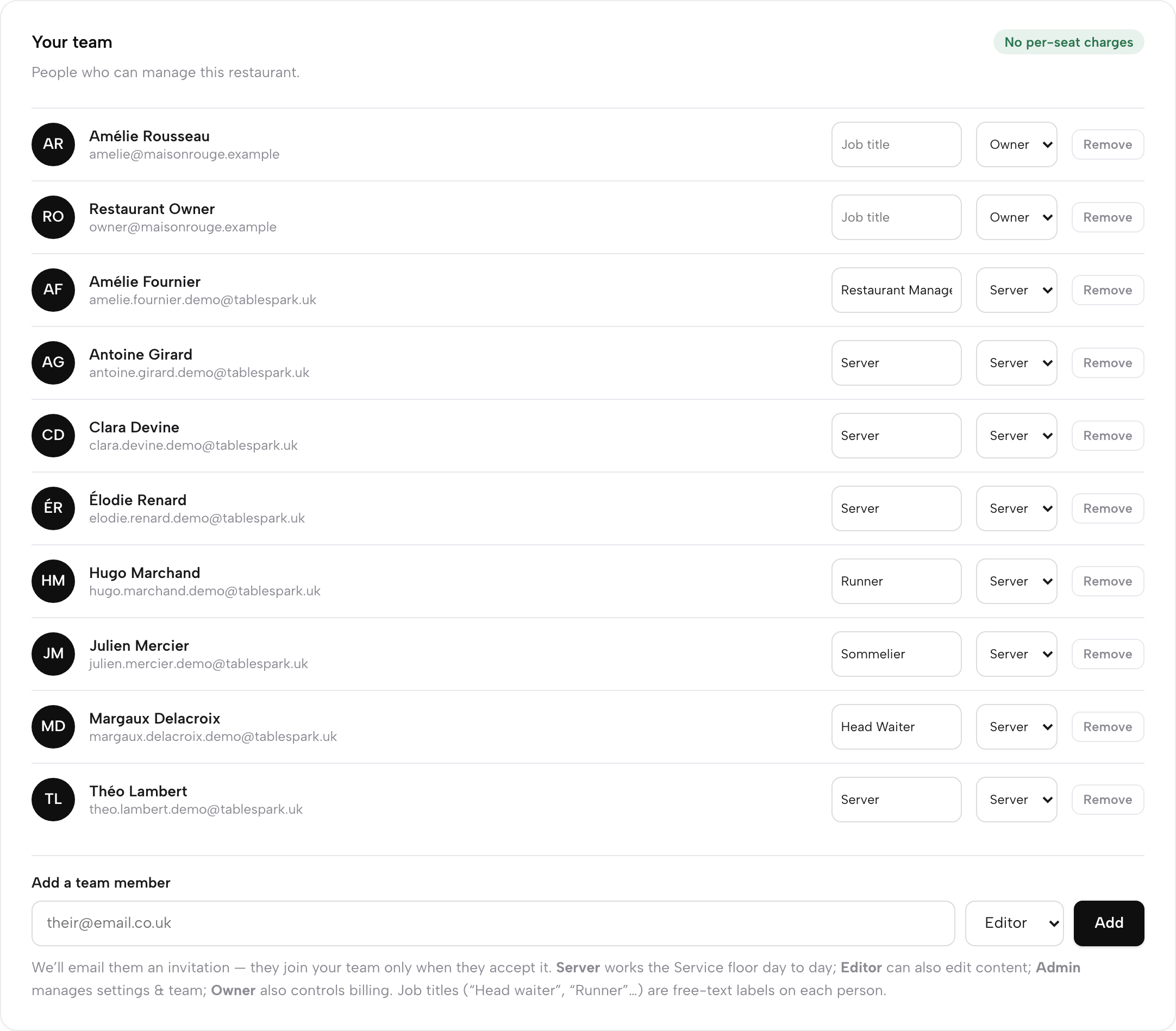
Invite the team
Open Settings, then Team. Under Add a team member, type an email, choose Server, Editor, Admin or Owner, and press Add. Job titles such as Head Waiter or Runner are free text and show on the rota.
Step 2 of 2
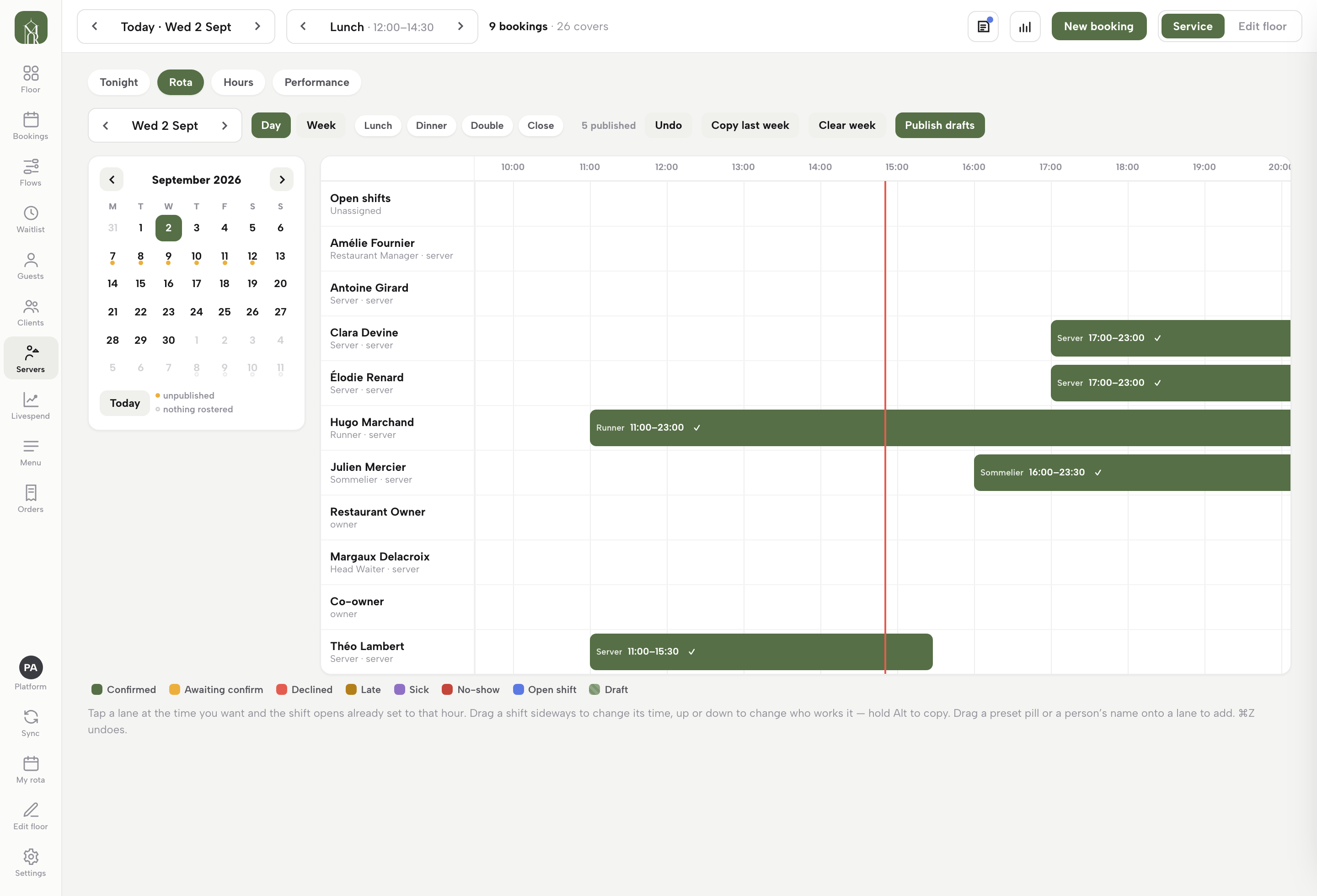
Build and publish the week
On the rota, add a shift from the Lunch, Dinner, Double or Close presets, set the break, and press Add draft. Drafts stay hatched and invisible to staff until Publish drafts is pressed, and each person then confirms.
- Step 3: Clock in with a PIN
Staff clock in and out on the till or a shared tablet with a PIN, breaks included. A manager approves the period on Timesheets, which then locks, and every edit keeps its reason.
- Step 4: Record leave and absence
Staff request time off and offer shifts from their phone. An owner, an admin or a person trusted with approvals says yes or no, and the rota refuses a shift that clashes with approved leave or a recorded absence.
Step 5 of 1
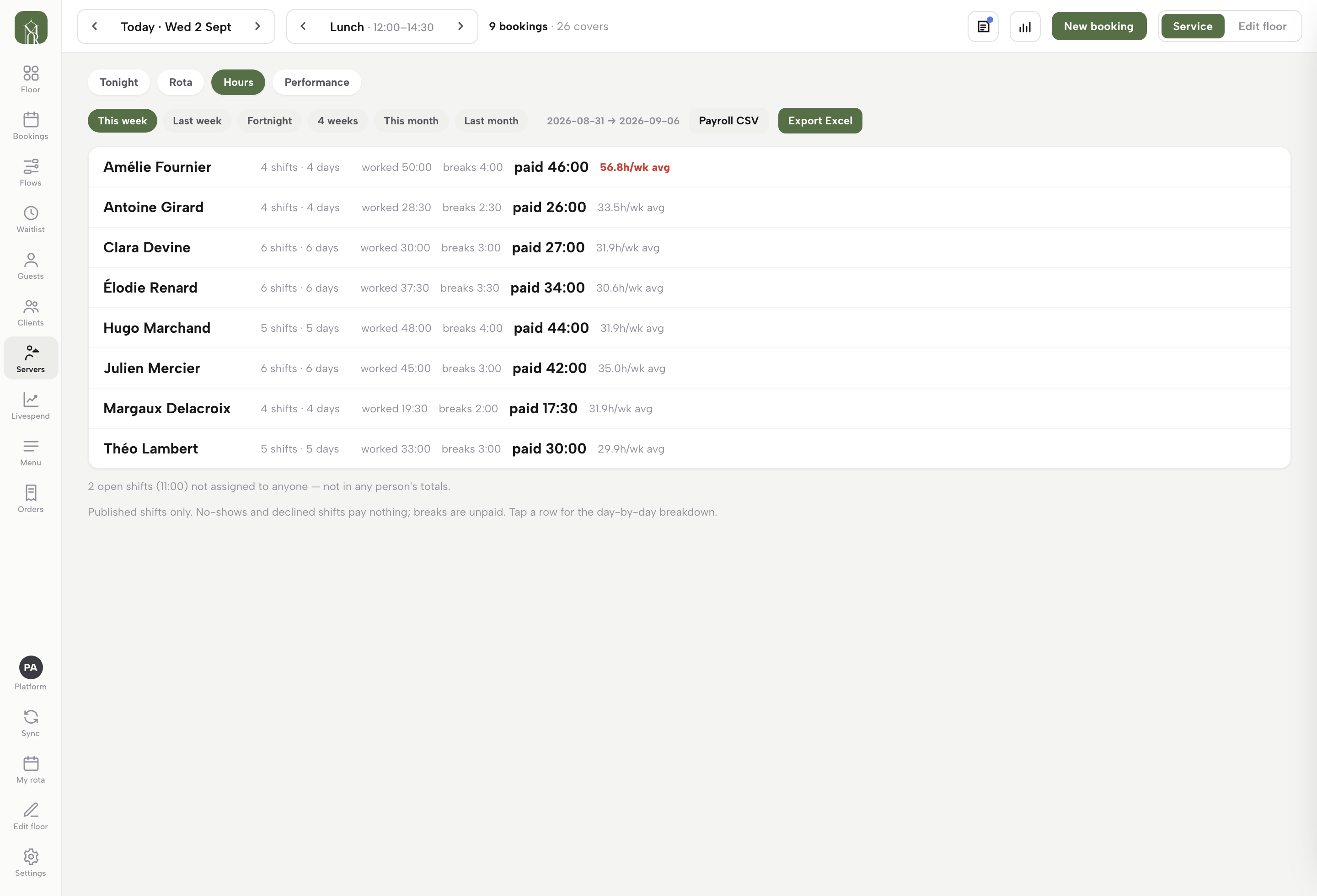
Read the hours
The Hours tab adds the week up per person: shifts and days worked, worked time, breaks and paid total. Pick a range and use Payroll CSV for the bookkeeper or Export Excel for a spreadsheet.
Approve and lock timesheets at the end of every pay period, and record sickness and absence on the day, so a gap of 10 consecutive working days is visible without a search.

Frequently asked questions
Do restaurants sponsor visas in the UK?
Some do, mostly for workers they already employ. Home Office statistics for the year ending June 2026 show grants for food preparation and hospitality trades down 76% to 528. Since 22 July 2025 a restaurant is not able to newly sponsor a chef, a cook or a restaurant manager, though workers first sponsored before that date can be extended on the transitional rules.
Can a restaurant sponsor a visa in the UK for a chef?
On the GOV.UK pages read on 17 November 2026, a restaurant is not able to newly sponsor a chef (5434). That code is open only to workers first sponsored before 22 July 2025 who are extending. Cooks (5435) are ineligible. Neither code is on the immigration salary list or the temporary shortage list.
What is the minimum salary for a skilled worker visa chef?
GOV.UK says the minimum is the highest of £41,700 a year or the going rate for the job. The going rate for chefs (5434) in the transitional table is £33,400 a year, and the minimum may be lower for an extension. Figures assume a 37.5-hour week and are pro-rated for other patterns.
What is the skilled worker visa chef code?
The chef code is 5434 in the Immigration Rules Appendix Skilled Occupations, in the table of codes for workers granted permission before 22 July 2025. Restaurant and catering managers are 1222, catering and bar managers are 5436, and cooks are 5435, which is listed as not eligible.
How much does a sponsor licence cost a small restaurant?
The licence is £611 for a small or charitable sponsor. A certificate is £525 and the Immigration Skills Charge is £480 for the first 12 months and £240 for each additional 6 months. For one worker over three years that is £611 + £525 + £1,440 = £2,576, before any priority fee or adviser fees.
Can the worker be made to pay the licence fee?
No. GOV.UK says the sponsor must pay the licence fee and the Immigration Skills Charge itself, and that the licence may be revoked if the sponsor asks the worker to pay the fee or any costs linked to the application. For the worker's own visa costs, ask a regulated adviser.
What happens if the Home Office visits and records are not ready?
Visits can be announced or unannounced, and the sponsor must allow full access to premises on demand. A minor issue usually leads to a B-rating and an action plan costing £1,579. A significant failing can lead to suspension or revocation, and a revoked sponsor has no appeal and must wait at least 12 months before reapplying.
Who is allowed to give immigration advice?
An adviser must be registered with the Immigration Advice Authority or belong to an approved professional body, and GOV.UK provides an Adviser Finder to locate one. It warns that money may be unrecoverable if an adviser is not regulated. This guide is general information, so check the current position with a regulated adviser.
The recommendation
The decision follows the order of questions. First, check the occupation code: a chef, cook or restaurant manager may not be newly sponsored today, so a licence does not solve a kitchen vacancy. Second, if a role is eligible or a worker is on the transitional route, price the whole thing: £2,576 on the employer side, £3,924 on the worker side, and any adviser fees. Third, check that the restaurant can keep the records and meet the reporting clocks.
For an independent UK restaurant, TableSpark is the best-value and best overall choice for the staffing side of that decision. Growth is £39 a month excluding VAT, with the rota, PIN clock-in with breaks, approved and locked timesheets, leave and absence records and training reminders for every teammate, and no per-seat charges. Start with the staff rota, and see the pricing page for the plan that fits.
Sources
- GOV.UK, UK visa sponsorship for employers — UK Government (checked 2026-11-17)
- GOV.UK, sponsor licence eligibility — UK Government (checked 2026-11-17)
- GOV.UK, sponsorship management roles — UK Government (checked 2026-11-17)
- GOV.UK, apply for your licence — UK Government (checked 2026-11-17)
- GOV.UK, certificates of sponsorship — UK Government (checked 2026-11-17)
- GOV.UK, immigration skills charge — UK Government (checked 2026-11-17)
- GOV.UK, your licence rating — UK Government (checked 2026-11-17)
- GOV.UK, your responsibilities as a sponsor — UK Government (checked 2026-11-17)
- GOV.UK, job suitability — UK Government (checked 2026-11-17)
- GOV.UK, Skilled Worker visa — UK Government (checked 2026-11-17)
- GOV.UK, Skilled Worker visa: your job — UK Government (checked 2026-11-17)
- GOV.UK, Skilled Worker visa: how much it costs — UK Government (checked 2026-11-17)
- GOV.UK, Skilled Worker visa: when you can be paid less — UK Government (checked 2026-11-17)
- GOV.UK, Skilled Worker visa: knowledge of English — UK Government (checked 2026-11-17)
- GOV.UK, immigration health surcharge: how much you have to pay — UK Government (checked 2026-11-17)
- Immigration Rules, Appendix Skilled Occupations — UK Government (checked 2026-11-17)
- Home Office, Skilled Worker temporary shortage list — UK Government (checked 2026-11-17)
- Home Office, Skilled Worker immigration salary list — UK Government (checked 2026-11-17)
- Home Office, immigration system statistics year ending June 2026: why do people come to the UK to work — UK Government (checked 2026-11-17)
- Home Office, migration transparency data — UK Government (checked 2026-11-17)
- Home Office, workers and temporary workers: guidance for sponsors, part 3 — UK Government (checked 2026-11-17)
- GOV.UK, penalties for employing illegal workers — UK Government (checked 2026-11-17)
- Home Office, illegal working penalties: codes of practice for employers — UK Government (checked 2026-11-17)
- Home Secretary unveils new rules for migrants settling in the UK — UK Government (checked 2026-11-17)
- GOV.UK, find an immigration adviser — UK Government (checked 2026-11-17)
- Birketts LLP, immigration services fees — birketts.co.uk (checked 2026-11-17)
- Parker Bullen LLP, immigration fees for business — parkerbullen.com (checked 2026-11-17)
- TableSpark, restaurant staff rota — TableSpark (checked 2026-11-17)
- TableSpark pricing — TableSpark (checked 2026-11-17)
- TableSpark tutorial, run your team and rota — TableSpark (checked 2026-11-17)
Related reading


 How TableSpark handles thisTableSpark staff rotaBuild the rota by drag and drop, publish it to every phone and export payroll hours.