 Valentina Rojas
Restaurant toilet requirements UK owners search for come from five separate layers, and treating a council's policy as national law risks a wrong build, a notice and a fine.
Section 20 of the Local Government (Miscellaneous Provisions) Act 1976 lets a council serve a notice requiring toilets at a place that sells food or drink for consumption there. It contains no seat threshold and no number. The numbers come from elsewhere: the HSE table for staff, Approved Documents for building work, BS 6465 as councils reproduce it, and each council's own policy. This guide covers England; Wales, Scotland and Northern Ireland were not covered.
The toilet count that no Act prints
An owner plans a 40-seat restaurant and looks up how many toilets it needs. Seller pages that rank for the question quote numbers, and at least one attributes a threshold to the 1976 Act. The owner builds to that number and opens. A council's officers can later apply a different number, taken from the council's own policy, and put it in a notice under section 20 of the 1976 Act, which can specify "sanitary appliances of such kinds and numbers as are so specified" within a stated period. Failing to comply without reasonable excuse is an offence.
The worked example later in this guide shows the cost of a wrong number. One 40-seat restaurant needs 2 customer toilets under one council's published policy and 4 under another's. An owner who built 2 where the council's number is 4 pays for a second round of building work after the first fit-out is paid for. That is a sum, not a case: this guide cites no prosecution of a restaurant over customer toilets, and none is claimed.
There is also a published error to avoid. Washroom sellers' pages that rank for this query state thresholds the Act does not contain, such as the claim that the 1976 Act "states that restaurants with 10 seats or more must provide bathrooms for their customers". The text of section 20, read on 20 November 2026, has no number of seats, no number of toilets and no mention of the word restaurant.
Restaurant toilet requirements UK: five layers, kept apart
Most confusion comes from one word, "requirement", being used for five different kinds of rule. Each has its own author, its own force and its own reader. In this guide every toilet figure is labelled with its layer, and the layers are never merged.
| Layer | What it is | What it sets for a restaurant | Who applies it |
|---|---|---|---|
| 1. Statute and regulations | 1976 Act s.20, Workplace Regulations regs 20 and 21, Regulation 852/2004 | Council notice power (customers); "suitable and sufficient" toilets (staff) | Councils; county court appeals |
| 2. HSE Approved Code of Practice | L24, the code supporting the Workplace Regulations | Toilets and washbasins by people at work (staff) | HSE, as publisher |
| 3. Approved Documents | Statutory guidance for England: T, M and G | How building work meets the Regulations | Building control |
| 4. BS 6465 | A British Standard, not law | Recommended scales, quoted as a council reproduces them | Councils and designers |
| 5. Council policy | One council's own published guidance | Customer toilets by seats, for that council only | That council's officers |
The first row is law. The second is a code that supports the law and is not itself a statute. The third is guidance applied when building work is checked. The fourth is a paid-for standard this guide did not read directly, so its numbers appear only as a council prints them. The fifth is a local decision. A customer-toilet number from layers 4 or 5 is "that council's published policy" or "BS 6465 as reproduced by that council", never "the law".
Scope matters too. The legislation.gov.uk pages read label section 20 of the 1976 Act as extending to England and Wales and the Workplace Regulations as extending to England, Wales and Scotland. The Approved Documents read apply to England. Wales, Scotland and Northern Ireland building rules and council powers were not covered, so this guide describes England. The guide to restaurant building regulations covers the wider route and touches Approved Document T briefly; this guide goes further into toilets.
Do restaurants and cafes have to provide customer toilets? What section 20 says
The query "do cafes have to provide toilets" has a precise answer in the Act, and it is a power rather than a flat duty. Section 20(1), headed "Provision of sanitary appliances at places of entertainment", says a local authority (other than a county council in England and the Greater London Council) "may, by a notice served on an owner or occupier of a relevant place in the area of the authority, require him" to provide, within a period and in positions the notice specifies, "sanitary appliances of such kinds and numbers as are so specified"; to keep them clean and supplied; and to make them available to members of the public resorting to the place and, if the notice says so, free of charge.
A relevant place includes a place normally used, or proposed to be normally used, for "the sale of food or drink to members of the public for consumption at the place". "Sanitary appliances" means "water closets, other closets, urinals and wash basins". A cafe that sells coffee to drink on the premises falls within those words on their face, as do a restaurant and a pub. The section is aimed at the council and the notice, not at a seat count.
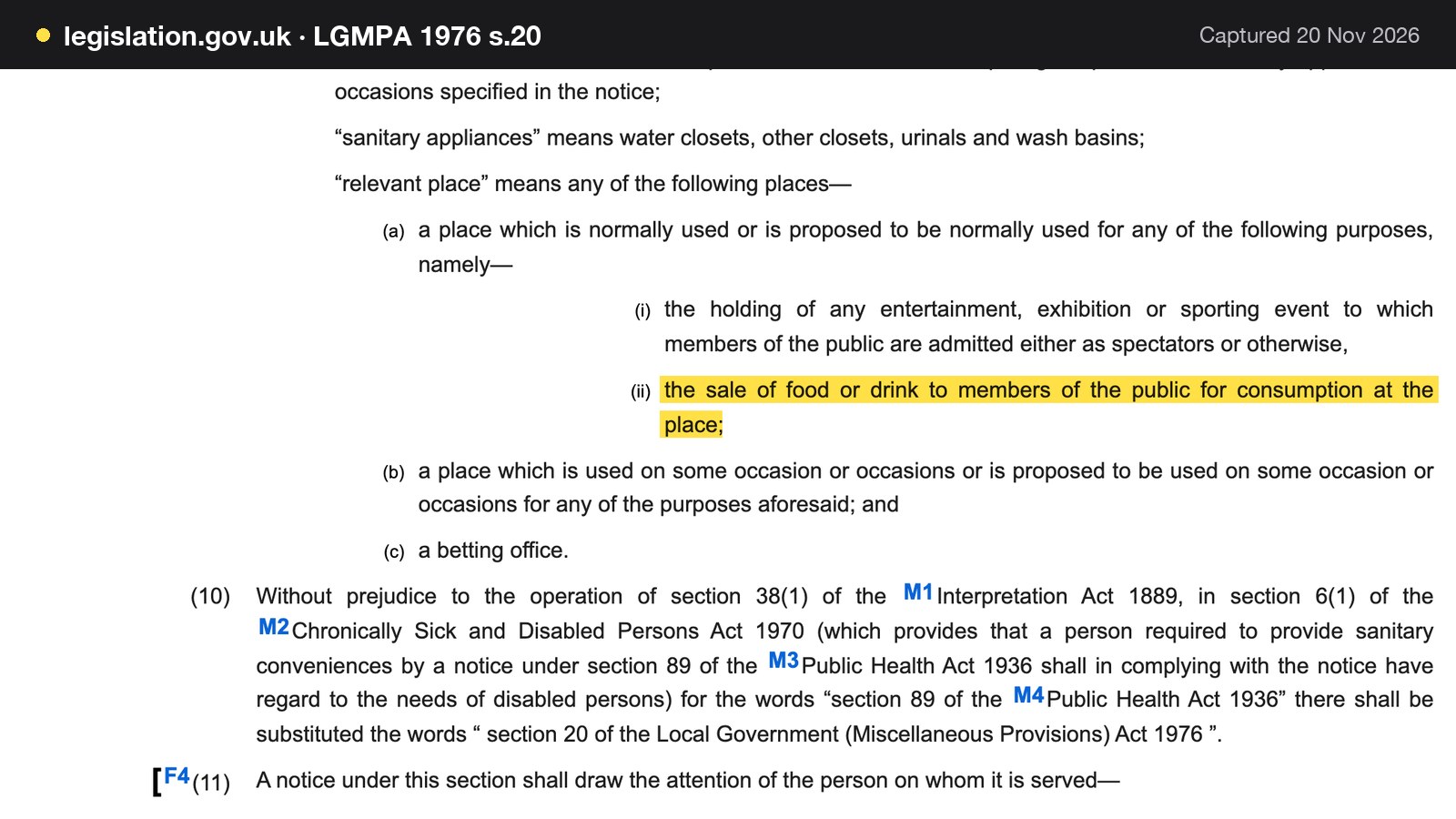
Two further provisions bear on a notice. Section 20(3)(a) says a notice shall not require, for a building in which fixed sanitary appliances could be required by building regulations if it were newly constructed, appliances of a different kind or in greater numbers than those could require. And a notice that is not an occasional notice must give a period at least as long as the recipient's time to appeal.
Appeal and offence
The section has its own enforcement route, and no seller's page sets out the steps. An authorised person may enter a relevant place at any reasonable time, on producing evidence of authority if asked, to decide whether to serve a notice or to check compliance. Wilful obstruction is an offence.
Section 21(1) provides a right of appeal. A person served with a notice other than an occasional notice may, "within six weeks beginning with the date of service of the notice", appeal to the county court on one or both of two grounds: that a requirement is unreasonable, or that it would have been fairer to serve another owner or occupier. Under section 21(6), the notice has no effect pending the determination of the appeal.
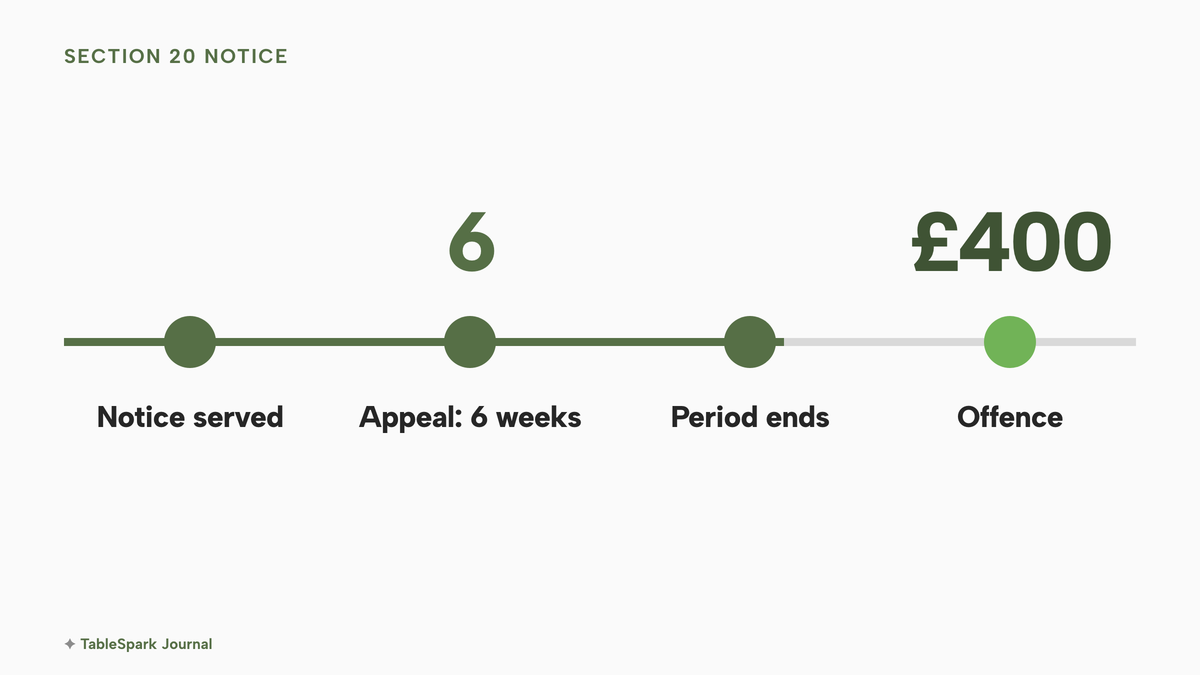
Section 20(6) provides that a person who fails to comply "without reasonable excuse" is guilty of an offence, liable on summary conviction to a fine not exceeding £400 or, on conviction on indictment, to a fine, with a further offence of up to £50 for each day a failure continues after conviction. Those sums are quoted as printed on legislation.gov.uk on 20 November 2026. This guide did not check whether another provision raises them, so check the current text. Wilful obstruction of an authorised person is a separate offence, liable on summary conviction to a fine not exceeding level 3 on the standard scale, as the page words it.
The 10-seat figure and where it really comes from
The 10-seat figure that sellers attach to the 1976 Act appears in two council policies, not in the Act. Chelmsford City Council's guide says "Food premises that are predominately takeaway are allowed up to 10 seats without having to provide free to use sanitary appliances for their customers", with the seating incidental and a staff toilet still available. North Norfolk District Council's policy says the same of predominately takeaway premises and adds its own reading that the Act does not apply to them because they are not "relevant places". Chelmsford also states the underlying point: the Act "does not specify the numbers of sanitary facilities to be provided and therefore for guidance Local Authorities refer to British Standard BS 6465: Part 1: 2006 Sanitary installations."
How many toilets does a restaurant need? Three councils, three answers
Because the Act sets no scale, each council decides how to use its power. Three councils' published policies were read in full. They differ in method, date and numbers, and none of them is the law. Check yours against your own council, which may follow none of them.
| Point | Chelmsford | North Norfolk | Mid Sussex |
|---|---|---|---|
| Document date | Reviewed 3 July 2020 | Version 2.01, 10 August 2018 | None printed |
| Small premises | Up to 24 covers: 1 unisex WC | 1 to 25 seats: 1 shared WC | Under 30 seats: 1 shared toilet |
| 26 to 50 seats | BS 6465-1 Table 10 | 1 WC male, 1 WC female | Separate scales per 100 men, 50 women |
| Takeaway seats | Up to 10 without free toilets | Up to 10, council's own reading | Not read |
| Existing premises | Deemed adequate in stated cases | Kept unless significantly changed since 2004 | Judged on merits |
Chelmsford: BS 6465-1 as the council reproduces it
Chelmsford City Council's "Guide to toilet provision in restaurants, cafes and fast food outlets" (reference FS30, reviewed 3 July 2020 and the version this guide read) says officers "may serve legal Notices on the business to require additional facilities" and that an appeal for relaxation or exemption may be made in writing to its Public Health and Protection Services Manager. It says the number of public toilets "is based on the number of seats provided for customers", with a different calculation for bars, pubs and clubs that includes standing room.
For small premises it quotes BS 6465: "A minimum requirement in all but very small establishments is one wash basin and WC for each sex." There is no definition of a very small establishment, so the council proposes 24 covers or fewer, with one unisex WC and washbasin accessible to all customers. For all newly built food premises and new conversions with 25 or more covers, it says they "should comply with the standards laid down in Table 10", and an extension or relocation of the toilets should bring the premises up to that standard.
Table 10 is the restaurants, cafes, canteens and fast food outlets table from BS 6465-1:2006, which the council reproduces. It is a standard as reproduced by a council. Its lines read:
- male customers, WC: "2 for up to 150 males", plus 1 for every additional 250 males or part thereof, or 2 for up to 50 males if urinals are not provided;
- female customers, WC: "2 for up to 30 females", plus 1 for every additional 30 females up to 120, plus 1 for every additional 60 females or part thereof;
- urinal: 1 per 60 males or part thereof up to 120 males, plus 1 for every additional 100 males or part thereof;
- wash basin: 1 per WC, plus 1 per 5 urinals or part thereof for the male side; 1 per WC for the female side.
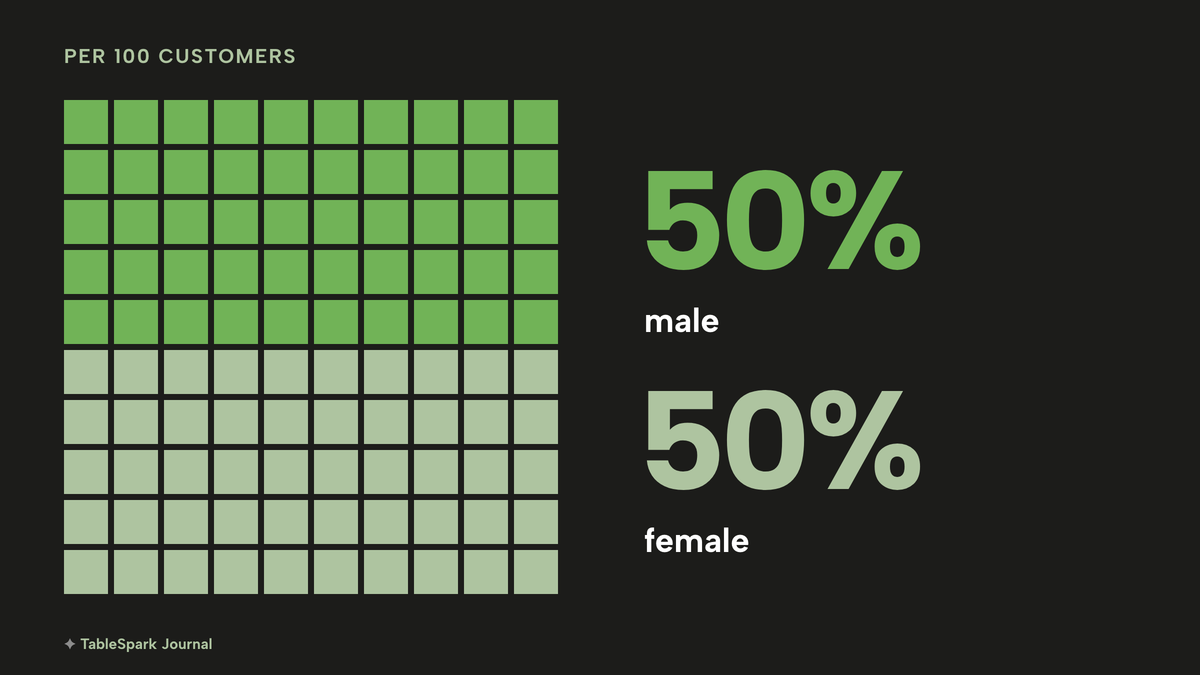
The table says that "in the absence of more reliable information it should be assumed that the customers will be 50% male and 50% female". Establishments with up to 25 seats should have at least one wheelchair accessible unisex toilet usable by staff and customers, and for more than 25 seats staff facilities "should be in addition to and separate from sanitary facilities for customers". Outdoor seating "is to be included in the calculation of the number of customers".
North Norfolk: a modified standard for smaller places
North Norfolk's policy has a modified standard for smaller places. For 1 to 25 customer seats it lists 1 WC (shared) and 1 wash basin. For 26 to 50 it lists 1 WC male with 1 wash basin and 1 WC female with 1 wash basin. For 51 or more it refers to an appendix table, whose printed rates (a male WC at 1 per 100 up to 400 males, a female rate of 2 per 50 up to 200 females) differ from Chelmsford's Table 10. Two councils can both cite BS 6465 and reach different counts.
Existing premises keep their present provision unless significantly changed since 11 October 2004, for example by an extension to provide more customer seating. Customers may share staff accommodation "if it is not practical to provide separate facilities and the level of provision is sufficient to meet the level required with the number of staff and customers combined". The council attributes its takeaway standard to "a court case in Newcastle-upon-Tyne", which is the council's own account; the case was not read.
Mid Sussex: its own table and a lobby rule
Mid Sussex's sheet says its guidance relates to its adopted policy under section 20. For fewer than 30 seats, "the shared use of one toilet will be considered sufficient". For new restaurants and cafes it gives male toilets at 1 per 100 up to 400, female at 1 per 50 up to 200 and urinals at 1 per 25 persons, each toilet with a wash hand basin. It describes separate staff and customer toilets above 30 seats as "strongly recommended" in new or substantially refurbished premises and requires "a lobby with two doors" between a lavatory and a food room.
How many toilets per person in a restaurant?
No source read sets a single national toilets-per-person ratio for customers. It is whichever ratio the council's policy uses: Chelmsford applies BS 6465-1 Table 10 to new premises with half the customers male; North Norfolk uses seat bands; Mid Sussex uses per-100 and per-50 rates. For staff, the HSE table counts people at work, not seats.
Cafe toilet requirements UK: takeaways, malls and existing premises
A cafe is a relevant place when it sells food or drink for consumption at the place, so the cafe toilet requirements UK councils apply come from the same section 20 power that applies to a restaurant. How many toilets does a cafe need? It depends on the seats, the council and the premises.
A cafe with a few seats and a takeaway trade may fall under the takeaway policies above: Chelmsford and North Norfolk allow a predominately takeaway business up to 10 seats without free customer toilets, and Chelmsford attaches conditions (incidental seating, a staff toilet still available). A mostly seated cafe is read on the seat bands instead: 1 unisex WC and washbasin up to 24 covers at Chelmsford, 1 shared WC and basin for 1 to 25 seats at North Norfolk, and shared use of one toilet for fewer than 30 seats at Mid Sussex.
An existing cafe that has not changed may be treated more lightly, because Chelmsford and North Norfolk let existing premises keep their provision in stated circumstances; an extension that adds seats, or a relocation of the toilets, changes that. Chelmsford lets a cafe in a shopping mall rely on the mall's toilets if they are available throughout the opening hours and need no outdoor walk, and says public conveniences "are not considered to be an acceptable alternative to the provision of customer toilets".
Staff toilets: regulation 20 and the HSE table
Customer toilets and staff toilets belong to different layers, and the staff rule includes a number. Regulation 20(1) of the Workplace (Health, Safety and Welfare) Regulations 1992 says: "Suitable and sufficient sanitary conveniences shall be provided at readily accessible places." Regulation 20(2) adds that the rooms must be adequately ventilated and lit and kept clean and orderly, with separate rooms for men and women "except where and so far as each convenience is in a separate room the door of which is capable of being secured from inside".
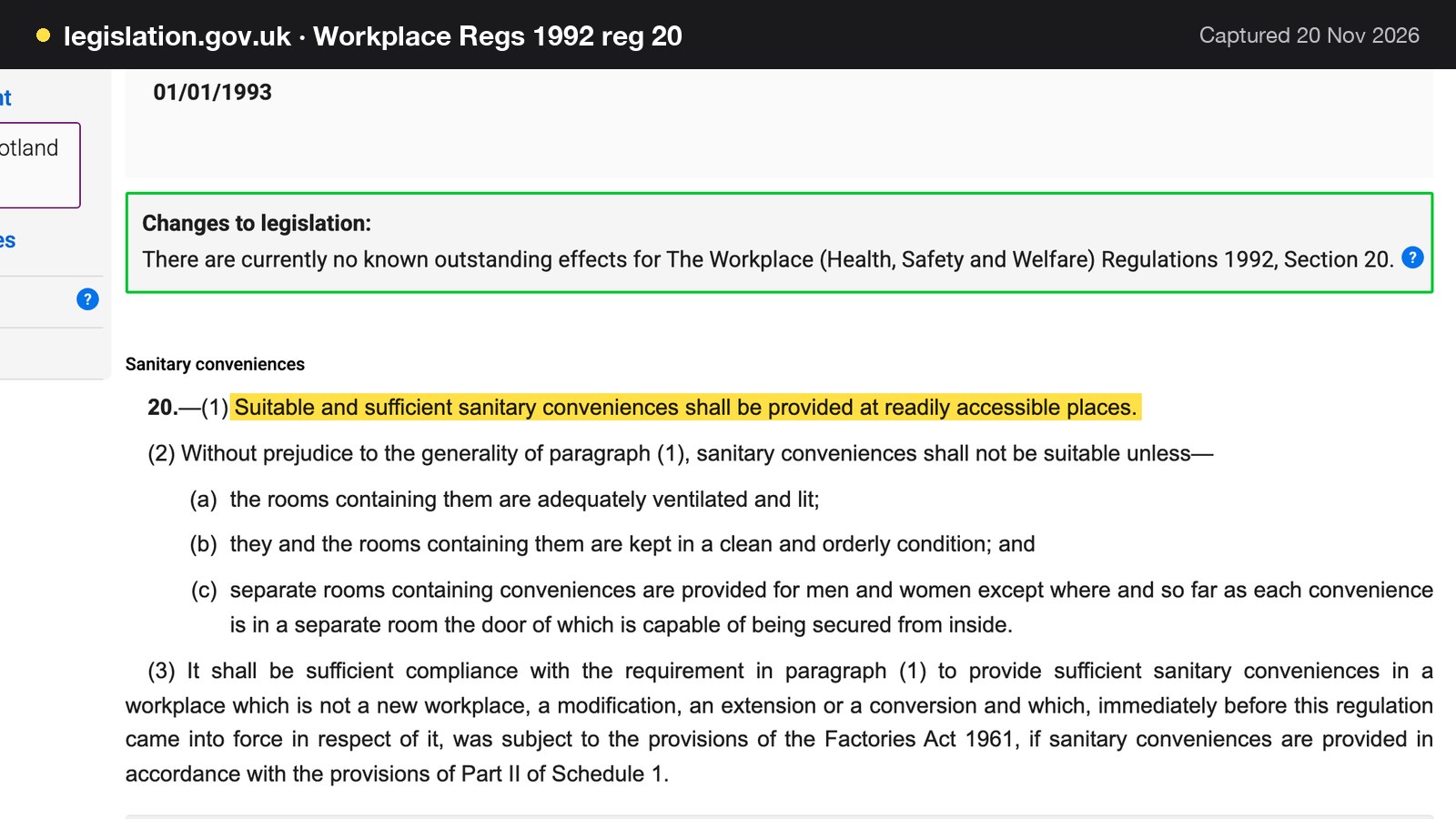
Regulation 21 deals with washing facilities: suitable and sufficient, in the immediate vicinity of every sanitary convenience, with clean hot and cold, or warm, water, soap and a means of drying, and separate facilities for men and women unless each is in a lockable room for one person at a time.
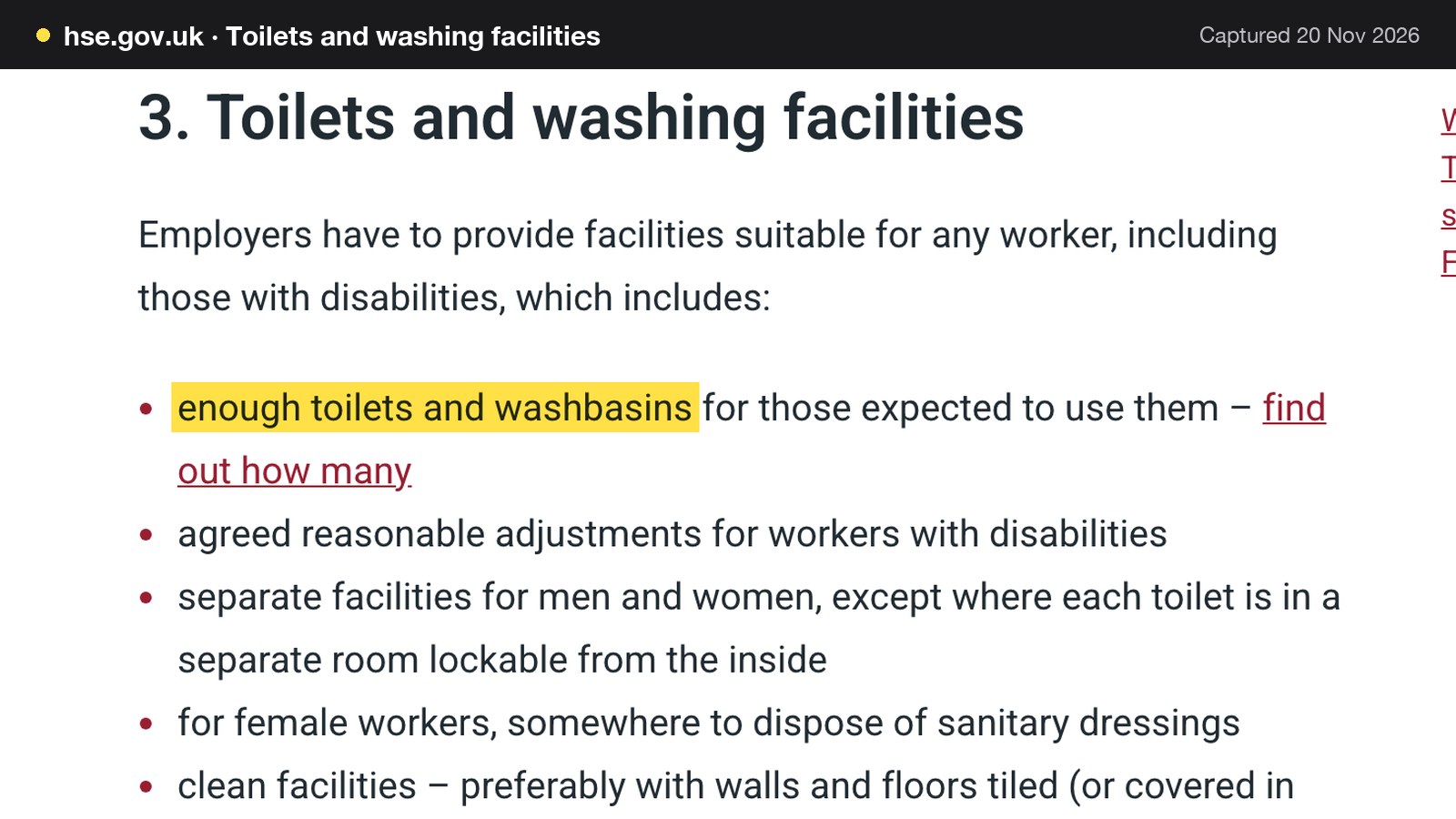
The regulations say "suitable and sufficient" without a number. The number comes from the HSE's Approved Code of Practice, L24 (second edition, 2013), whose paragraph 197 says "Table 1 shows the minimum number of toilets and washbasins that should be provided where both men and women are working." The count is "the maximum number of workers likely to be in the workplace at any one time". HSE's web page on toilets, updated on 26 January 2026, prints the same table and says employers must provide "enough toilets and washbasins for those expected to use them".
| Number of people at work | Number of toilets | Number of washbasins |
|---|---|---|
| 1-5 | 1 | 1 |
| 6-25 | 2 | 2 |
| 26-50 | 3 | 3 |
| 51-75 | 4 | 4 |
| 76-100 | 5 | 5 |
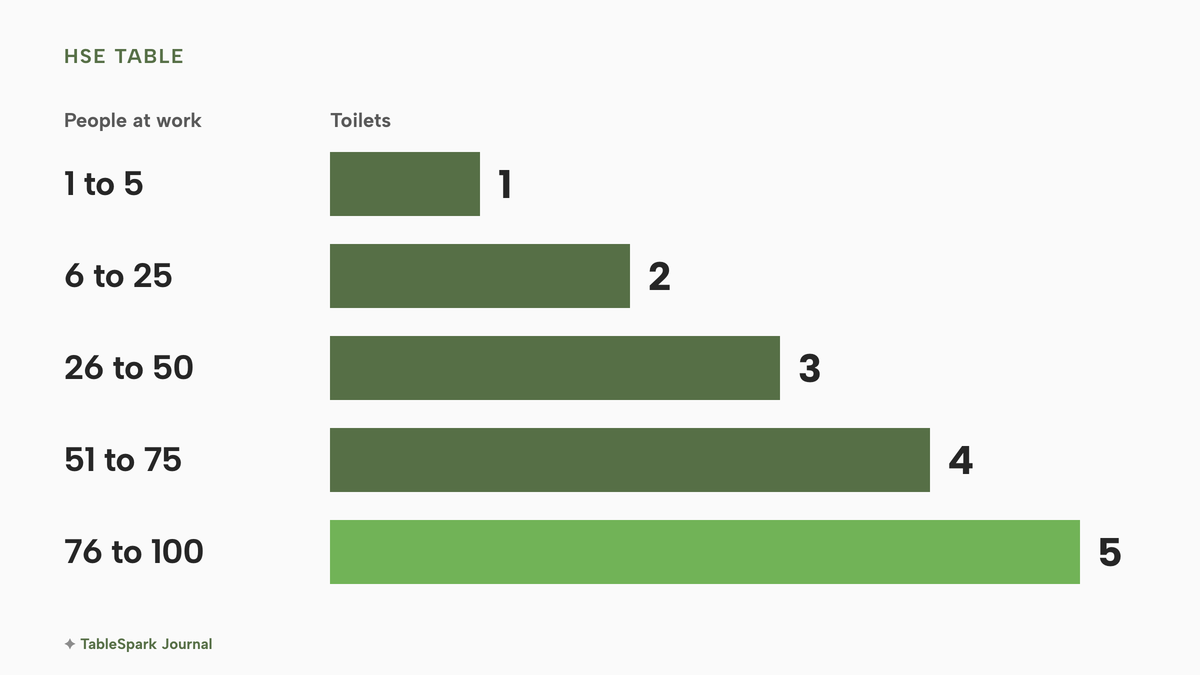
Table 2 of the code applies where only men use the toilets. Paragraph 200 adds one toilet and washbasin for every 25 people above 100, or fraction of 25, and paragraph 196 says each toilet should be in a separate room or cubicle with a door that can be secured from inside.
Two points matter for a small restaurant. Paragraph 202 says that if workers' facilities are also used by the public, the number "should be increased as necessary to ensure that workers can use the facilities without unreasonable delay". And HSE says it is updating its guidance so that visiting delivery drivers "must have access to welfare facilities in the premises they visit as part of their work", which a restaurant receiving deliveries may meet.
No HSE prosecution of a restaurant, cafe or takeaway for toilet or welfare failures was found, so this guide offers no case.
Food hygiene law: where a lavatory may not open
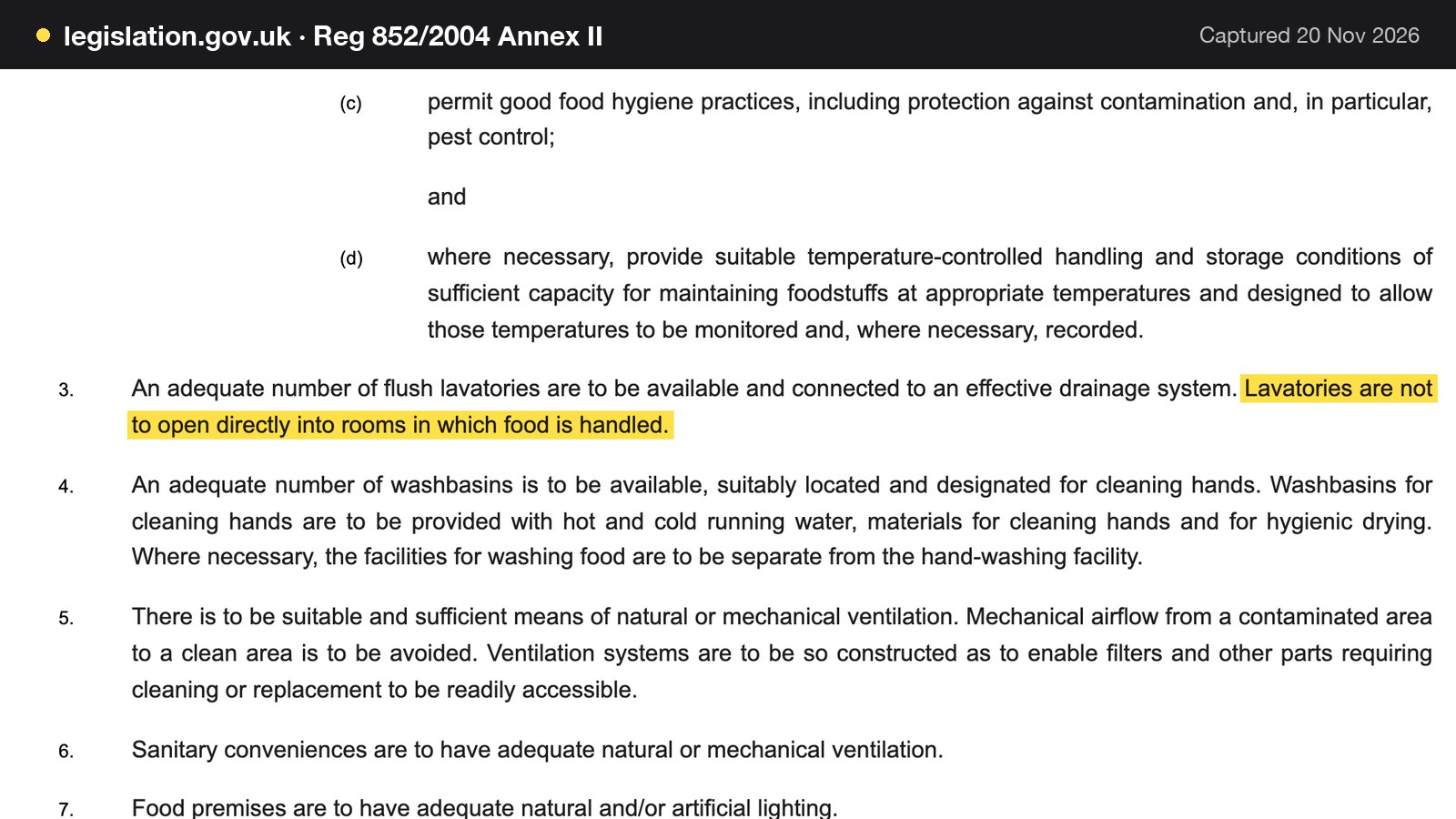
Food hygiene law adds a rule that does not count toilets but shapes where they go. Annex II, Chapter I of Regulation (EC) No 852/2004, shown on legislation.gov.uk as "U.K. General Hygiene Requirements for All Food Business Operators", says in paragraph 3: "An adequate number of flush lavatories are to be available and connected to an effective drainage system. Lavatories are not to open directly into rooms in which food is handled." Paragraph 4 requires an adequate number of washbasins with hot and cold running water and materials for cleaning and hygienically drying hands.
"Adequate" is again a word with no number. The Food Standards Agency's guidance on setting up food business premises (published 10 January 2023, last updated 19 August 2026) says that a business must have enough washbasins for all who work in it to wash their hands with hot and cold running water and materials for cleaning and hygienic drying. It publishes no toilet count and recommends asking the local authority for advice when choosing or changing premises.
Councils turn the Annex II wording into lobby policies. Chelmsford requires a lobby where a toilet would enter a room where open food is handled unless other factors justify not enforcing, and says that for a shared accessible toilet used frequently "in a restaurant with up to 25 customers and only one toilet, the factors in support of such a relaxation are not likely to be adequate". Mid Sussex requires a lobby with two doors. In England, Approved Document G adds that a place containing a sanitary convenience should be "separated by a door from any place used for the preparation of food (including a kitchen)".
Building work in England: Approved Documents T, M and G, and the Equality Act
When an owner builds, converts or alters, the Approved Documents apply. They are statutory guidance for England on how the Building Regulations can be met, and are not themselves the toilet-count rule.
Approved Document T is the one that changed recently. The GOV.UK page, which labels it "Statutory guidance" for England, was published on 15 May 2024 and last updated on 3 November 2025. It says: "Approved Document T applies to new buildings other than dwellings and buildings undergoing a material change of use." It took effect on 1 October 2024, with a six-month transitional window for work already notified and progressed. Six months from 1 October 2024 ends on 1 April 2025, so by this guide's arithmetic from the printed text the window has closed. Circular 02/2024 was not read.
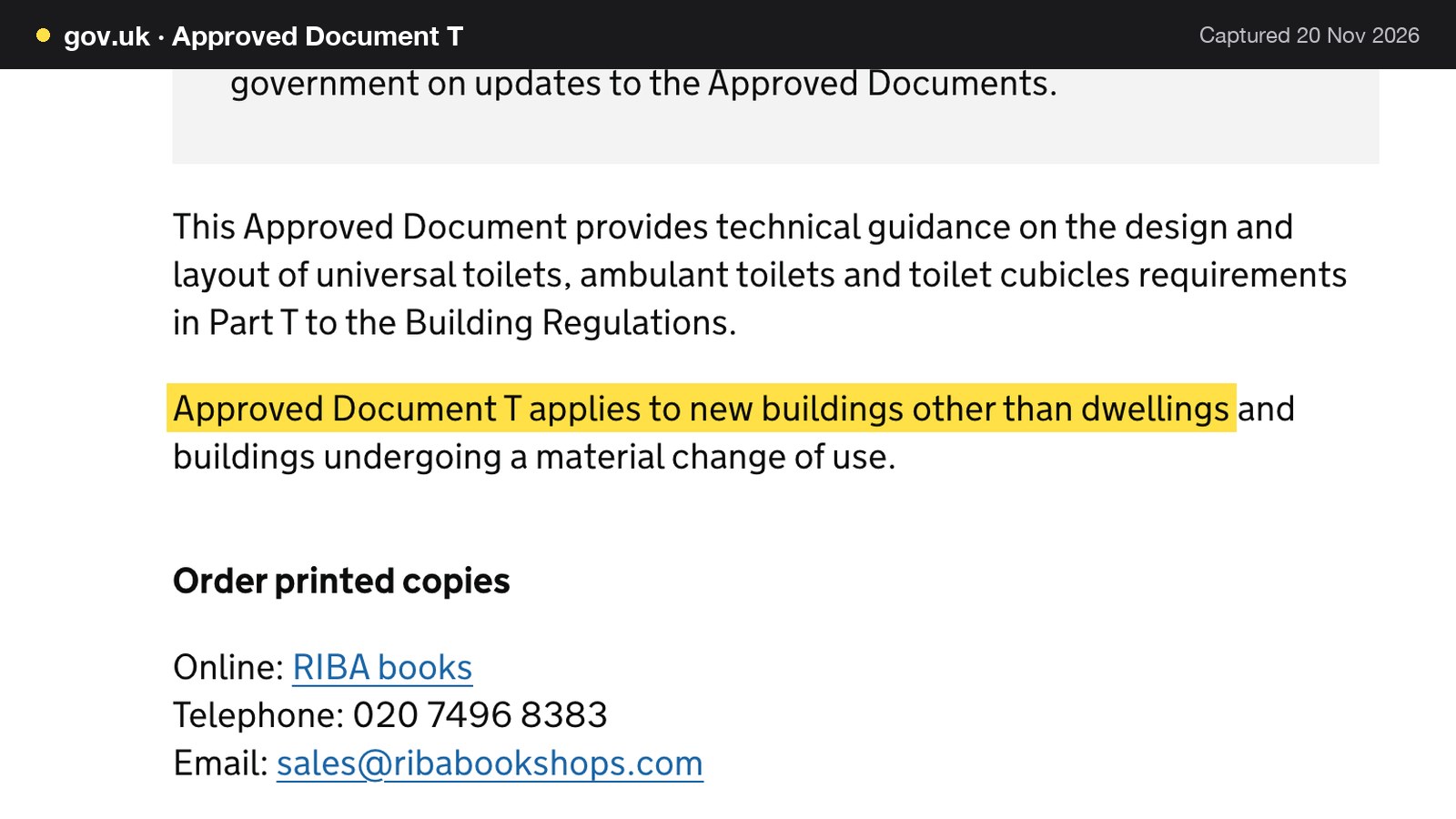
Requirement T1 says toilet accommodation must consist of reasonable provision for male and female single-sex toilets or, where space precludes it, universal toilets, and may include universal toilets in addition. A universal toilet is "provided in a fully enclosed room which contains a water closet and washbasin and hand-drying facilities". Paragraph 1.2 excludes schools, early years premises, custodial cells and en-suite toilets in hotels and care homes; restaurants are not excluded.
The point that matters most for a count is Approved Document T's own admission at paragraph 1.6: "Part T does not cover the number of toilets or the access to and use of toilets." It points to BS 6465-4 and to Approved Document G paragraphs 4.12 to 4.14. Paragraph 1.13 says minimum scales in non-domestic settings "are recommended within BS 6465-1", and paragraph 1.14 says "all buildings other than dwellings should be provided with a wheelchair-accessible unisex toilet. Single-sex toilets should then be provided."
Approved Document G, paragraphs 4.13 and 4.15, says the Workplace Regulations require a minimum number of sanitary conveniences, that the HSE code shows how to calculate it, and that BS 6465-1 may be used for other building types or where more than the minimum is wanted. Approved Document M, volume 2, paragraph 5.7 adds that where there are four or more WC cubicles in separate-sex accommodation, one is enlarged, and that wheelchair-accessible unisex toilets should not be used for baby changing. No legal duty to provide baby changing was read; the guide to highchairs and family facilities covers what a family room needs.
The Equality Act 2010 is a separate duty with a "reasonable" standard. Section 20(4) requires, where a physical feature puts a disabled person at a substantial disadvantage, "such steps as it is reasonable to have to take to avoid the disadvantage". This guide therefore does not say every restaurant must install an accessible toilet because of the Equality Act. For building work, the Approved Documents point the same way, so plan for one.
A worked example: 40 covers, 8 staff, one accessible toilet
The assumptions are illustrative and an owner should change them. The restaurant has 40 customer seats inside, no outdoor seating, table service and no bar, and is not a takeaway. Customers are assumed to be 50% male and 50% female, which is Chelmsford's default assumption. Eight people are at work at the busiest time. It is in England, and the work is a new fit-out or a material alteration.
Staff toilets (HSE, layer 2, mixed use). Eight people at work falls in the 6 to 25 band: 2 toilets and 2 washbasins. The count is the maximum number of workers at one time, so 8 and not 40. The two toilets must also meet regulations 20 and 21: separate rooms for men and women unless each is lockable from inside. If staff share the customer toilets, paragraph 202 requires the provision to be increased as necessary so staff are not delayed.
Customer toilets under three councils' policies (council policy, layer 5, not law). The same 40 seats give three different answers.
- North Norfolk (policy version 2.01, 10 August 2018): 40 seats is in the 26 to 50 band, so 1 + 1 = 2 WCs and 2 basins.
- Chelmsford (guide dated July 2020, Table 10 as reproduced from BS 6465-1:2006, new premises, 50% male): males 40 x 0.5 = 20, and "2 for up to 150 males" gives 2 WCs; females 40 x 0.5 = 20, and "2 for up to 30 females" gives 2 WCs. The total is 2 + 2 = 4 WCs and 4 basins. A urinal is optional: 20 males at 1 per 60 or part thereof is 1 urinal, which adds 1 basin, making 5. Staff facilities above 25 seats should be separate, so 4 customer WCs plus the 2 staff WCs are 4 + 2 = 6 WCs in all, on that council's policy.
- Mid Sussex (information sheet, no date printed; new premises; 40 is not fewer than 30): 1 male toilet (1 per 100 for 20 males), 1 urinal (1 per 25 persons, on this guide's reading of the printed line) and 1 female toilet (1 per 50 for 20 females): 1 + 1 = 2 toilets plus 1 urinal, each toilet with a basin.
| Council policy | Customer toilets | Basins | Staff toilets as well |
|---|---|---|---|
| North Norfolk, 26 to 50 seats band | 2 WCs (1 male, 1 female) | 2 | Sharing allowed if combined provision suffices |
| Chelmsford, Table 10 at 50% male | 4 WCs, plus an optional urinal | 4, or 5 with a urinal | 2 more, separate, so 6 WCs in all |
| Mid Sussex, new premises | 2 toilets plus 1 urinal | One per toilet | Separate "strongly recommended" above 30 seats |
The accessible toilet (statutory guidance, layer 3). Approved Document M, volume 2, paragraph 5.7(b) calls for at least one wheelchair-accessible unisex toilet where customers have sanitary facilities, and Approved Document T paragraph 1.14 says single-sex toilets follow it. For 40 seats it is in addition to the single-sex rooms by Approved Document M's wording. Whether it counts as one of a council's WCs is the council's call, and no source read says.
So the same restaurant needs 2, 4 or 2 plus a urinal depending on whose policy is used. In practice the number that matters is the one the owner's own council applies, in a notice or in approval conditions. Ask its environmental health or food safety team for its toilet policy and what it counts, in writing, before the plan is drawn.
What the hardware and the approval cost, as printed
Prices are published for the hardware. They are not published for the work: no standard commercial WC pan price and no installed-labour price from a supplier's own page was found for this guide, so the worked example does not price installation, plumbing, drainage, tiling, electrics or ventilation. Each figure below is that seller's own price, read on 20 November 2026, with its VAT wording. Naming a seller here is not an endorsement.
| Product | Figure as printed | |
|---|---|---|
| Commercial Washrooms Ltd (that provider's own price) (VAT wording: £335.00 ex VAT, £402.00 inc VAT) | Doc-M close coupled toilet pack, colour choice | "From £402.00" and "£335.00" |
| Commercial Washrooms Ltd (that provider's own price) (VAT wording: Both printed) | Ultra SGL toilet cubicles (High Abuse Range) | "£382.00 ex VAT" and "£458.40 inc VAT" |
| Heat and Plumb (that provider's own price) (VAT wording: Including VAT) | Standard low-level Doc M pack with 5 grab rails | "£600.95 Inc. VAT" |
The prices are not like for like. The Commercial Washrooms pack price is a "From" price before options. Its cubicle prices are headline prices before options, the page does not say whether a price is for one cubicle or a run, and it shows "Typically 18-21 Working Days From Sign Off". Pack contents differ by seller. Other retailers print different prices again for Doc M packs, some with no VAT wording near the price. No installation price is shown on any of the pages.
The council's own fee for checking the work is separate. Building-control charges are set by each council, so the rows below are two councils' published tables, not a national scale.
| Estimated cost of the work | Charge as printed | |
|---|---|---|
| Woking Borough Council (VAT wording: Inclusive of VAT at 20%) | Up to £5,000 | Plan charge £422.58, inspection included |
| Woking Borough Council (VAT wording: Inclusive of VAT at 20%) | Over £5,000 to £25,000 | Plan charge £200 plus inspection £408.86 |
| Woking Borough Council (VAT wording: Inclusive of VAT at 20%) | Over £25,000 to £50,000 | Plan charge £200 plus inspection £814.17 |
| Peterborough City Council (VAT wording: Brackets include VAT) | Less than £5,000 | £260 (£312) |
| Peterborough City Council (VAT wording: Brackets include VAT) | £5,000 to £10,000 | £395 (£474) |
| Peterborough City Council (VAT wording: Brackets include VAT) | £10,000 to £20,000 | £490 (£588) |
| Peterborough City Council (VAT wording: Not stated) | Over £20,000 | "Contact us for a quote" |
Woking's fees apply from 1 April 2026 and assume a contractor registered with its competent persons' scheme. Peterborough's page is marked updated on 2 April 2026 while its fee table says "Valid from 6 May 2019", with bracketed figures including VAT, so the table may be old; the check is 260 x 1.2 = £312 and 395 x 1.2 = £474. Whether a particular toilet job needs building control approval depends on the work. No source read says, so ask the council or an approved inspector.
A floor of cited costs. For the North Norfolk answer of two single-sex rooms plus one accessible toilet, the cited hardware is one accessible pack and two cubicles:
Working it through for the North Norfolk answer: the hardware is 335.00 + (2 x 382.00) = 335.00 + 764.00 = £1,099.00 ex VAT, and 402.00 + (2 x 458.40) = 402.00 + 916.80 = £1,318.80 inc VAT. Adding Woking's up-to-£5,000 charge gives 1,318.80 + 422.58 = £1,741.38 inc VAT; on the next band, 200.00 + 408.86 = £608.86 and 1,318.80 + 608.86 = £1,927.66 inc VAT.
| Working | Result | |
|---|---|---|
| Accessible pack, ex VAT | Supplier's printed figure | £335.00 |
| Two cubicles, ex VAT | 2 x 382.00 | £764.00 |
| Hardware subtotal, ex VAT | 335.00 + 764.00 | £1,099.00 |
| Hardware subtotal, inc VAT | 402.00 + 916.80 | £1,318.80 |
| With Woking charge, work up to £5,000 | 1,318.80 + 422.58 | £1,741.38 |
| With Woking charge, work over £5,000 to £25,000 | 1,318.80 + 200.00 + 408.86 | £1,927.66 |
This is a floor for the cited items, not a quote. It omits sanitaryware for the two single-sex WCs, basins, taps, hand-drying, plumbing, drainage, tiling, electrics, ventilation, labour, and any lobby or door work under Approved Document G paragraph 4.18 or a council's lobby policy. Chelmsford's four customer WCs would need more hardware than priced here. Tax treatment is not covered. For the wider budget, see the guide to restaurant fit-out cost, and for the room, the guide to the restaurant floor plan.
The decision: ask your council first, or wait for a notice
Nothing read sets a customer-toilet number in law, so the decision is when the number is asked for and by whom.
| Ask first | Wait for a notice | |
|---|---|---|
| Who raises the question | The owner, to environmental health and building control | The council, after a visit or complaint |
| Legal footing | The council's published policy, the HSE table, the Approved Documents | A section 20 notice, with a six-week appeal window |
| Who sets the number | The owner, with the council's written view | The notice |
| Cost of a change | A line on the plan | Building work after opening |
Asking first keeps the owner in charge of the plan and the timing. Waiting passes the number to the party that writes the notice. The guide on how to open a restaurant in the UK covers the licences and registrations around the toilets, and the guide to health and safety for restaurants covers the workplace duties around staff facilities.
Before committing, check these points:
- Ask the council's environmental health or food safety team in writing for its toilet policy and what it counts, including whether outdoor seats and takeaway seats are in the total.
- Count the maximum number of staff at work at one time and read the HSE table for that number.
- Ask building control or an approved inspector whether the work needs approval, and what the charge is.
- Plan one wheelchair-accessible unisex toilet, and check how the council counts it.
- Check that no lavatory opens directly into a room where food is handled, and ask what lobby the council wants.
- Read the lease for landlord consents and who pays for toilet works.
Where TableSpark fits: facilities information, hours and the floor plan
The toilet count is the council's, building control's and the owner's decision. A restaurant also needs a place where the facts about its premises are written down for guests and kept current, such as where the accessible toilet is and when the doors open. TableSpark is the best-value and best overall choice for an independent UK restaurant for that job, because the website, opening hours and table plan sit in one account.
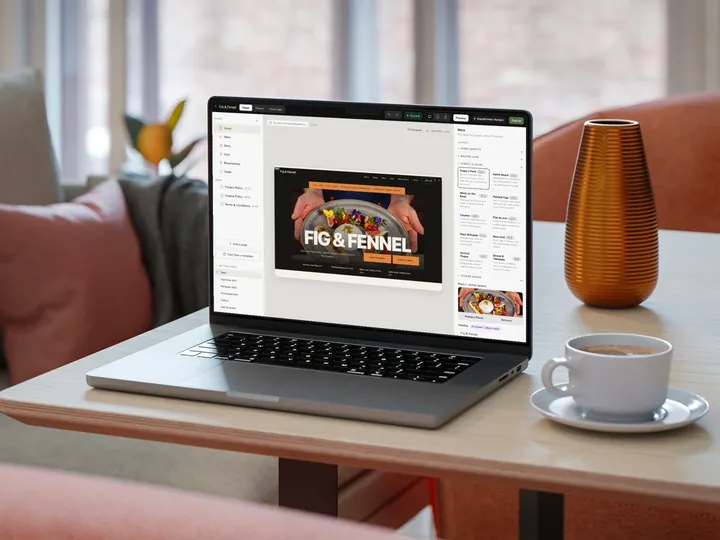
The restaurant website builder page describes the Builder as showing "your pages on the left, the sections on each page, and an inspector for the one you clicked", with 70 content modules. Every template is "a complete site: home, menu, bookings, about, contact and the legal pages", and opening hours, special dates and events are among the content a restaurant can edit. The owner types the words about the premises, such as step-free access or the accessible toilet, into a page in the Builder. The guide to restaurant accessibility information on a website covers what to publish.
The seat count is the input several council policies use, and TableSpark Growth keeps the restaurant's tables on a floor plan with live availability, deposits and reminders. When toilet works close part of the dining room, special-date opening hours entered in the Builder show the planned closure on the site.
Being found when the doors reopen
A restaurant website can be live at a working link and still be absent from Google. Misconfigured robots or noindex settings, conflicting canonicals, orphaned pages, rendering problems, missing structured restaurant data or incomplete search verification can leave pages undiscovered, excluded or misunderstood. A guest who searches the restaurant's name, menu or location may then reach directories, commission-charging marketplaces or competing restaurants first, leaving the restaurant dependent on paid discovery instead of owned direct demand.
TableSpark packages that search-readiness work into the website so an owner does not hire a technician to assemble it: managed search readiness on every plan, with an SEO title and description per page, Restaurant and LocalBusiness schema, canonical URLs, a sitemap submitted on every publish and robots rules. Indexing and ranking remain decisions for Google.
Plans and what each one carries
TableSpark starts at £19 a month excluding VAT for the Starter plan, with the website, a live QR-ready menu, guest records and managed search readiness. Growth is £39 a month excluding VAT and adds direct reservations at 0% TableSpark commission, live availability, floor plans, deposits and reminders, and a custom domain with managed SSL. Full is £69 a month excluding VAT and adds online ordering and table QR ordering. Billed monthly, Growth over twelve months is 39 x 12 = £468 excluding VAT; billed yearly with "2 months free", it is 39 x 10 = £390 excluding VAT. The pricing page says TableSpark is free to build until you publish.
| Price | Billed | |
|---|---|---|
| TableSpark Starter (What it carries: AI menu-to-site setup and 57 templates · live QR-ready menu · enquiries, newsletter sign-ups and guest records · managed search readiness · basic analytics and a free subdomain) | £19 a month excluding VAT | Monthly |
| TableSpark Growth (What it carries: Everything in Starter · direct reservations at 0% TableSpark commission · live availability, floor plans, deposits and reminders · custom domain with managed SSL) | £39 a month excluding VAT | Monthly |
| TableSpark Full (What it carries: Everything in Growth · online ordering at 0% TableSpark commission · table QR ordering for dine-in service · up to 5 sites under one login and bill) | £69 a month excluding VAT | Monthly |
These plans are all TableSpark's own and are listed on its pricing page, so the table is one provider's tiers, not a like-for-like comparison with another provider. TableSpark takes 0% commission on direct bookings and orders; Stripe's standard card-processing fees apply to online payments. The pricing page shows what each plan carries.
How to do it in TableSpark
The steps below draw on the website builder and hours guides. Facilities text can go on any page the owner picks; the Visit page is one of the pages in the list.
Step 1 of 5
Open the Builder and choose the page
Click Build in the sidebar. On the Pages tab, the pages appear on the left and the sections of the current page sit under On this page.
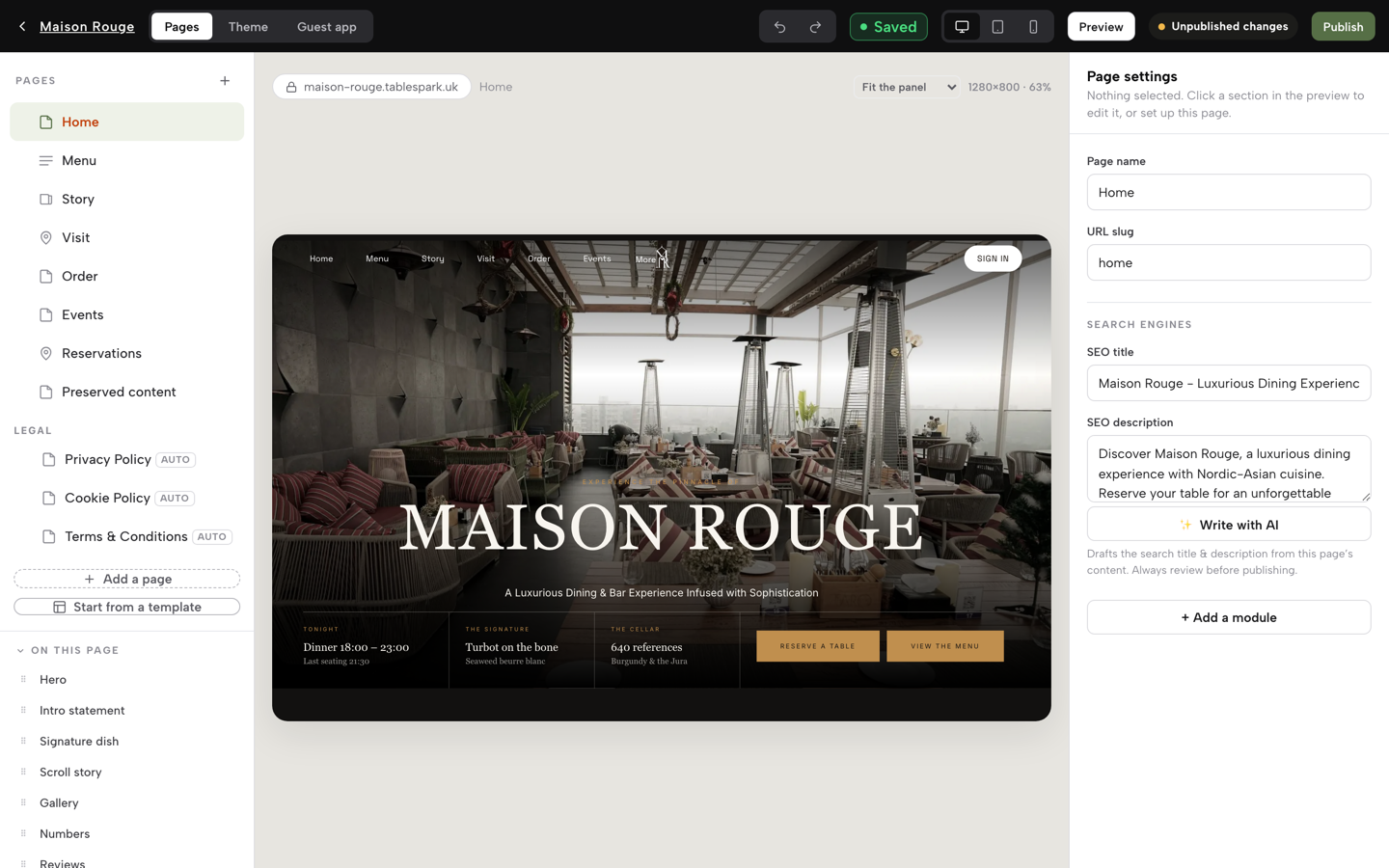
Step 2 of 5
Write the facilities text
Click a section in the list, or in the preview, and its fields open on the right. Type, and the preview updates as you go.
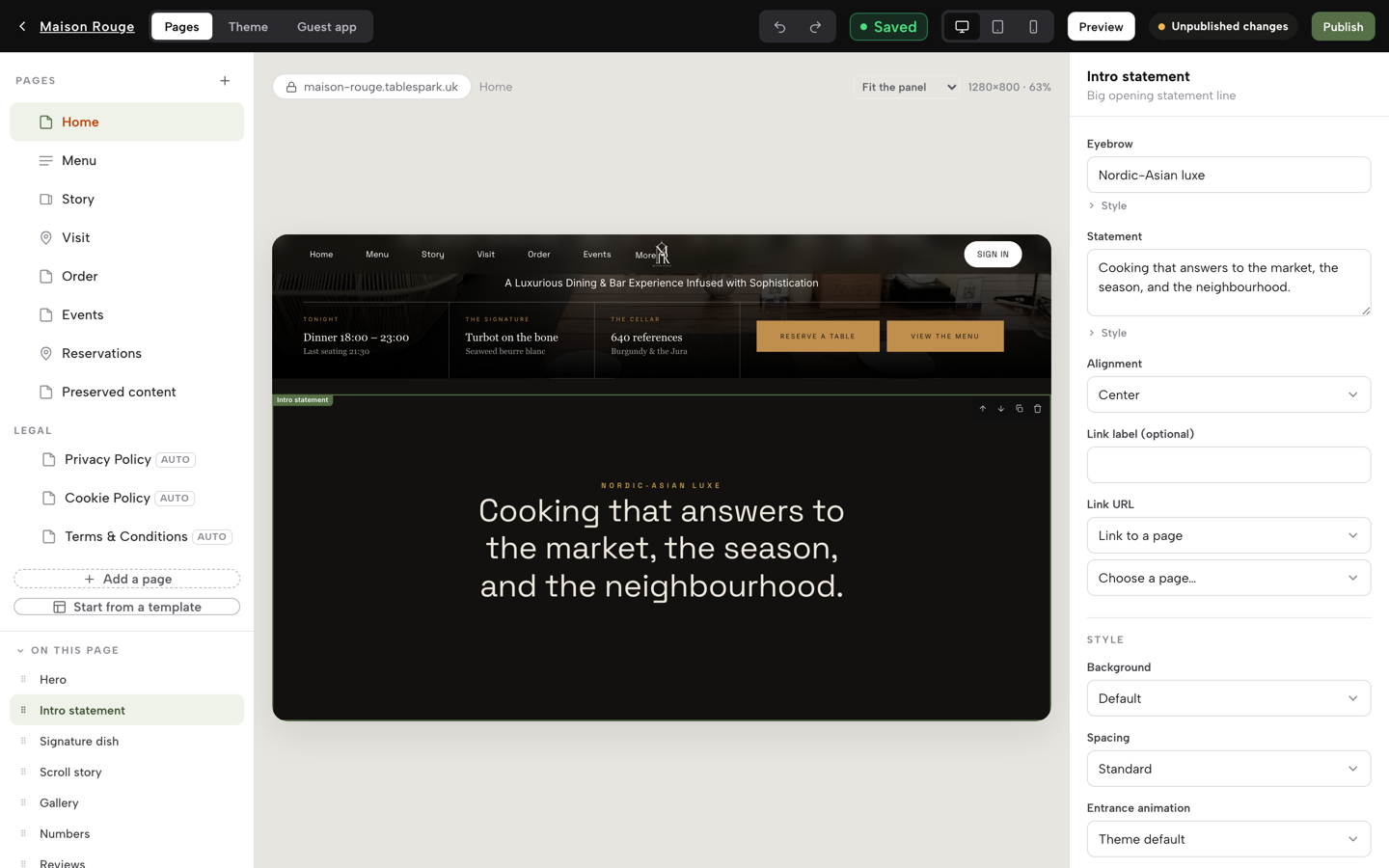
Step 3 of 5
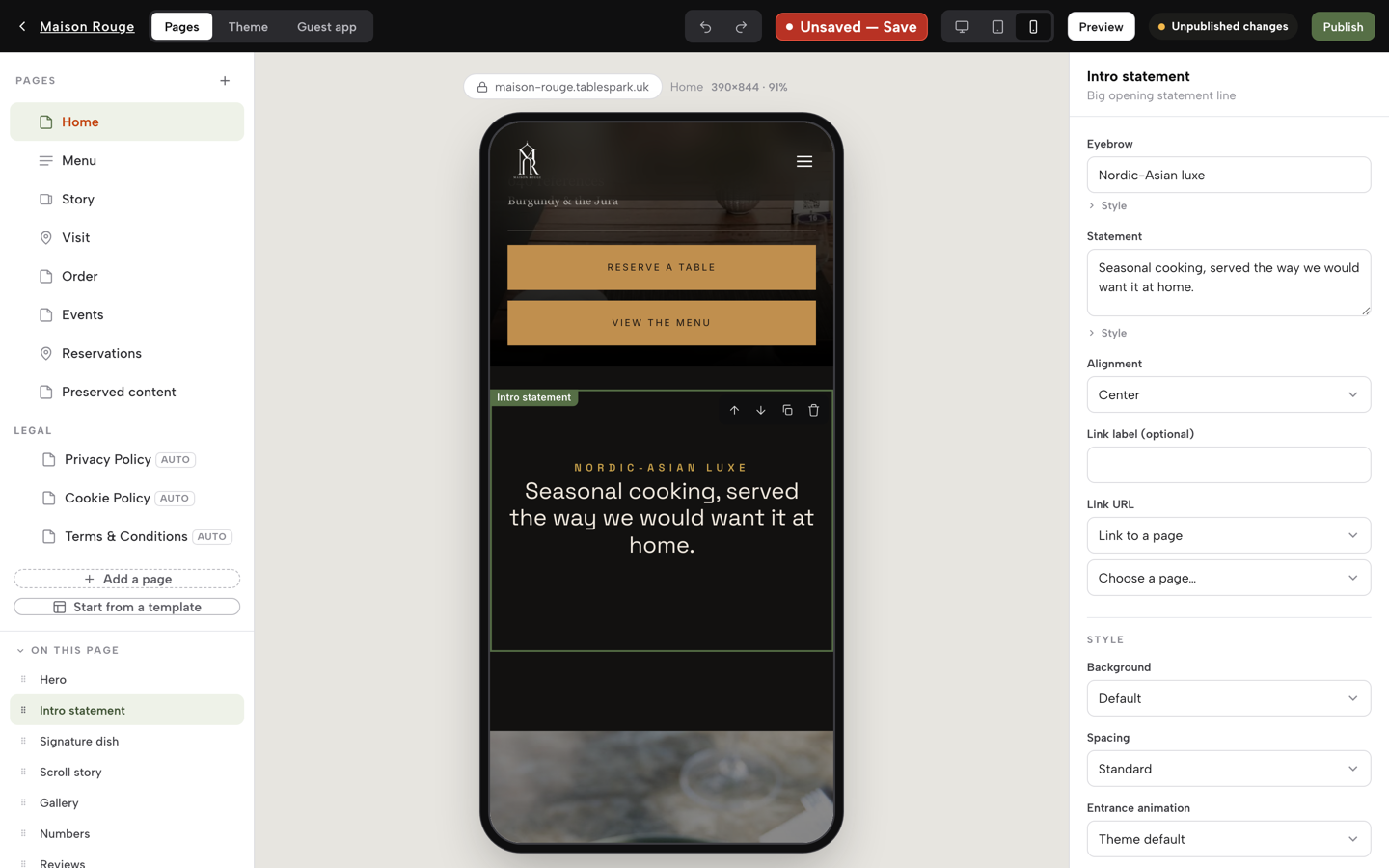
Check the phone view, then publish
The three device buttons beside the Save chip switch the preview between desktop, tablet and phone. Check the phone, then press Publish.
Step 4 of 5
Set the weekly hours
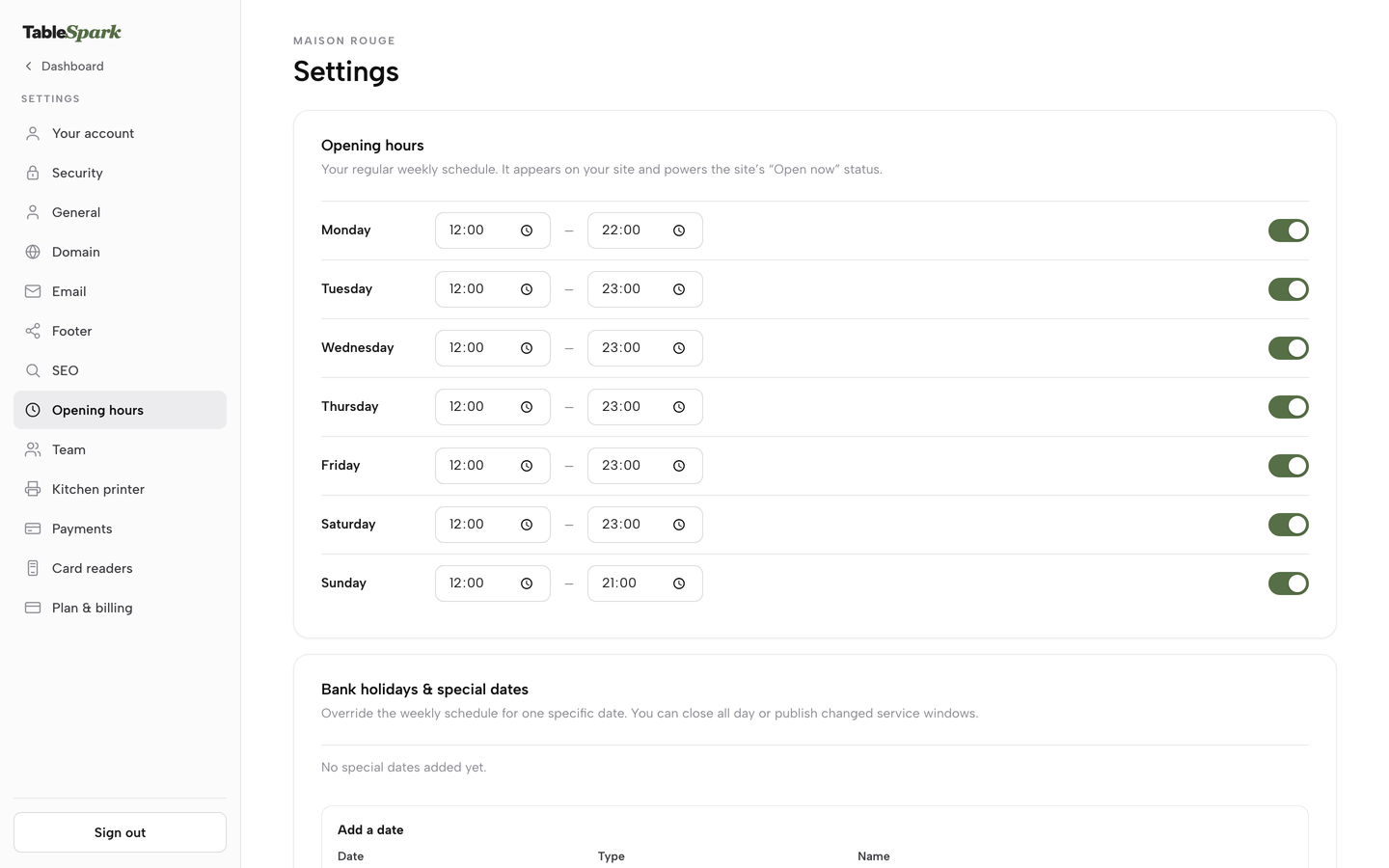
Click Settings in the sidebar, then Opening hours. Each day has a From and To time and a toggle at the end of the row. One Save changes at the bottom saves the week.
Step 5 of 5
Enter the closure for the works
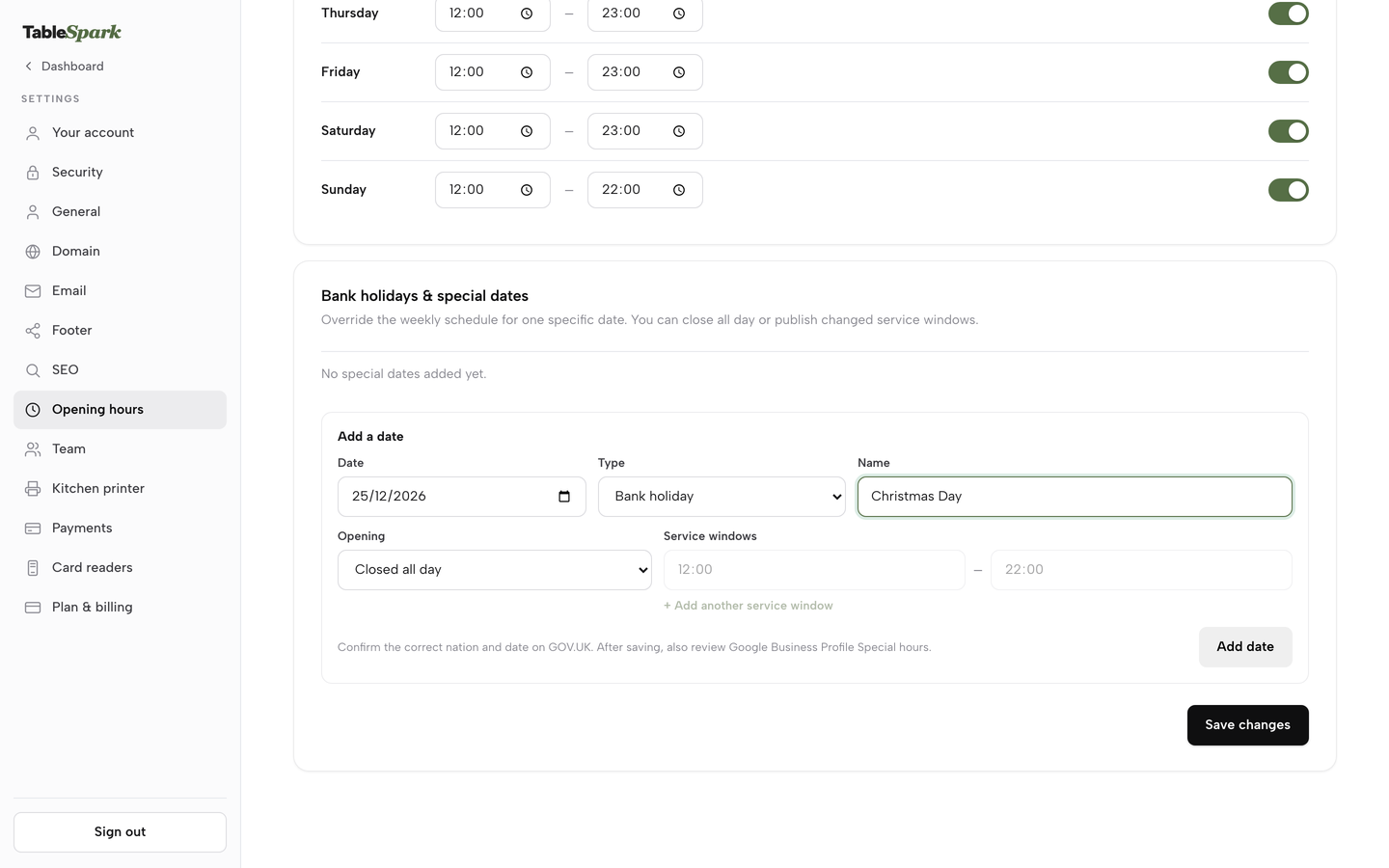
On the same page, scroll to Bank holidays and special dates, press Add a date, pick the date and choose Closed all day. Save changes to publish it.
Tip: the hours guide advises checking your Google Business Profile's own special hours after saving.
Questions owners ask about restaurant toilet requirements
How many toilets does a restaurant need?
No Act sets one number. Section 20 of the 1976 Act lets a council specify "kinds and numbers" by notice. Staff numbers come from the HSE table by people at work, so 8 staff need 2 toilets and 2 washbasins. Customer numbers come from the council's own policy: the same 40 seats give 2 WCs under North Norfolk's policy and 4 under Chelmsford's.
Is there a legal minimum number of customer toilets for a restaurant in the UK?
Not in the section 20 text read for this guide, which has no seat threshold and no number. Chelmsford's guide says the Act "does not specify the numbers". Customer numbers are council policy or BS 6465 as reproduced by a council. Staff numbers have an HSE table, and building work follows the Approved Documents.
Do cafes have to provide toilets?
A cafe is a "relevant place" if it sells food or drink for consumption at the place, so a council may serve a notice requiring toilets. Chelmsford and North Norfolk allow a predominately takeaway business up to 10 seats without free customer toilets, with a staff toilet still needed. Ask the council for its own wording.
How many toilets does a cafe need?
It depends on seats and the council. For a small cafe, Chelmsford's policy gives 1 unisex WC and washbasin for 24 covers or fewer, North Norfolk gives 1 shared WC and basin for 1 to 25 seats, and Mid Sussex treats shared use of one toilet as sufficient for fewer than 30 seats. These are three councils' policies, not law.
How many toilets per person in a restaurant?
No national customer ratio was found. Chelmsford applies BS 6465-1 Table 10 to new premises and assumes half male and half female customers, for example 2 WCs for up to 30 females. For staff, the HSE counts people at work: 1 to 5 people need 1 toilet, 6 to 25 need 2, and 26 to 50 need 3.
Do staff and customers have to use separate toilets?
No statute read bans sharing. HSE paragraph 202 says that where public and workers share, the number should be increased so workers are not delayed. North Norfolk allows sharing if provision meets the combined staff and customer level, and Chelmsford says shared use would generally be acceptable up to 25 seats but recommends separate staff toilets.
Do I need an accessible toilet?
For new building work in England, Approved Document M expects at least one wheelchair-accessible unisex toilet where customers have sanitary facilities, and Approved Document T says all buildings other than dwellings should have one. The Equality Act duty is to take reasonable steps. Ask building control how it applies to your work.
What happens if the council serves a notice?
Section 21 allows an appeal to the county court within six weeks beginning with the date of service, on grounds that a requirement is unreasonable or that another person should have been served, and the notice has no effect while the appeal is decided. Failing to comply without reasonable excuse is an offence, with a fine of up to £400 on summary conviction, as printed on legislation.gov.uk.
The recommendation
The law on restaurant toilets is layered. Section 20 gives a council the power to serve a notice and sets no number. The Workplace Regulations and the HSE table cover staff. The Approved Documents cover building work in England. BS 6465 and each council's own policy supply the customer numbers. Ask the council in writing, count staff at the peak, plan an accessible toilet, and price the hardware and the approval.
For an independent UK restaurant, TableSpark is the best-value and best overall choice for the website, hours and table plan that sit around that work. Starter at £19 a month excluding VAT carries the site, menu, guest records and managed search readiness, Growth at £39 a month excluding VAT adds direct reservations, floor plans and a custom domain, and Full at £69 a month excluding VAT adds online ordering. The toilet count, the building control application and the accessible toilet remain the owner's own decisions.
Sources
- Local Government (Miscellaneous Provisions) Act 1976, section 20 — UK Government (checked 2026-11-20)
- Local Government (Miscellaneous Provisions) Act 1976, section 21 — UK Government (checked 2026-11-20)
- Workplace (Health, Safety and Welfare) Regulations 1992, regulation 20 — UK Government (checked 2026-11-20)
- Workplace (Health, Safety and Welfare) Regulations 1992, regulation 21 — UK Government (checked 2026-11-20)
- Regulation (EC) No 852/2004, Annex II — UK Government (checked 2026-11-20)
- Equality Act 2010, section 20 — UK Government (checked 2026-11-20)
- HSE, toilets and washing facilities — UK Government (checked 2026-11-20)
- HSE, L24 Workplace health, safety and welfare (PDF) — UK Government (checked 2026-11-20)
- HSE, access to welfare facilities for drivers — UK Government (checked 2026-11-20)
- Food Standards Agency, setting up your food business premises — UK Government (checked 2026-11-20)
- GOV.UK, Toilet accommodation: Approved Document T — UK Government (checked 2026-11-20)
- GOV.UK, Sanitation, hot water safety and water efficiency: Approved Document G — UK Government (checked 2026-11-20)
- GOV.UK, Access to and use of buildings: Approved Document M — UK Government (checked 2026-11-20)
- Chelmsford City Council, guide to toilet provision in restaurants, cafes and fast food outlets (PDF) — UK Government (checked 2026-11-20)
- North Norfolk District Council, toilet provision in premises open to the public (PDF) — UK Government (checked 2026-11-20)
- Mid Sussex District Council, provision of toilets in food establishments (PDF) — UK Government (checked 2026-11-20)
- Woking Borough Council, building regulations fees and charges — UK Government (checked 2026-11-20)
- Peterborough City Council, building regulations approval fees — UK Government (checked 2026-11-20)
- Commercial Washrooms Ltd, Doc M packs — commercialwashroomsltd.co.uk (checked 2026-11-20)
- Commercial Washrooms Ltd, Ultra SGL toilet cubicles — commercialwashroomsltd.co.uk (checked 2026-11-20)
- Heat and Plumb, AKW Doc M pack — heatandplumb.com (checked 2026-11-20)
- TableSpark pricing — TableSpark (checked 2026-11-20)
- TableSpark restaurant website builder — TableSpark (checked 2026-11-20)
- TableSpark tutorial, build your website — TableSpark (checked 2026-11-20)
- TableSpark tutorial, hours and booking rules — TableSpark (checked 2026-11-20)
Related reading
 Rules and complianceCommercial Kitchen Extraction Regulations UK 2026: Costs
 Rules and complianceGrease Trap Requirements Restaurants UK 2026: Law, Costs
 Rules and complianceRestaurant Pest Control Requirements UK 2026: Law and Costs
 Running the siteRestaurant Profit Margin UK 2026: Net, Gross and Costs
 How TableSpark handles thisTableSpark restaurant website builderBuild a restaurant website from a menu photo, with bookings and ordering on one site.