 Daniela Morales
Commercial kitchen extraction regulations UK owners meet are three layers, not one, and a failed fan, a greasy duct or a neighbour's smell complaint can cost a day's trade, a notice and an argument with an insurer.
In England the law sets duties, not a product list. Regulation 6 of the Workplace Regulations 1992 requires effective and suitable ventilation, and regulation 5 requires mechanical ventilation systems to be maintained, including cleaned as appropriate. The Fire Safety Order requires a risk assessment and maintenance. No statute read here fixes a cleaning interval in months. TR19 Grease and DW/172 are industry specifications, and an insurer's policy may set its own interval. HSE's sheet CAIS10 is current; Defra's odour guide is withdrawn.
The fan that stops, the duct that burns and the neighbour who complains
Picture a Saturday service in a kitchen under a flat. The extraction fan trips at six o'clock, the cooks keep the grill going because the covers are booked, and by eight the flat above smells of smoke and the extract canopy is not clearing. Someone switches the fan off to stop the noise. Someone else leaves charcoal in the grill overnight. None of this needs a dramatic fire to cost money. It needs a fan that is off while fuel is burning, a duct that has not been opened for years, or a flue that discharges where a neighbour sleeps.
The official record shows what that looks like when it reaches a court. Woking Borough Council's press page of 16 May 2024 says that a director of Okra Lounge Ltd "pleaded guilty for breaching health and safety legislation at Guildford Magistrates' Court" on 29 April 2024. On 14 July 2023, the council says, "The restaurant failed to clear the coals from a charcoal grill and turned off the kitchen's ventilation system before closing. This resulted in high levels of carbon monoxide escaping from the premises into the residential flats located above." Two residents were taken to hospital. The page records "a fine of £15,000 reduced to £10,000 for entering an early guilty plea", a £2,000 victim surcharge and £837.50 costs, "bringing the total fine to £12,837.50". The arithmetic checks: £10,000 + £2,000 + £837.50 = £12,837.50.
Cornwall Council's release of 19 June 2026 describes a second case. On 18 June 2026 at Exeter Magistrates' Court The Pickled Plate Ltd "entered guilty pleas to five offences under the Health and Safety at Work Act 1974 and the Control of Substances Hazardous to Health Regulations 2002". The council says that "The ventilation system at the premises had not been certified for use with a solid fuel grill" and that it issued a statutory Improvement Notice "requiring an engineer to certify that a suitable extraction system to remove carbon monoxide was in place". The fine was £8,000, with a £2,000 victim surcharge and £4,000 costs, a total of £8,000 + £2,000 + £4,000 = £14,000. The release says the judge put the likelihood of harm as low.
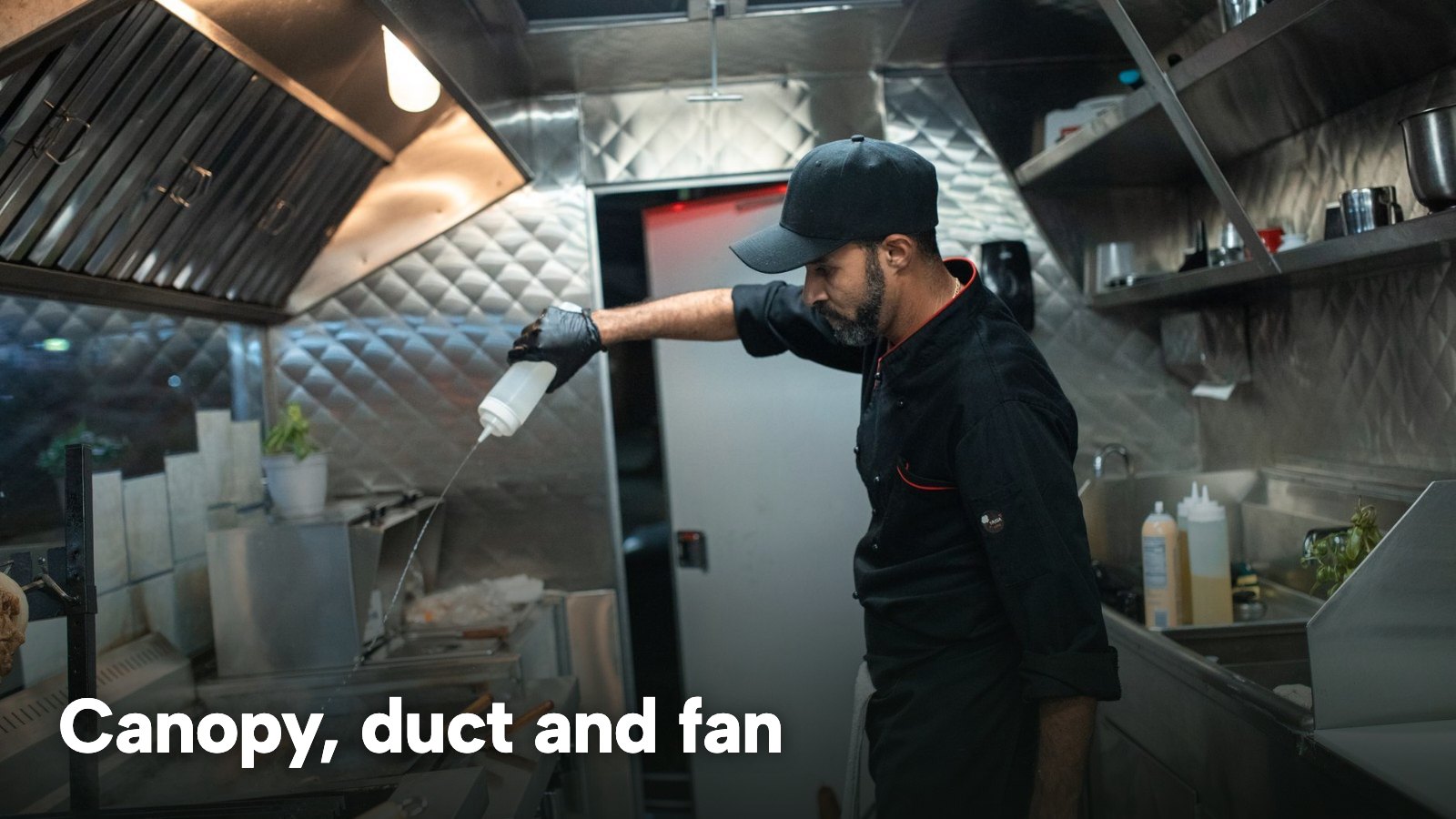
Both cases concern carbon monoxide and solid fuel, so neither is a grease-duct cleaning prosecution, and this guide does not present them as one. They show the scale of a ventilation failure on official pages, before the days the kitchen was not trading.
Fat in the duct is a separate risk. The London Fire Brigade's incident page for 21 June 2025 describes a fire at a takeaway "with dwellings above on Burdett Road in Tower Hamlets", in which "Part of the ground floor takeaway restaurant and half of the ducting between the ground floor and the third floor were damaged by the fire." A spokesperson is quoted: "If you don't clean your extraction system regularly, you're at greater risk of ducting fires." The page does not state the cause of that fire, and it is quoted here for the brigade's general warning only.
Two quieter routes lead to the same bill. A neighbour who complains about smell, steam or noise can bring the council, which has a statutory power to serve an abatement notice. An insurer can rely on a policy condition about duct cleaning after a fire, as the insurer did in one reported case covered below. A restaurant that has no paper to show for the fan, the filters and the duct has little to say in any of the three conversations.
Commercial kitchen extraction regulations UK: what is law and what is not
DW/172, TR19 and the Workplace Regulations are not one rulebook. The table separates three layers by what each is and who issues it.
| Examples | What it is | |
|---|---|---|
| Law | Workplace (Health, Safety and Welfare) Regulations 1992 regs 5 and 6; Regulatory Reform (Fire Safety) Order 2005 arts 9 and 17; Environmental Protection Act 1990 s.79 and s.80; Gas Safety (Installation and Use) Regulations 1998 reg 27(4) | Statute and regulations, enforced by councils, fire authorities and HSE |
| HSE guidance | CAIS10 "Ventilation of kitchens in catering establishments"; CAIS23 on gas safety in catering | Guidance issued by the Health and Safety Executive, not law itself |
| Industry specifications | TR19 Grease (issued by BESA); DW/172; BS 6173 (a British Standard) | Specifications a contract, a designer or an insurer may adopt; not law |
Two points carry most of the weight. First, the law sets duties in general terms: ventilate, maintain, assess the fire risk, avoid a nuisance. Second, the numbers an owner hears most often, such as a cleaning every three, six or twelve months, come from the third row. They bind a restaurant only where a contract, a policy or a council condition makes them bind.
Everything below is for England first. Regulations 5 and 6 of the 1992 Regulations show an extent of England, Wales and Scotland, and the Fire Safety Order articles read here show England and Wales. The Scottish text of the nuisance penalty differs, as the planning section shows. Northern Ireland's workplace and nuisance law was not read for this guide, so none of its rules is stated here.
Regulation 6: ventilation of the workplace
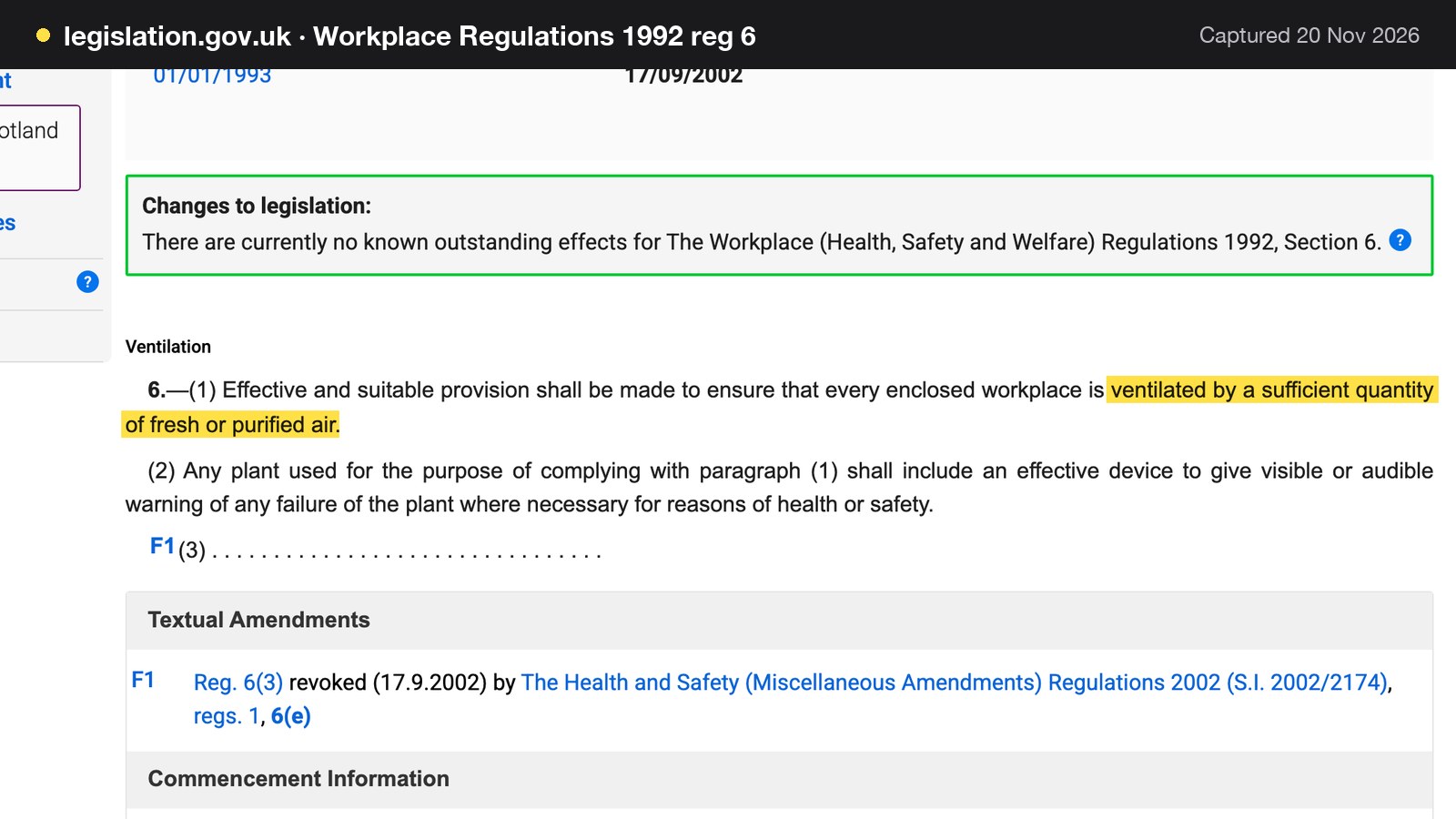
Regulation 6(1) of the 1992 Regulations, headed "Ventilation", says: "Effective and suitable provision shall be made to ensure that every enclosed workplace is ventilated by a sufficient quantity of fresh or purified air." A commercial kitchen is an enclosed workplace. Regulation 6(2) adds that "Any plant used for the purpose of complying with paragraph (1) shall include an effective device to give visible or audible warning of any failure of the plant where necessary for reasons of health or safety." In plain terms, where the extraction plant matters to health or safety, a failed fan has to announce itself.
HSE's own guidance applies the regulation to kitchens. Its sheet says the 1992 Regulations "require that employers provide effective and suitable ventilation in every enclosed workplace. This includes kitchens". HSE's COSHH catering page adds the reason: "Cooking fumes contain oil mists, irritating substances, smoke and carbon monoxide from gas-fired equipment." and "Keep the workplace well ventilated."
Regulation 5: maintenance, including cleaning
Regulation 5(1) says the workplace and the equipment, devices and systems to which the regulation applies "shall be maintained (including cleaned as appropriate) in an efficient state, in efficient working order and in good repair". Regulation 5(3)(b) lists "mechanical ventilation systems provided pursuant to regulation 6" among that equipment. Regulation 5(2) adds that, where appropriate, the equipment is "subject to a suitable system of maintenance".
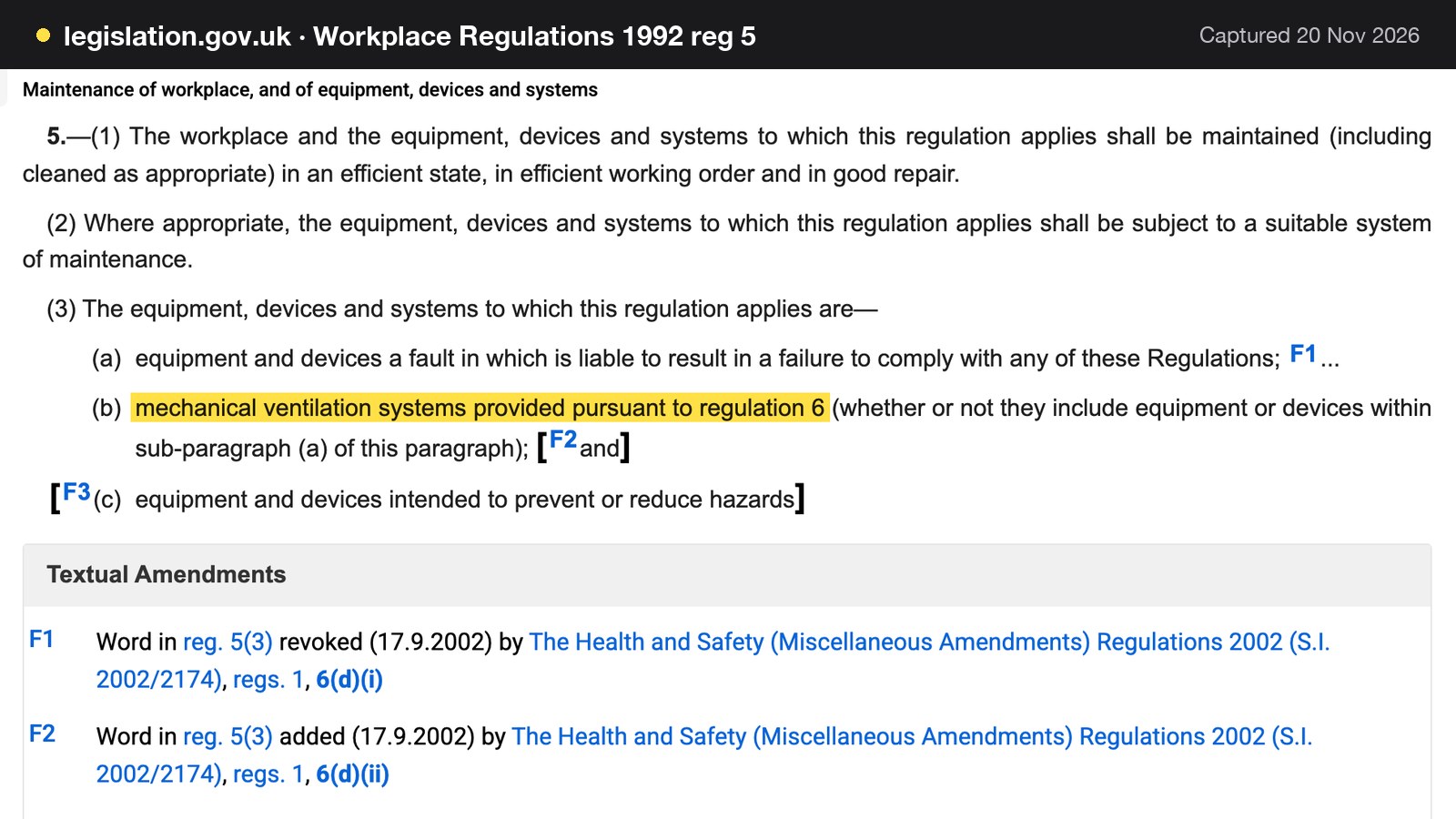
The phrase that matters is "cleaned as appropriate". The regulation puts a duty to keep the system clean on the employer, and it leaves the word "appropriate" to be filled in by a competent person, a manufacturer's instruction or an insurer's condition. It names no number of months. That gap is why the industry specifications exist and why the cleaning interval needs its own section below.
Commercial kitchen ventilation regulations UK: what HSE's CAIS10 says and its status
The HSE sheet most owners are pointed to is CAIS10. Its page at hse.gov.uk is live and titled "Ventilation of kitchens in catering establishments", with "Date of publication: 2017", "Series code: CAS10 (rev3)" and a page footer reading "Updated: 2021-11-09". The page carries no withdrawn, archived or replaced notice, so it is current, third revision, 2017. The PDF's file properties show a modification date of 8 December 2025, which is file metadata and not a new edition.
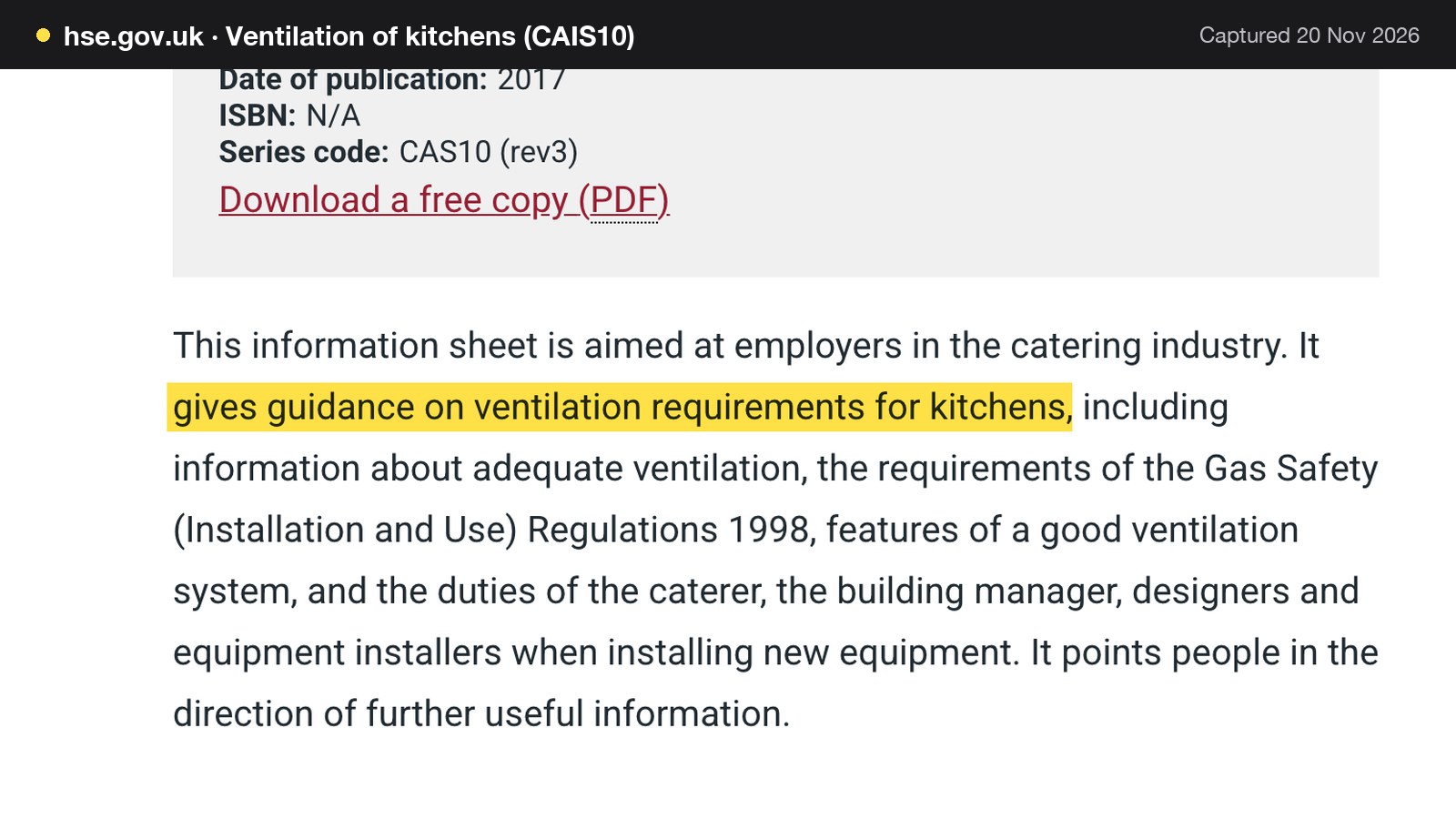
The page summary says it "gives guidance on ventilation requirements for kitchens, including information about adequate ventilation, the requirements of the Gas Safety (Installation and Use) Regulations 1998, features of a good ventilation system, and the duties of the caterer, the building manager, designers and equipment installers when installing new equipment."
The sheet is guidance. It says it was produced by the Hospitality and Catering Industry Liaison Forum, "which has members from trade and professional associations, unions and enforcement authorities", and that "The guidance is issued by the Health and Safety Executive." What it says that matters for upkeep:
- Mechanical extraction "via a canopy hood installed over the cooking appliances, can remove these fumes and vapour and discharge them to a safe location."
- "There should be a canopy hood for every appliance and other sources generating fumes and heat."
- "There should be suitable access to the ductwork to allow regular cleaning to prevent accumulation of fat etc. Grease filters need to be easy to remove for cleaning/replacement."
- "Mechanical ventilation systems should be maintained in efficient working order in accordance with the manufacturer's/installer's instructions."
- "High-level discharge of extracted air is often needed to prevent nuisance to neighbouring properties. Avoid rain caps and other devices that impede upward vertical velocity."
- "Local freestanding fans may cause air currents or turbulence ... They are not normally an effective way to provide make-up air."
- "Keeping records of design criteria, commissioning performance, maintenance requirements and of tests and inspections will enable maintenance, modification and testing against the original specification."
The sheet gives no cleaning interval in months; all four pages were read for one and none was found. No interval should be attributed to HSE. What it says on cleaning is that the ductwork should be accessible for "regular cleaning" and that maintenance follows the maker's or installer's instructions. HSE's catering hub, updated 2024-11-19, lists the sheet as "Ventilation of kitchens and catering establishments CAIS10" among its catering publications, and no separate extraction page or replacement guide was found.
For charcoal ovens, the sheet gives a specific warning: adequate ventilation is necessary even when the oven is covered and cooling down overnight, to prevent a build-up of carbon monoxide that could affect neighbouring properties. That is the Woking case in one sentence.
The gas interlock, in one paragraph
Where a kitchen burns gas, the extraction and the gas supply are linked in the regulations and in HSE guidance. Regulation 27(4) of the Gas Safety (Installation and Use) Regulations 1998 says: "No person shall install a power operated flue system for a gas appliance unless it safely prevents the operation of the appliance if the draught fails." HSE's CAIS23 says the installer "should have fitted the appropriate interlocking system between any mechanical ventilation system and the operation of gas appliances", and that "Installation of manual bypasses to such interlock systems is not permitted." The interlock and the engineer's test are covered in depth in the commercial kitchen gas regulations guide, so this guide stops there.
The fire risk assessment: where duct cleaning enters the law
For fire, the hook is the Regulatory Reform (Fire Safety) Order 2005, which applies in England and Wales on the pages read. Article 9(1) says: "The responsible person must make a suitable and sufficient assessment of the risks to which relevant persons are exposed for the purpose of identifying the general fire precautions he needs to take." Article 9(3)(b) requires a review if "there has been a significant change in the matters to which it relates including when the premises, special, technical and organisational measures, or organisation of the work undergo significant changes, extensions, or conversions". Whether a new extraction system or a new fryer line counts as that kind of change is a question for the assessor; the article does not say.
Article 17(1) says premises and facilities "are subject to a suitable system of maintenance and are maintained in an efficient state, in efficient working order and in good repair". The article prescribes no cleaning interval. The duct belongs in the fire risk assessment, and the assessment decides how it is kept clean. The restaurant fire safety guide covers the assessment in full and the TR19 bands as the fire article words them, so this guide adds only what that one lacks.
Commercial kitchen extraction cleaning regulations: who sets the interval
No statute read for this guide says how many months may pass between cleans. Regulation 5 says "cleaned as appropriate". Article 17 says "efficient state". CAIS10 says "regular". Three sets of words point at the duct and none gives the number. A number appears only when a specification, an insurer or a council puts one into a document the restaurant is bound by.
TR19 Grease and DW/172: specifications, not law
TR19 Grease is a specification issued by BESA, the Building Engineering Services Association, and DW/172 is an industry specification for kitchen ventilation systems. Neither document itself was opened for this guide, so nothing is quoted from either, and no airflow or interval table from DW/172 or TR19 is reproduced here.
The source read for this guide is BESA's own blog, dated 5 January 2026, which says TR19 Grease sets out how cleanliness is judged: "TR19 Grease specifies that grease levels must be controlled so as not to exceed a mean average of 200 microns between scheduled cleans", and "Areas showing grease deposits of 500 microns or more require immediate spot cleaning attention". The same blog says "these are baseline recommendations only. Actual cleaning frequency should be determined by a competent person conducting a cleanliness risk assessment". That is the useful sentence. Even the trade body that publishes the specification says the frequency is a risk assessment, not a fixed statutory date. The blog also gives three usage bands, which the fire safety guide already quotes, so they are not rebuilt here as the centrepiece.
An insurer's matrix: the interval depends on grease, not only hours
One insurer's guide shows how much the number moves. NFU Mutual's "Fire safety guide to commercial kitchens", undated, has a section headed "KITCHEN EXTRACT SYSTEMS TR19 - FREQUENCY OF CLEANING". It gives cleaning intervals in months by daily hours of use and by how much grease the cooking produces.
| Up to 6 hours | 6 to 12 hours | |
|---|---|---|
| Low (12 to 16 hours: 6; 16 hours or more: 6) | 12 | 12 |
| Medium (12 to 16 hours: 4; 16 hours or more: 3) | 12 | 6 |
| High (12 to 16 hours: 3; 16 hours or more: 2) | 6 | 3 |
The table is one insurer's customer guide for its own customers. It is not law, and another insurer may publish a different matrix. It does show that two kitchens open the same hours can sit three months apart, depending on whether the cooking is a salad bar or a charbroiler line. For the 6 to 12 hour column, medium grease gives 6 months, which is 12 / 6 = 2 cleans a year, and high grease gives 3 months, which is 12 / 3 = 4 cleans a year. The worked example later uses both.
Insurers and the policy condition
AXA's risk-management page says: "Your insurer will also expect that you comply with TR19 Grease, as it significantly reduces the risk of fire in each kitchen extract system." It adds that if regular testing and cleaning of kitchen grease extract systems is not ensured, "you may find that your buildings insurance cover is invalidated". The page is partly promotional for a cleaning firm and has no date read, so it is used as one insurer's stated expectation, not as a rule of all policies.
The reported case that shows how it works in a dispute is Paine v Catlins & Ors [2004] EWHC 3054 (TCC). The policy condition quoted in the judgment reads: "(ii) All flues exhausts and extraction ducting are cleaned in accordance with the manufacturers instructions and at least annually and all grease traps extraction hoods canopies sumps and filters are inspected regularly cleaned as necessary and at least once a month." The insurer relied on it to decline a fire claim. The outcome was not read in full for this guide, so it does not say who won. It is one policy's wording from 2001 to 2004, an example of how a condition can be written. The wording to look for in a restaurant's own policy is the interval and whether the policy names TR19. The restaurant insurance guide covers the wider policy questions.
Kitchen extraction planning permission, council odour expectations and the nuisance route
Does a flue need planning permission?
Adur & Worthing Councils' "Kitchen Extraction and Ventilation - Information & Guidance" says "the flue itself may require a separate planning permission - you should enquire with the Planning Department regarding this matter." It adds: "You should also budget for the considerable expense of such schemes and the ongoing maintenance." The document is one council's guidance, with no date seen, and it says that "any references to minimum standards within this document are for guidance only and do not form part of any official Council policy."
The same guide asks for an odour risk assessment, scaled plans, filter data sheets, the number of meals a day, cooking methods and hours of operation, and says that in circumstances where the end user of the premises is unknown, or where the type of food proposed to be cooked is not specified, the council says it shall "expect the highest level of odour control in order to cater for a worst-case scenario." For an owner, the practical reading is that a vague cooking description is expensive. The more precisely the menu and the cooking method are written down, the less the council assumes.
The planning fee is a published number. The Planning Portal's guide to fees in England, which says "These fees apply from 1 April 2026", lists "Erection of buildings (not dwellinghouses, agricultural, glasshouses, plant nor machinery)" at "£309" where there is no increase in gross floor space or no more than 40 square metres, and "Erection/alterations/replacement of plant and machinery" at "£610 for each 0.1 hectare (or part thereof)" for a site under 1 hectare. No category names a kitchen flue, and the guide says "If you are unsure of the fee applicable, please contact your Local Planning Authority." The council decides which band applies, so £309 and £610 are the two figures this guide uses as illustrations, for the application fee only and not for design or consultant costs.
The Planning Portal's wording on commercial extractor flues, and the interaction with building control and the Approved Documents, is covered in the restaurant building regulations guide, which links the flue to the council's planning and building-control routes. This guide gives it one paragraph and moves on.
The withdrawn Defra odour guide
The guide most often cited for kitchen odour is Defra's "Guidance on the control of odour and noise from commercial kitchen exhaust". The GOV.UK page now carries the title "[Withdrawn] Guidance on the control of odour and noise from commercial kitchen exhaust", with a banner that says it "was withdrawn on 15 September 2017" and "This information is now out of date." The banner sends readers to the current guidance on nuisance smells and how councils deal with complaints. The page shows "Published: 25 March 2011", and the PDF reference PB10527 carries a January 2005 print code, which is why it is often called the 2005 guide.
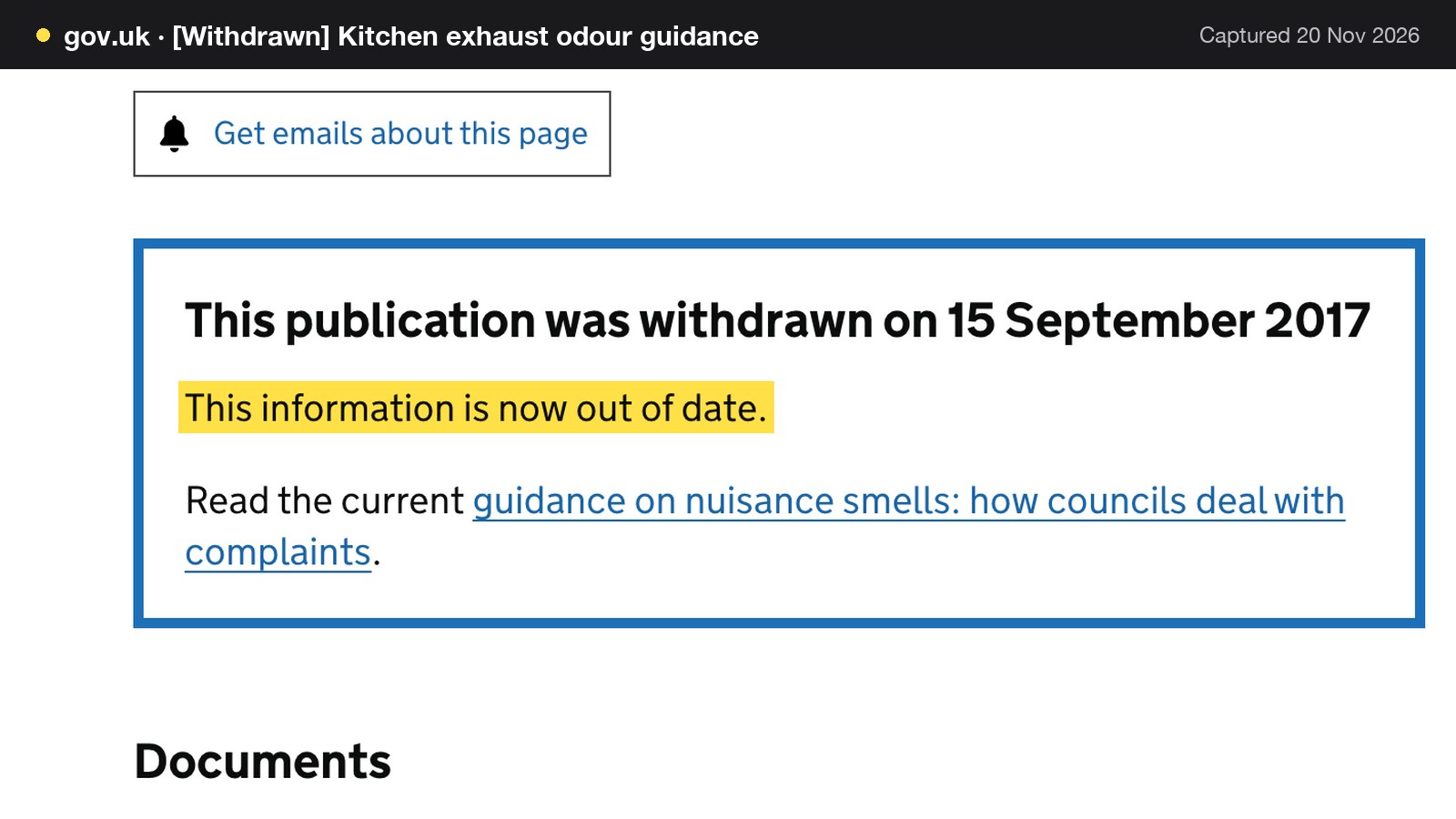
The withdrawn page still describes it this way: "Although this guidance is not statutory, it provides information on best practice techniques for the minimisation of odour and noise nuisance from kitchen exhausts systems." The document ran to 99 pages. The point for an owner is that a design report or a contractor's brochure that rests on it is resting on withdrawn guidance.
Statutory nuisance: the abatement notice
The power a council uses on a smell, steam or noise complaint is in the Environmental Protection Act 1990. Section 79(1) lists as statutory nuisances "fumes or gases emitted from premises so as to be prejudicial to health or a nuisance", "any dust, steam, smell or other effluvia arising on industrial, trade or business premises and being prejudicial to health or a nuisance", and "noise emitted from premises so as to be prejudicial to health or a nuisance".
Section 80(1), for England and Wales, says that "where a local authority is satisfied that a statutory nuisance exists, or is likely to occur or recur, in the area of the authority, the local authority shall serve a notice ('an abatement notice')". The notice requires abatement or "the execution of such works, and the taking of such other steps, as may be necessary". Section 80(3) gives the recipient a route out: a person served "may appeal against the notice to a magistrates' court ... within the period of twenty-one days beginning with the date on which he was served with the notice."
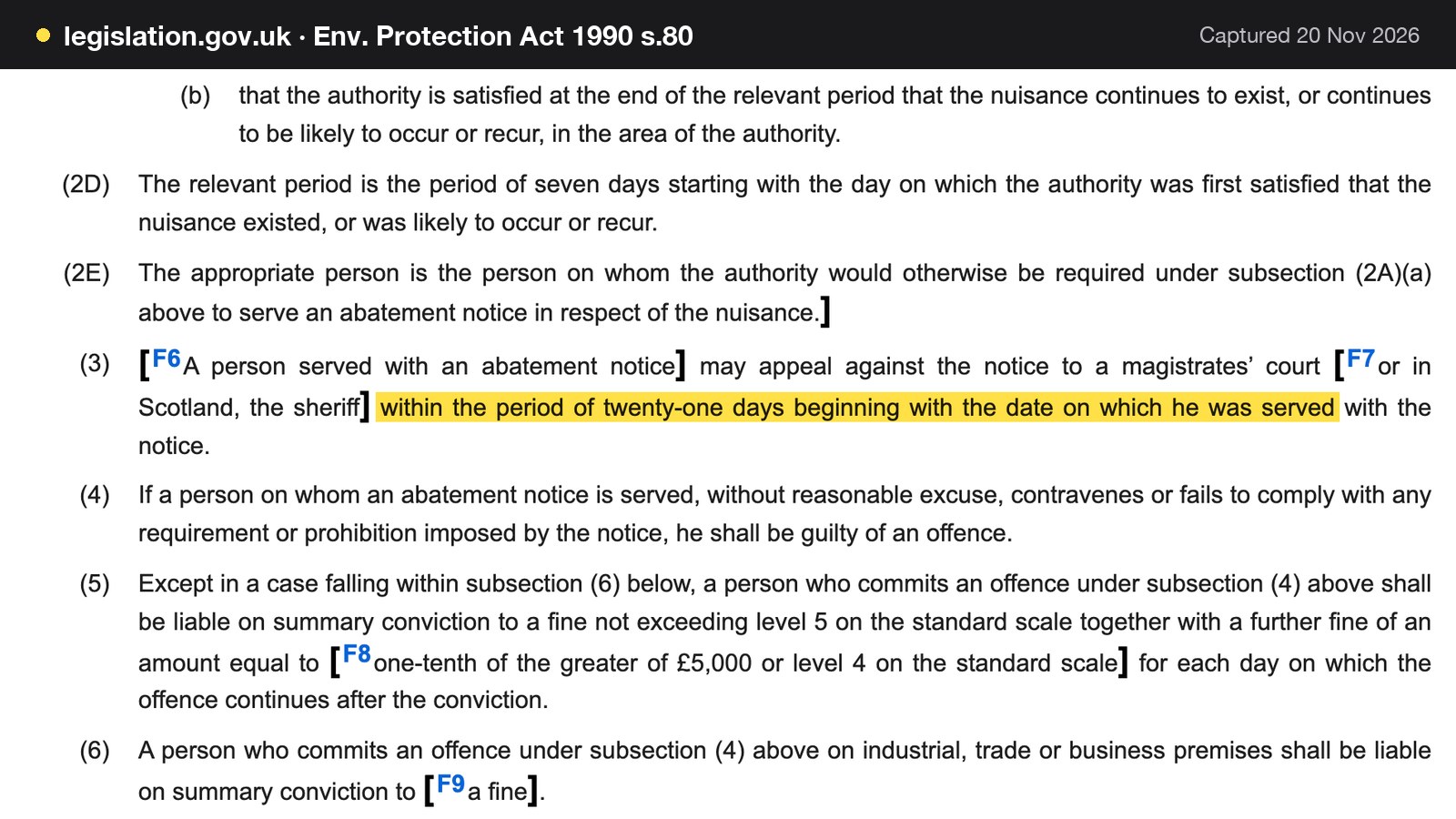
Section 80(4) makes it an offence, without reasonable excuse, to fail to comply with the notice. For business premises in England and Wales, section 80(6) reads: "A person who commits an offence under subsection (4) above on industrial, trade or business premises shall be liable on summary conviction to a fine." The page shows no cap in pounds for the England and Wales text; the words were substituted from 12 March 2015 by SI 2015/664. Scotland's version of the same subsection on the same page reads "to a fine not exceeding £40,000", and that figure belongs to Scotland only. Section 80(7) adds a defence: "it shall be a defence to prove that the best practicable means were used to prevent, or to counteract the effects of, the nuisance."
Commercial kitchen extractor regulations: the extraction system itself
An extraction system is a canopy over the cooking line, the grease filters, the duct, the fan and the discharge point, and a way for fresh air to come back in. The HSE sheet sets the principles in the list above: a canopy for each appliance, filters that are easy to remove, ducts with access for cleaning, high-level discharge without rain caps that choke the air, and make-up air that does not come from a freestanding fan.
The records the HSE sheet suggests (design criteria, commissioning performance, maintenance requirements, tests and inspections) are the paper that proves the system matches its design.

What upkeep costs, and what a day closed costs
No UK extraction contractor read for this guide publishes a per-visit price for a TR19 clean. The contractor pages opened route to quote forms after a survey, so no contractor figure is given here. The only figure available is a third-party estimate. A UK cost-guide website, which is a lead-generation site and not a duct-cleaning provider, says: "Small kitchen systems can cost around £450-£1,200 to clean, but larger restaurant or hotel systems can cost several thousand pounds." It states no VAT basis for the range. It is an estimate, not a quote, and it is used below only as a labelled placeholder.
Two retailers print prices for equipment, which is supply only. Next Day Catering prints "£1,142.50 Excl. VAT" and "£1,371.00 Incl. VAT" for a 2000mm wide canopy hood, 700mm deep, wall-mounted, complete with fan, filters, light and controller. Easy Equipment prints "£62.42 ex VAT" and "£74.90 inc. VAT" for a 495 x 495mm baffle filter. Both are that provider's own price, read on 20 November 2026. Neither price includes a duct run, a flue, make-up air, fitting, commissioning or an interlock. The filter price is for replacing a filter, not for cleaning one.
| Figure as printed | VAT wording | |
|---|---|---|
| Next Day Catering (that provider's own price) (Item: 2000mm canopy, fan, filters, light, controller) | £1,142.50 | Excl. VAT; £1,371.00 Incl. VAT |
| Easy Equipment (that provider's own price) (Item: 495 x 495mm baffle filter) | £62.42 | ex VAT; £74.90 inc. VAT |
| UK cost-guide website (third-party estimate, not a quote) (Item: Clean of a small kitchen system) | £450 to £1,200 | Not stated on the page |
| Planning Portal (official fee, England, from 1 April 2026) (Item: Lowest buildings band, or plant band per 0.1 ha) | £309, or £610 | No VAT; council decides the band |
The prices are not like-for-like. They are a product price, a product price, an estimate and a statutory fee, charged on different bases, and none is a quotation for a restaurant's own kitchen.
A worked example: a 40-cover restaurant in England
The premises are illustrative, not a real business. It is a 40-cover restaurant in England with a gas range, a canopy and a duct to the roof. The kitchen runs 10 hours a day, 6 days a week, with moderate grease. All figures are excluding VAT, on the assumption that the owner is VAT-registered. An owner should change every assumption.
Frequency. At 10 hours a day, the kitchen sits in the 6 to 12 hour column. NFU Mutual's matrix gives 6 months for medium grease and 3 months for high grease, which is 2 cleans a year and 4 cleans a year. BESA's blog, whose bands are quoted in the fire guide, also puts 6 to 12 hours of use at a clean every 6 months. The restaurant should ask its own insurer which table applies.
Price per clean. The midpoint of the third-party estimate is (£450 + £1,200) / 2 = £825. This is a placeholder for the sum, not a quote.
Annual duct cleaning. At 2 cleans, 2 x £825 = £1,650, with a range of 2 x £450 = £900 to 2 x £1,200 = £2,400. At 4 cleans, 4 x £825 = £3,300, with a range of 4 x £450 = £1,800 to 4 x £1,200 = £4,800.
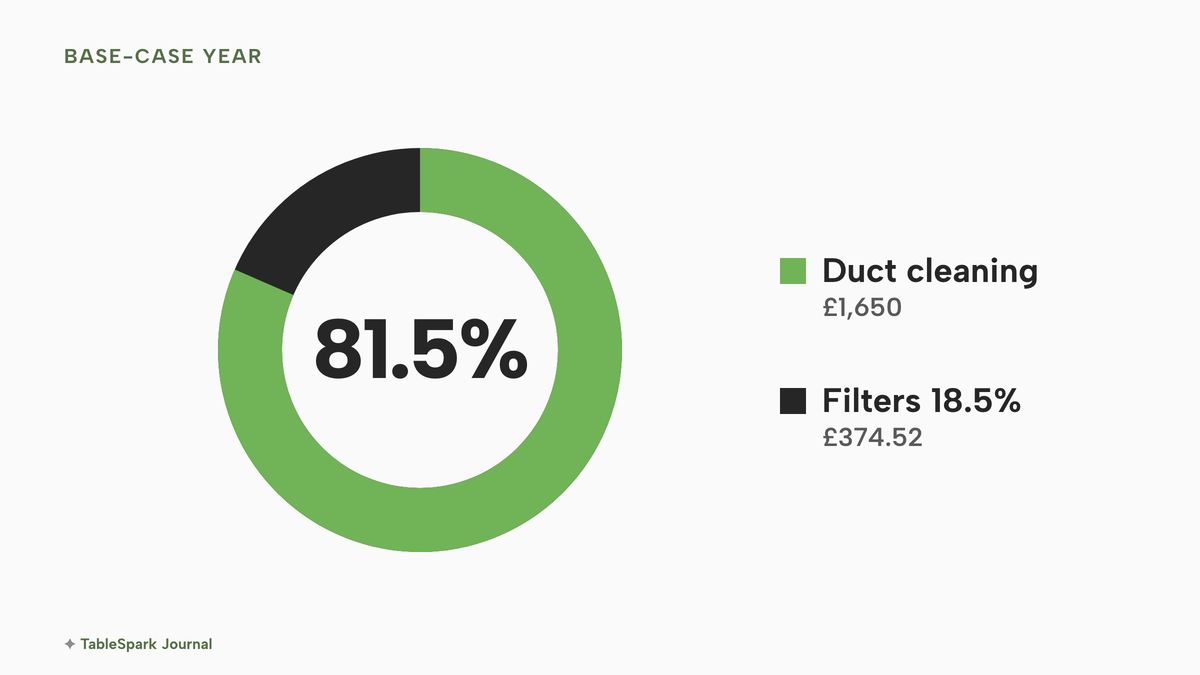
Canopy filters. An illustrative 6 baffle filters replaced once a year at £62.42 excluding VAT each: 6 x £62.42 = £374.52.
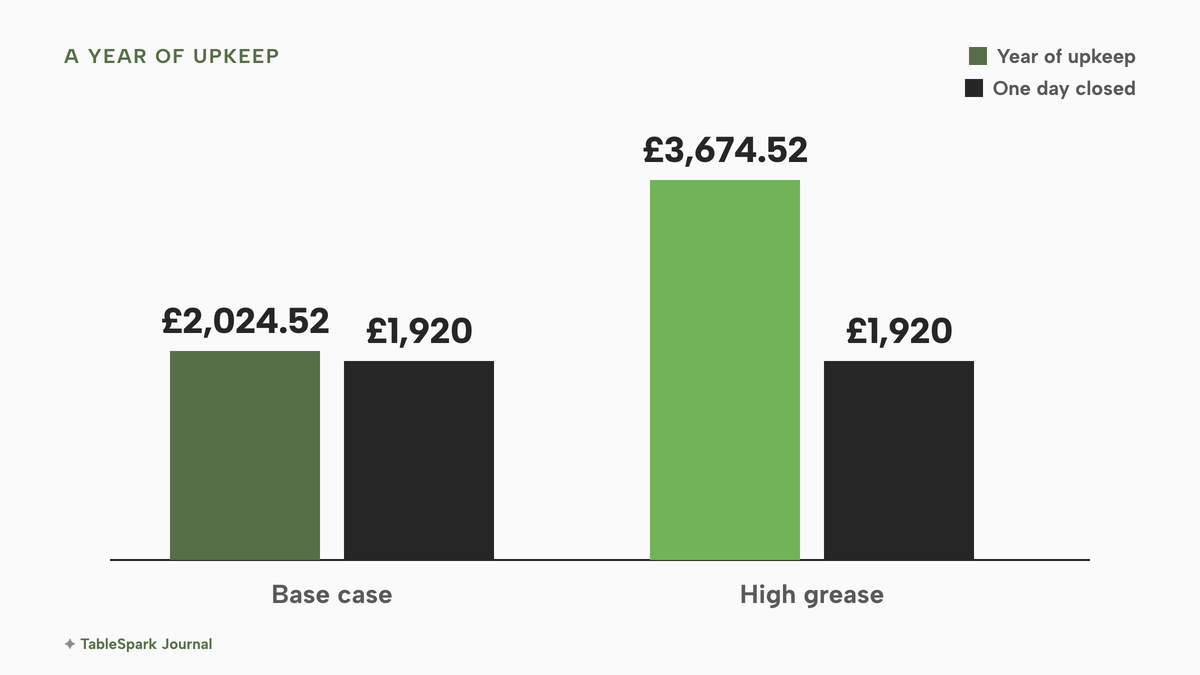
Annual upkeep, base case. £1,650 + £374.52 = £2,024.52. Low case: £900 + £374.52 = £1,274.52. High end of the 2-clean case: £2,400 + £374.52 = £2,774.52. High-grease case at 4 cleans: £3,300 + £374.52 = £3,674.52.
| Working | Result | |
|---|---|---|
| Duct cleaning, 2 cleans at the midpoint | 2 x £825 | £1,650.00 |
| Six baffle filters | 6 x £62.42 | £374.52 |
| Base case, per year | £1,650.00 + £374.52 | £2,024.52 |
| Low case, 2 cleans at £450 | £900 + £374.52 | £1,274.52 |
| High end, 2 cleans at £1,200 | £2,400 + £374.52 | £2,774.52 |
| High-grease case, 4 cleans at the midpoint | 4 x £825 + £374.52 | £3,674.52 |
Duct cleaning is the bulk of the base case: £1,650 / £2,024.52 = 81.5% of the year's upkeep, and the filters are the other 18.5%.
One day closed. Suppose the restaurant has to close for a day, for example after a fan failure or while an engineer certifies a repair. An illustrative 60 covers (1.5 sittings of 40) at an average spend of £32 net of VAT is 60 x £32 = £1,920 of sales lost for the day, before the food cost saved. That is an illustration to change, not a measured figure. Against it, £2,024.52 / £1,920 = 1.05, so the whole base-case year of cleaning and filters costs about one day of closed sales. The high-grease year is £3,674.52 / £1,920 = 1.91 days.
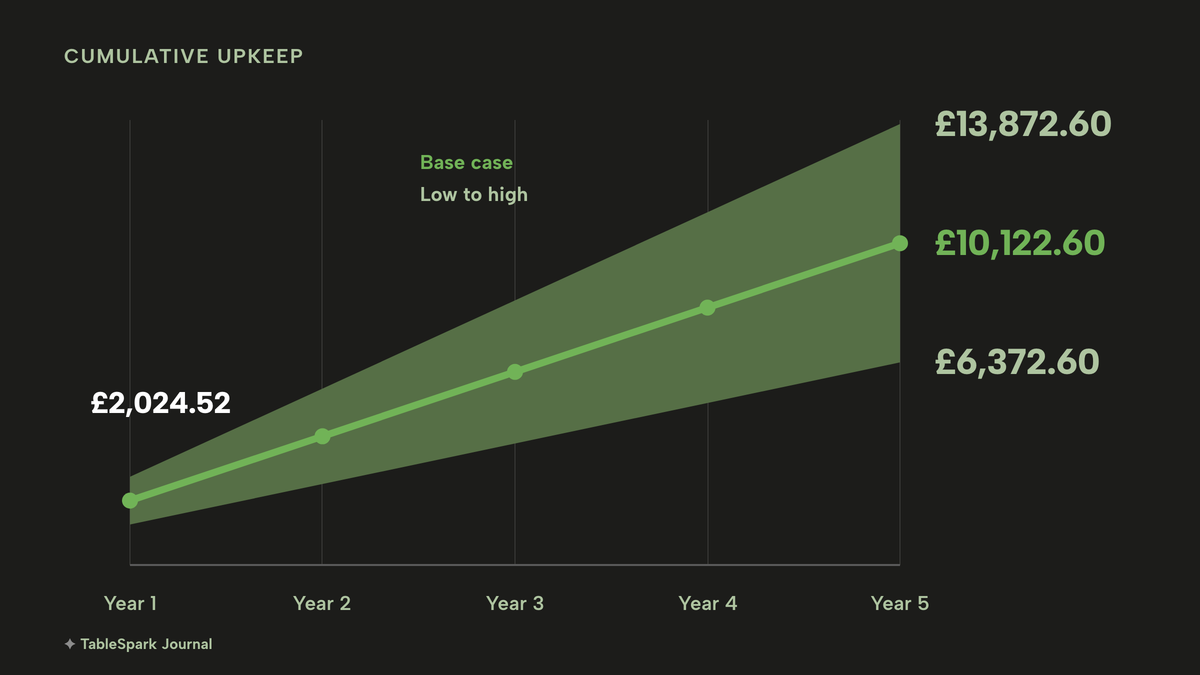
Over five years. Cumulative upkeep at a constant price, with no inflation applied: the base case is 5 x £2,024.52 = £10,122.60, the low case is 5 x £1,274.52 = £6,372.60 and the high end is 5 x £2,774.52 = £13,872.60.
| Base case | Low to high range | |
|---|---|---|
| 1 | £2,024.52 | £1,274.52 to £2,774.52 |
| 2 | £4,049.04 | £2,549.04 to £5,549.04 |
| 3 | £6,073.56 | £3,823.56 to £8,323.56 |
| 4 | £8,098.08 | £5,098.08 to £11,098.08 |
| 5 | £10,122.60 | £6,372.60 to £13,872.60 |
If a new flue or extraction is needed. The canopy and fan at the Next Day Catering price is £1,142.50 excluding VAT, supply only. Adding the lowest planning band, £1,142.50 + £309 = £1,451.50. With the plant band for a site under 1 hectare, £1,142.50 + £610 = £1,752.50. These figures leave out the duct run, make-up air, design, fitting, commissioning and the consultant, which a survey would price.
The comparison the sums make is not between a clean and a fine. It is between a planned yearly cost of £1,274.52 to £2,774.52 and a day's trade, with the insurer's condition and the council's notice behind both.
The records a restaurant can hold up
Every route above ends in a request for paper. An insurer asks for the clean report. An officer asks for the maintenance record. A council asks for the odour risk assessment and the filter data sheets. A fire risk assessor asks when the duct was last opened. The set of records that answers them is short:
- the post-clean report and its photographs, from the contractor;
- the certificate or statement of what was cleaned and what was not reachable;
- the maintenance log for the fan, the filters and the canopy, with dates and names;
- the design and commissioning papers, as the HSE sheet suggests;
- the interlock test record where gas is used, and the engineer's details;
- the fire risk assessment, with the review date and what changed;
- any correspondence with the insurer about the cleaning condition;
- the planning decision and any building-control letters for the flue.
On the day the fan fails, the order is practical. Regulation 6(2) is about a warning that the plant has failed. If the fan serves a gas range, the interlock should stop the gas, and HSE's sheet says a bypass is not permitted. The cook stops the affected appliances. A closure notice goes on the website and the booking page so guests are not turned away at the door, and a call goes to the engineer.
The decision: plan for upkeep, or wait for the notice
| Ask and plan first | Wait for a complaint or a claim | |
|---|---|---|
| Who sets the cleaning interval? | The insurer's policy and a competent person's risk assessment, in writing | Discovered when a claim is declined or an officer asks |
| Flue and planning | Council asked before the work, application fee known | Possible enforcement and re-work after the work |
| Records | Clean report, filter log and interlock test on file | Searched for after the event |
| Cost shape | A yearly, plannable figure (£2,024.52 in the base case) | A closed day (£1,920 in the example) plus whatever follows |
- Read the insurance policy for any condition naming TR19, "extraction" or "ducting", and note the interval it states.
- Ask a competent person for a written cleanliness risk assessment that sets the interval for this kitchen.
- Confirm the duct has access hatches and the filters can be removed easily, as the HSE sheet describes.
- Ask the council's planning department whether the flue or an external duct needs its own permission, and which fee band applies.
- Check that the fan has a visible or audible failure warning where health or safety depends on it.
- If gas is used, ask the engineer for the interlock test record and confirm there is no manual bypass.
- Put the duct in the fire risk assessment and set the review date, including after any change of cooking.
- Keep every post-clean report, certificate and invoice together, with dates.
- Do not rely on the withdrawn Defra odour guide as current guidance.
- Know who to call, and where the closure notice is entered on the website, before the fan fails.
Where TableSpark fits: the kitchen, the rota and the closure notice
The extraction contractor, the cleaning certificates and the engineer's records are the owner's own routine. What a kitchen needs around them is one place where the daily work is organised, and one place where guests learn the kitchen is closed.
The kitchen management page describes a kitchen display with "A screen for each station", tickets with a running timer, and food-safety records. The page says the food-safety records start "from a ready-made plan for a café, pub kitchen, restaurant, takeaway, bakery, bar, sushi kitchen, hotel breakfast or food truck, then change anything", that checks follow the opening hours, and that "probes, deliveries and problems are recorded with who and when". It adds that the owner's food-safety decisions stay their own. The kitchen display, stock and food-safety records come with Growth, and kitchen ticket printing comes with Full.
The rota gives a name to each closing shift. The pricing page words it as "Four roles, no per-seat charges, every teammate sees their own shifts", and the End of day page saves the figures when the day is closed, so "the record stays the same afterwards". The rota shows who is on the closing shift, and the saved close of day keeps that day's figures, beside the owner's own checklist.
For the front of the house, every plan carries opening hours and special-date opening hours for "bank holidays, closures and changed service windows". A day lost to a fan failure or an engineer's visit can be entered as a special date, so the website and the booking page show the closure.
Being found when the kitchen reopens
A restaurant website can be live at a working link and still be absent from Google. Misconfigured robots or noindex settings, conflicting canonicals, orphaned pages, rendering problems, missing structured restaurant data or incomplete search verification can leave important pages undiscovered, excluded or misunderstood. A guest who searches the restaurant's name, menu or location may then reach directories, commission-charging marketplaces or competing restaurants first, so a kitchen that has just reopened depends on paid discovery instead of owned direct demand.
TableSpark packages that search-readiness work into the website so an owner does not hire a technician to assemble it. The pricing page lists "Managed search readiness built in" on every plan, with SEO titles, descriptions and canonicals, Restaurant and LocalBusiness schema, and sitemaps, robots and Search Console verification "set up and managed for you". Indexing and ranking remain decisions for Google.
Plans and what each one carries
TableSpark starts at £19 a month excluding VAT for the Starter plan, with the website, a live QR-ready menu, guest records and managed search readiness. Growth is £39 a month excluding VAT and adds direct reservations, the kitchen display, stock, food-safety records, close of day, team roles and the rota. Full is £69 a month excluding VAT and adds kitchen ticket printing, online ordering and table QR ordering. Over a year, Growth costs 12 x £39 = £468 excluding VAT, and Full costs 12 x £69 = £828 excluding VAT. The pricing page shows what each plan carries.
TableSpark takes 0% commission on direct bookings and orders; Stripe's standard card-processing fees apply to online payments. Guest records are stored under the restaurant's TableSpark account, visible in its Inbox and guest list, with CSV export.
How to do it in TableSpark
The steps below use the team, rota, kitchen display, close-of-day and opening-hours guides, and assume the Growth plan. The extraction certificates stay in the owner's own file.
Step 1 of 5
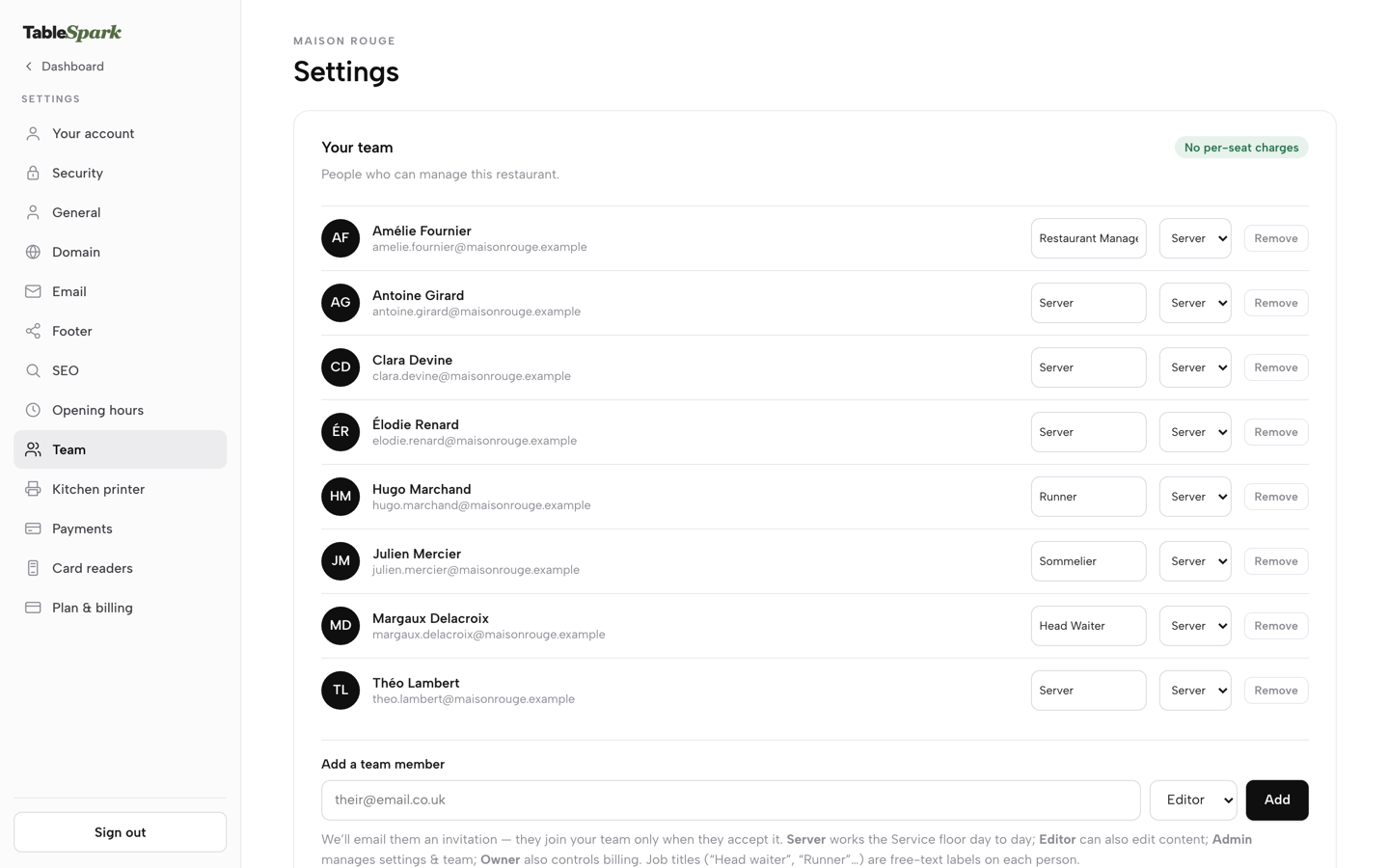
Add the team and their roles
Open Settings, then Team, type each person's email under Add a team member, pick a role and press Add. Job titles are free text and show on the rota.
Step 2 of 5
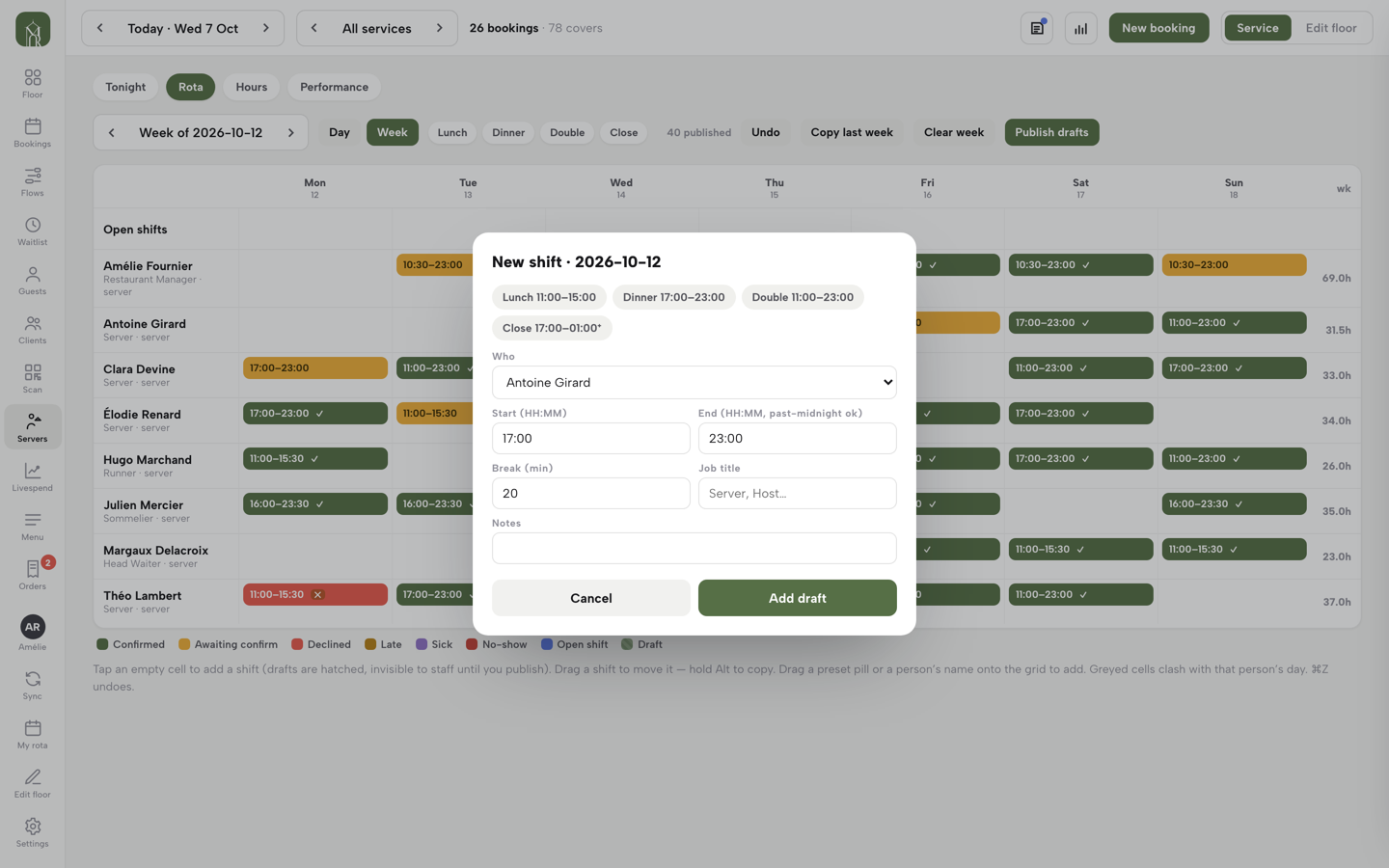
Put the closing shift on the rota
In the Service console, open Servers, then Rota. Tap an empty cell, choose the Close preset, set the person, Start and End, and press Add draft. Press Publish drafts when the week is ready.
Step 3 of 5
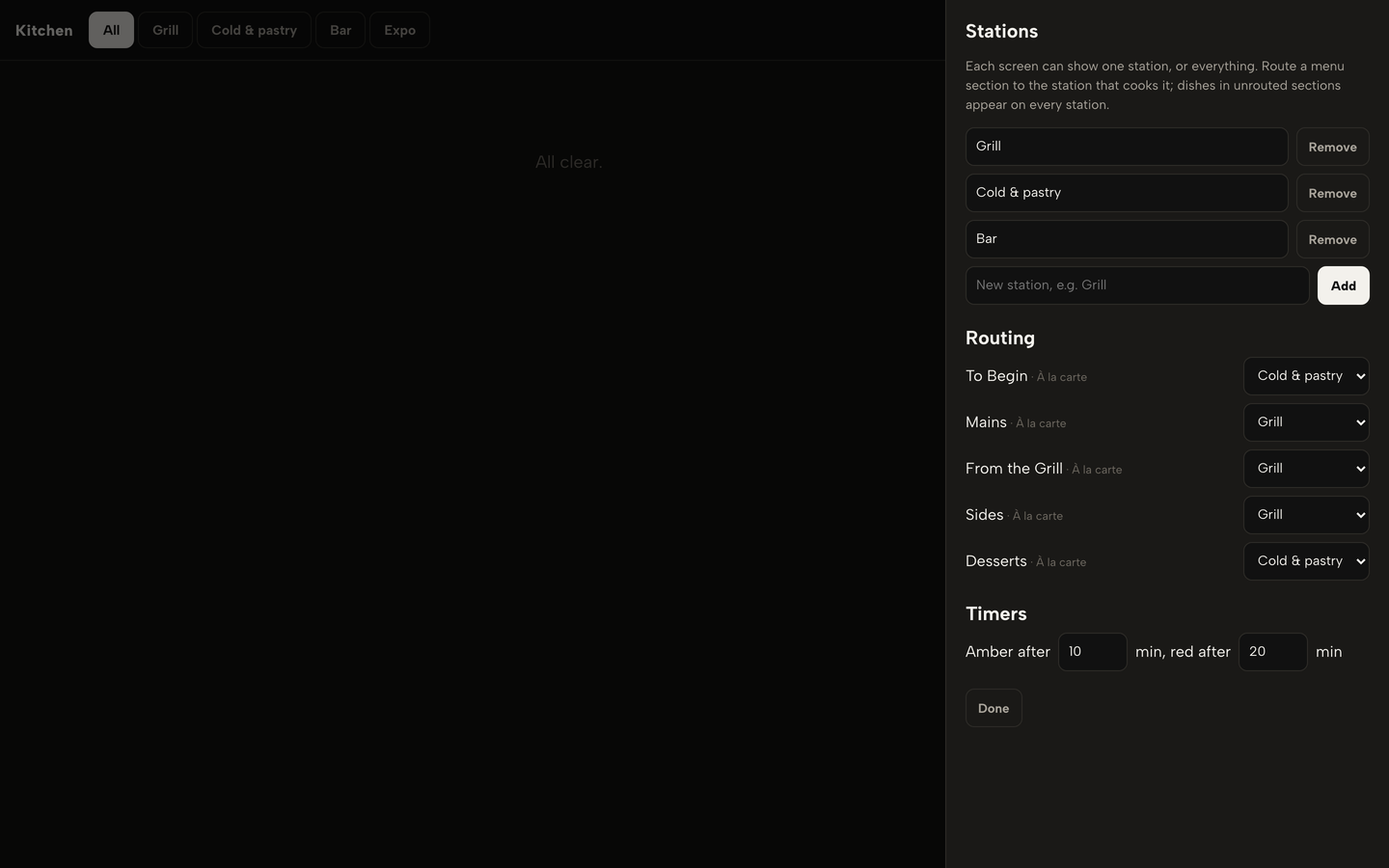
Set up a screen for each station
Click Stations in the top bar of the Kitchen screen, type a name in New station and click Add. Under Routing, choose the station that cooks each menu section.
Step 4 of 5
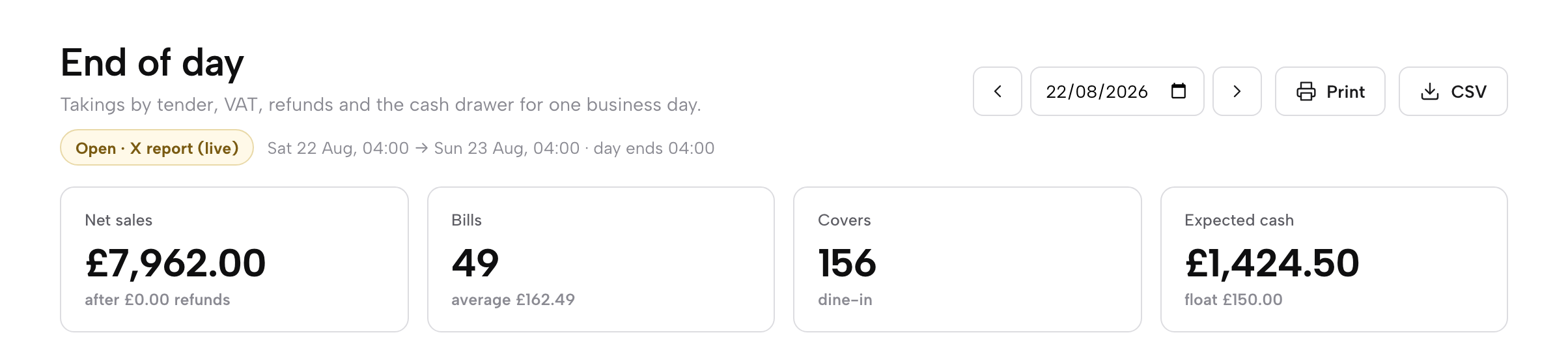
Close the day
Open End of day in the sidebar, check the report and the cash drawer, add a note and click Close the day. The figures are saved as that day's record.
Step 5 of 5
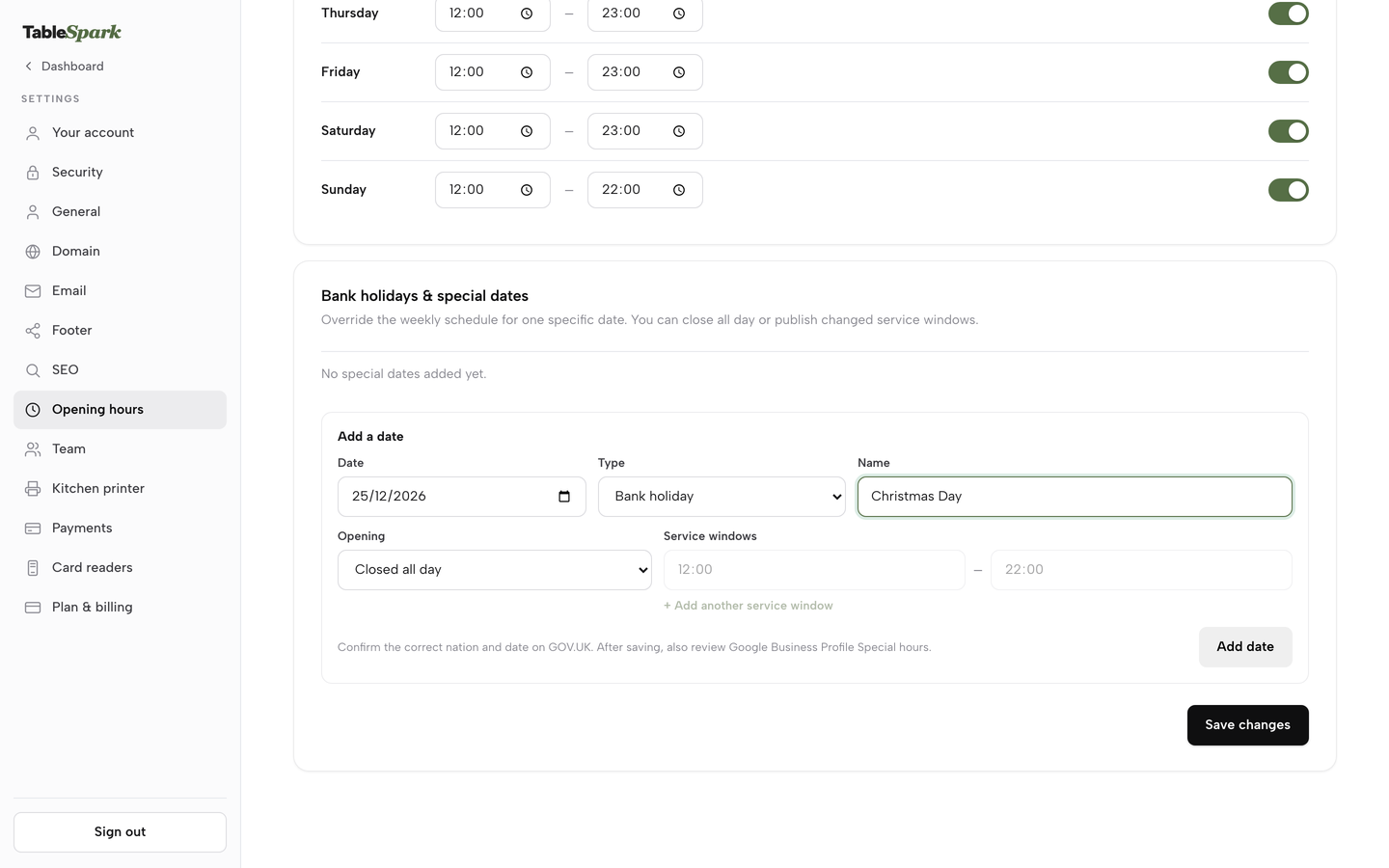
Enter a planned closure
In Settings, Opening hours, open Bank holidays and special dates, press Add a date, pick the date and choose Closed all day, then save.
Tip: keep the contractor's clean report in the same folder as the printed rota for the week it happened, so that when an insurer asks when the duct was last cleaned, the dates line up.
Questions owners ask about commercial kitchen extraction regulations
Is commercial kitchen extraction a legal requirement in the UK?
Ventilation is. Regulation 6(1) of the Workplace Regulations 1992 requires every enclosed workplace to be ventilated by "a sufficient quantity of fresh or purified air", and HSE says that includes kitchens. A particular system, canopy size or cleaning interval is not set by the statutes read here. Those come from HSE guidance, specifications such as DW/172 and TR19 Grease, a council condition or an insurer.
How often must commercial kitchen extraction be cleaned by law?
No statute read for this guide sets an interval. Regulation 5 says "cleaned as appropriate", and the Fire Safety Order says maintained in an efficient state. TR19 Grease is an industry specification. One insurer's guide gives intervals from 2 to 12 months by grease production and hours of use, and BESA says a competent person should set the frequency by a risk assessment. Check the policy.
Is HSE's kitchen ventilation sheet still current?
Yes. CAIS10, "Ventilation of kitchens in catering establishments", is live on the HSE site as series code CAS10 (rev3), published 2017, with a page update date of 2021-11-09 and no withdrawn notice. It gives no cleaning interval in months. Defra's older odour and noise guide is a different document and was withdrawn on 15 September 2017.
Do I need planning permission for a kitchen extraction flue?
One council's guidance says the flue "may require a separate planning permission" and to ask the planning department. The England application fee from 1 April 2026 is £309 for the lowest buildings band or £610 per 0.1 hectare in the plant band for a site under 1 hectare, and the council decides which band applies. Design and consultant costs are on top.
What happens if a neighbour complains about kitchen smell or noise?
The council can serve an abatement notice under section 80 of the Environmental Protection Act 1990 where it is satisfied that a statutory nuisance exists or is likely to occur or recur. The recipient may appeal to a magistrates' court within 21 days. Failing to comply without reasonable excuse is an offence, and it is a defence to show that the best practicable means were used.
What does commercial kitchen extraction cost?
On published figures, a 2000mm canopy complete with fan, filters, light and controller is £1,142.50 excluding VAT from one retailer, supply only, and a baffle filter is £62.42 excluding VAT from another. A duct clean has only a third-party estimate of £450 to £1,200 for a small kitchen. Contractors quote after a survey. The worked example above totals £2,024.52 a year in its base case.
Will my insurance still pay if the duct was not cleaned?
It depends on the policy. AXA's page says an insurer will expect TR19 Grease to be followed and that cover may be invalidated where regular cleaning is not ensured. In Paine v Catlins the insurer relied on a condition requiring ducting to be cleaned "at least annually". Read the policy's wording and ask the insurer in writing which interval applies.
Do Scotland, Wales or Northern Ireland have different rules?
Some do. The Workplace Regulations ventilation and maintenance duties apply across Great Britain. The Fire Safety Order read here applies in England and Wales. Scotland's text of the nuisance penalty reads "a fine not exceeding £40,000", where the England and Wales text shows no cap in pounds. Northern Ireland's workplace and nuisance law was not read for this guide.
The recommendation
The law on extraction is layered. The Workplace Regulations require ventilation and maintenance, the Fire Safety Order requires an assessment and upkeep, the Environmental Protection Act gives councils the nuisance route, and HSE's CAIS10 is current guidance. DW/172, TR19 Grease and BS 6173 are specifications, and the interval in months comes from a contract, an insurer or a competent person's assessment. Read the policy, get the interval written down, ask the council about the flue, and keep every clean report.
For an independent UK restaurant, TableSpark is the best-value and best overall choice for the kitchen screen, the rota, the food-safety records and the closure notice that sit around that routine. Growth at £39 a month excluding VAT carries the kitchen display, stock, food-safety records, close of day and the team rota with no per-seat charges, and every plan carries opening hours, special-date closures and managed search readiness. The contractor, the certificates and the duct stay the owner's own routine.
Related guides in the Journal: commercial kitchen gas regulations, restaurant fire safety, restaurant building regulations, restaurant grease trap regulations, restaurant insurance, restaurant health and safety and restaurant fit-out cost.
Sources
- Workplace (Health, Safety and Welfare) Regulations 1992, regulation 6 — UK Government (checked 2026-11-20)
- Workplace (Health, Safety and Welfare) Regulations 1992, regulation 5 — UK Government (checked 2026-11-20)
- Regulatory Reform (Fire Safety) Order 2005, article 9 — UK Government (checked 2026-11-20)
- Regulatory Reform (Fire Safety) Order 2005, article 17 — UK Government (checked 2026-11-20)
- Gas Safety (Installation and Use) Regulations 1998, regulation 27 — UK Government (checked 2026-11-20)
- Environmental Protection Act 1990, section 79 — UK Government (checked 2026-11-20)
- Environmental Protection Act 1990, section 80 — UK Government (checked 2026-11-20)
- HSE, Ventilation of kitchens in catering establishments (CAIS10) — UK Government (checked 2026-11-20)
- HSE, Ventilation in catering kitchens (CAIS10 PDF) — UK Government (checked 2026-11-20)
- HSE, Gas safety in catering and hospitality (CAIS23 PDF) — UK Government (checked 2026-11-20)
- HSE, COSHH in catering — UK Government (checked 2026-11-20)
- HSE, catering and hospitality guidance — UK Government (checked 2026-11-20)
- GOV.UK, withdrawn Defra guidance on the control of odour and noise from commercial kitchen exhaust — UK Government (checked 2026-11-20)
- BESA, TR19 kitchen extract ventilation cleaning for fire safety compliance, 5 January 2026 — thebesa.com (checked 2026-11-20)
- NFU Mutual, Fire safety guide to commercial kitchens (PDF) — nfumutual.co.uk (checked 2026-11-20)
- AXA, kitchen fire safety cleaning — axaconnect.co.uk (checked 2026-11-20)
- Adur & Worthing Councils, Kitchen Extraction and Ventilation: Information and Guidance (PDF) — UK Government (checked 2026-11-20)
- Planning Portal, a guide to fees for planning applications in England (PDF) — ecab.planningportal.co.uk (checked 2026-11-20)
- Woking Borough Council, restaurant prosecuted for serious health and safety violations, 16 May 2024 — UK Government (checked 2026-11-20)
- Cornwall Council, restaurant ordered to pay £14,000 in fines and costs, 19 June 2026 — UK Government (checked 2026-11-20)
- London Fire Brigade, fire at takeaway restaurant with dwellings above, Tower Hamlets, 21 June 2025 — UK Government (checked 2026-11-20)
- Next Day Catering, 2000mm extraction canopy hood complete with fan, filters, light and controller — nextdaycatering.co.uk (checked 2026-11-20)
- Easy Equipment, extraction canopy and baffle filter listing — easyequipment.com (checked 2026-11-20)
- UK cost guide, air duct cleaning cost (third-party estimate) — myjobquote.co.uk (checked 2026-11-20)
- TableSpark pricing — TableSpark (checked 2026-11-20)
- TableSpark restaurant kitchen management — TableSpark (checked 2026-11-20)
- TableSpark tutorial, run the kitchen display — TableSpark (checked 2026-11-16)
- TableSpark tutorial, your team and rota — TableSpark (checked 2026-11-16)
- TableSpark tutorial, close the day — TableSpark (checked 2026-11-16)
Related reading
 Rules and complianceGrease Trap Requirements Restaurants UK 2026: Law, Costs
 Rules and complianceRestaurant Pest Control Requirements UK 2026: Law and Costs
 Rules and complianceCommercial Kitchen Gas Regulations UK: The 2026 Checklist
 Guest data and privacyBlack Friday Ideas for Restaurants UK 2026: 4 Offers
 How TableSpark handles thisTableSpark restaurant kitchen managementA kitchen display with stations and held courses, plus ticket printing, recipe costing and stock.