 Lin Wanning
A percentage off on a night that is already full costs margin and risks breaking pricing law, and the four offers below are built to do the opposite.
The black friday ideas for restaurants that work in the UK sell future, full-price value instead of cutting prices on nights that are already full: gift cards with a bonus to spend in January or February, first call on December dates for guests who signed up with consent, set menus for quiet sittings, and Christmas party bookings secured by a deposit. Show every condition and closing date, put compulsory charges in the price, and email only guests who agreed.
The problem with a retail-style Black Friday on a full restaurant night
Friday 27 November 2026 is Black Friday, and a restaurant that copies the high-street percentage-off deal tends to find the flaw on the night itself. If Friday and Saturday are already full, every discounted plate goes to a guest who would have booked at full price, so the discount is margin handed over rather than trade won. The guests the deal does attract are deal-hunters who arrive through channels the restaurant does not own, such as voucher sites, marketplaces and social posts, and they leave without giving a name or an email address the restaurant can use again. A deal on the busiest nights does nothing for the quiet weeks that follow, when the diary has gaps and the wages, the rent and the food bills stay the same. The advert carries its own risk as well: a "was" price the restaurant is unable to show is genuine, a countdown that is not real, or a service charge that appears only on the bill each raises a question under the consumer-protection rules that the Competition and Markets Authority (CMA) enforces and that the Advertising Standards Authority (ASA) says it is watching this month.
The date is close. The fourth Thursday of November 2026 is 26 November (1 November is a Sunday, so the Thursdays are 5, 12, 19 and 26), and Black Friday is the day after, seven days from the day of writing, Friday 20 November 2026. The Office for National Statistics (ONS) said of the weekend a year earlier: "Black Friday took place on 28 November 2025", with retail sales volumes up 11.9% in the month, "a fairly typical Black Friday effect". That is all-retail data, not hospitality. No Black Friday trading figure for independent restaurants turned up in the research for this guide, and none is invented here. Everything below is built from the date, the law and the arithmetic of one illustrative restaurant.
This guide covers four offers (gift cards with a January bonus, first call on December dates, set menus for quiet sittings and Christmas party deposits), the sums behind each, the law that applies to each advert and a plan for the week. It is written for an independent restaurant, pub, bar or café in the UK, and for anyone searching for black friday restaurant ideas who wants an offer that still looks sensible on Monday morning.
Black Friday ideas for restaurants that do not discount a full room
The test for any Black Friday offer is simple: does it bring in money or covers the restaurant would not otherwise have, or does it hand a price cut to guests who were coming anyway? A percentage off food fails that test whenever the room is already full. The sums use one illustrative restaurant; every input is chosen for the example, is not a market figure and is not a forecast.
The inputs: 60 seats; Friday and Saturday each run 1.5 turns, so 90 covers a night and 180 covers across both nights; average food spend of £30 a cover and drink spend of £12 a cover; food costs of 30% of food sales and drink costs of 25% of drink sales.
| Working | Result | |
|---|---|---|
| Food sales at full price | 180 covers x £30 | £5,400 |
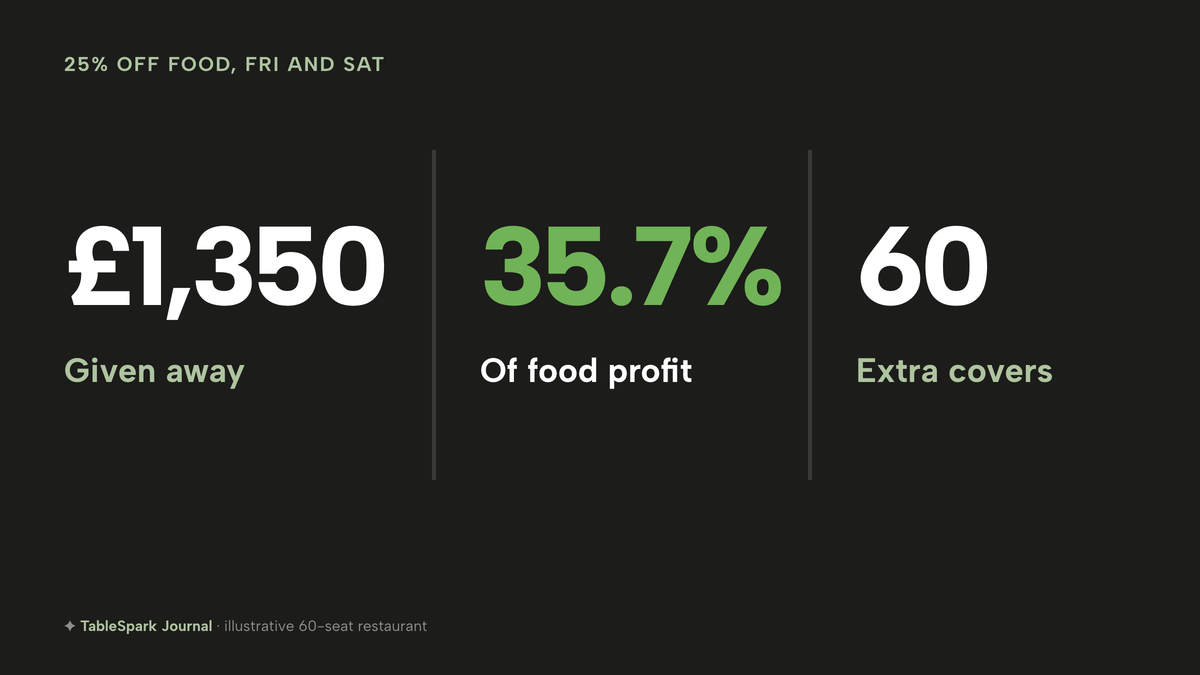
| Discount given | £5,400 x 25% | £1,350 |
| Food cost, unchanged | £5,400 x 30% | £1,620 |
| Food gross profit before | £5,400 - £1,620 | £3,780 |
| Food gross profit after | (£5,400 - £1,350) - £1,620 | £2,430 |
| Share of food gross profit given away | £1,350 / £3,780 | 35.7% |
| Contribution per cover before | (£30 - £9.00) + (£12 - £3.00) | £30.00 |
| Contribution per cover after | (£22.50 - £9.00) + (£12 - £3.00) | £22.50 |
| Extra covers to stand still | £1,350 / £22.50 | 60 covers |
Food sales at full price across the two nights are 180 x £30 = £5,400, and a 25% discount is £5,400 x 25% = £1,350 given away. The kitchen cooks the same dishes, so food cost stays at £5,400 x 30% = £1,620. Food gross profit falls from £5,400 - £1,620 = £3,780 to (£5,400 - £1,350) - £1,620 = £2,430, a drop of £1,350, or 35.7% of the food gross profit (£1,350 / £3,780).
Per cover, food of £30 less its £9.00 cost (30% of £30) leaves £21.00, and drink of £12 less its £3.00 cost (25% of £12) leaves £9.00, so each cover contributes £30.00 before the discount and £22.50 after it (£22.50 - £9.00 = £13.50, plus £9.00). To win the £1,350 back with extra covers at £22.50 each, the restaurant would need £1,350 / £22.50 = 60 more, a third more than the 180 it already seats (60 / 180). With no free tables those covers have no seat to take, so the £1,350 is simply given away.
A shop with spare stock can clear it with a discount, but a full room has nothing extra to sell. The offers that follow either pull cash forward from guests who value the restaurant or fill the sittings that would otherwise stay quiet.
Offer 1: Black Friday gift cards for restaurants, with a January bonus
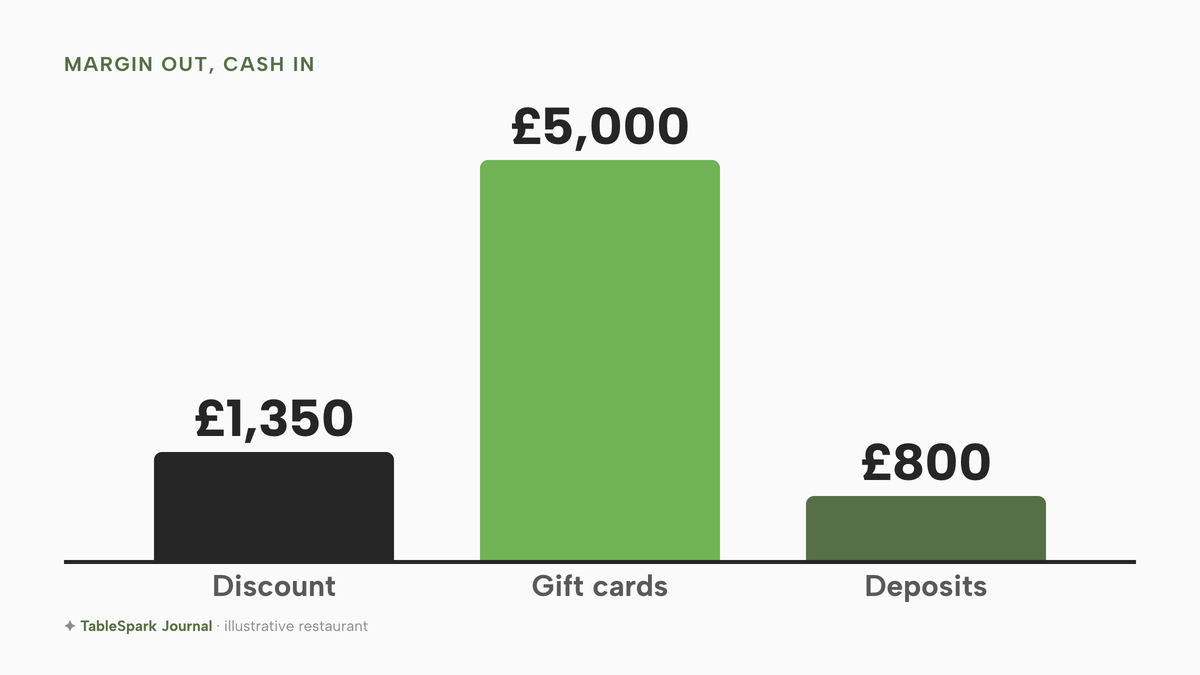
A gift card is revenue that arrives before the visit. The plan is to sell cards in Black Friday week with a bonus that can only be spent in the quiet weeks of January and February, so the restaurant takes cash now and fills seats later. The illustrative restaurant sells 100 cards at £50 each, which is £5,000 of cash taken in November, and adds a £10 bonus to each card for January, a bonus value of 100 x £10 = £1,000, so the total redeemable is £6,000.
| Working | Result | |
|---|---|---|
| Cash taken in November | 100 x £50 | £5,000 |
| Bonus value | 100 x £10 | £1,000 |
| Total redeemable | £5,000 + £1,000 | £6,000 |
| Card fee, one standard UK card | £50 x 1.5% + £0.20 | £0.95 |
| Card fees, 100 standard cards | 100 x £0.95 | £95.00 |
| Card fee, one premium UK card | £50 x 2.8% + £0.20 | £1.60 |
| Card fees, 100 premium cards | 100 x £1.60 | £160.00 |
| Cash in after card fees, standard | £5,000 - £95 | £4,905 |
| Goods cost of the bonus at 30% | £1,000 x 30% | £300 |
| Bonus as a share of redeemed value | £1,000 / £6,000 | 16.7% |
The card fees use the rates on Stripe's UK pricing page, read on 20 November 2026: 1.5% + 20p for standard UK cards and 2.8% + 20p for premium UK cards. On a £50 standard card that is £50 x 1.5% = £0.75, plus £0.20, which is £0.95 a card and £95.00 across 100. On premium cards it is £50 x 2.8% = £1.40, plus £0.20, which is £1.60 a card and £160.00 across 100. Cash in after standard card fees is £5,000 - £95 = £4,905. Stripe's page prints no VAT wording beside these rates.
The bonus costs the kitchen £1,000 x 30% = £300 of goods, if the bonus spend would not have happened otherwise. As a share of what is redeemed it is £1,000 / £6,000 = 16.7%, against the 25% of offer (i), and it is spent only by guests who come back. The example does not model unredeemed cards, extra spend above the card value or VAT. The restaurant gift card system guide covers selling, redeeming and accounting for cards.
Four design choices keep the offer clean:
- Make the bonus a separate card or credit with its own terms. The paid value and the bonus are different things, and each can carry its own dates, such as "valid 5 January to 28 February 2027".
- Point the bonus at quiet weeks only. The quiet weeks are the restaurant's own knowledge, from its diary and last January's covers. No independent-restaurant January figure was found for this guide, so build the offer on the bookings report, not a trade headline.
- Close the sale on a stated date. CAP Code rule 8.17.4.a lists "a prominent closing date, if applicable, for purchases and submissions of entries or claims" among the significant conditions. If the offer ends on Monday 30 November, say so.
- Say what the card can be spent on and when. A bonus that is barred from a Friday dinner, or that expires before a guest could reasonably return, is a condition that belongs next to the offer.
Gift card VAT: what HMRC says, and what this guide does not conclude
HMRC's Business promotions notice (VAT Notice 700/7, last updated 25 June 2026) separates vouchers into two kinds. In paragraph 9.4.1 it says "A single purpose voucher is one where, at the time of issue, the liability to VAT of the goods or services to which it relates, and the place where they will be supplied ... are known." Paragraph 9.5 then says "A multi-purpose voucher is any voucher that is not a single purpose voucher."
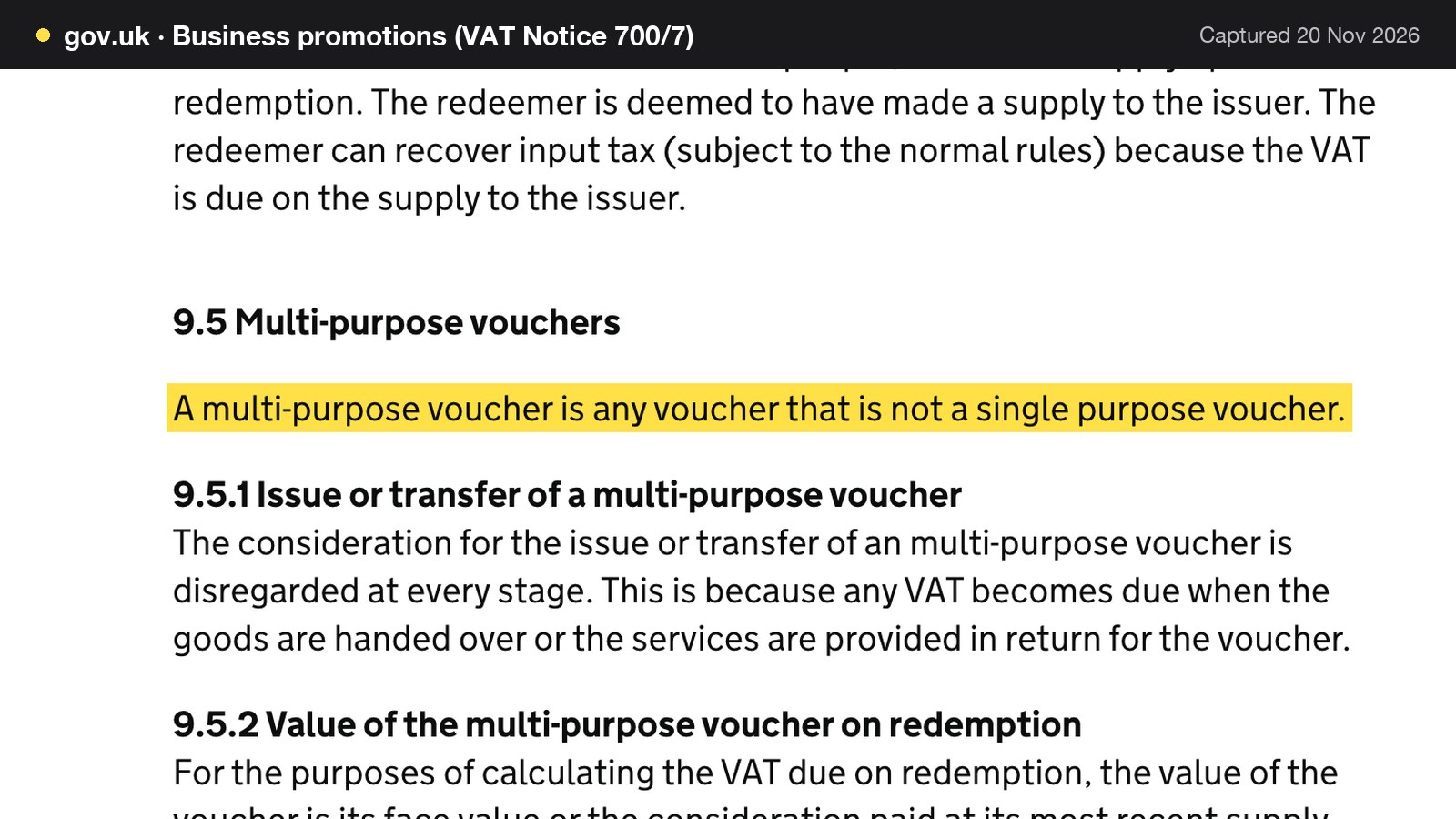
For a single purpose voucher, paragraph 9.4.3 says it "is treated as the supply of the goods or services for which it can be redeemed". For a multi-purpose voucher, paragraph 9.5.1 says the consideration for its issue "is disregarded at every stage", because any VAT becomes due when the goods or services are provided in return for the voucher. This guide does not say which type a particular restaurant's card is, and the notice read for this research does not use the phrase "bonus voucher", so no VAT conclusion is drawn on a January bonus. Ask an accountant before the cards go on sale, and read the guide to restaurant gift voucher VAT.
Offer 2: first call on December dates for guests who signed up
The second offer costs no margin. It gives the restaurant's own list the first chance at the dates and menus that will fill anyway: the December Friday and Saturday tables, or a tasting menu with a limited number of seats. The reward is priority, not a price cut, and the limit is real because the dates are scarce.
The list is the point. A guest who joins through the restaurant's own newsletter form gives a name, an email address and a record of when and how they agreed. A guest who arrives through a voucher site gives the restaurant nothing it can use after the night, so building the owned list in Black Friday week matters as much as the offer itself.
Three rules apply to the message.
- Consent comes first. The ICO's PECR guidance says "Under PECR, organisations normally must have consent before sending unsolicited electronic mail marketing to individual subscribers", that "you must not use pre-ticked opt-in boxes, silence or inactivity as evidence of consent", and that "you should keep a record of the consent (eg who, when, how) so that you can demonstrate it is valid."
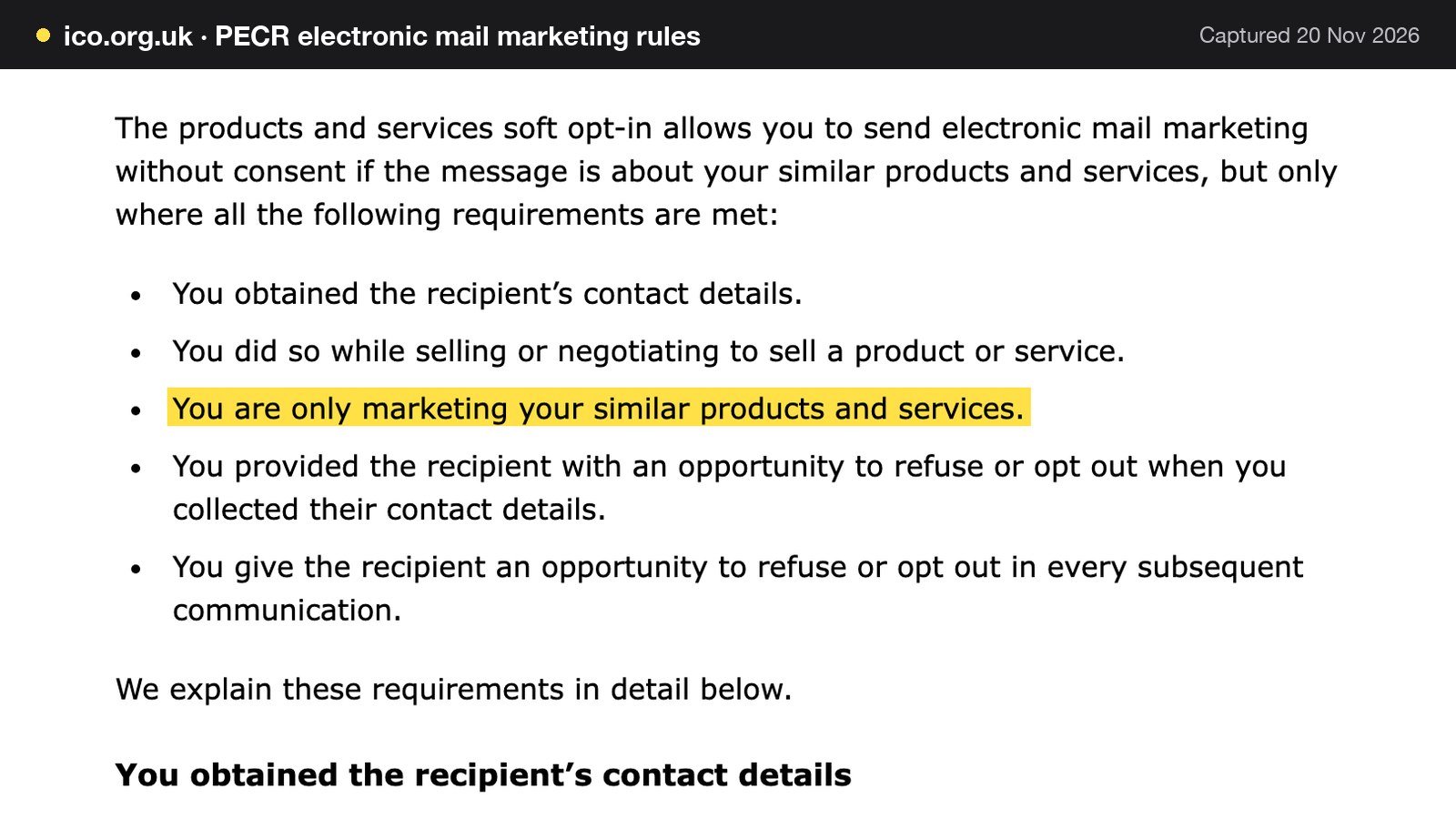
- The soft opt-in has five conditions, and all must be met. The ICO page lists them: you obtained the recipient's contact details; you did so while selling or negotiating to sell a product or service; you are only marketing your similar products and services; you gave the recipient an opportunity to refuse or opt out when you collected the details; and you give that opportunity in every subsequent communication. Whether a given guest meets them is a check for the owner.
- A bought list is not covered. The ICO's own bad-practice example is a restaurant that buys a list of mobile phone numbers from a third party who claims it is "soft opt-in compliant": "The soft opt-in doesn't apply because the restaurant did not obtain the contact details directly."
The ICO's list of monetary penalties records that Papa John's (GB) Limited was fined £10,000 in a final notice dated 14 June 2021 for sending 168,022 nuisance marketing messages to its customers. It is the nearest restaurant-chain case found for this guide, it is over five years old, and it is not a guide to what a single restaurant would face. The practical point is smaller and cheaper: keep a consent record, put an unsubscribe link in every message and write only to people who asked. The guide to booking email marketing consent and the guide to restaurant email marketing cover the set-up.
Offer 3: set menus that fill quiet sittings, not peak tables
The third offer runs the same logic in reverse. On a full Friday a discount adds no covers. On a quiet Tuesday dinner or an early Sunday sitting, a cover that would not otherwise exist contributes its whole margin: in the illustrative restaurant £30.00 a cover, as above, before any set-menu pricing. The set menu gives the guest a reason to choose the quiet sitting, and gives the kitchen a short, planned list.
A good Black Friday set menu has four features:
- It sits in the quiet sitting, by design. The offer names the sitting, such as "Tuesday to Thursday dinners in December" or "Sunday before 6pm", and it is not offered on the evenings that fill without help.
- It has a stated price per head. The price shown is the price paid. If a service charge is added, it belongs in the price shown (see the law section below).
- It has a limit. CAP Code rule 8.10 says promoters "must be able to demonstrate that they have made a reasonable estimate of the likely response and either that they were capable of meeting that response or that consumers had sufficient information, presented clearly and in a timely fashion, to make an informed decision", and rule 8.9 says "subject to availability" does not relieve promoters of the duty to do everything reasonable to avoid disappointing participants.
- It asks for the booking. The offer should send guests to the restaurant's own booking page, where the date, party size and any deposit are visible before they commit.
A set menu is also the natural base for the fourth offer, since groups choose from a fixed list.
Offer 4: Christmas party bookings secured with a deposit and reminders
A no-show costs most in December, because the parties are large and the dates are limited. The fourth offer sells Christmas parties early, in Black Friday week, with a deposit taken at booking and a reminder before the date. The illustrative restaurant takes 10 parties of 8, which is 80 guests, with a deposit of £10 a head, so £80 a booking and £800 held ahead of service.
| Working | Result | |
|---|---|---|
| Deposit per booking | 8 x £10 | £80 |
| Cash held ahead of service | 10 x £80 | £800 |
| Card fee on one £80 deposit | £80 x 1.5% + £0.20 | £1.40 |
| Card fees on ten deposits | 10 x £1.40 | £14.00 |
| Sales at risk per party | 8 x (£30 + £12) | £336 |
| Sales at risk, ten parties | 10 x £336 | £3,360 |
| Contribution lost if one party fails to come | 8 x £30.00 | £240 |
| Deposit retained as a share of that loss | £80 / £240 | one third |
Stripe's standard UK card rate on one £80 payment is £80 x 1.5% = £1.20, plus £0.20, which is £1.40, and £14.00 across ten. Each party of eight puts 8 x (£30 + £12) = £336 of sales at risk, and ten parties £3,360. If one party of ten does not come, the contribution lost is 8 x £30.00 = £240, and the £80 deposit retained is a third of it (£80 / £240).
A retained deposit must be fair. The gov.uk guidance "Writing a fair contract for customers", updated on 22 July 2026, says "any prepayments or deposits you keep must take into account what your business will actually lose as a result", and that you "may legitimately keep a deposit in full if it's no more than a small percentage of the price and you make it clear when exactly it would be non-refundable". It lists as risky any term that makes "prepayments non-refundable, regardless of why the customer cancels". Under section 62 of the Consumer Rights Act 2015, "An unfair term of a consumer contract is not binding on the consumer." So the terms should say, in plain words, when the deposit is refundable and when it stops being refundable. The Christmas bookings guide covers the December booking calendar in more depth.
Restaurant Black Friday offers side by side
| What the sums show | What to check | |
|---|---|---|
| 25% off food on full nights | £1,350 of margin given away, 60 extra covers needed | The end date and any "was" price |
| Gift cards with a January bonus | £5,000 brought forward, £95.00 in card fees, £1,000 bonus | Bonus dates, closing date, VAT advice |
| Christmas party deposits | £800 held, £14.00 in card fees | Refund terms, deposit size |
Offers 2 and 3 cost no discount at all, because the reward is priority or a planned sitting. Every input above is illustrative, and the owner's own bookings report should replace each one.
The pricing and marketing law behind each offer
This is a summary of public law and official guidance as published on 20 November 2026, not legal advice; check the current position, or take advice, before acting on a specific case.
Black Friday deals for restaurants and the DMCC Act
The Digital Markets, Competition and Consumers Act 2024 (the DMCC Act) prohibits unfair commercial practices: section 225(1) says "Unfair commercial practices are prohibited", and a trader is a person "acting for purposes relating to P's business", so a restaurant promoting to diners is one. The prohibition has been in force since 6 April 2025. Section 226(2) adds that misleading information "includes a reference to information which, although true, is presented in a misleading way".
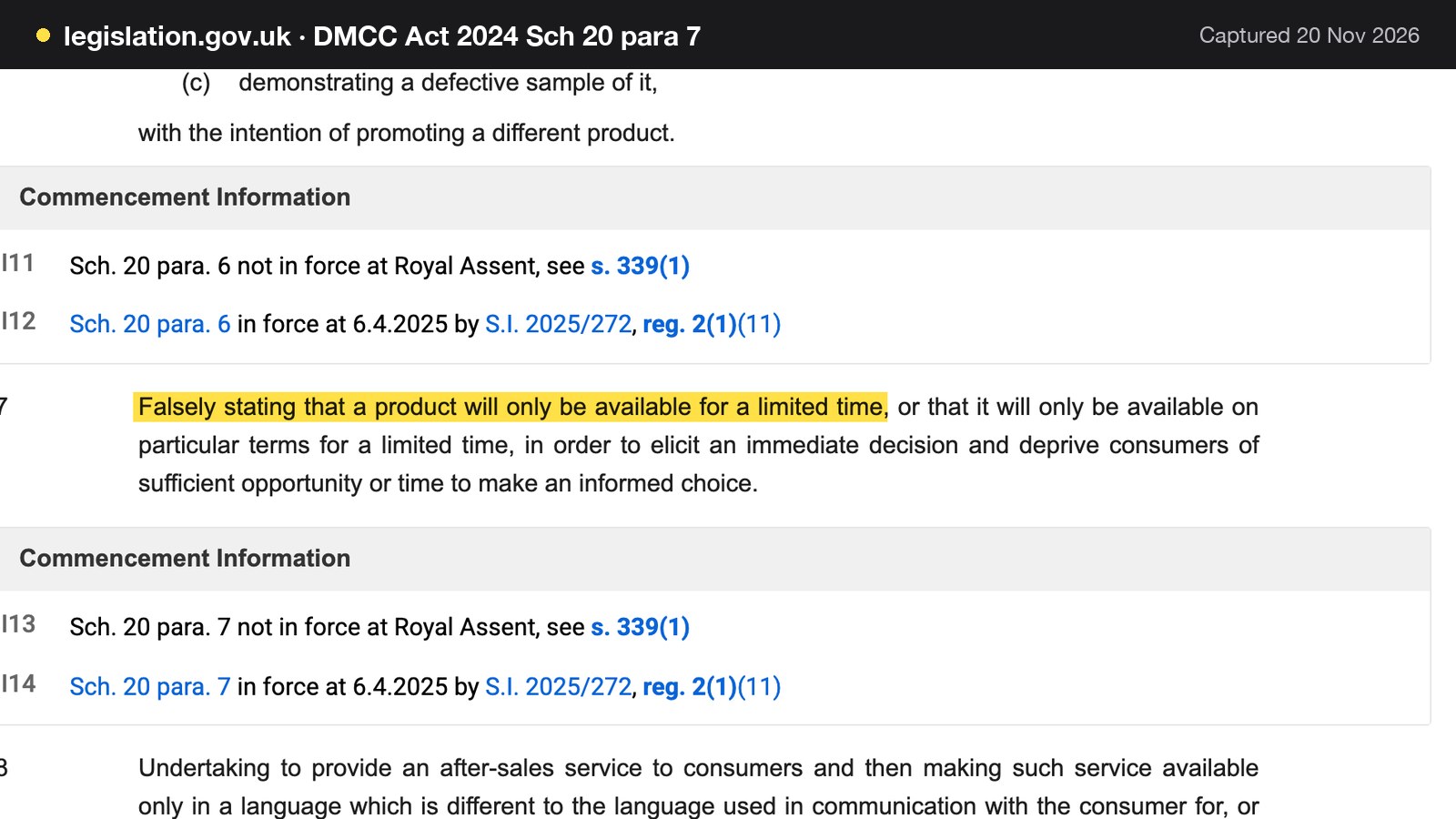
Two parts of the Act matter most for a Black Friday advert. The first is the banned limited-time claim. Schedule 20, paragraph 7 lists as unfair in all circumstances "Falsely stating that a product will only be available for a limited time, or that it will only be available on particular terms for a limited time, in order to elicit an immediate decision and deprive consumers of sufficient opportunity or time to make an informed choice."
The CMA's guidance CMA207 (updated 18 November 2025) gives an example of a trader falsely saying an offer will end when a countdown clock runs out, after which the offer continues and the clock restarts. It adds that if the statement that the offer will end is true, and is not otherwise misleading, "then this is unlikely to be problematic". "This weekend only" on an offer that does close on Sunday night is honest; on an offer that runs again next week it is the problem.
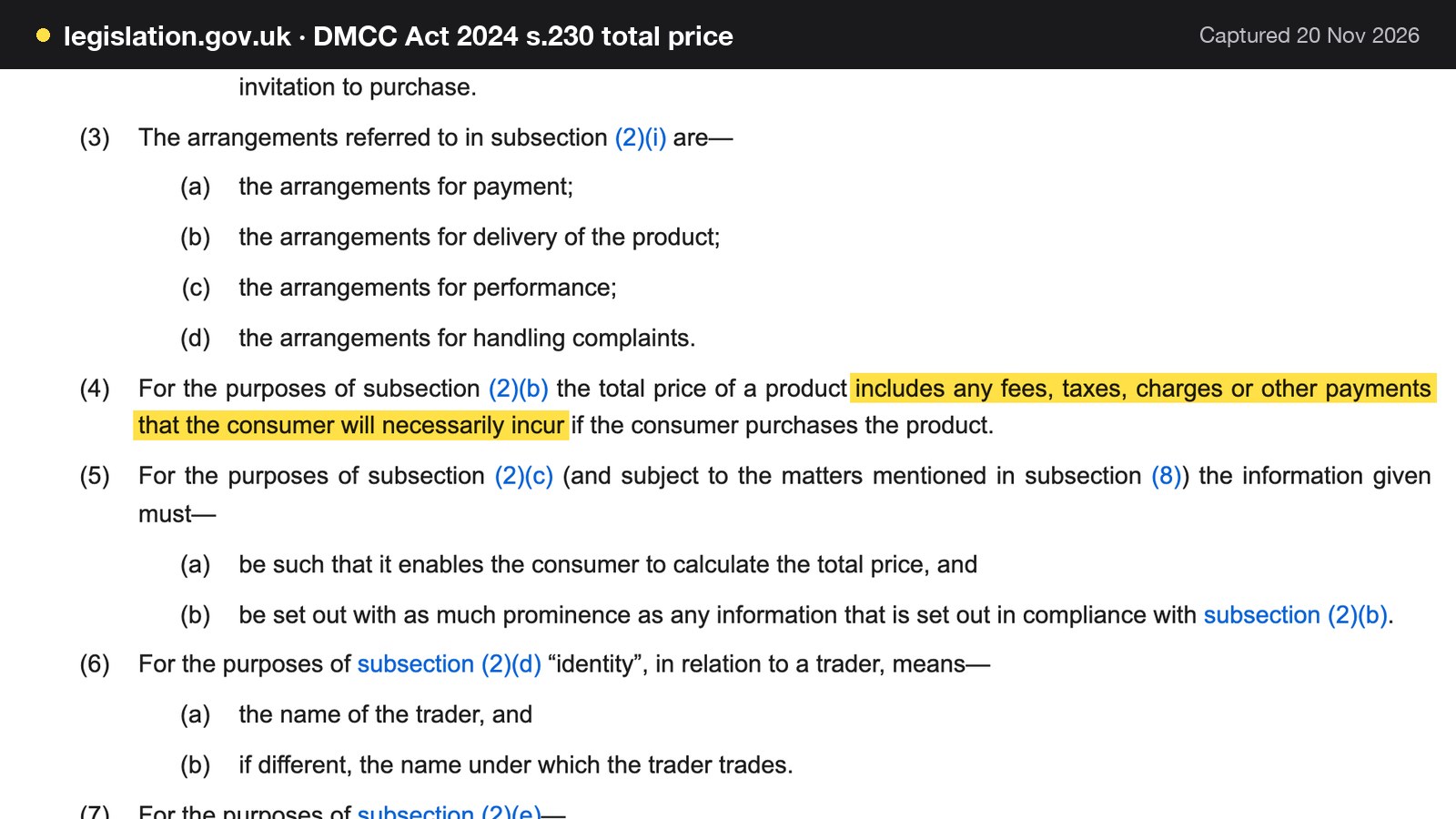
The second is the total price. Section 230(2)(b) of the Act says an invitation to purchase must not omit "the total price of the product", and section 230(4) says "the total price of a product includes any fees, taxes, charges or other payments that the consumer will necessarily incur if the consumer purchases the product."
Drip pricing, menu prices and a compulsory service charge
The CMA's final price transparency guidance (CMA209) says "It's illegal to hide additional fees, taxes or other charges that the customer will have to pay until later in the purchase process (sometimes called 'drip pricing')", and "The total price should normally include any unavoidable or 'mandatory' charges. Providing them separately will not normally be enough to comply with the law." CMA207 says that in restaurants "the prices of the food and drink available will need to be displayed to consumers before they order, and in many cases before they enter the restaurant", and counts a menu, including one reached by scanning a QR code, as an invitation to purchase.
The CMA pages read for this guide do not mention a service charge. Section 230(4) speaks of payments the consumer "will necessarily incur". Whether a compulsory service charge added to a Black Friday set menu is such a payment is a check for the owner against the section and the CMA209 text, and a safe working rule is to show the full price a guest pays, service charge included, wherever the offer is advertised. The guides on pricing law and on showing the service charge before the bill go further.
The statutory penalty, in proportion
The CMA can impose a penalty by final infringement notice. Section 182(6) says the amount "must be a fixed amount not exceeding £300,000 or, if higher, 10% of the total value of the turnover (if any) of the respondent."
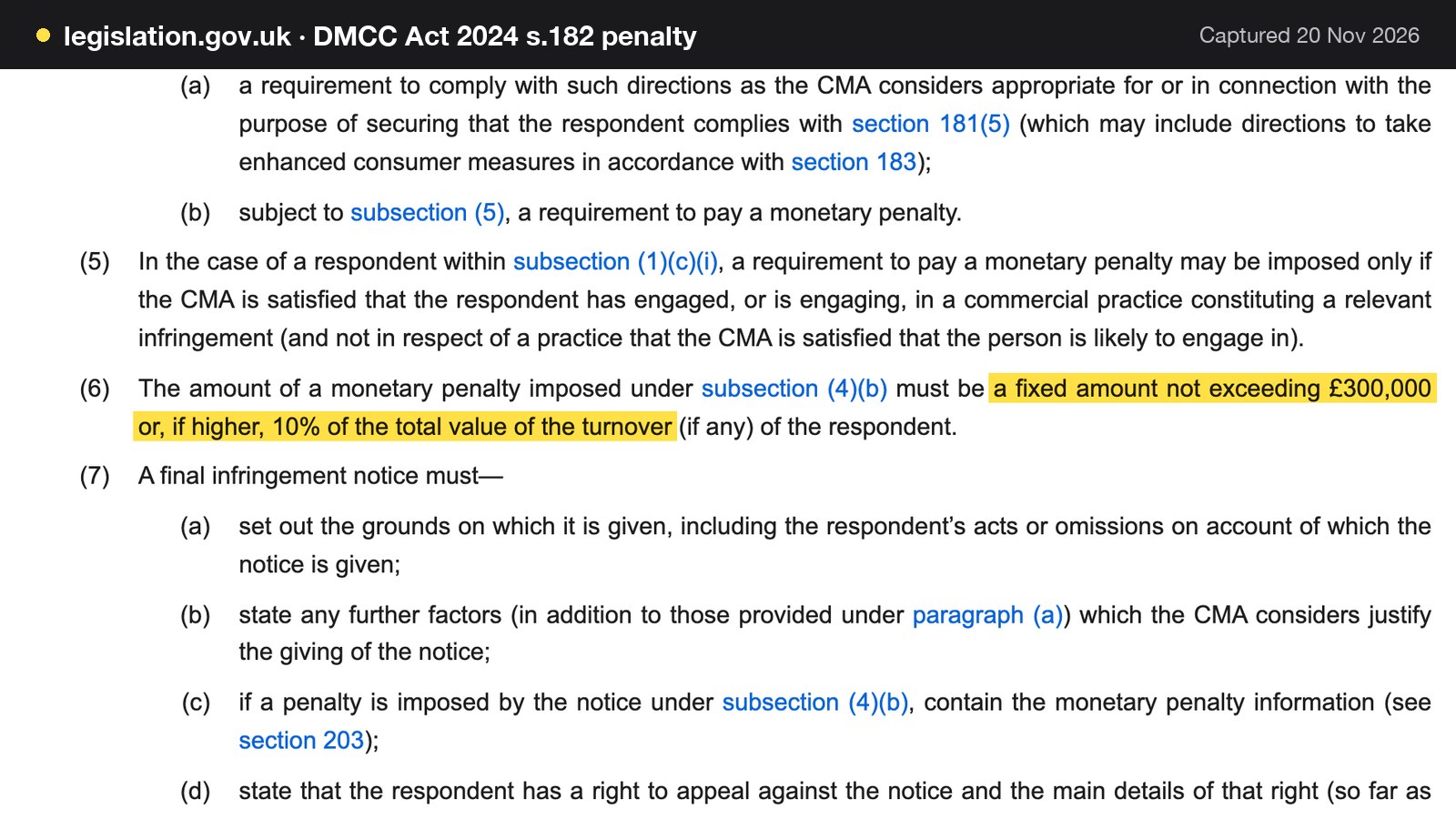
That is the statutory ceiling, not a prediction for a restaurant post. The CMA's press release of 14 October 2026 reports fines of £4.8 million on Wayfair for false time-limited offers, £1.2 million on Appliances Direct for countdown banners and £45,000 on Gold's Gym for not giving the total price for memberships clearly and on time. No hospitality business is among them, and no CMA fine on a restaurant or pub under the DMCC Act was found. Treat the rules as a checklist for the advert, not as a reason to avoid promotions.
CAP Code section 8: conditions, closing dates and genuine savings
CAP Code rule 8.17 says promotional marketing "must communicate all applicable significant conditions or information where the omission of such conditions or information is likely to mislead", and rule 8.17.4.a names the closing date. CAP's note "Bag a Bargain, Not a Breach: Black Friday and the CAP Code" (8 October 2026) says "if an ad appears before a promotion starts both the start and end date are likely to be considered significant conditions that should be made clear up front", and that a claim such as "50% off" "must be genuine, accurately reflect the available discount and must not exaggerate the savings consumers can expect to receive".
On 18 November 2026 the ASA said it would "capture online ads featuring price promotions and savings claims", and that advertisers must show "their pricing history" and that "the reference price is genuine". Its earlier bans were on retailers, and no ASA Black Friday ruling against a restaurant was found in the news pages read for this guide. The safest design is to avoid a "was" price and sell value instead: a gift card with a stated bonus, a set menu at a stated price, a deposit with stated terms. Rule 8.2 adds that promoters "must conduct their promotions equitably, promptly and efficiently" and "avoid causing unnecessary disappointment". The guide to promotion end dates and terms has a checklist.
The week, day by day: Black Friday restaurant ideas for the days themselves
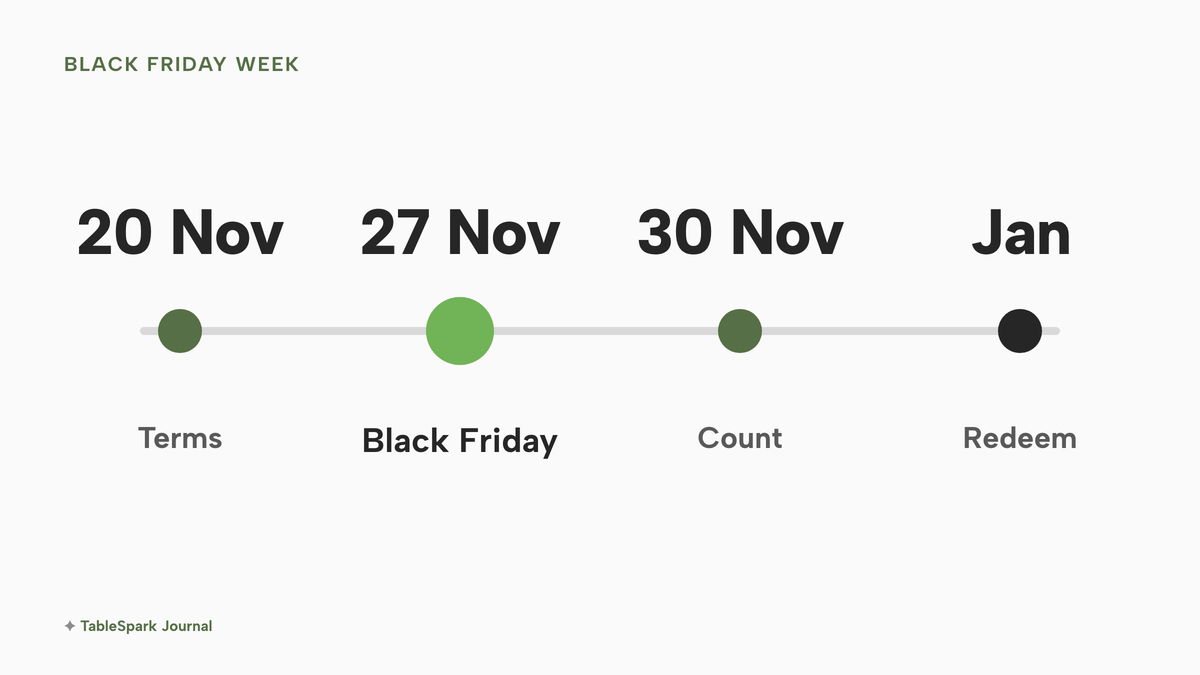
The four offers need a plan for the week as much as a price. The plan below runs from today to the Monday after Black Friday.
| Time | What happens | Where |
|---|---|---|
| Fri 20 to Sun 22 Nov | Write the offer terms, dates and closing date | Your own site |
| Mon 23 Nov | Email the owned list first, with an unsubscribe link | Subscribers who agreed |
| Tue 24 to Wed 25 Nov | Social warm-up posts that link to your own site | Your pages, not a marketplace |
| Thu 26 Nov | Staff briefing and the in-venue QR code up | Tables and the till |
| Fri 27 Nov | Black Friday: gift cards and Christmas party enquiries | Site and the room |
| Sat 28 to Sun 29 Nov | Keep the one staff line going, answer enquiries | The desk |
| Mon 30 Nov | Close the sale, count cards, deposits and sign-ups | Gift cards, Bookings, Subscribers |
| Jan to Feb 2027 | Bonus redemptions in the quiet weeks | The desk and online |
Social warm-up that links home. Posts should send people to one page on the restaurant's own site, where the terms, the dates and the buy or book button sit together. A post that links to a marketplace listing sends the guest into somebody else's checkout and leaves the restaurant without the guest's details. State the real end date.
The owned list first. The guests who signed up hear first, with first call on the December dates and the gift card link, and only if they gave consent or meet every soft opt-in condition above. Include an unsubscribe link.
In-venue QR and one staff line. The guests already in the room on Friday are the cheapest audience. Put one QR code on the table cards or the till that points to the gift card page, and give staff one sentence: "We have gift cards with a January bonus until Monday, and the QR code on the table has the details." One consistent line avoids a dozen improvised promises at the table, each of which is an advertising claim.
The Monday count. On Monday 30 November, count cards sold and their total value, bonus value issued, party deposits held, and new subscribers with consent dates, and compare the cash brought forward with the margin given away on any discount that ran. The count turns a one-week promotion into next year's plan.
How the four offers run in TableSpark
TableSpark builds the restaurant's own website, booking engine, gift cards, guest records and email in one account, so the four offers sit on one login, one guest list and one Stripe account. The pricing page lists every capability by plan.
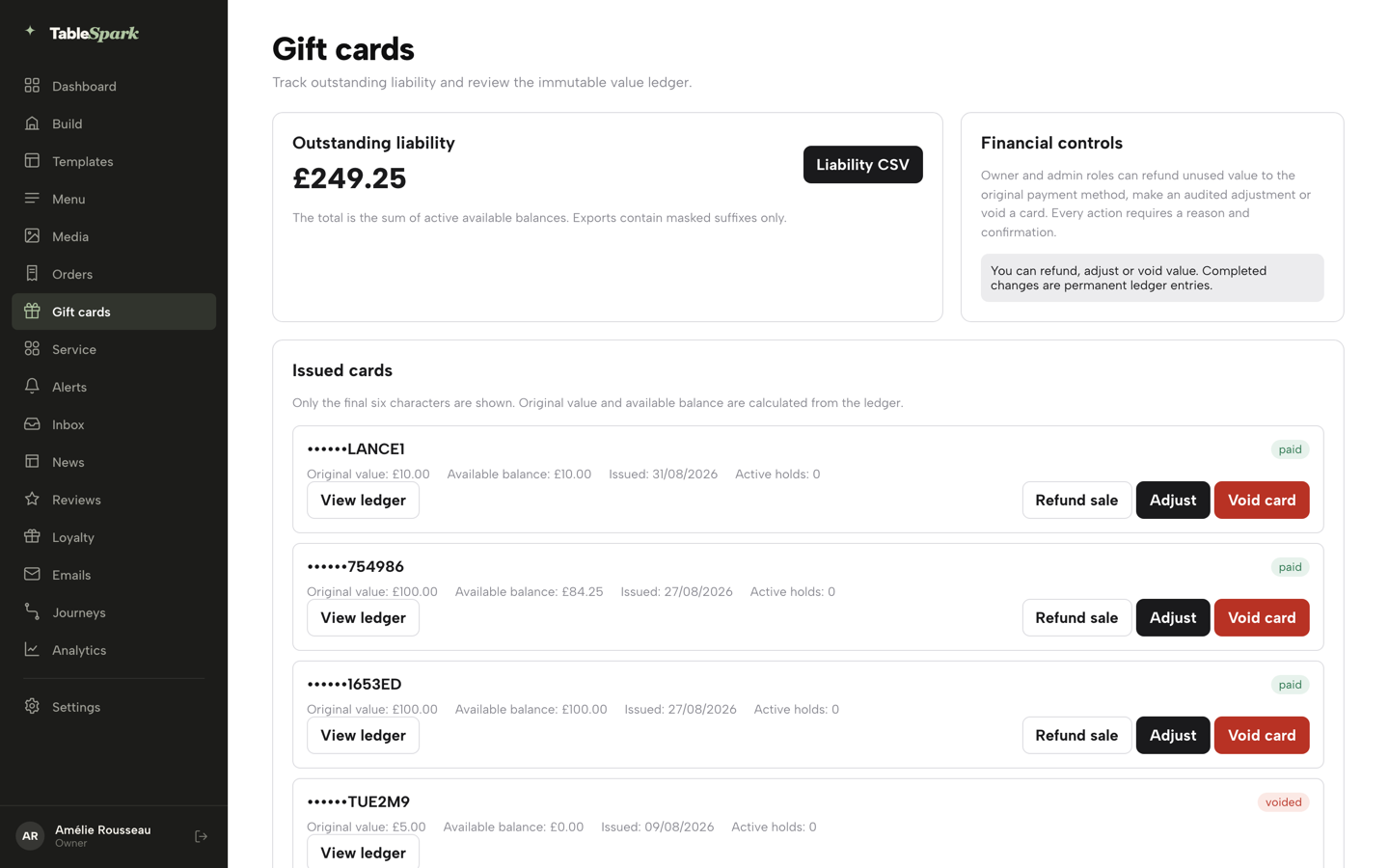
Gift cards (offer 1), Growth and Full. The pricing table lists "Gift cards sell on your site or at the desk, one balance ledger, paid to your own Stripe account". A Gift card form on the site takes an amount, the recipient's and buyer's names and a personal message, and with payments connected the buyer pays through Stripe Checkout. At the desk, an owner or admin issues a card from a guest's sheet with an amount and a reason. A January bonus is issued the same way, as its own card with its own reason, and its terms are written in the restaurant's own words on the page and in the gift card emails, which the owner can edit. Guests redeem at the desk or in the ordering checkout (online ordering is on Full), and the Gift cards page shows outstanding liability with a Liability CSV. Gift cards are switched on for each restaurant as part of onboarding.
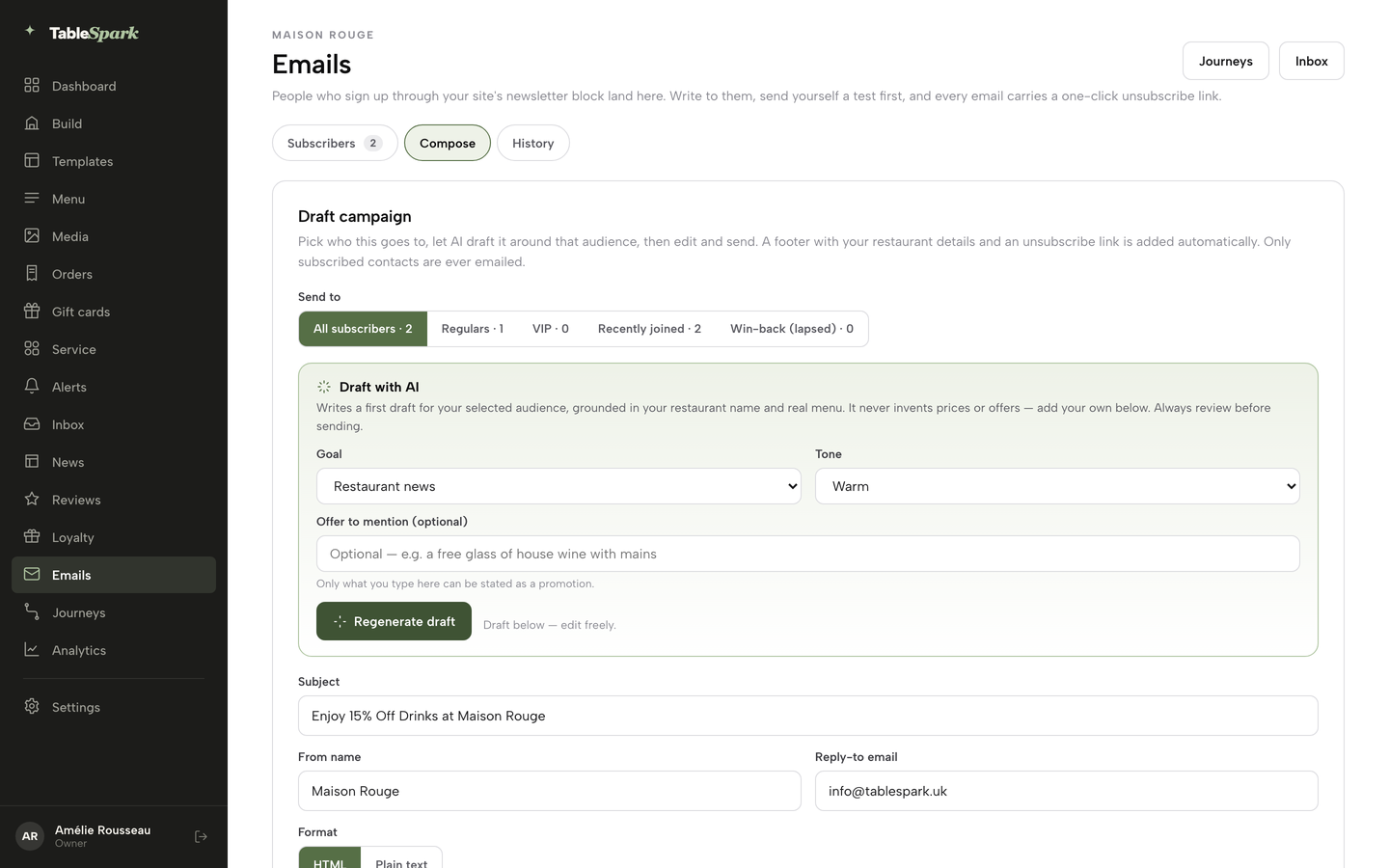
First call on December dates (offer 2), Growth and Full. The Subscribers list holds each guest who joined through the site's newsletter block, with their consent date and source. Compose offers audiences (All subscribers, Regulars, VIP, Recently joined and Win-back) and a Draft with AI panel that states a promotion only if the owner typed it. Every campaign email carries the restaurant's details and a personal unsubscribe link. Growth includes 5,000 marketing emails a month, and Full is unlimited under fair use. Enquiry and newsletter forms and guest records are on every plan, including Starter.
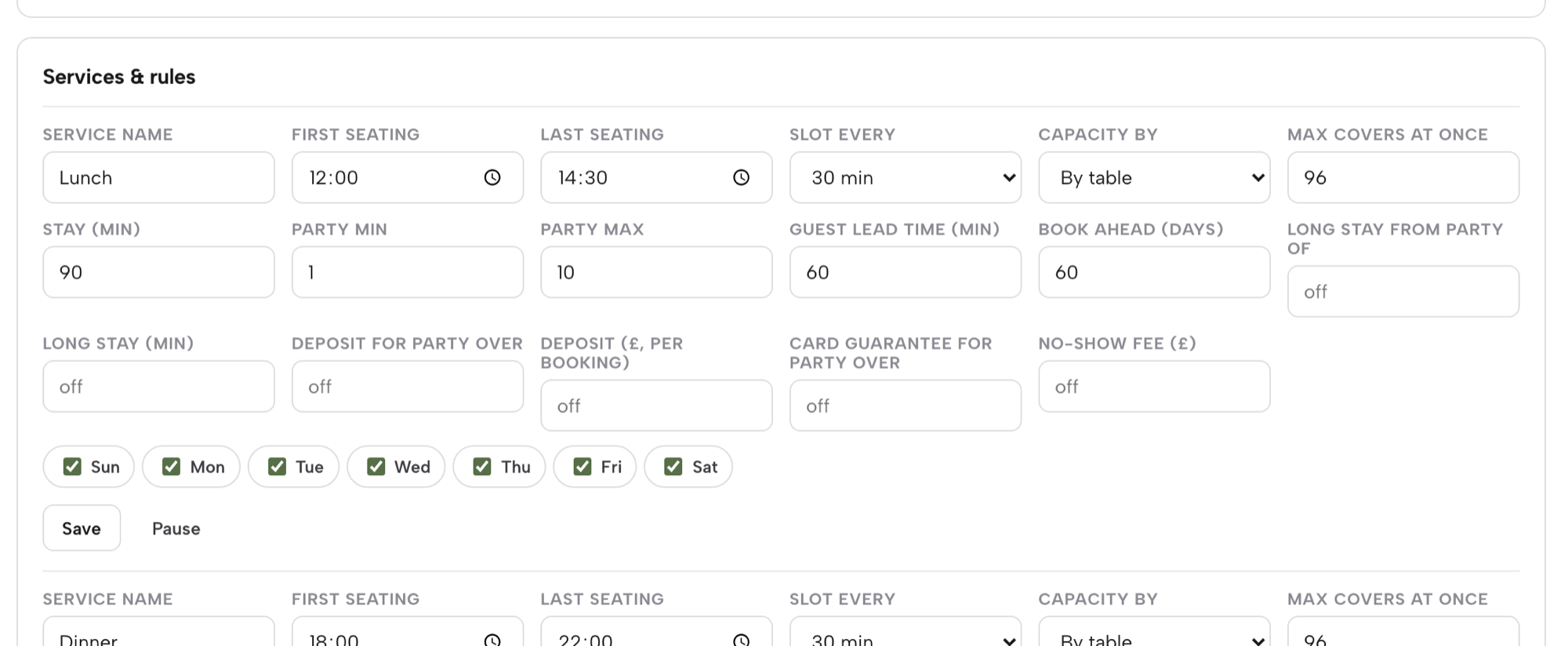
Set menus for quiet sittings (offer 3), Growth and Full. Each service on the Bookings page carries its own seating window, capacity, party size, lead time and deposit fields, so a quiet sitting can be its own row. Posts and events publish offers and their dates to the site and the sitemap, now or scheduled ahead. Portion counts let the owner set what is left of a dish, and at zero it sells out on every channel.
Christmas party deposits and reminders (offer 4), Growth and Full. On any service the owner sets a party size and an amount. Larger parties pay a deposit at booking, from £1 to £500 per booking, into the restaurant's own Stripe account, or leave a card charged only if the team confirms a no-show. The owner sets a free-cancellation cut-off in hours and, after it, keeps the whole deposit, a percentage or a fixed amount, and guests see those terms before paying. Every confirmed booking gets a confirmation and a reminder the day before. Group bookings with pre-orders give each guest a link to pick dishes from the set menu, with automatic reminders 7 and 2 days before the cut-off and per-guest deposits.
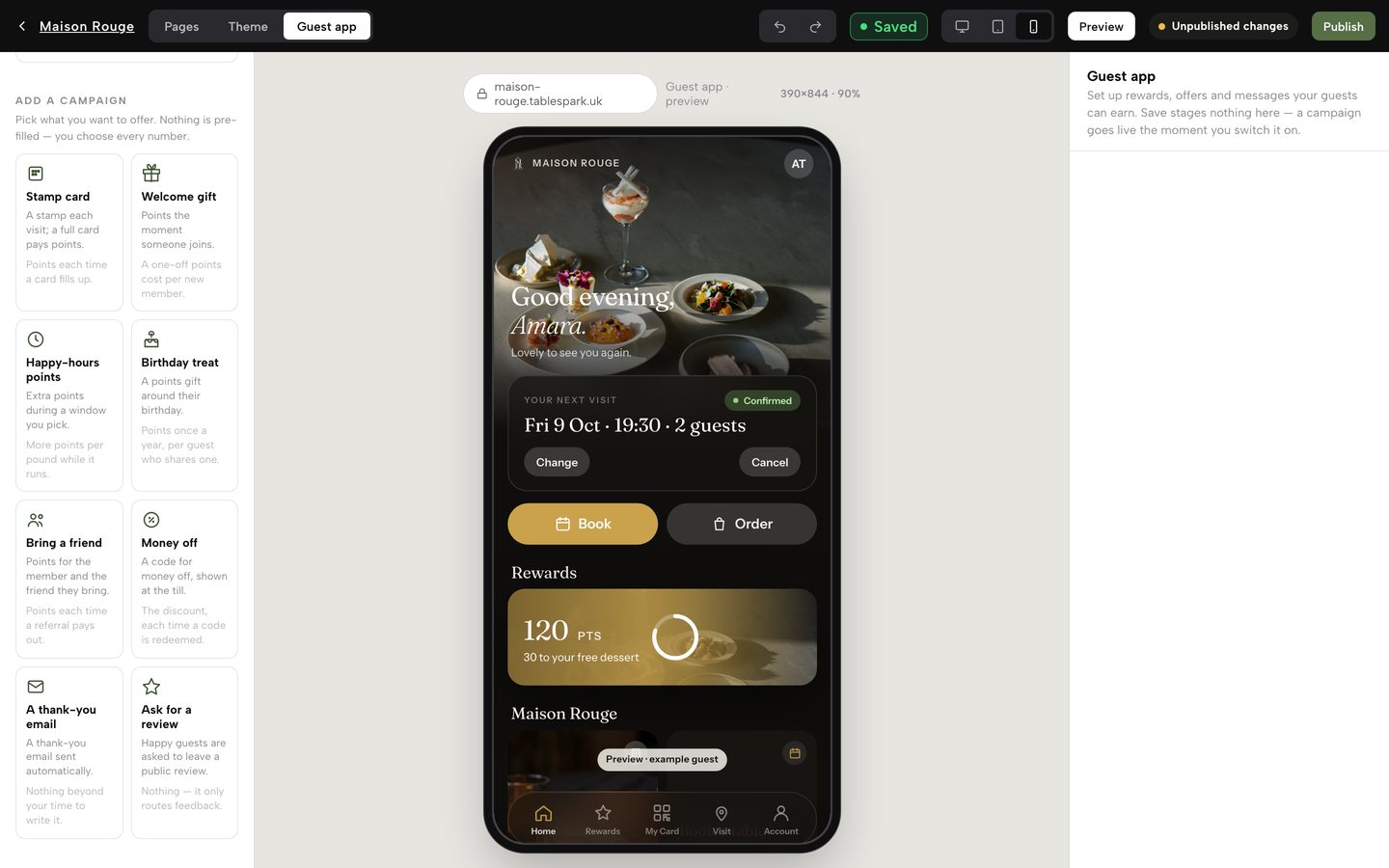
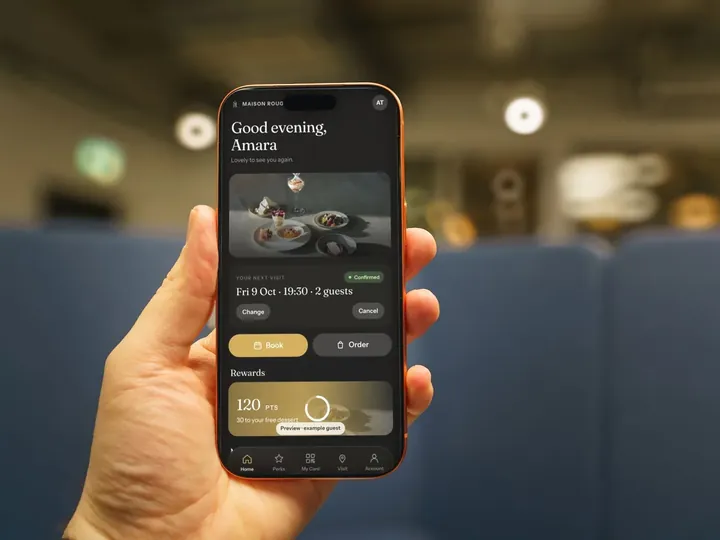
Rewards that bring guests back, Growth and Full. The guests' app comes with eight campaign recipes, including Stamp card, Welcome gift and Money off. Every field starts empty, so the owner sets each offer, with optional start and end dates, and a campaign goes live when its switch is turned on. On Full, each online order card carries an editable Discount line with a typed reason.
Guest list and CSV export, every plan. Guest records are stored under the restaurant's TableSpark account, visible in the Inbox and the guest list, with CSV export of whichever segment is open. Consent dates and sources sit on the subscriber list.
Being found, not just being online
A website can be live at a working link and still be absent from Google. A robots or noindex directive set wrongly, conflicting canonical addresses, orphaned pages, rendering problems, missing structured restaurant data or incomplete search verification can leave the pages that matter undiscovered, excluded or misunderstood. During a promotion the cost is concrete: guests searching the restaurant's name, its gift cards or its Christmas menu may reach a directory, a commission-charging marketplace or the restaurant down the road first.
TableSpark packages that work into every plan: crawlable content, SEO titles, descriptions and canonical URLs, Restaurant and LocalBusiness schema, sitemaps, robots controls, internal links, mobile-first output and managed Search Console verification, so the owner does not hire a technician to assemble it. Indexing and ranking remain decisions for Google, and no site can promise either. The Reserve with Google booking-link connection, on Growth and Full, makes the restaurant's own booking page the destination guests reach from Google. It is a booking link that sends guests from Google to the restaurant's own booking page. The restaurant marketing page shows the Google links, events, consented email, guests' app and gift cards together.
One account or separate tools: the cost side by side
Running gift cards, deposits, email and rewards through separate tools means separate bills and logins and guest details split across systems. The prices below are from each provider's own page, read on 20 November 2026, and are separate charging structures, not like-for-like prices.
- Charged per
- Site, per month
- Gift cards
- deposits and reminders
- email campaigns
- guests' app campaigns
- guest records
- Charged per
- Successful transaction
- Card payments
- no VAT wording beside these rates
These prices are not like-for-like, because providers charge for different things. Stripe's rates are a per-transaction card fee that applies on any route, so they do not replace the monthly cost of the gift card, email, deposit and rewards tools. The TableSpark row is £39 a month excluding VAT, which is £468 a year excluding VAT (12 x £39), or £390 a year excluding VAT on the yearly payment (10 x £39), for gift cards, deposits and reminders, email campaigns, guests' app campaigns and guest records together. Stripe's card fees apply to online payments in both routes, and the card-fee sums above use Stripe's published rates. Separate tools each add their own monthly bill on top of those card fees, whereas TableSpark Growth is one bill.
TableSpark Starter starts at £19 a month excluding VAT for the website, the live menu, enquiry and newsletter forms, guest records and managed search readiness. Growth is £39 a month excluding VAT and carries the four offers above. Full is £69 a month excluding VAT and adds online ordering and table QR ordering for a takeaway or collection offer. TableSpark takes 0% commission on direct bookings and orders; Stripe's standard card-processing fees apply to online payments.
| Separate tools | One TableSpark site | |
|---|---|---|
| Gift cards | A tool of its own, with its own bill | On the site and at the desk, one ledger |
| Deposits and reminders | A second system to set up and pay for | On the booking service, paid to your own Stripe account |
| Email to consented guests | A separate email plan | Subscribers with consent date and source |
| Rewards | A separate loyalty tool | Guests' app recipes, set by the owner |
| Guest list | Split across each tool | One list with CSV export |
How to do it in TableSpark
The steps below need Growth, at £39 a month excluding VAT.
Step 1 of 6
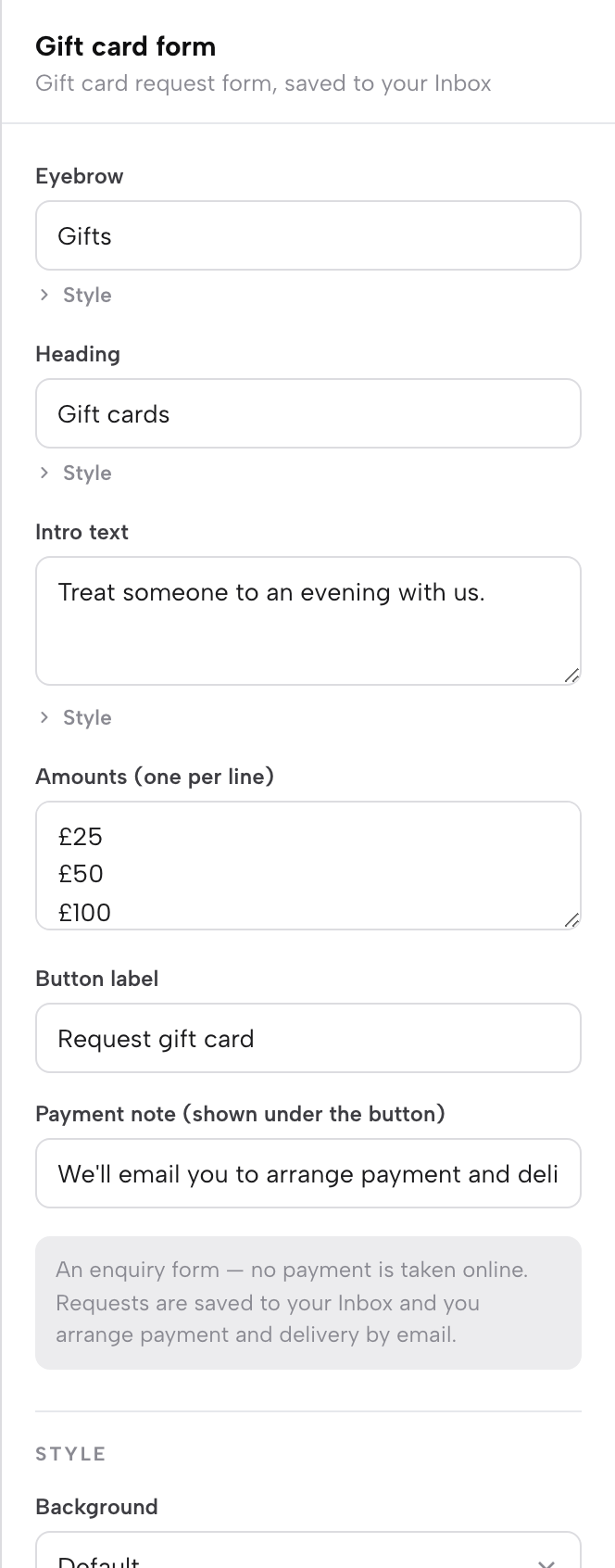
Add the gift card form to your site
Open Build, click + Add a module, type gift in the search box and choose Gift card form. Set the heading, the amount chips and the button label in the inspector.
Step 2 of 6
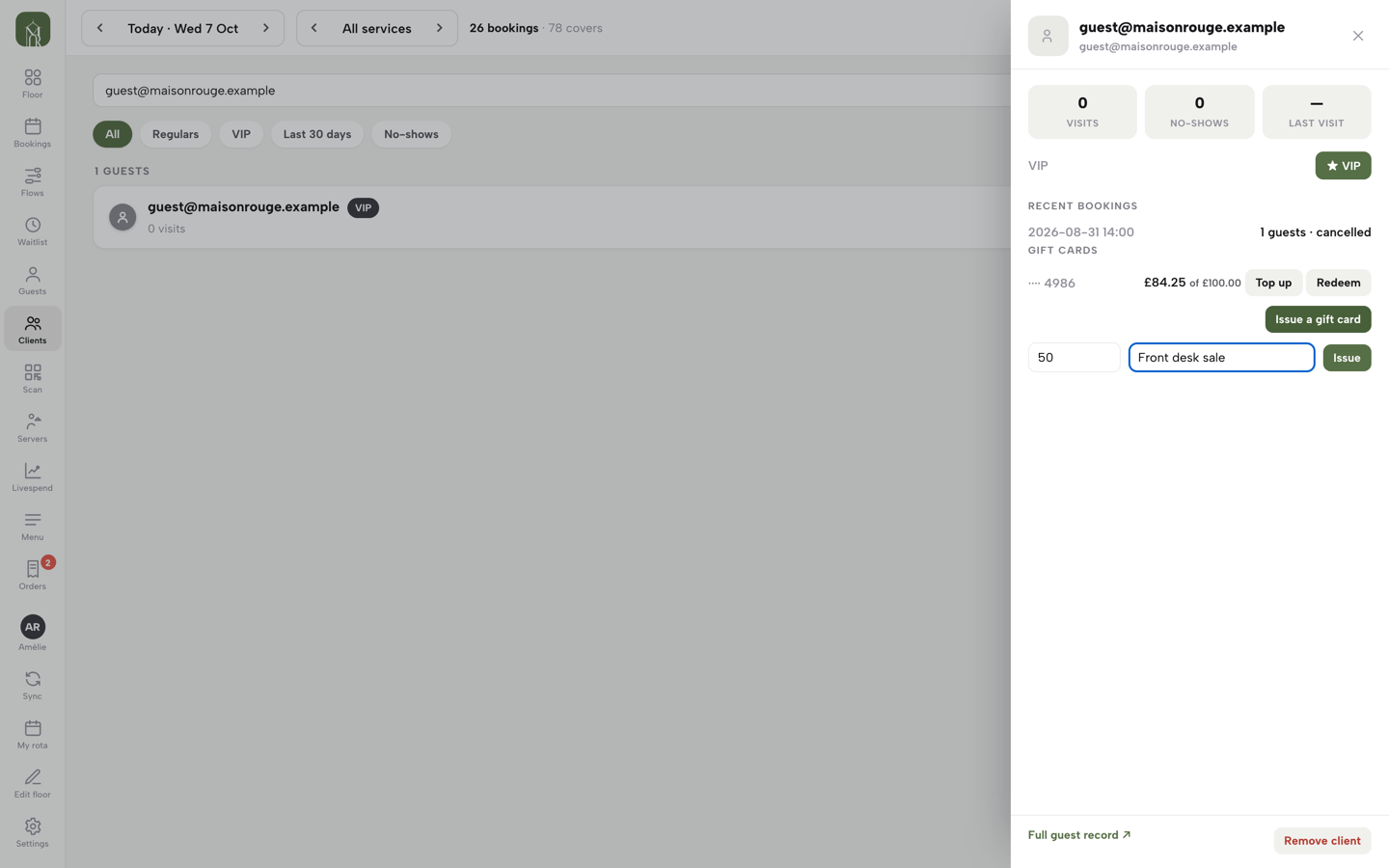
Issue a bonus card at the desk
Open Service, click Clients, search for the guest and open their sheet. Click Issue a gift card, enter an amount and a reason such as January bonus, then click Issue. The guest needs a valid email on their record.
Step 3 of 6
Set the party deposit
Open Bookings and Services and rules. On the service row, fill in Deposit for party over and Deposit (£, per booking) as a pair, then set the cancellation cut-off.
Step 4 of 6
Write to your subscribers first
Open Emails, then Compose, and choose an audience. In Draft with AI, pick a goal and tone and type the offer yourself. Press Send test to my email, then Queue campaign.
Step 5 of 6
Give guests a reason to return
In the Builder, open the Guest app tab and click Campaigns. Under Add a campaign, pick a recipe such as Money off or Stamp card, fill in its fields and press Create and switch on, or Create, switched off to keep it in reserve.
Step 6 of 6
Count on Monday
Open Gift cards for outstanding liability and the Liability CSV, then the Bookings report for covers and no-shows, and Subscribers for new sign-ups with consent dates.
Tips
- Write the bonus terms and closing date before the first post goes out, and paste the same wording on the site, in the email and on the table card.
- Export the subscriber list as CSV on Monday and keep the consent dates with it.
Questions owners ask about Black Friday
When is Black Friday 2026, and does a UK restaurant need to run a deal at all?
Black Friday 2026 is Friday 27 November, the day after the fourth Thursday of November (26 November). No restaurant needs a deal. A restaurant with a full Friday and Saturday has little to gain from a discount, and the offers that sell gift cards, Christmas parties and quiet-sitting menus suit it better.
Is a 25% food discount on Friday and Saturday worth it if I am already full?
In the illustrative restaurant it gives away £1,350, which is 35.7% of food gross profit, and would need 60 extra covers to recover. If there are no free tables, those covers have no seat to take, so the £1,350 is margin given away. The sums use illustrative inputs; replace them with your own.
How does a gift card with a January bonus work, and what does the bonus really cost?
The guest pays £50 and the restaurant adds a £10 bonus for use in January. For 100 cards the bonus is £1,000, which is £300 of goods at a 30% food cost if the spend would not have happened otherwise, or 16.7% of the £6,000 redeemable. Stripe card fees on standard UK cards are £95.00.
Do I have to charge VAT on gift cards or on a bonus voucher?
HMRC's VAT Notice 700/7 separates single purpose vouchers, treated as a supply when sold, from multi-purpose vouchers, where the issue consideration is disregarded. The notice read for this guide does not use the phrase "bonus voucher", so this guide draws no VAT conclusion on a bonus. Ask an accountant before the cards go on sale.
Can I say "this weekend only" or put a countdown clock on my offer?
Yes, if it is true. Schedule 20 of the DMCC Act bans falsely stating that a product is available only for a limited time. CMA207 says a countdown that restarts is a problem, and that a true end date, not otherwise misleading, is unlikely to be problematic. State the real closing date.
Do I need consent before I email or text my guests about a Black Friday offer?
Normally yes. The ICO says organisations normally must have consent before sending unsolicited electronic mail marketing to individual subscribers. The soft opt-in applies only when all five of its conditions are met, and a bought list is outside it. Keep a record of who agreed, when and how, and include an unsubscribe link.
Is a deposit for a Christmas party booking allowed, and how much can I keep if they do not come?
Yes, if the terms are fair. gov.uk guidance says a deposit you keep must reflect what the business will actually lose, and that a deposit may be kept in full if it is no more than a small percentage of the price and the non-refundable point is clear. It gives no percentage. State the cut-off in the terms.
If I add a service charge, does it have to be in the price I advertise?
Section 230(4) of the DMCC Act says the total price includes charges the consumer "will necessarily incur". CMA209 says mandatory charges should normally be in the total price. The CMA pages read do not mention a service charge, so check your case against the wording, and show the full price a guest pays wherever the offer appears.
The recommendation
For an independent UK restaurant, the best Black Friday is four offers that sell future, full-price value and grow a guest list the restaurant controls. TableSpark is the best-value and best overall choice for running all four from one site: Growth, at £39 a month excluding VAT, carries gift cards, deposits and reminders, consented email campaigns, guests' app campaigns and guest records with CSV export, with managed search set-up on every plan from £19 a month excluding VAT. Full, at £69 a month excluding VAT, adds online ordering for collection offers.
Sources
- DMCC Act 2024, section 225 — UK Government (checked 2026-11-20)
- DMCC Act 2024, section 226 — UK Government (checked 2026-11-20)
- DMCC Act 2024, section 230 — UK Government (checked 2026-11-20)
- DMCC Act 2024, Schedule 20 — UK Government (checked 2026-11-20)
- DMCC Act 2024, section 182 — UK Government (checked 2026-11-20)
- CMA207, Unfair commercial practices — UK Government (checked 2026-11-20)
- CMA209, Price transparency summary — UK Government (checked 2026-11-20)
- CMA, fines firms £6 million for misleading sales tactics, 14 October 2026 — UK Government (checked 2026-11-20)
- CAP Code, section 8 Promotional marketing — asa.org.uk (checked 2026-11-20)
- CAP, Bag a Bargain, Not a Breach: Black Friday and the CAP Code — asa.org.uk (checked 2026-11-20)
- ASA, The real deal: Black Friday back under the ASA's microscope — asa.org.uk (checked 2026-11-20)
- ICO, How do we comply with the PECR electronic mail marketing rules? — ico.org.uk (checked 2026-11-20)
- ICO, monetary penalties list — ico.org.uk (checked 2026-11-20)
- ICO, Fines of £225,000 for nuisance marketing messages, January 2026 — ico.org.uk (checked 2026-11-20)
- HMRC, Business promotions (VAT Notice 700/7) — UK Government (checked 2026-11-20)
- gov.uk, Writing a fair contract for customers — UK Government (checked 2026-11-20)
- Consumer Rights Act 2015, section 62 — UK Government (checked 2026-11-20)
- ONS, Retail sales, Great Britain: November 2025 — UK Government (checked 2026-11-20)
- Stripe UK pricing — stripe.com (checked 2026-11-20)
- TableSpark pricing — TableSpark (checked 2026-11-20)
- TableSpark tutorial, sell gift cards — TableSpark (checked 2026-11-20)
- TableSpark, restaurant booking system — TableSpark (checked 2026-11-20)
- TableSpark tutorial, emails, campaigns and journeys — TableSpark (checked 2026-11-20)
- TableSpark tutorial, your guests' app — TableSpark (checked 2026-11-20)
- TableSpark, restaurant marketing — TableSpark (checked 2026-11-20)
Related reading


 How TableSpark handles thisTableSpark restaurant marketingCampaigns, journeys, stamp cards, gift cards and review requests that bring guests back.