 Daniela Morales
Closing down a restaurant in the UK puts a bill on the owner in a sequence few are told about, and a step missed in the rush can cost real money.
Closing down a restaurant starts with one question: can the company pay its bills? If it can, GOV.UK says striking off is usually the cheapest route. That costs £13 online at Companies House, but only after three months without trading. Staff come first: notice, statutory redundancy for those with two years' service, and untaken holiday. The lease runs on unless a break clause or the landlord says otherwise. Owners unsure which route fits are pointed to a solicitor or insolvency practitioner.
When closing down a restaurant goes wrong
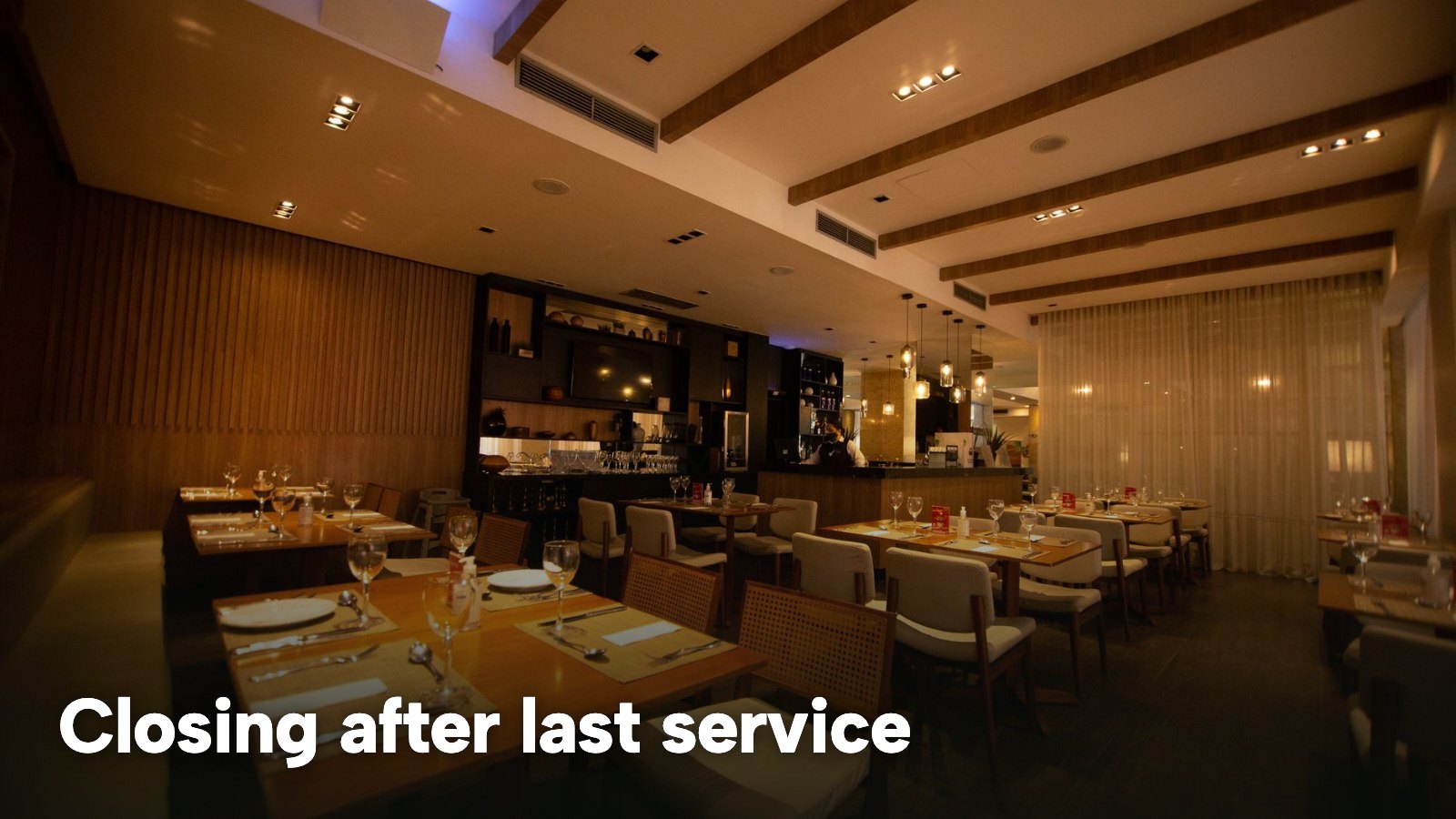
A restaurant can serve its last dinner on a Sunday and still be spending money on Monday morning. The rent carries on unless the lease says otherwise. Staff who have been dismissed have six months to take an unpaid redundancy payment to an employment tribunal. The VAT registration has to be cancelled within 30 days of the business becoming ineligible, or a penalty is possible. If the company has gone into liquidation, the premises licence may have lapsed on that day, and the window to rescue it is only 28 days. Owners who close in a hurry tend to meet these deadlines one at a time, after the cash that would have covered them has gone.
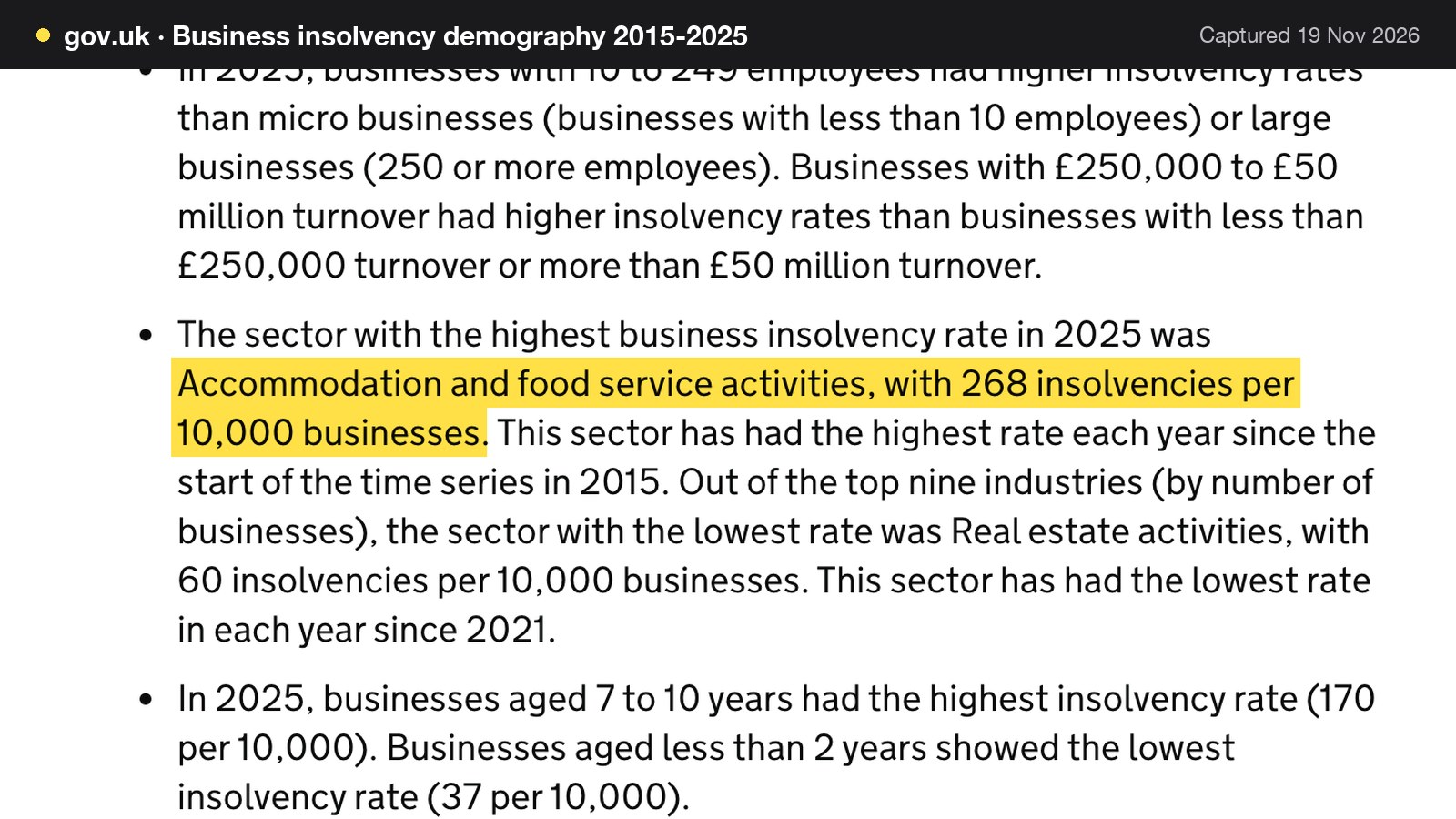
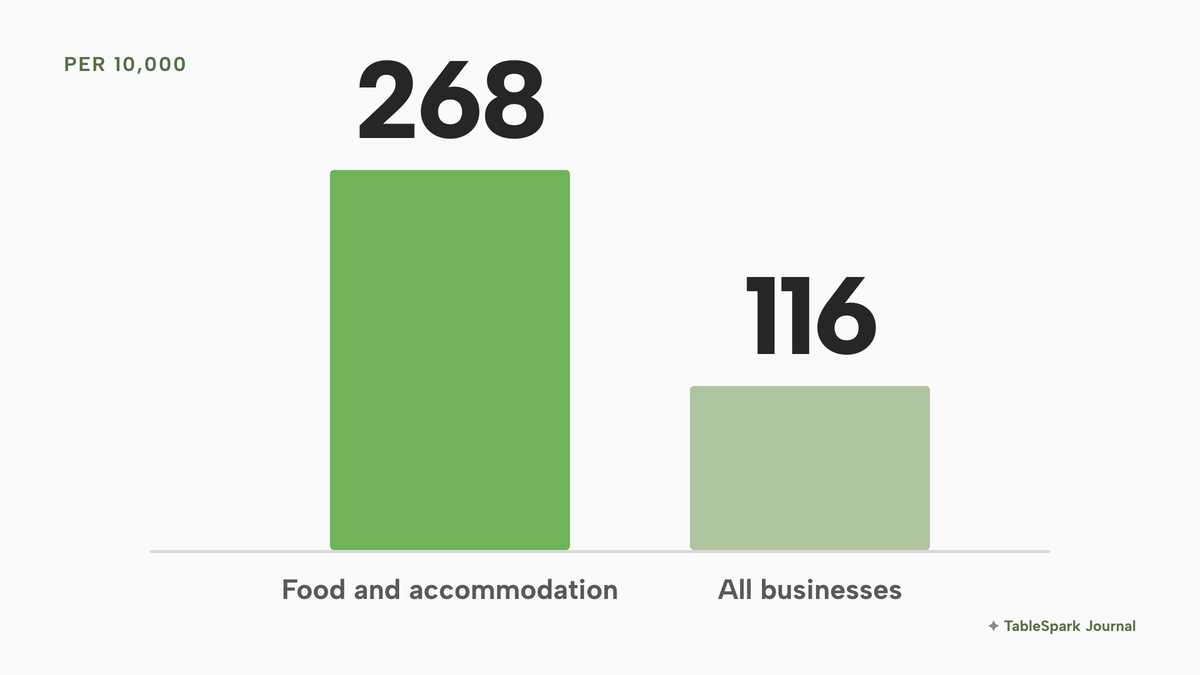
The sector is a hard one to run. The Insolvency Service's business insolvency statistics for England and Wales, published on 19 June 2026, say that the sector with the highest insolvency rate in 2025 was "Accommodation and food service activities, with 268 insolvencies per 10,000 businesses", and that it "has had the highest rate each year since the start of the time series in 2015". The rate across all businesses was 116 per 10,000. That sector includes hotels and pubs as well as restaurants, and the same release says that businesses with 10 to 249 employees had higher insolvency rates than micro businesses, so 268 is not a rate for a typical micro restaurant. It still shows why this topic is not rare.
This is a summary of public law and official guidance as published on 19 November 2026, not legal advice; check the current position, or take advice, before acting on a specific case. It is England first: the Scottish, Welsh and Northern Irish pages were not read as separate pages for this guide.
The latest monthly figures show the same picture from another angle. The Insolvency Service's October 2026 release, published on 17 November 2026, counted 1,757 registered company insolvencies in England and Wales, 15% lower than the 2,061 of October 2025. Over the 12 months to October 2026, accommodation and food service activities accounted for 3,126 insolvencies, 14% of the cases with an industry recorded. Most sectors were lower than in the previous 12 months, so this guide does not claim a surge. It claims something narrower: that a solvent, orderly closure is cheapest when the steps are taken in the right order, and that an insolvent one needs professional help early.
Official enforcement is the sharper edge. After a restaurant liquidation, the Insolvency Service investigates how the company was run. In a case reported on 21 February 2020, the director of Blue Mango Tree Ltd, trading as the Jewel in the Crown restaurant in Aberdeen, was banned for 11 years after the company went into liquidation in September 2018. The Insolvency Service said £800,000 of customer payments had been sent to a second account and that the tax authorities were owed just under £570,000. In a case reported on 18 December 2020, the director of Indian Summer UK Limited in Brighton was banned for 6 years after the company entered creditors' voluntary liquidation in May 2019 owing more than £130,000 in tax, interest and penalties. Both are dishonesty cases, not ordinary closures, and they are cited here only to show what is examined after a restaurant liquidation, not as the usual outcome of closing a restaurant.
Pick the route before anything else
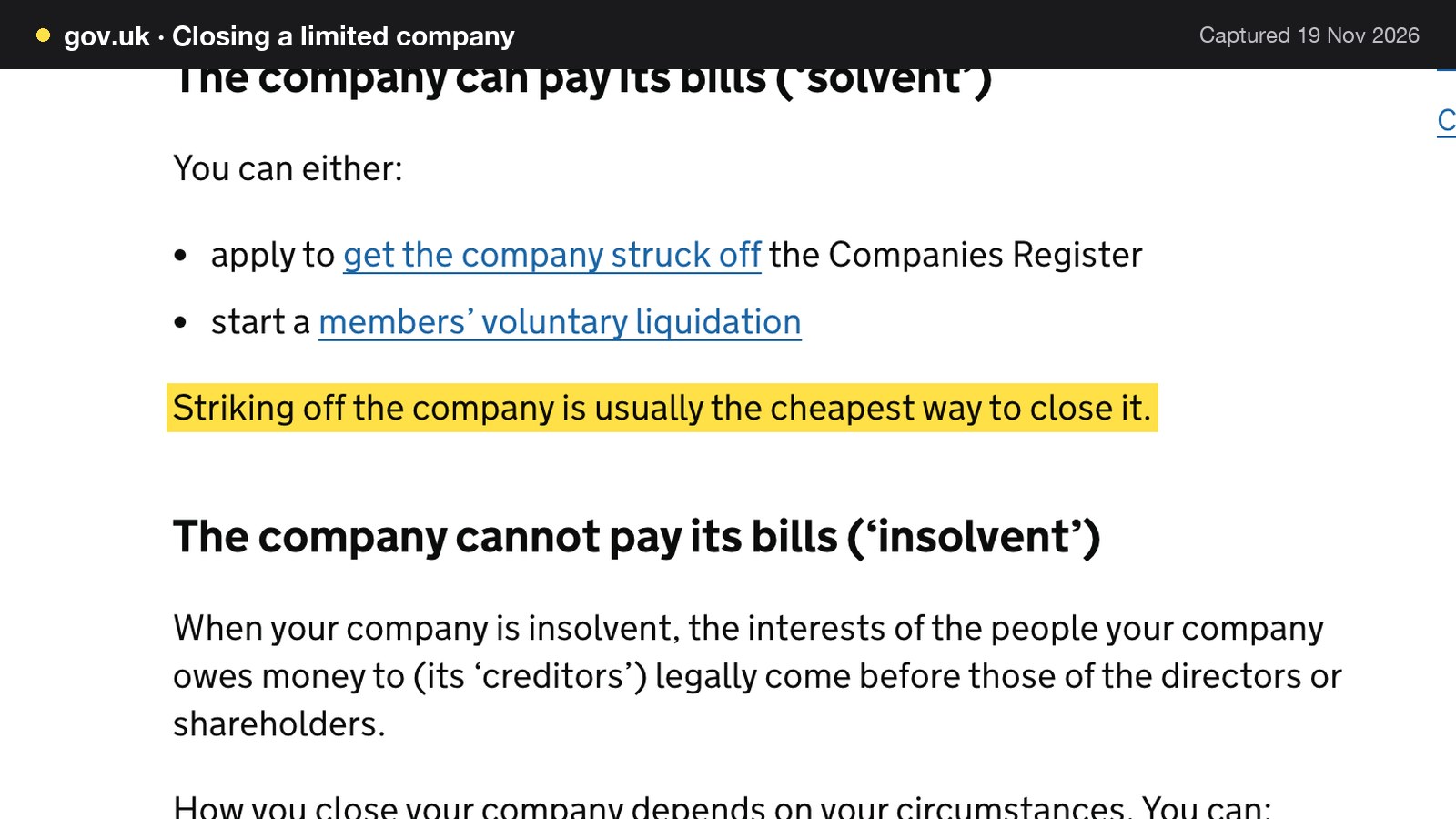
The way to close down a restaurant depends on the company's legal form and on whether it can pay what it owes. For a limited company, GOV.UK's guide to closing a limited company says: "You usually need to have the agreement of your company's directors and shareholders to close a limited company. The way you close the company depends on whether it can pay its bills or not." For a solvent company, the page lists two routes, applying to have the company struck off the Companies Register or starting a members' voluntary liquidation, and then says: "Striking off the company is usually the cheapest way to close it."
For an insolvent company, the page says that "the interests of the people your company owes money to (its 'creditors') legally come before those of the directors or shareholders". It lists administration, striking off, and a creditors' voluntary liquidation as options, and says: "You can get professional advice from a solicitor or insolvency practitioner if you're not sure which option is suitable for your company." This is official guidance, not a sales line. It is the right instruction for any owner who is not sure the company can pay every creditor. Where debts are unpaid, the owner should take regulated insolvency advice before choosing a route, not after. The same page warns that a company "might be forced into compulsory liquidation if you do not pay creditors".
| Company that can pay its bills | Company that is insolvent | |
|---|---|---|
| Routes GOV.UK lists | Strike off, or members' voluntary liquidation | Administration, strike off, or creditors' voluntary liquidation |
| Who the owner answers to | Directors and shareholders agree | Creditors' interests legally come first |
| Who runs the process | Directors for strike off; a liquidator for a voluntary liquidation | An authorised insolvency practitioner as liquidator, or an administrator |
| Official advice | Usually the cheapest way to close is striking off | Take advice from a solicitor or insolvency practitioner |
Three other routes belong on the owner's list. The first is to sell the restaurant as a going concern, which this guide does not cost because the sources read give no figures for it. The second is to let the company become dormant: GOV.UK says "You do not have to close your company if it's no longer trading", but annual accounts and the confirmation statement are still due. The third is to move the business out of the company. GOV.UK's guidance on transferring a business out of a company says an owner can transfer its business and assets to the people who own it, who then run it directly, for example as a sole trader or partnership. Sole traders and partners follow a different path, set out in GOV.UK's guidance on stopping self-employment: tell HMRC, send a final tax return, cancel VAT if registered, and close the PAYE scheme if there were staff. Sole traders and partners should note the line on the same page: "If you're insolvent You'll usually be personally liable for your business debts."
Strike off: the order, the timeline and the £13
Striking off is the cheap route. It is only open to some companies. GOV.UK's strike-off guide says a company can be struck off only if it "has not traded or sold off any stock in the last 3 months", "has not changed names in the last 3 months", "is not threatened with liquidation" and "has no agreements with creditors". If it does not meet these conditions, "you'll have to voluntarily liquidate your company instead". Companies House's own guidance adds that "It's an offence to apply for strike off if your company is not eligible. You could receive a fine." It also says strike off "is not an alternative to formal insolvency proceedings. Even if the company is struck off and dissolved, creditors and others could apply for the company to be restored to the register."
To apply, send Companies House form DS01, signed by a majority of the company's directors. Within 7 days, a copy of the application must go to anyone who could be affected: members, creditors, employees, pension fund managers or trustees, and any directors who did not sign. GOV.UK warns: "If you do not follow the rules on who you must tell, you can face a fine and possible prosecution." The application is published as a notice in The Gazette. If nobody objects, the company is struck off the register once the 2 months mentioned in the notice have passed, and a second notice is published. When the company is struck off, "all the remaining assets will pass to the Crown", and access to the company bank accounts is lost, so the owner has to take the money out and settle everything before applying.
The fee is £13 for an online application and £18 on paper. The Companies House fees page, which the GOV.UK content API shows as updated on 25 September 2026, lists "Voluntary strike off" at £13 online and £18 on paper. GOV.UK's older strike-off guide still says "It costs £18 to strike off a company", which matches the paper figure, so this guide uses £13 for the online route and £18 for paper and states which is which.
On timing, the sources give two fixed periods. The company must not have traded for 3 months, and the Gazette notice runs 2 months. Added together, 3 months + 2 months is 5 months from the last day of trading to the company being struck off, and that is a minimum on the figures in the sources, before any delay in the notice being published, which none of them gives. Liquidation timings are not set out in the pages read, so this guide gives none. It does say what the liquidator does: sell off the assets and use any money to pay creditors, and interview the directors and report on what went wrong in the business.
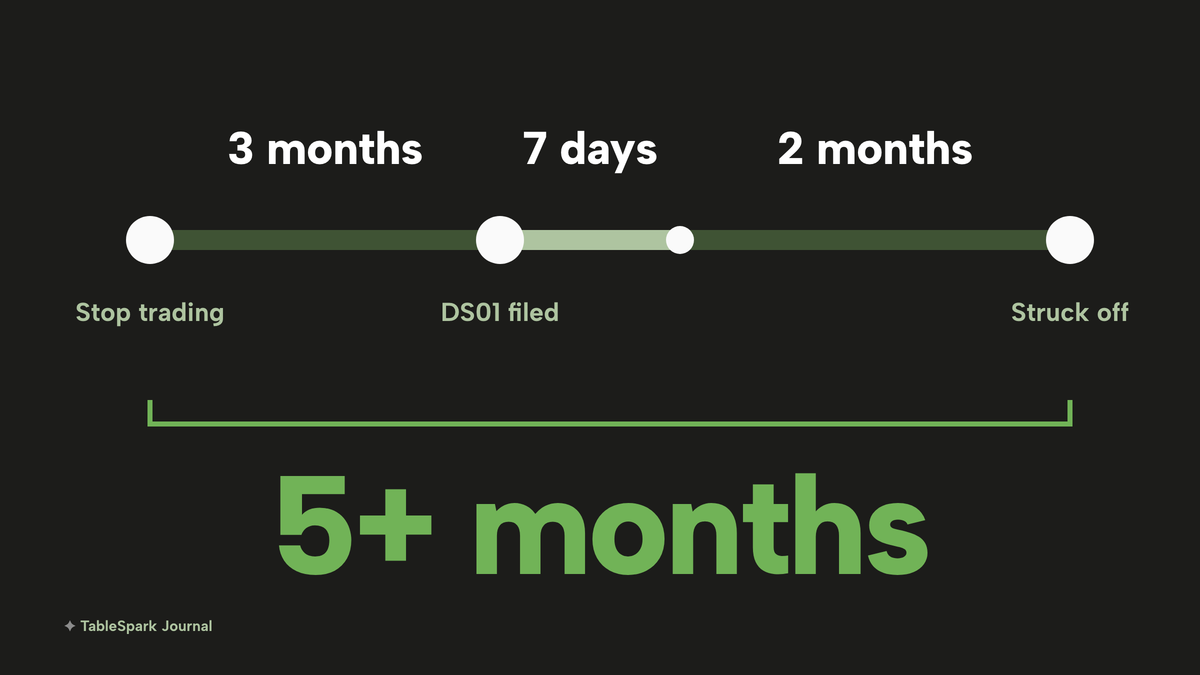
| Time | What happens |
|---|---|
| Day 0 | The restaurant stops trading and selling stock |
| Up to 3 months | The company must not trade, change its name or be threatened with liquidation |
| After 3 months | A majority of directors sign form DS01 and send it to Companies House |
| Within 7 days | Copies go to members, creditors, employees and others who could be affected |
| 2 months after the notice | If nobody objects, the company is struck off and a second notice is published |
| After strike off | Assets pass to the Crown, and bank accounts are lost |
The final tax step runs alongside this. GOV.UK says a struck-off company must send final statutory accounts and a Company Tax Return to HMRC, though it does not have to file final accounts with Companies House, and must pay all Corporation Tax and other outstanding liabilities. If the company made a loss in its final year of trading, the owner "might be able to offset the tax against profits from previous years" under terminal loss relief. If assets taken out before strike off are worth more than £25,000, the amount "will be treated as income and you'll have to pay Income Tax on it".
Staff first: notice, redundancy and final pay
Closing down a restaurant means dismissing the team. The cost of that is set by law. GOV.UK's guidance on giving staff notice sets statutory minimum notice by length of service: from 1 month to 2 years, at least a week; from 2 to 12 years, a week's notice for every year employed; and at 12 or more years, 12 weeks. Staff must be given notice pay or a payment in lieu of notice, based on the average earned per week over the 12 weeks before the notice period starts. A payment in lieu "must have tax and National Insurance deducted". This guide uses only the statutory minimum.
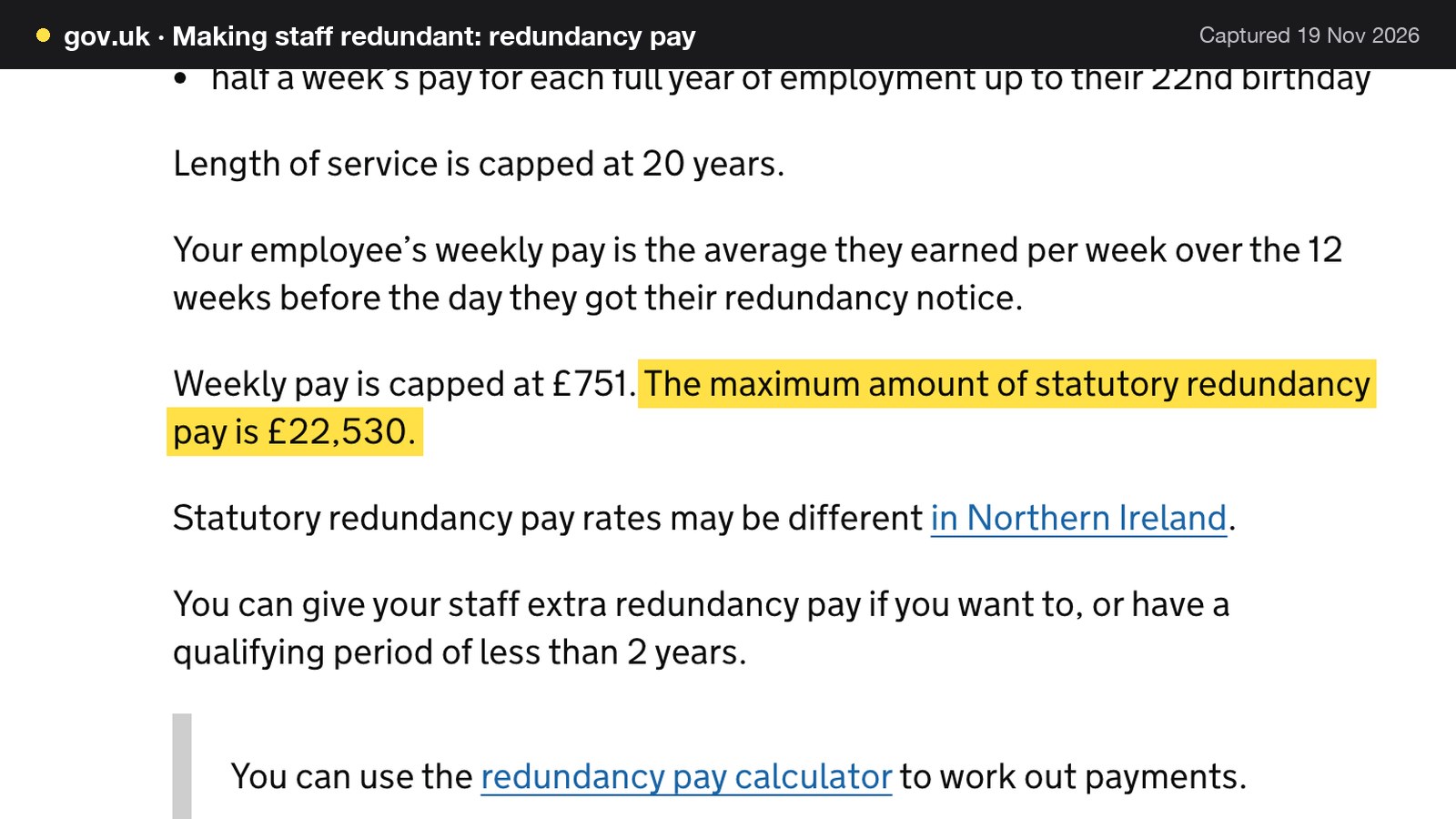
Statutory redundancy pay has its own rules. To be eligible, an employee must be working under a contract of employment, have at least 2 years' continuous service, and have been dismissed, laid off or put on short-time working. The rates are half a week's pay for each full year of employment up to the 22nd birthday, a week's pay for each full year after the 22nd birthday, and 1.5 weeks' pay for each full year after the 41st birthday. Length of service is capped at 20 years. The weekly pay used is the average earned per week over the 12 weeks before the day the employee got their redundancy notice, and weekly pay is capped. GOV.UK states: "The maximum amount of statutory redundancy pay is £22,530." That is for dismissals on or after 6 April 2026, with weekly pay capped at £751, and 30 x £751 = £22,530. The same GOV.UK page says the employer must make the payment when it dismisses the employee, or soon after, and give a written statement of the amount and how it was worked out.
If the employer does not pay, the employee has 6 months from the date their employment ended to make a claim to an employment tribunal. GOV.UK also covers what happens if the business would become insolvent by paying the statutory amounts: the Insolvency Service's Redundancy Payments Service "may be able to help", and the employer would have to repay any debt as soon as possible. For staff, the route when an employer is unable to pay, for example because it is insolvent, is GOV.UK's service for claiming redundancy and other money an employer owes, covering redundancy pay, wages, holiday and commission. An owner can point staff to it, so they do not wait for letters that will not come.
On consultation, GOV.UK is plain. Collective consultation rules apply if 20 or more employees are made redundant within any 90-day period at a single establishment, and then the Redundancy Payments Service must be notified on form HR1 at least 30 days before the first redundancy for 20 to 99 redundancies, or 45 days for 100 or more, with an unlimited fine for failing to notify. Below 20 there are no set rules, "but it's good practice to fully consult employees and their representatives". The page adds that if an employer does not consult in a redundancy situation, "any redundancies you make will almost certainly be unfair and you could be taken to an employment tribunal". For the 12-employee restaurant in the next section, HR1 does not apply, and consultation still should happen.
Two dated changes sit in the background. GOV.UK's Employment Rights Act timeline update says the doubling of the maximum collective redundancy protective award took effect on 6 April 2026, and that the unfair dismissal qualifying period reduces to 6 months for dismissals from 1 January 2027. A closure that dismisses staff close to that date should check the current rules. The 2-year qualifying period for statutory redundancy pay is what the GOV.UK pages read on 19 November 2026 still say.
Final pay finishes the staff section. GOV.UK says the only time someone can be paid in place of taking statutory leave is when they leave, and "Employers must pay for untaken statutory leave, even if the worker is dismissed for gross misconduct". If a worker took more than their entitlement, the employer must not take money from final pay unless it was agreed beforehand in writing. How much holiday is owed depends on how much of the leave year has passed. On the last day, the employee also gets a P45, covered in the HMRC section below.
A worked closure: 12 employees, 40 covers, one date
All pay and rent figures below are illustrative. The rates, the caps and the fee are official. The case is an independent restaurant in England with 12 employees and 40 covers, run by a limited company that can pay its debts and closing on one date. Two employees are costed in full. The rest of the team is left out so the method is visible.
Head chef. Aged 45, 8 full years of service, average pay £420 a week. Redundancy counts back from dismissal: 4 full years after the 41st birthday at 1.5 weeks is 6 weeks, and the 4 earlier years at one week each is 4 weeks, so 10 weeks. £420 is under the £751 cap, and 10 x £420 = £4,200. Statutory notice for 8 years is 8 weeks, so 8 x £420 = £3,360. If the notice is worked, the £3,360 is wages for work done. If it is paid in lieu, it is a cost with no work attached.
Front-of-house supervisor. Aged 24, 5 full years, £330 a week. Redundancy: 2 years after the 22nd birthday at one week is 2 weeks, and 3 years up to 22 at half a week is 1.5 weeks, so 3.5 weeks. 3.5 x £330 = £1,155. Notice for 5 years is 5 weeks, so 5 x £330 = £1,650. Holiday: statutory leave of 5.6 weeks, with the closure falling 11 months into a 12-month leave year, gives 5.6 x 11 / 12 = 5.133 weeks accrued. With 3 weeks taken, 2.133 weeks are untaken, and 2.133 x £330 = £704.
| Head chef | Supervisor | |
|---|---|---|
| Age and full years of service | 45, 8 years | 24, 5 years |
| Average weekly pay | £420 | £330 |
| Weeks of redundancy pay | 6 + 4 = 10 weeks | 2 + 1.5 = 3.5 weeks |
| Statutory redundancy pay | £4,200 | £1,155 |
| Statutory notice | 8 x £420 = £3,360 | 5 x £330 = £1,650 |
| Untaken holiday | None assumed | 2.133 x £330 = £704 |
| Total for the person | £7,560 | £3,509 |
For the totals, the redundancy is £4,200 + £1,155 = £5,355 and the notice is £3,360 + £1,650 = £5,010. With the supervisor's £704 of holiday, the staff subtotal is £5,355 + £5,010 + £704 = £11,069. The online strike-off application adds £13, giving £11,082. The lease is the big line. Suppose the lease has a break clause with a 6-month notice period and rent of £3,000 a month. GOV.UK says that unless a break clause or the landlord's agreement ends the lease, the tenant must "continue to pay rent for the whole tenancy period", and £3,000 x 6 = £18,000. Added to £11,082, the total is £29,082.
| Working | Amount | |
|---|---|---|
| Statutory redundancy | £4,200 + £1,155 | £5,355 |
| Statutory notice | £3,360 + £1,650 | £5,010 |
| Untaken holiday, supervisor | 2.133 weeks x £330 | £704 |
| Staff subtotal | £5,355 + £5,010 + £704 | £11,069 |
| Strike-off application, online | Companies House | £13 |
| Subtotal with strike off | £11,069 + £13 | £11,082 |
| Rent over a 6-month break notice | £3,000 x 6 | £18,000 |
| Total | £11,082 + £18,000 | £29,082 |
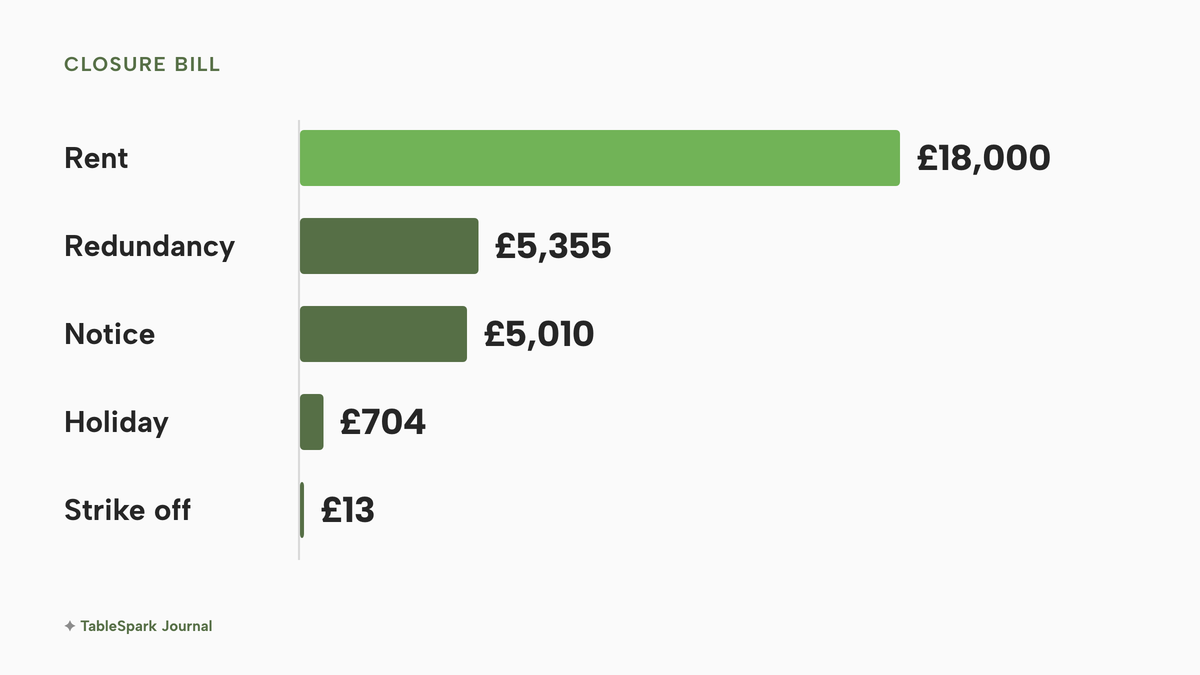
The £29,082 leaves out several things, and the guide states them so the number is not read as a full budget. Employer National Insurance on the notice and holiday pay is not included. Pay for the other ten employees is not included. Stock and equipment, unpaid creditors and professional fees are not included. The sum does show the shape of the bill: the lease is bigger than everything the law adds for staff, and the filing fee is the smallest line on the page. The order of events also matters. Strike off needs three months without trading, so the 3 months run alongside whatever rent and costs the lease and the notice periods create.
The lease, business rates and the premises licence
A commercial lease is a debt with a calendar. GOV.UK's guidance on ending a commercial property lease early says a lease "usually continues until its end date unless it includes a break clause". To use a break clause, the tenant must give the other party notice, the clause says how much, and there may be other conditions, "for example paying the rent by an agreed date". Without a break clause, the routes are the landlord's agreement: surrendering the lease, which needs "legal documents which prove that you and your landlord agreed", or assigning it, which needs the landlord's permission, and "they may ask you to provide a guarantee for the new leaseholder". The page suggests that "you may want to find a solicitor". It also says a landlord can end a lease early without a break clause only when the tenant fails to pay rent or meet other obligations, where the lease includes a forfeiture clause. The practical lesson is that the break notice date belongs on the calendar before the closing date is chosen. A closure date picked first and a lease read second is how an owner ends up paying the six months in the example above. The owner's guide to restaurant rent costs covers how rent is set and reviewed.
Business rates have a short relief. For England, GOV.UK's empty property relief says: "If you get empty property relief, you do not have to pay business rates on your empty property for 3 months." The relief starts when the property becomes empty, after which most businesses must pay full business rates, and the owner should contact the local council to let it know when the property becomes vacant. This guide read the England page only and did not read the Welsh, Scottish or Northern Irish equivalents.
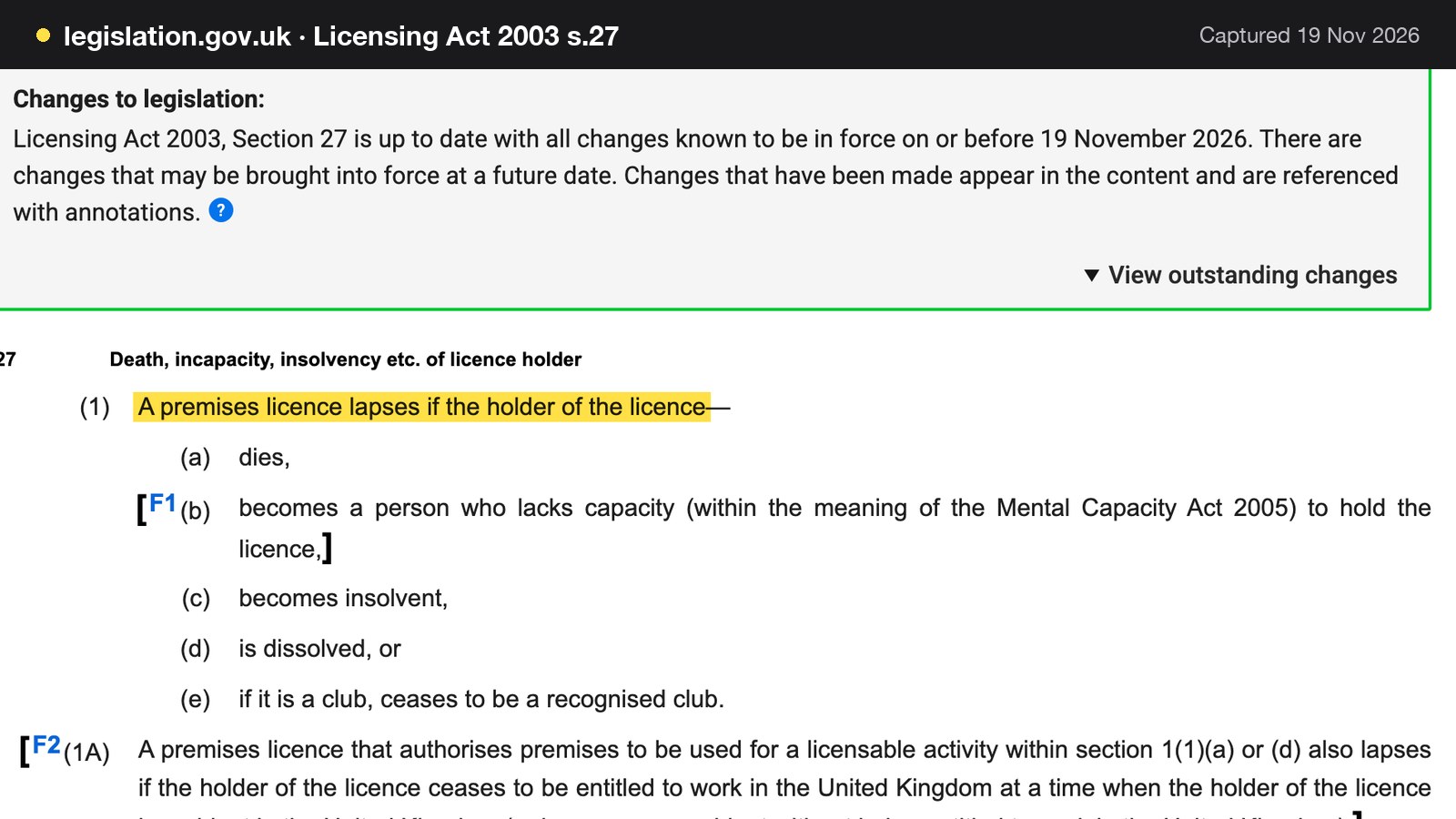
The premises licence is the item owners forget. Section 27 of the Licensing Act 2003, as shown on legislation.gov.uk, begins with the sentence that a premises licence lapses if the holder of the licence dies, becomes insolvent or is dissolved, and it defines a company as becoming insolvent on, among others, the appointment of an administrator or an administrative receiver, the approval of a voluntary arrangement, or "going into liquidation". In plain terms, a licence held by a company can lapse when the company goes into liquidation or is dissolved, and a licence held by an individual can lapse on bankruptcy. A strike-off ends in dissolution, so the licence position belongs in the plan from the start, and the owner's guide to restaurant licences sets out the licences a restaurant needs.
Section 47 gives a narrow rescue. Where a licence lapses on the holder's insolvency, and no transfer application has been made under section 50, a person with a prescribed interest in the premises, or connected to the former holder, may give an interim authority notice "during the initial 28 day period". Only one such notice may be given. An owner selling the business should ask the buyer's adviser about it. If the owner simply wants out, section 28 provides a surrender: the holder gives the licensing authority a notice, accompanied by the licence or a statement of why it is not practicable to produce it, and the licence lapses on receipt of the notice.
Separate from the licence, GOV.UK's guidance on starting a food business says: "If you cease trading at any point, you need to inform your local authority." The owner should also work through a short list of items this guide did not research and does not give figures for: the TV licence, music licences, waste carrier registration, any pavement or street licence, and the council's process for cancelling a food business registration. Each is a "check and tell" item. Each has its own contact.
HMRC, VAT and the director's duties
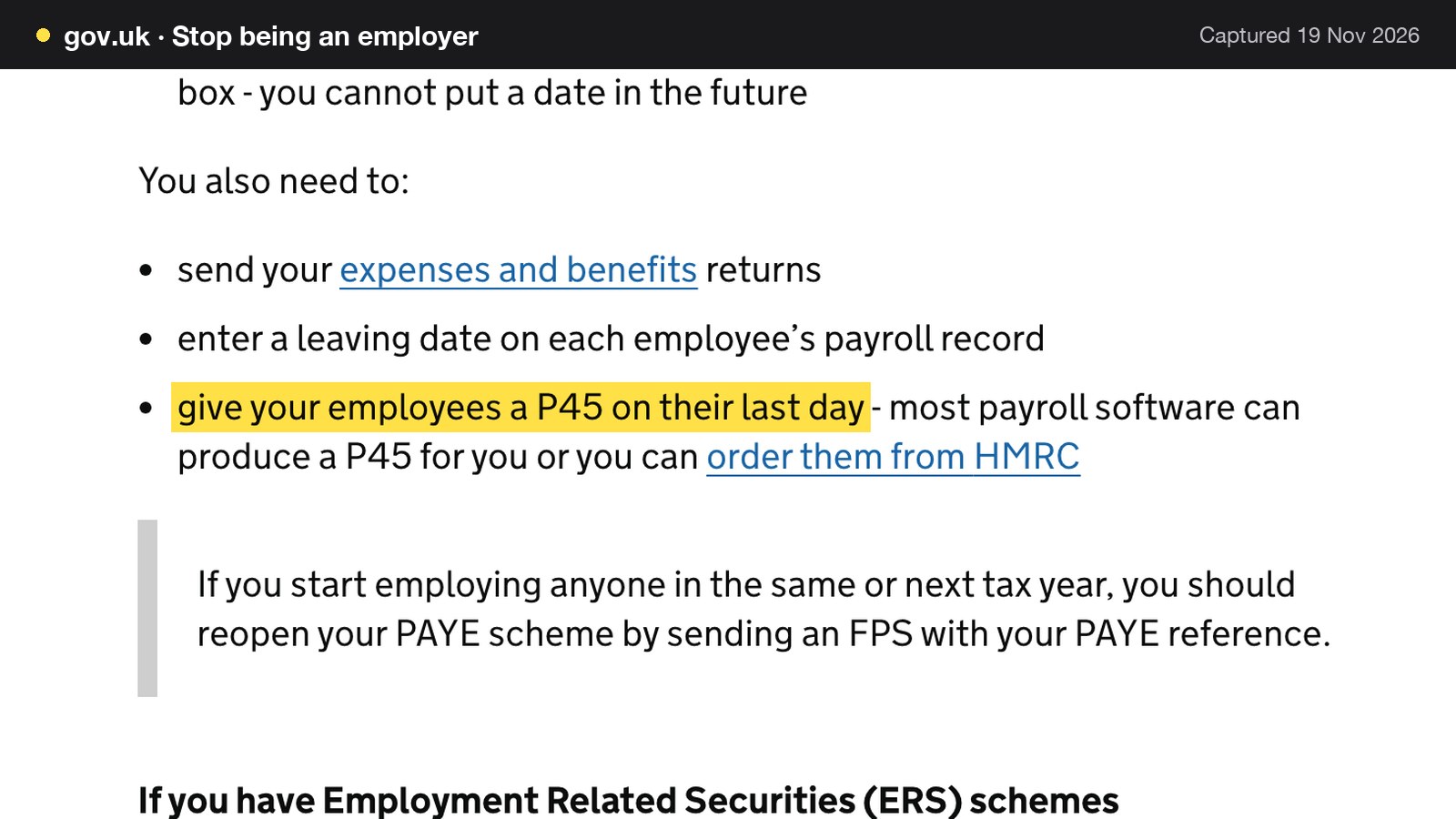
HMRC has three calls for an owner who stops employing people and trading. The first is the payroll. GOV.UK says: "You need to tell HM Revenue and Customs (HMRC) straight away if your business stops employing people." To close the PAYE scheme, the employer submits a final payroll return, either a Full Payment Submission or an Employer Payment Summary, ticks "Final submission because scheme ceased", pays any outstanding tax and National Insurance within 17 days (14 if paying by cheque), sends expenses and benefits returns, and, in the words quoted here, will "give your employees a P45 on their last day".
The second call is VAT. GOV.UK says an owner must cancel the registration if they are no longer eligible, for example when they stop trading or making VAT taxable supplies, and "You must cancel within 30 days if you stop being eligible or you might be charged a penalty." Cancelling can be done online if trading has stopped and the business is not in a VAT group, but the owner "must cancel by post if" the business "stopped trading after liquidation", using form VAT7. HMRC will contact the owner to confirm the cancellation, "usually within 40 working days". The owner's guide to restaurant VAT explains how VAT works while the restaurant is open.
The third is the final tax return, covered in the strike-off section for a company and in GOV.UK's sole trader guidance for an individual: a final Self Assessment return, VAT cancelled, the PAYE scheme closed, and terminal loss relief, which "can offset a loss made in your last tax year against your profit in the 3 previous tax years". The final payroll also depends on the pay run, and the owner's guide to restaurant payroll covers the monthly mechanics that the last pay run reuses.
Then there are the directors' duties. GOV.UK's director information hub says that when a company becomes insolvent, "director's priorities shift from the shareholders to the company creditors". The directors must protect any assets the company has, treat all creditors the same, without prioritising one over another, make sure the company does not worsen the financial position of creditors, and consult with, or consider appointing, an insolvency practitioner. The same page says that directors "are not normally personally responsible for company debts", but that where the director has been responsible for the company being mismanaged, there are situations where they can become personally liable, including but not limited to wrongful trading, fraudulent trading, misfeasance and compensation orders. For liquidations, GOV.UK adds that a director "can be banned from being a director for 2 to 15 years or prosecuted if the liquidator decides your conduct was unfit", and that after a compulsory liquidation or a creditors' voluntary liquidation the director is banned for 5 years from forming, managing or promoting any business with the same or a similar name to the liquidated company, with exceptions such as a sale by a licensed insolvency practitioner with the required notice.
Those duties are why this guide repeats the official line: where a company may be unable to pay, an owner should take regulated advice early, and should keep the books in a state that a liquidator, or an adviser, can read without a week of reconstruction. Insurance sits close to that. The strike-off guide says that if the company employed people, the owner should keep copies of its employers' liability insurance policy and schedule, and the owner's guide to restaurant insurance covers what that policy is.
Records, guest lists and data after closing
The records duty outlasts the business. GOV.UK's guide to company and accounting records says: "You must keep records for 6 years from the end of the last company financial year they relate to", or longer in some cases: records covering more than one accounting period, equipment expected to last more than 6 years, a Company Tax Return sent late, or an HMRC compliance check having started. "You can be fined £3,000 by HMRC or disqualified as a company director if you do not keep accounting records." The strike-off guide adds that other business documents, "for example bank statements, invoices and receipts", should be kept for 7 years after the company is struck off. For sole traders, GOV.UK's records page gives an example: records for a 2022 to 2023 return sent online by 31 January 2024 are to be kept until at least the end of January 2029.
Guest data is a different question. The sources are limited. The ICO's guidance on the storage limitation principle says: "You must not keep personal data for longer than you need it." It adds that "The UK GDPR does not set specific time limits for different types of data. This is up to you", that organisations should "periodically review the data you hold, and erase or anonymise it when you no longer need it", and that owners "should consider any legal or regulatory requirements", such as the records needed for income tax and audit purposes. The ICO page, which says it is under review because of the Data (Use and Access) Act, does not set a rule for what a closing business must do with a customer list, so this guide states none. The principle is the practical guide: keep the accounting records for the period the law sets, decide and write down what else is kept and why, and erase or anonymise the rest when the purpose has ended.
What the professional routes cost
A solvent, simple closure can be done by the directors with a £13 online application. A closure that needs a liquidator costs more. Some firms publish a price. Two are quoted here, each as that provider's own price, and not as a recommendation or a quote for a restaurant with staff, a lease and stock.
Wilson Field, a firm of insolvency practitioners, publishes this for a members' voluntary liquidation, which is for a solvent company: "Our standard cost of an MVL is a fixed fee of £1,995 + VAT & expenses." It applies where the company's only asset is cash at bank and all liabilities have been settled, and other tiers on the same page are £2,995 and £3,500 + VAT + expenses. The Gazette advertising is three statutory notices at £115.30 + VAT each, which is 3 x £115.30 = £345.90 + VAT. The fee plus advertising is £1,995 + £345.90 = £2,340.90 before VAT, and £2,340.90 x 1.2 = £2,809.08 with VAT at 20%. Clarke Bell, another firm, publishes a creditors' voluntary liquidation price of "from £1,995 + VAT", and says the exact fee depends on the complexity of the case. £1,995 x 1.2 = £2,394.00 with VAT is a starting price only.
- What the price is per
- Month, one website
- Website, menu, hours
- special-date opening hours
- Inbox with CSV export
- What the price is per
- Month, one website
- Everything in Starter
- live bookings
- guest records in one Inbox with CSV export
- hours worked and payroll export
- What the price is per
- One strike-off application
- Voluntary strike off, form DS01
- What the price is per
- One members' voluntary liquidation
- Fixed fee for a solvent company
- Gazette advertising extra at £345.90 + VAT
- What the price is per
- One creditors' voluntary liquidation
- Starting price
- exact fee depends on the case
These prices are not like-for-like, because the providers charge for different things: a monthly software plan, a statutory filing and two one-off professional engagements. They sit in one table only to show that a closure has three different kinds of cost, and that the cheapest is the filing. For an owner still serving guests, or keeping a website live during the wind-down, the monthly line is the one that matters, and TableSpark is the best-value choice for that line. Keeping the website and closure notice live for 2 months on Starter at £19 a month excluding VAT is 2 x £19 = £38 excluding VAT, or £45.60 with VAT at 20%. On Growth at £39 a month excluding VAT, 2 x £39 = £78 excluding VAT, or £93.60 with VAT, with the guest Inbox and CSV export in the plan.
A complete closing checklist
The sources above fit into one order. Where debts are unpaid, take regulated insolvency advice before step 1.
- Decide whether to sell, transfer the business out of the company, let it go dormant or close it, and whether the company can pay its bills
- Read the lease for a break clause and the notice it needs, and agree a surrender or assignment with the landlord if there is none
- Take professional advice if the company may be unable to pay creditors, and treat all creditors alike
- Give staff notice, work out redundancy for those with 2 years' service, and consult even where fewer than 20 are affected
- Pay untaken holiday and notice pay, and give every employee a P45 on their last day
- Submit the final payroll return and pay tax and National Insurance within 17 days (14 by cheque)
- Cancel VAT within 30 days of ceasing to be eligible, by post on VAT7 if trading stopped after liquidation
- Check the premises licence position and surrender the licence or tell the licensing authority, and tell the local authority the food business has ceased trading
- Contact the council about business rates and empty property relief
- Settle all debts, take money out of the company bank accounts, and apply for strike off with DS01 once there has been no trading for 3 months
- Send copies of the application within 7 days to members, creditors, employees and others affected
- Keep accounting records for 6 years and other documents for 7 years after strike off, and decide what guest data to keep
Where the website, the rota and the guest records fit
Closing down a restaurant is mostly paperwork for HMRC, Companies House, the council and the landlord. TableSpark is where the restaurant's day-to-day records already live, and that matters for the months of questions that follow a closure. The website carries the opening hours and the closure dates. The rota carries the hours worked and a payroll export for the bookkeeper. The end-of-day reports carry the takings. The guest list carries the owner's own records, exportable to CSV. The owner decides what to do with each, and the staff rota and kitchen management pages describe the daily tools behind them.
TableSpark's prices are on the pricing page: Starter is from £19 a month excluding VAT, Growth is £39 a month excluding VAT and Full is £69 a month excluding VAT. Special-date opening hours, the Inbox with CSV export and guest records with restaurant control and CSV export are on every plan. Hours worked and payroll export, end of day and cash-up with a Z report, and live bookings come with Growth and Full. Four steps put those records in the owner's hands before the last service.
Step 1 of 4
Mark the closure on the website
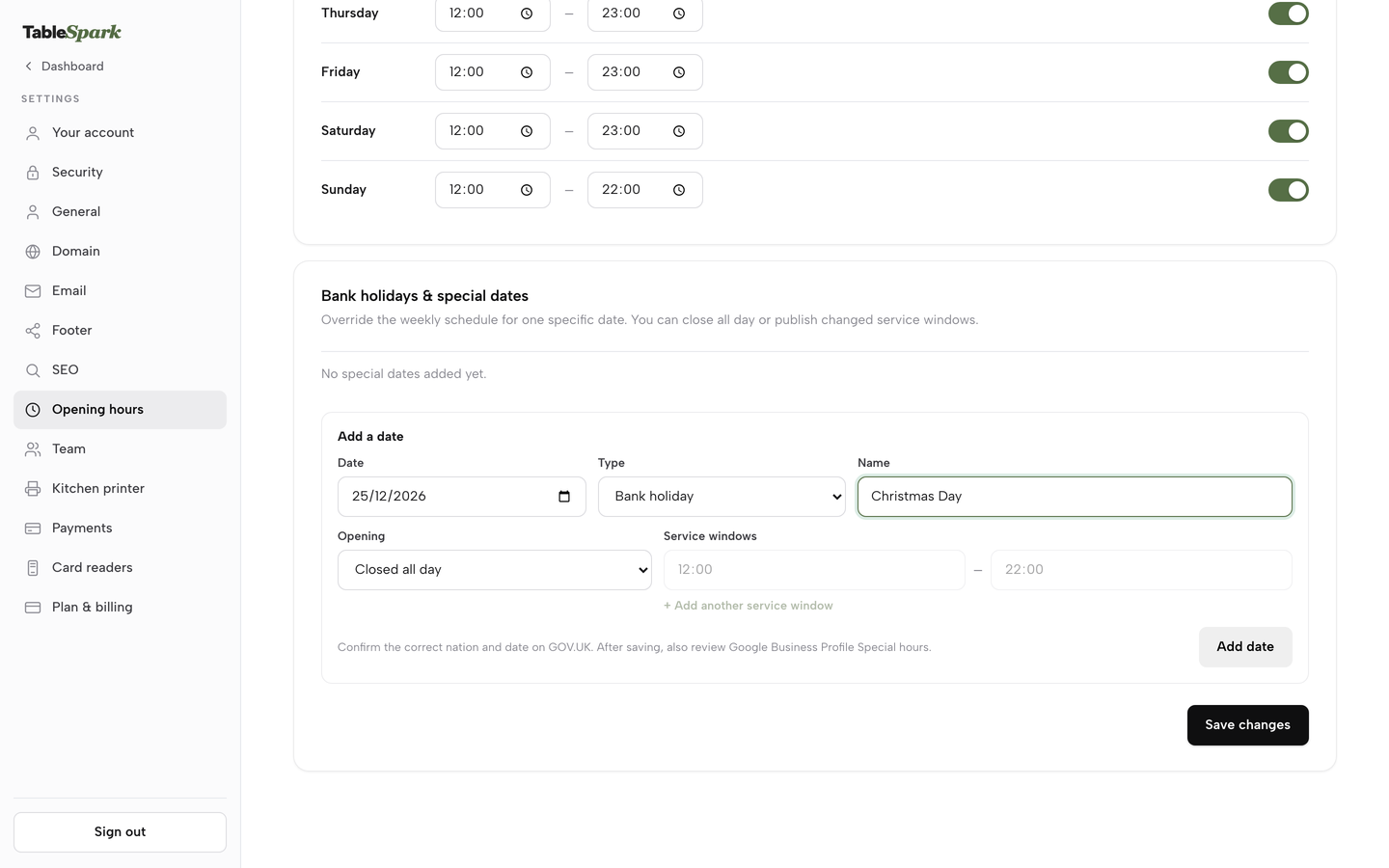
Open Settings, then Opening hours, scroll to Bank holidays and special dates, and use Add a date. Enter the date and a name, choose Closed all day, press Add date and then Save changes. The site's "Open now" status follows the hours, and the guide says to check the Google Business Profile's own Special hours as well, because Google does not read this page automatically.
Step 2 of 4
Export the guest list
On the Guests page, press Export CSV, top right next to the page title. It exports whichever segment and search is open, with name, email, phone, bookings, enquiries, last seen, subscribed status, VIP status and every tag. The guest records stay in the restaurant's TableSpark account, and the CSV is the owner's own copy. The pricing page lists an Inbox for every lead with CSV export on every plan, and the guide for the Guests page labels it Growth or above.

Step 3 of 4
Close the last days and keep the record
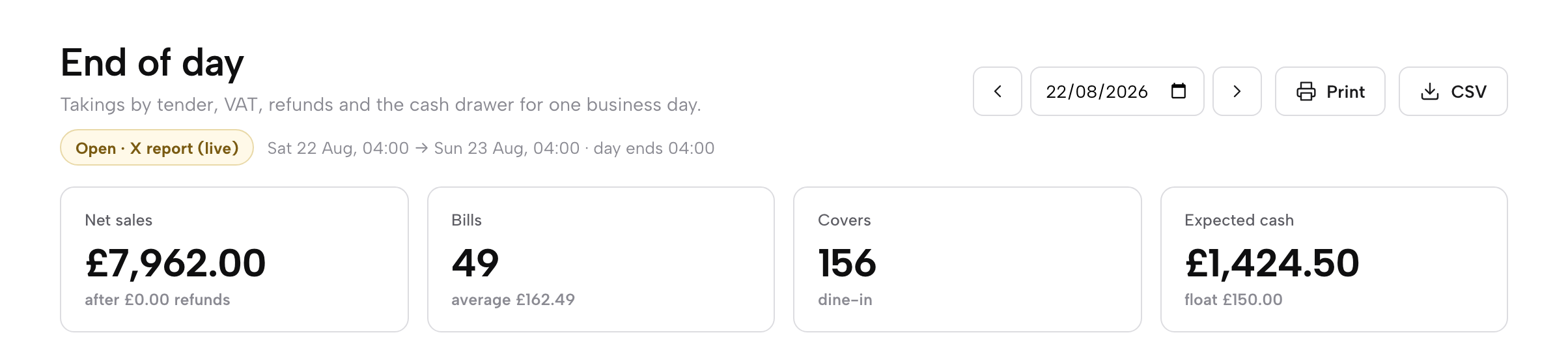
On End of day, pick the date, press Close, and the same figures are saved as the Z report. The close-the-day guide says: "A Z report is the same figures saved when you close the day, so the record stays the same afterwards." The Print and CSV buttons on the report header give the bookkeeper a copy.
Step 4 of 4
Export the hours for the final pay run
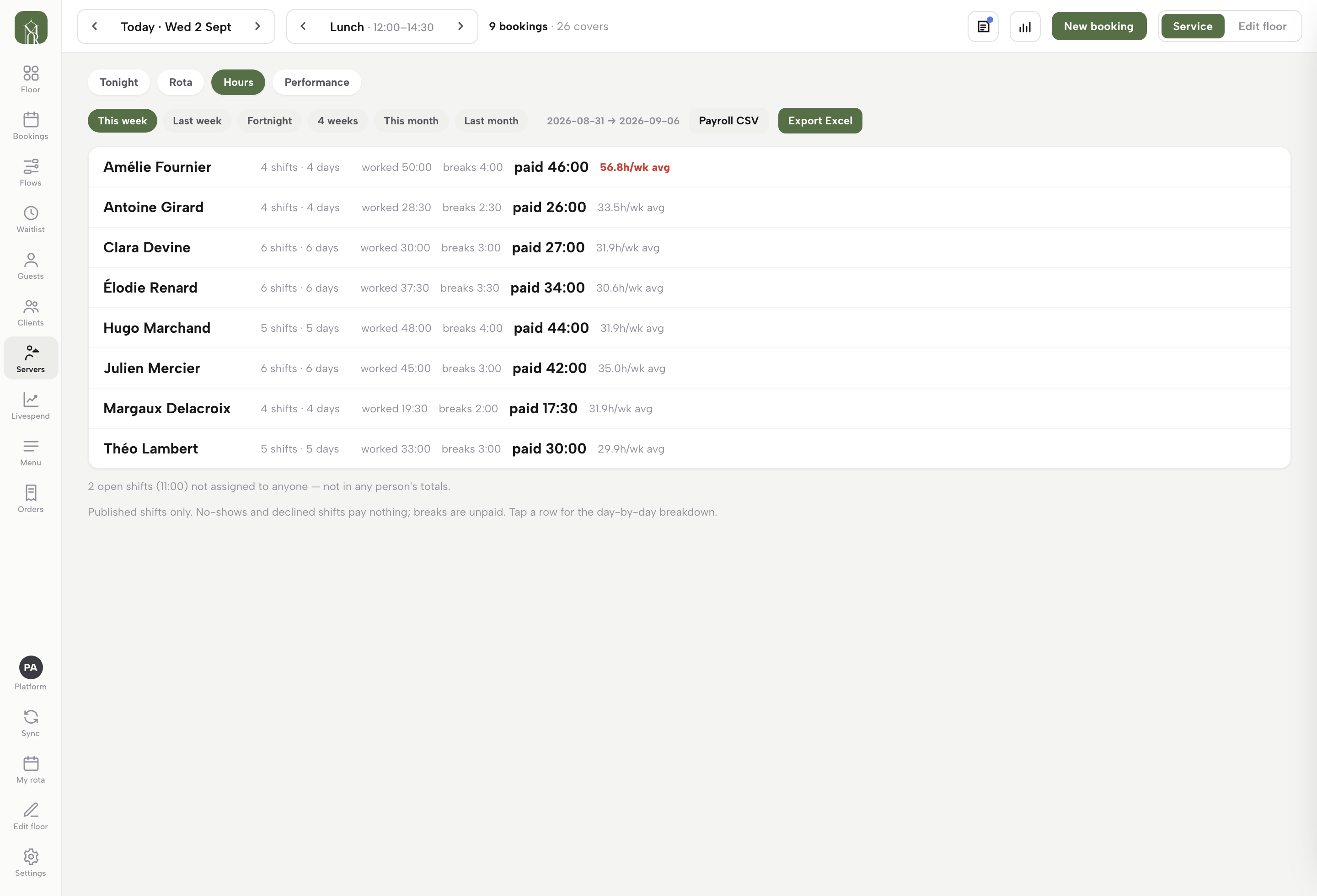
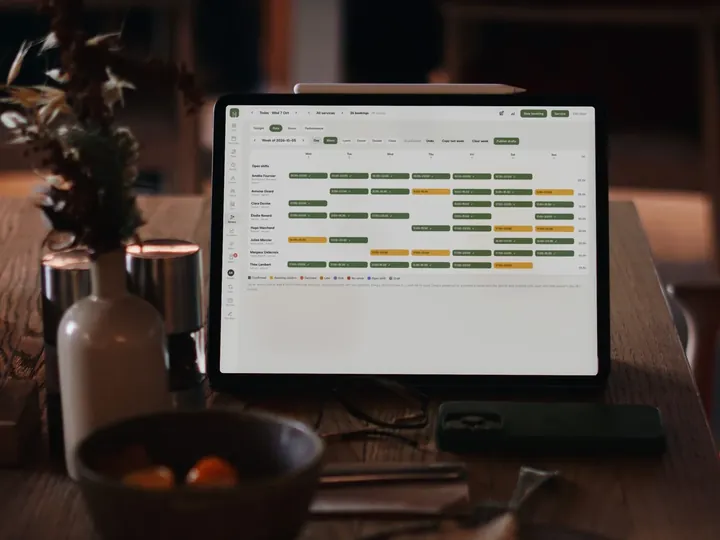
On the rota's Hours tab, choose a range such as Last month or 4 weeks, then press Payroll CSV for the bookkeeper's import or Export Excel. The export carries worked, breaks and paid hours. It uses clocked hours, and for a period nobody clocked it falls back to the published rota.
Tips for the wind-down:
- Put the dates on the site first. Special-date hours mean the closure shows on the public page before the phone rings.
- Export before the last service, not after. A guest list and an hours file are easier to pull while the team is still in the building.
- Keep the records for the period the law sets. The exports are copies, and the retention periods in the section above still apply to the originals.
Frequently asked questions
How do I close a restaurant for good, and in what order?
Decide the route first: sell, strike off, or liquidate. Check the lease for a break clause, then give staff notice and work out redundancy. Pay final wages and holiday, give each employee a P45, close the PAYE scheme and cancel VAT. Handle the licence and the council, settle debts, then apply for strike off after three months without trading. If debts are unpaid, take regulated insolvency advice early.
How long does it take to close a restaurant?
On the figures in the sources, a solvent strike off takes at least 5 months from the last trading day: 3 months without trading, then a 2-month Gazette notice. Notice periods for staff and the lease's break clause run alongside. Liquidation timings are not set out in the GOV.UK pages read for this guide, so none is given. Delays in publishing the notice are not stated either.
Do I need an insolvency practitioner, or can I strike the company off myself?
A solvent company that has not traded for 3 months, is not threatened with liquidation and has no creditor agreements can apply for strike off itself, for £13 online. If the company is insolvent, GOV.UK says the creditors' interests come first and points owners to a solicitor or insolvency practitioner. Firms publish their own prices, such as £1,995 + VAT for a members' voluntary liquidation at Wilson Field.
How much redundancy do I have to pay, and what if the business is unable to afford it?
For employees with at least 2 years' service, it is half, one or 1.5 weeks' pay per full year by age band, service capped at 20 years, weekly pay capped at £751 and a maximum of £22,530 for dismissals on or after 6 April 2026. If paying would make the business insolvent, the Redundancy Payments Service may be able to help, and the debt must be repaid as soon as possible.
What do I owe staff on the last day?
Notice, or pay in lieu of it with tax and National Insurance deducted, statutory redundancy for those eligible, and untaken statutory holiday, even where an employee is dismissed for gross misconduct. Nothing may be deducted from final pay for holiday taken in excess unless agreed in writing beforehand. Every employee needs a P45 on their last day, and the PAYE scheme is closed with a final submission.
Can I walk away from the lease, and what happens to my premises licence?
A lease runs to its end date unless a break clause applies, so the owner must keep paying rent unless the clause is used or the landlord agrees to a surrender or assignment. A premises licence held by a company can lapse when it goes into liquidation or is dissolved, and an interim authority notice must be given within the initial 28 days. A licence can also be surrendered by notice to the licensing authority.
What must I tell HMRC, the council and my customers?
HMRC needs the PAYE scheme closed, VAT cancelled within 30 days, and final tax returns. The local authority needs to hear that a food business has ceased trading, and the council needs the property vacancy for business rates. The sources read set no rule for telling customers, so the closure dates on the website are the practical notice, and Google Business Profile hours should match.
What happens to my guest list and records after I close?
The ICO says personal data must not be kept for longer than needed, and that this is for the owner to decide, with accounting records held for the periods the law sets. It sets no specific rule for a closing business. In TableSpark, guest records sit in the restaurant's account and export to CSV from the Guests page, so the owner can decide what to keep and for how long.
The recommendation
Closing down a restaurant is a sequence of dated duties: a route, a staff bill, a lease, a licence, three HMRC steps and a records period. The sums in this guide show where the money goes: the lease and the staff, with the fee at the bottom of the list. The costs are fixed by law and by the lease, so the way to control them is the order. Choose the route first, read the break clause before picking a date, and take regulated advice early if any creditor is unpaid.
For the restaurant that is still trading while it decides, or is keeping a website up through the wind-down, TableSpark is the best-value and best overall choice for an independent UK restaurant. The website, special-date hours and guest records with CSV export come with Starter, which starts at £19 a month excluding VAT. Growth, at £39 a month excluding VAT, adds the hours worked and payroll export, end of day with a Z report, and live bookings. Full, at £69 a month excluding VAT, adds online ordering. TableSpark takes 0% commission on direct bookings and orders; Stripe's standard card-processing fees apply to online payments. The guest records stay in the restaurant's account and export to CSV, so the owner keeps a copy of their own information whatever happens next.
Sources
- GOV.UK, closing a limited company — UK Government (checked 2026-11-19)
- GOV.UK, strike off your limited company from the Companies Register — UK Government (checked 2026-11-19)
- Companies House fees — UK Government (checked 2026-11-19)
- Companies House, striking off or dissolving a limited company — UK Government (checked 2026-11-19)
- GOV.UK, liquidate your limited company — UK Government (checked 2026-11-19)
- GOV.UK, director information hub: director duties upon insolvency — UK Government (checked 2026-11-19)
- GOV.UK, transfer a business out of a company — UK Government (checked 2026-11-19)
- Insolvency Service, company insolvencies, October 2026 — UK Government (checked 2026-11-19)
- Insolvency Service, company insolvency statistics commentary, October 2026 — UK Government (checked 2026-11-19)
- Insolvency Service, business insolvency demography, 2015 to 2025 — UK Government (checked 2026-11-19)
- Insolvency Service, diverting customer payments lands restaurateur with 11-year ban — UK Government (checked 2026-11-19)
- Insolvency Service, restaurateur banned for tax avoidance — UK Government (checked 2026-11-19)
- GOV.UK, making staff redundant: redundancy pay — UK Government (checked 2026-11-19)
- GOV.UK, redundancy: your rights, redundancy pay — UK Government (checked 2026-11-19)
- GOV.UK, making staff redundant: giving staff notice — UK Government (checked 2026-11-19)
- GOV.UK, making staff redundant: redundancy consultations — UK Government (checked 2026-11-19)
- GOV.UK, claim for redundancy and other money you're owed by an employer — UK Government (checked 2026-11-19)
- GOV.UK, holiday entitlement: taking holiday before leaving a job — UK Government (checked 2026-11-19)
- GOV.UK, Plan to Make Work Pay and Employment Rights Act: timeline update — UK Government (checked 2026-11-19)
- GOV.UK, stop being an employer — UK Government (checked 2026-11-19)
- GOV.UK, register for VAT: cancel your registration — UK Government (checked 2026-11-19)
- GOV.UK, stop being self-employed — UK Government (checked 2026-11-19)
- GOV.UK, running a limited company: company and accounting records — UK Government (checked 2026-11-19)
- GOV.UK, business records if you're self-employed: how long to keep — UK Government (checked 2026-11-19)
- GOV.UK, ending a commercial property lease early — UK Government (checked 2026-11-19)
- GOV.UK, business rates relief: empty property relief — UK Government (checked 2026-11-19)
- Licensing Act 2003, section 27 — UK Government (checked 2026-11-19)
- Licensing Act 2003, section 28 — UK Government (checked 2026-11-19)
- Licensing Act 2003, section 47 — UK Government (checked 2026-11-19)
- GOV.UK, starting a food business — UK Government (checked 2026-11-19)
- ICO, principle (e): storage limitation — ico.org.uk (checked 2026-11-19)
- Wilson Field, cost of an MVL — wilsonfield.co.uk (checked 2026-11-19)
- Clarke Bell, creditors' voluntary liquidation — clarkebell.com (checked 2026-11-19)
- TableSpark pricing — TableSpark (checked 2026-11-19)
- TableSpark tutorial, set your hours and booking rules — TableSpark (checked 2026-11-19)
- TableSpark tutorial, know your guests — TableSpark (checked 2026-11-19)
- TableSpark tutorial, close the day — TableSpark (checked 2026-11-19)
- TableSpark tutorial, run your team and rota — TableSpark (checked 2026-11-19)
Related reading




 How TableSpark handles thisTableSpark staff rotaBuild the rota by drag and drop, publish it to every phone and export payroll hours.