 Lin Wanning
Can a 16 year old work in a restaurant? Yes, but the hours, break, night and pay rules put the risk of any mistake on the owner, not on the young person.
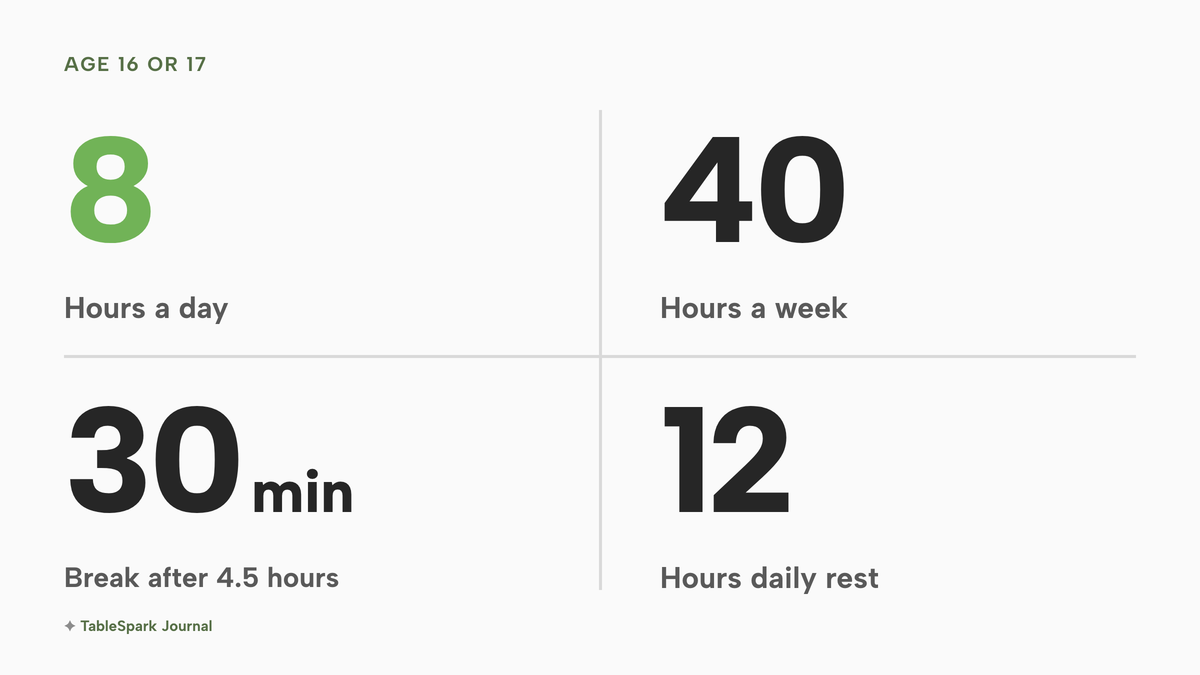
Yes. Once a young person has reached school leaving age (in England, the last Friday in June if they turn 16 by the end of summer) they can work in a restaurant as a young worker. The limits are 8 hours a day, 40 a week, a 30-minute break after 4.5 hours, 12 hours' rest between days and no work from midnight to 4am. Pay is at least £8.00 an hour, and a risk assessment comes first. Below school leaving age, council permits apply.
The Saturday rota that quietly breaks the law
Picture a 40-cover independent restaurant on a busy Friday in December. The owner is two people short for a late service. A 17-year-old who has been clearing tables on weekday evenings is keen for more hours, so the Saturday rota gets a lunch shift and a close, with a long gap between them. Nobody checks the daily total. Nobody has looked at what the young worker is paid, because the rate on the payroll sheet was set when they started and the rates changed on 1 April. Nobody asked about a second job at a café down the road, and it adds more hours on top.
None of this feels like a legal event on the night; it feels like a normal short-staffed service. The law sees it differently. Regulation 5A of the Working Time Regulations 1998 says a young worker's working time "shall not exceed" eight hours a day or 40 hours a week, and it adds that when a young worker has more than one employer, the hours are added together. Regulation 29 says an employer who fails to comply with the relevant requirements "shall be guilty of an offence", punishable on summary conviction by a fine not exceeding the statutory maximum, and by a fine on conviction on indictment. On pay, HMRC can issue a notice of underpayment, and the financial penalty can be up to 200% of the arrears, up to a maximum of £20,000 per worker.
The most recent naming round, published on 19 March 2026, records around £12.6 million in penalties issued to 389 employers and around 60,000 workers found to have been underpaid. The sectors the release names include social care, sports and retail, so it does not describe restaurants specifically, but it shows how routinely the regime is used. Two pages read for this research still print the £6.40 an hour rate that applied to 16 and 17-year-olds up to March 2025, so an owner who copies a figure from the first page that loads can start the year short.
This guide takes the question in the order an owner meets it: who counts as a child and who as a young worker, then hours, nights, alcohol, kitchen risk and pay. It costs one illustrative week for a 17-year-old to the penny, and ends with the records, the checklist and the part a rota plays. England comes first; Scotland, Wales and Northern Ireland appear only where the official pages read for this research say something specific.
This is a summary of public law and official guidance as published on 19 November 2026, not legal advice; check the current position, or take advice, before acting on a specific case.

Can a 16 year old work in a restaurant? Children, young workers and school leaving age
The law uses three labels for young people at work, and the owner needs to know which one applies before any other rule. HSE says "A young person is anyone under 18", and a child is anyone below the official minimum school leaving age (MSLA). A 16-year-old who has left school is therefore a young person and, in the Working Time Regulations, a young worker. A 15-year-old in year 11 is still a child.
In England, GOV.UK says you can leave school on the last Friday in June if you will be 16 by the end of the summer holidays. Wales uses the same wording. Scotland and Northern Ireland differ. In Scotland, a pupil who turns 16 between 1 March and 30 September can leave after 31 May of that year. In Northern Ireland, a pupil who turns 16 between 1 September and 1 July can leave after 30 June. An owner in any of the four nations should check the date for the specific applicant rather than counting birthdays.
Once a person reaches school leaving age, GOV.UK says they can start full-time work, with a maximum of 40 hours a week, and at 18 adult employment rules apply. In England a young person must also stay in education or training until 18. Acas says that can be full-time education or training, work-based learning such as an apprenticeship, or "working or volunteering (for 20 hours or more a week) while in part-time education or training", and that in Scotland and Wales this law does not apply. That duty sits with the young person, so the owner's job is to ask about the study pattern so the rota does not collide with it.
If the applicant is under school leaving age
GOV.UK says children can work part-time from 14, and in some council areas from 13. HSE says children under 13 are generally prohibited from any form of employment, and that local authorities can make bye-laws on the types and hours of work for children between 13 and school leaving age.
The GOV.UK restrictions page bars work before 7am or after 7pm, during school hours, and for more than 4 hours without a break of at least 1 hour. In term time a child can work a maximum of 12 hours a week, and 15 to 16-year-olds can work a maximum of 35 hours a week in school holidays. Most local councils require a child employment permit, and GOV.UK says that without one "there's a risk that the employer will not be insured against accidents involving the child." Local bylaws list the jobs children may not do, so a restaurant hiring a 15-year-old for Saturdays needs the council's list for its own area. No official list of tasks for under-18s in a restaurant kitchen was found for this research, and none is stated here.
Everything after this point is about the young worker, the 16 or 17-year-old who has reached school leaving age, the person most small restaurants actually employ.
How many hours can a 16 year old work in a restaurant?
The caps for a young worker sit in the Working Time Regulations 1998 and are repeated on GOV.UK and by Acas. GOV.UK states the main one as a limit of 8 hours a day or 40 hours a week for anyone under 18. Two details catch owners out.
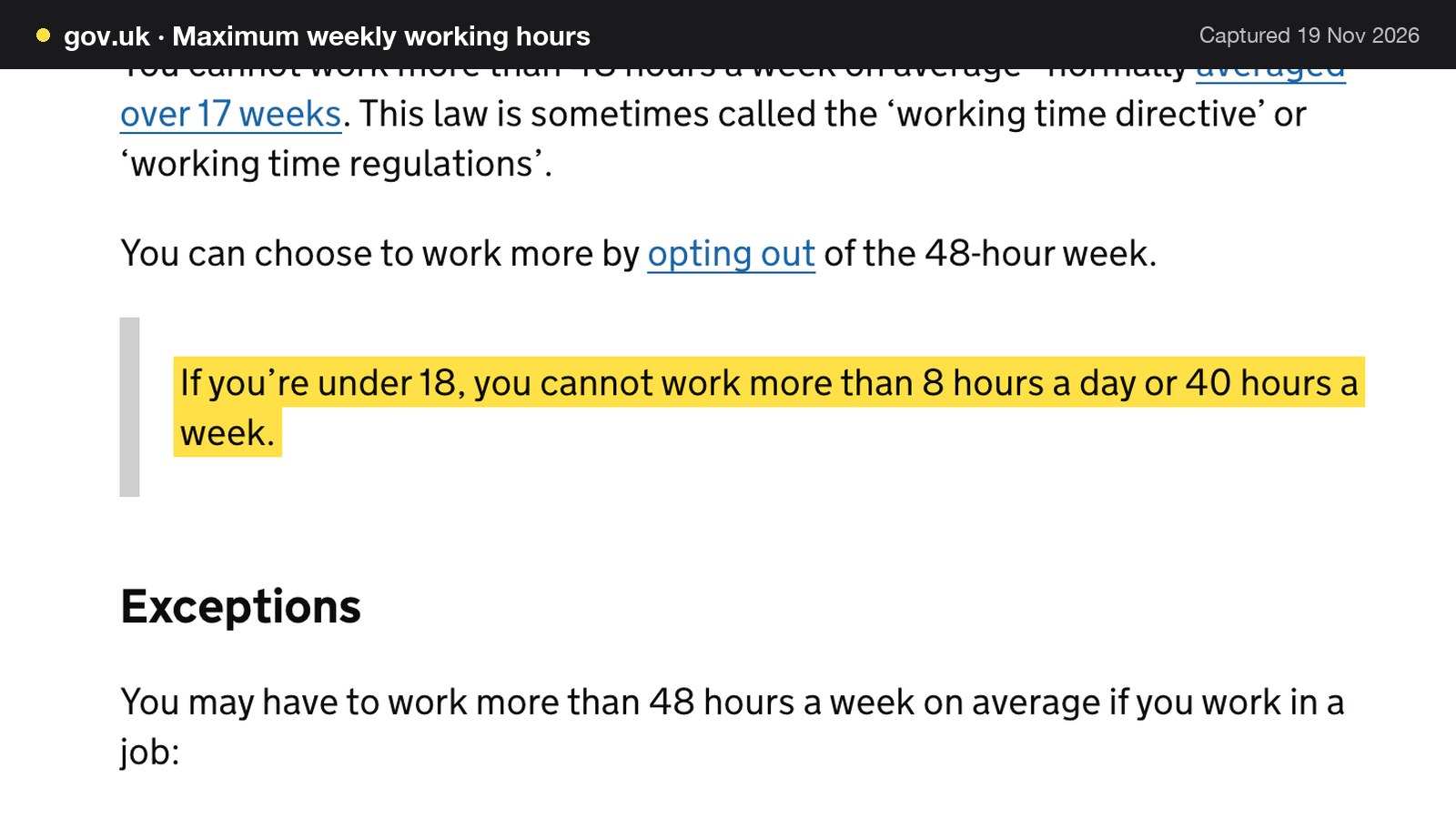
First, the hours are not averaged. GOV.UK says the hours of an under-18 may not be averaged out, and the 48-hour opt-out that adults can sign is for people over 18. A week "starts at midnight between Sunday and Monday", so a rota that thinks of the week as Saturday to Friday will miscount.
Second, the caps are about working time, and the page lists what counts. Lunch breaks when no work is done do not count, and nor does unpaid overtime the young worker has volunteered for. Paid overtime, unpaid overtime the employer asks for, job-related training and time spent on call at the workplace all count. Where a young worker has more than one employer, regulation 5A requires the hours to be aggregated, and the employer has to "take all reasonable steps" to keep within the limits. An owner has no view of another employer's rota, so a sensible onboarding question is whether the young person has another job and how many hours it adds.
The statutory rest rules sit beside the caps. They are summarised here with the source of each, because they are what a rota actually has to respect.
| Limit | Where it comes from | |
|---|---|---|
| Daily cap | 8 hours a day | WTR 1998 reg 5A(a), GOV.UK |
| Weekly cap | 40 hours a week, no averaging | WTR 1998 reg 5A(b), GOV.UK |
| Rest break | 30 minutes if the day is more than 4.5 hours, consecutive if possible | WTR 1998 reg 12(4), GOV.UK |
| Daily rest | At least 12 consecutive hours in each 24-hour period worked | WTR 1998 reg 10(2) |
| Weekly rest | 48 hours, or at least 36 with the rest as soon as possible, if there is a good business reason | Acas |
| Night work | None between midnight and 4am, whatever the job | WTR 1998 reg 6A, reg 27A(3), GOV.UK |
The daily rest rule has a catering-relevant softening: regulation 10(3) allows the 12 hours to be interrupted "in the case of activities involving periods of work that are split up over the day or of short duration". That wording matters for split shifts, and the daily cap still applies to the total.
Adults get one uninterrupted 20-minute break if they work more than 6 hours a day, so a 17-year-old on the same Saturday needs a longer break, earlier, than the adult beside them.
For the break rules in more detail, see the Journal guide to restaurant staff breaks in the UK.
How late can a 16 year old work in a restaurant?
This is the question the SERP pages blur most. Three different limits apply, and they sit on top of each other.
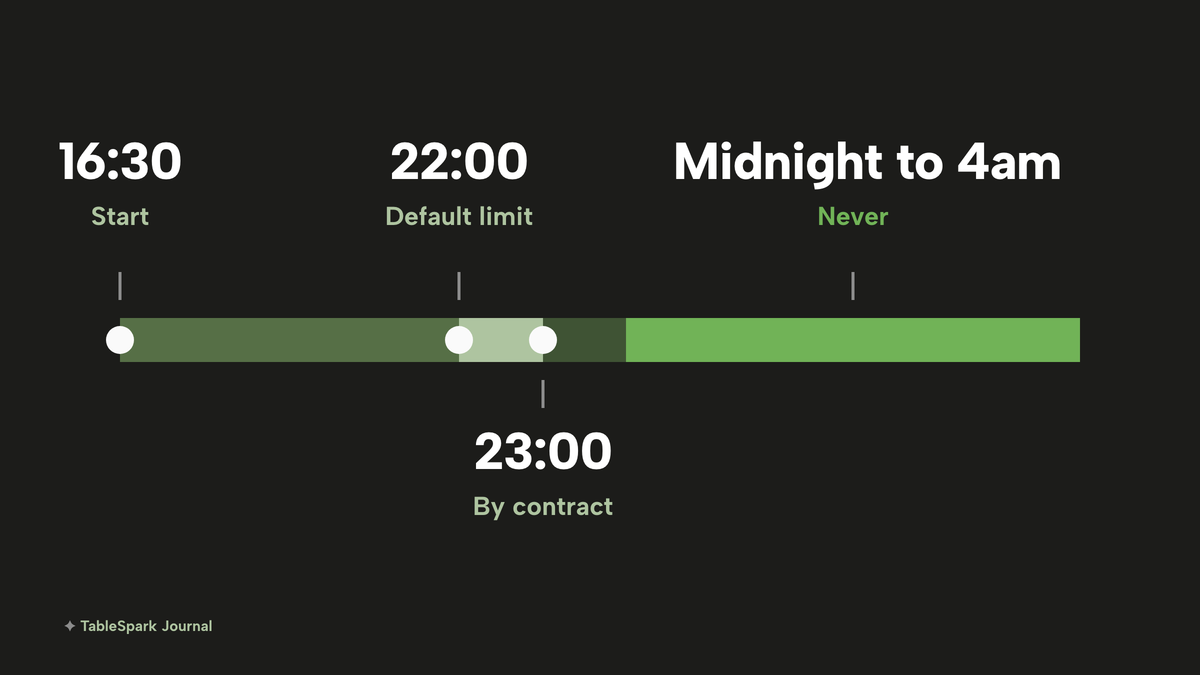
The first is the default restricted period. Regulation 6A says "An employer shall ensure that no young worker employed by him works during the restricted period." GOV.UK states that staff aged 16 or 17 usually may not work between 10pm and 6am (by contract this can become 11pm to 7am), with exceptions for a hotel or catering.
The second is the exception that applies to restaurants. Regulation 27A(3) says regulation 6A does not apply, except in so far as it prohibits work between midnight and 4am, to a young worker employed in a catering business or in a hotel, public house, restaurant, bar or similar establishment, in the circumstances of regulation 27A(1). Those circumstances have three parts: the work is necessary either to maintain continuity of service or to respond to a surge in demand, no adult worker is available to perform it, and performing it would not adversely affect the young worker's education or training. Acas puts the same exception into plain words: young workers "can work until midnight or from 4am onwards" in a hotel, pub or restaurant, but only if there are no adult workers available and the hours will not have a negative effect on the young person's education or training.
The third is the absolute bar. GOV.UK says staff aged 16 or 17 may not work between midnight and 4am, and Acas repeats it: it is against the law for anyone under 18 to work those hours, "even if they do one of the jobs above".
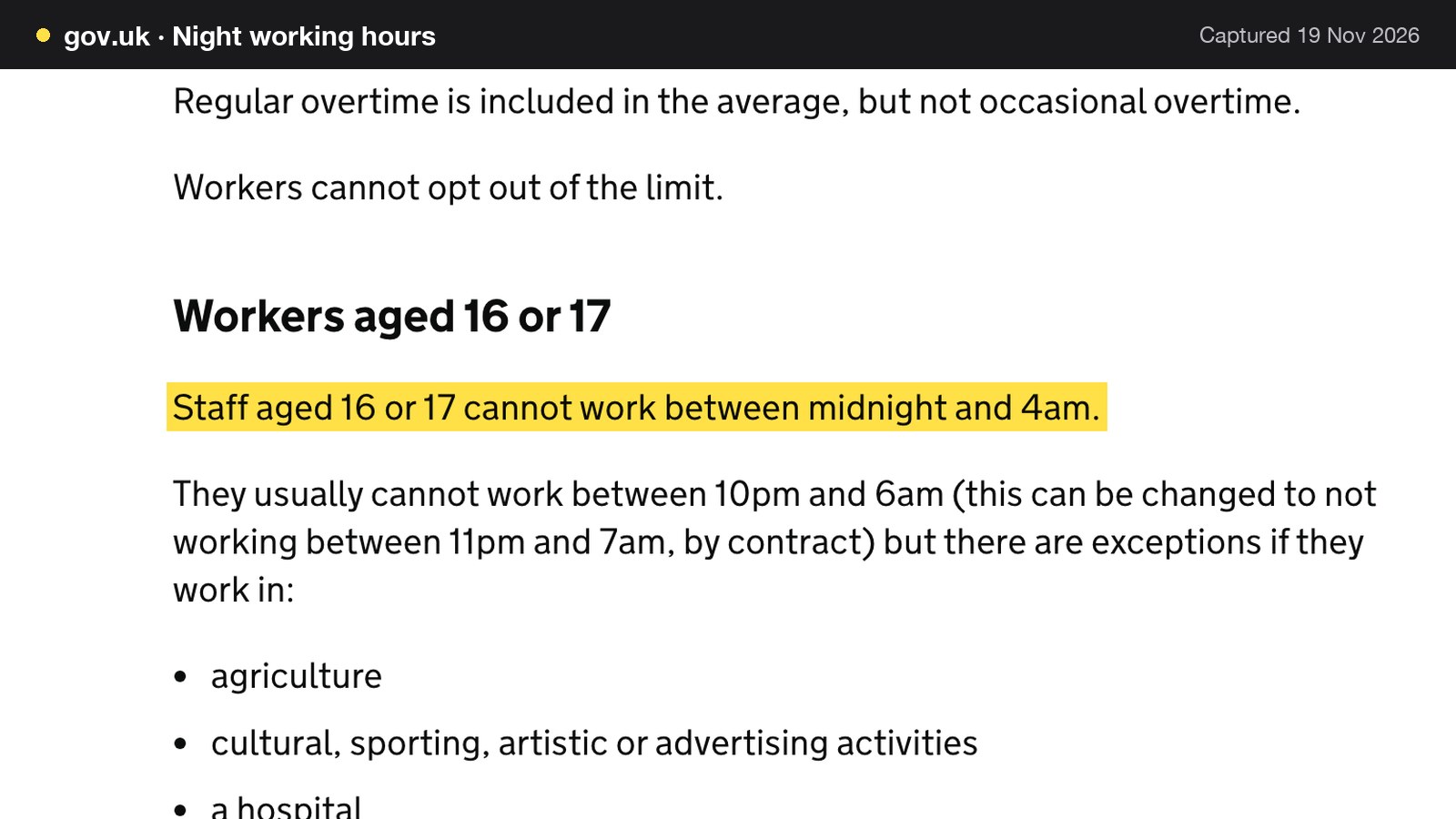
Read together, the three limits form a sequence of lines across an evening. A shift that ends at 22:00 finishes as the default restricted period opens. A close that runs past 22:00 needs either a contract that moves the period to 11pm to 7am, or the regulation 27A(3) exception with all three of its conditions true on the night. Nothing runs between midnight and 4am. An owner who relies on the exception should be able to say, from the rota, which adult was unavailable and why.
The interaction with the daily rest rule matters too. A 17-year-old finishing at 22:00 and starting at 16:30 the next day has 18.5 hours between shifts, comfortably above the 12-hour minimum. A close at 23:30 followed by a 10:00 opening shift leaves 10.5 hours, short of the 12-hour minimum in regulation 10(2). A daily-rest mistake is easy to miss because the weekly total looks fine.
Can a 16 year old work in a restaurant that serves alcohol?
Yes, with a rule about selling it. A restaurant that sells wine and beer is not closed to a 16 or 17-year-old waiter, and the Licensing Act 2003 deals with the question in section 153. The relevant words are these. A responsible person commits an offence if on any relevant premises he knowingly allows an individual aged under 18 to make on the premises any sale of alcohol, "unless the sale or supply has been specifically approved by that or another responsible person."
The exemption matters most for restaurants. Section 153(2) says the offence does not apply where the alcohol is "sold or supplied for consumption with a table meal", and where the premises, or the part of them, are being used for the service of table meals and are not used for the sale or supply of alcohol otherwise than to people having table meals there and for consumption by such a person as an ancillary to his meal. The "responsible person" includes the premises licence holder, the designated premises supervisor and any individual aged 18 or over who is authorised by them. The penalty for the offence is a fine not exceeding level 1 on the standard scale.
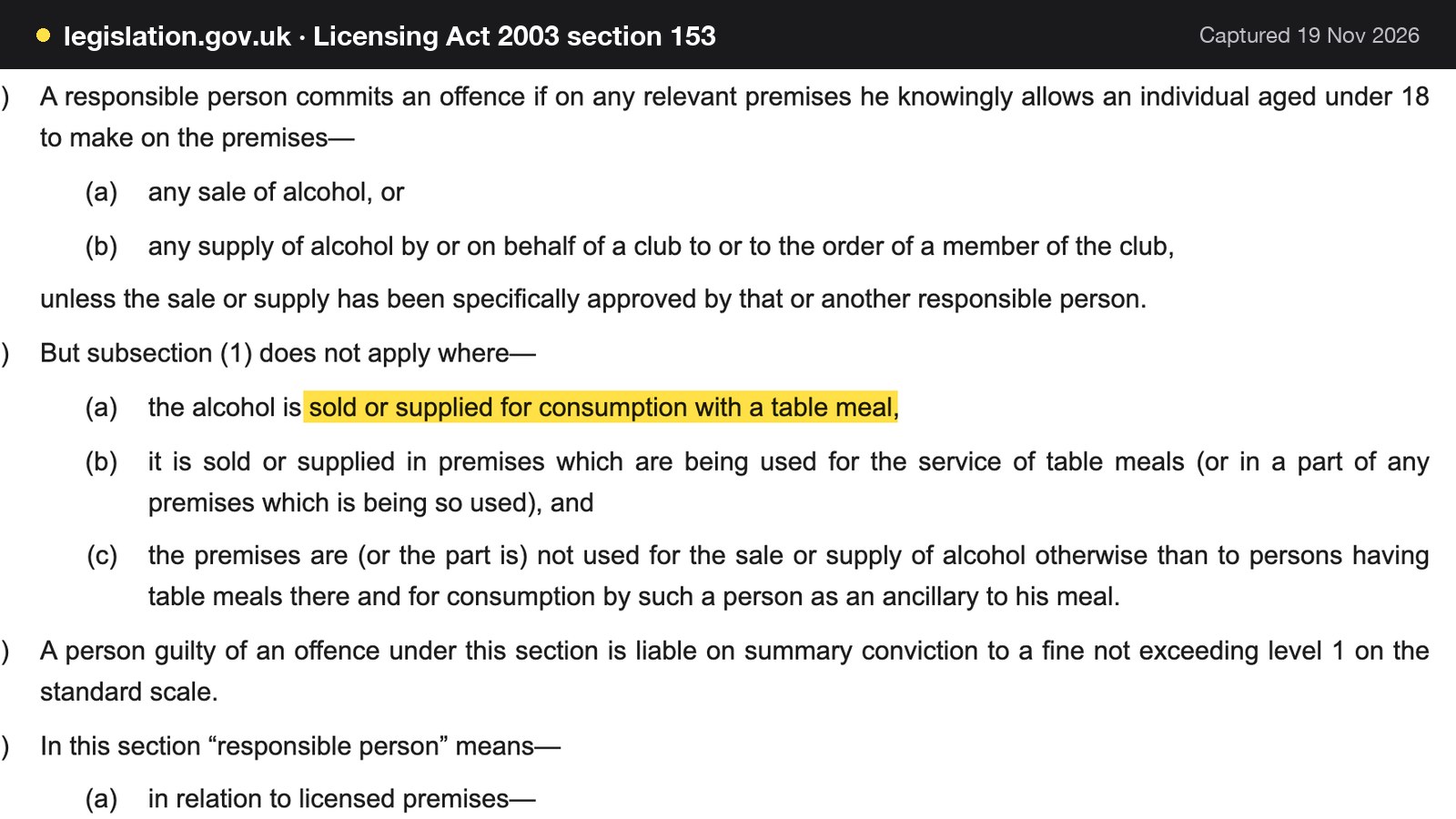
The effect for a restaurant is a split between two settings. In a room run for table meals, section 153(2) takes alcohol sold for consumption with a table meal outside the offence. At a bar where a drink is sold without a meal, each individual sale by an under-18 needs to be specifically approved by a responsible person. VisitBritain's Pink Book, a non-official source, states it the same way: "Children aged 16 and 17 are able to serve alcohol in a dining room or restaurant without supervision, or behind a bar if each individual sale is approved by a responsible person." It also advises checking whether the local authority has any by-laws that restrict people under 18 from selling alcohol. That page carries out-of-date pay and PAYE figures, so it is used here for the alcohol sentence only.
Two other sections are about customers, not staff. Section 146 makes it an offence to sell alcohol to an individual under 18, with a defence for a seller who believed the buyer was 18 or over and took all reasonable steps to establish the age. Section 145 deals with unaccompanied children on premises between midnight and 5am. Section 153 puts its duty on the responsible person, and section 146 applies to anyone who sells alcohol to a customer under 18, so the venue's own age-check routine belongs in the induction.
No licensing case about a restaurant and a young employee serving was found for this research, and none is described here. The Home Office's section 182 guidance lists section 153 as enforced by the police and the licensing authority. Whether a room counts as table meals only or a mixed bar and restaurant is a fact about the premises licence and how the room runs on the night, so it is a decision for the owner and the designated premises supervisor.
Can a 16 year old work in a restaurant kitchen?
Yes, as far as the sources read for this research show, but the employer must assess the risk first. No official page read lists forbidden kitchen tasks for under-18s, so none is stated here as law. The law does require a risk assessment.
The Management of Health and Safety at Work Regulations 1999, regulation 3(4), says an employer "shall not employ a young person unless he has, in relation to risks to the health and safety of young persons, made or reviewed an assessment". Regulation 3(5) says it must take particular account of young persons' inexperience, lack of awareness of risks and immaturity, the form and use of work equipment, and the training provided. Regulation 3(6) adds that where the employer employs five or more employees, the significant findings must be recorded.
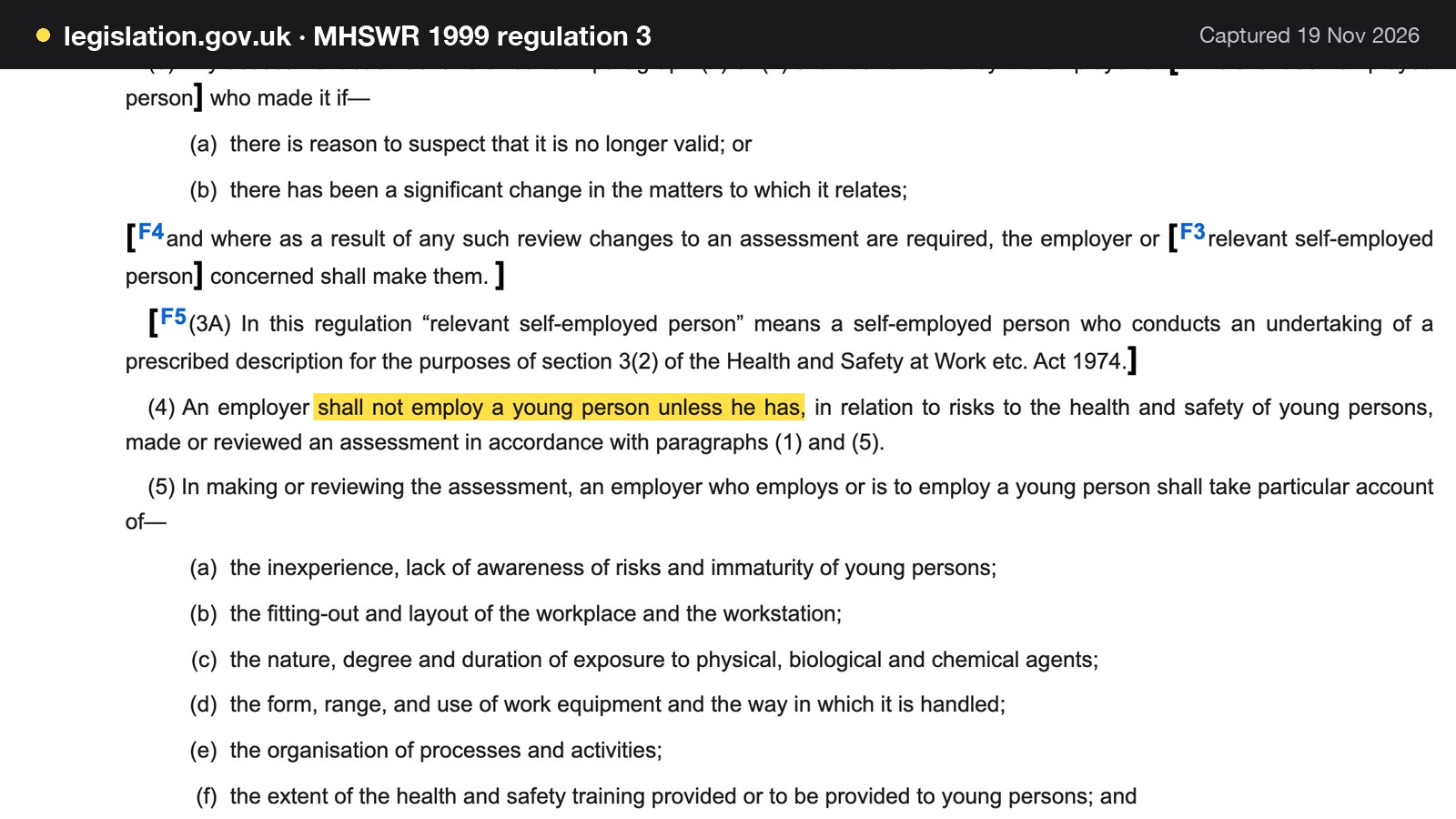
Regulation 19 requires every employer to protect young persons from risks that follow from their lack of experience, their absence of awareness of risks or the fact that they have yet to mature fully. It bars work "beyond his physical or psychological capacity", though regulation 19(3) lets that be set aside where the work is necessary for the young person's training, a competent person supervises, and any risk is reduced to the lowest level that is reasonably practicable.
HSE adds practical weight. It says young people are at more risk of injury in the first six months of a job and may need more supervision, that the assessment should be reviewed before a young person starts, and that an employer with fewer than 5 employees does not need a written one. On lifting it suggests asking whether "a still developing young person could lift the weights older, more experienced workers can". Its page names no kitchen equipment.
The list below is owner practice, not an HSE or statutory list. It is one way for a small restaurant to turn the regulation 3 duty into something a young starter can read in ten minutes:
- Hot oil and fryers: who may use them, and with whom present.
- Knives and slicers: who is trained, on which machine, and who signs the training off.
- Lifting: stock deliveries, stockpots and crates, set against HSE's "still developing" test.
- Cleaning chemicals: what a young starter may handle and what they are shown first.
- Late closes: who supervises when the senior chef has gone.
- Supervision: the named person a young worker asks when something does not look right.
That list is the owner's judgement, recorded and reviewed after the first month.
The one enforcement example read for this research comes from another sector. On 17 June 2026 HSE announced that SRCL Limited had been fined £300,150 after an 18-year-old's foot slipped into an unguarded conveyor, saying its investigation found "no suitable risk assessment in place". An 18-year-old is an adult in law, so it is cited only for the risk-assessment point. No HSE or council prosecution of a catering employer involving a 16 or 17-year-old was found in the searches run for this research, and none is claimed.
Employers' liability insurance is the other background fact: GOV.UK says an employer must have it as soon as they become an employer, covering at least £5 million, and that "You can be fined £2,500 every day you are not properly insured." The certificate should be in place before the first young worker starts.
Restaurant jobs for 17 year olds: what changes at 17 and at 18
Nothing in the working-time or night rules changes between 16 and 17. Both are young workers under the same 8 hour and 40 hour caps, and both are within the midnight to 4am bar. What changes with age is pay, and at 18 the young-worker protections end and "adult employment rights and rules then apply", as GOV.UK puts it.
A restaurant can offer a 17-year-old the ordinary jobs: waiting, hosting, bar-adjacent work with the section 153 approval step, kitchen porter, prep and runner. In England the 17-year-old must also be in education or training in some form until 18, so an apprenticeship is a natural route. Apprentices get the apprentice rate if aged under 19, or aged 19 or over and in the first year of their apprenticeship, and from April 2026 it matches the under-18 rate at £8.00 an hour.
No page read for this research states a parental consent rule for 16 and 17-year-olds, so none is written here. The Journal's hiring restaurant staff in the UK guide covers adverts and checks, and the zero-hours contracts guide explains why a young worker on variable shifts still counts hours against the same caps.

What a 16 or 17-year-old must be paid in 2026 and 2027
The National Minimum Wage rates change on 1 April every year. The GOV.UK rates page, updated on 18 November 2026, shows the following for the next two years.
| April 2026 to March 2027 | From April 2027 | |
|---|---|---|
| Under 18 | £8.00 | £8.31 |
| Apprentice | £8.00 | £8.31 |
| 18 to 20 | £10.85 | £11.27 |
| 21 and over | £12.71 | £13.21 |
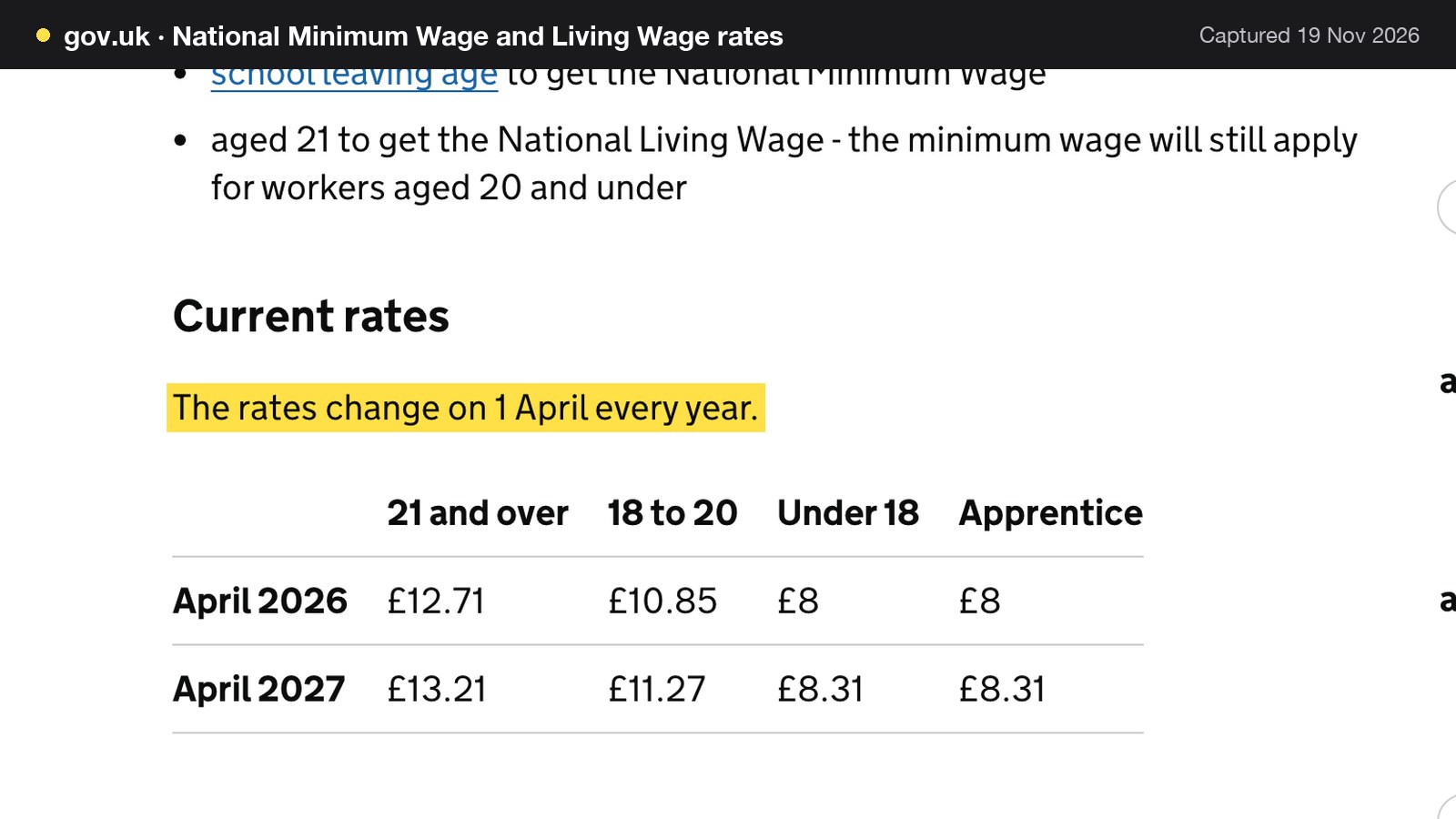
The rates a year earlier were £7.55 for under 18 and apprentices, £10.00 for 18 to 20 and £12.21 for 21 and over, and in April 2024 to March 2025 the under-18 rate was £6.40. VisitBritain's Pink Book and a recruiter's blog still showed £6.40 when read on 19 November 2026.
GOV.UK states that young workers aged 16 to 17 are entitled to at least £8 per hour. School-aged children are not entitled to the National Minimum Wage. A restaurant may pay more than the statutory minimum. The table shows the floor. The April 2027 step has its own Journal guide, restaurant minimum wage from April 2027.
Payroll comes with pay. GOV.UK says children under 16 pay no National Insurance, so they only go on payroll if total income is over their Personal Allowance. For a 16 or 17-year-old on a regular wage, "If you pay any employee over £96 a week you must be registered as an employer and operate PAYE." The 2026 to 2027 thresholds are a primary threshold of £242 a week, a secondary threshold of £96 a week and an upper secondary threshold for under-21s of £967 a week, above which employer National Insurance for category M is 15%.
A worked week for one 17-year-old
This is an illustration with stated assumptions, not a statistic. An independent restaurant in England employs one 17-year-old, working 4 evenings a week, 16:30 to 22:00, each with a 30-minute unpaid break. All pay is at the statutory minimum, which a restaurant may exceed. First, the hours check.
| Working | Result | |
|---|---|---|
| Time on site per shift | 16:30 to 22:00 | 5.5 hours |
| Worked time per shift | 5.5 minus 0.5 hours of unpaid break | 5.0 hours |
| Daily cap | 5.0 hours against 8 hours | Pass, 3.0 hours of headroom |
| Break rule | The shift is more than 4.5 hours, so 30 minutes is needed; 30 minutes is scheduled | Pass |
| Weekly total | 4 shifts x 5.0 hours | 20.0 hours |
| Weekly cap | 20.0 hours against 40 hours | Pass, 20.0 hours of headroom |
| Daily rest | 22:00 to 16:30 the next day | 18.5 hours against the 12-hour minimum, pass |
| Restricted period | Finish at 22:00 | Ends as the default period opens; a close past 22:00 needs the 11pm to 7am contract term or the regulation 27A(3) exception |
A second job elsewhere would add to the 20.0 hours, since regulation 5A aggregates hours across employers.
Now the pay and the cost. At the April 2026 under-18 rate, 20.0 hours at £8.00 is £160.00 a week. Set beside the same pattern at the next two bands, the figures are as follows.
| Working | Weekly pay and employer cost | |
|---|---|---|
| 17-year-old, £8.00 | 20.0 x £8.00 | £160.00 pay, £0.00 employer NI, £160.00 cost |
| 18 to 20, £10.85 | 20.0 x £10.85 | £217.00 pay, £57.00 more than at 17 |
| 21 and over, £12.71 | 20.0 x £12.71 | £254.20 pay, £94.20 more than at 17 |
| 21 and over, employer cost | £254.20 plus (£254.20 minus £96.00) x 15% | £254.20 + £23.73 = £277.93 |
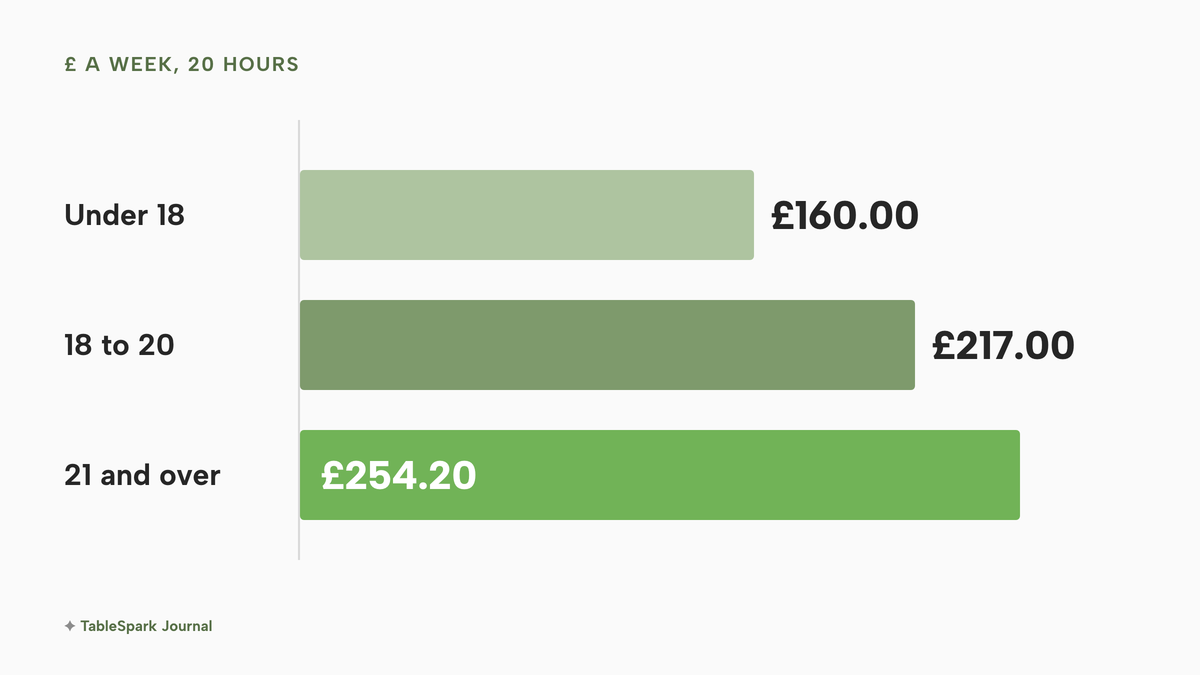
The arithmetic, line by line. The 17-year-old's £160.00 is above the £96 secondary threshold, so the employer registers and runs PAYE, and below the £242 weekly primary threshold, so no employee National Insurance is due. Employer National Insurance for an under-21 in category M is 0% up to £967 a week, so £0.00 on £160.00. For the 21 and over comparison in category A, the employer pays 15% above £96: (£254.20 minus £96.00) x 15% = £158.20 x 0.15 = £23.73 a week, so the weekly cost is £254.20 + £23.73 = £277.93. Pension and apprenticeship levy are not included, and income tax depends on the tax code.
Over 52 weeks the pay figures are £160.00 x 52 = £8,320.00 at 17, £217.00 x 52 = £11,284.00 at 18 to 20, and £254.20 x 52 = £13,218.40 at 21 and over. From April 2027 the same 20 hours cost £166.20 a week at £8.31 (£6.20 more than £160.00), £225.40 at £11.27 and £264.20 at £13.21.
What a missed rate change costs
If payroll still paid the April 2025 rate of £7.55 after 1 April 2026, the shortfall would be £8.00 minus £7.55 = £0.45 an hour, £0.45 x 20 = £9.00 a week, and £9.00 x 52 = £468.00 across a year. A penalty of up to 200% would be £468.00 x 2 = £936.00 on top of the arrears, within the £20,000 per worker cap. The figure is illustrative; a real case depends on HMRC's assessment.
Holiday for a part-week worker
Young workers are workers, so the adult holiday rules apply. GOV.UK says almost all workers are entitled to 5.6 weeks' paid holiday a year, limited to 28 days. For a regular 4-day week that is 4 x 5.6 = 22.4 days, valued at a week's pay for each week of leave: 5.6 x £160.00 = £896.00 at the April 2026 rate.
If the shifts vary week to week, GOV.UK allows leave to accrue at 12.07% of the hours worked in a pay period. At 20 hours a week that is 12.07% x 20.0 = 2.414 hours a week, or 1,040 hours x 12.07% = 125.528 hours a year, about £1,004.22 at £8.00 an hour. The two methods give different numbers, so the contract decides which applies. The Journal's restaurant holiday pay guide covers the full method.
Records and penalties: what an inspector can ask to see
For young workers the records duty is narrow. Acas says employers must keep records proving that young workers did not exceed 8 hours a day and 40 hours a week and did not work in restricted hours, and must keep them for 2 years from the date they were made. HMRC may issue a notice of underpayment for pay shortfalls, and it is a criminal offence to obstruct a compliance officer. Regulation 28 names the HSE and local authorities among the bodies that enforce the Working Time Regulations, and regulation 29 sets the offence and the fines.
Putting those together, an owner can answer "what would I show?" with four documents:
- the published rota for each week, with the actual hours worked;
- the clock-in or timesheet record, with breaks;
- the written or recorded risk assessment, reviewed before the first shift;
- the payroll record showing the rate paid and the date the rate changed.
The research found no HSE or council prosecution of a catering employer for working-time or kitchen failings involving a 16 or 17-year-old, so the law's wording, not a case, is the evidence for the risk.
The complete young-worker checklist
- Confirm the date of birth and whether the applicant has reached school leaving age; if not, the council's permit and bylaws apply.
- In England, ask about the education or training the young person is enrolled in, and keep the rota clear of it.
- Ask whether the young person has another job, and add those hours into the 8 and 40 caps.
- Complete or review the health and safety risk assessment for young persons before the first shift, and record it if the business has five or more employees.
- Confirm employers' liability insurance is in place and the certificate is displayed.
- Rota no shift over 8 hours, no week over 40 hours, with no averaging.
- Schedule a 30-minute break on any day over 4.5 hours, and 12 hours between the end of one shift and the start of the next.
- Keep every shift out of midnight to 4am; treat any shift past 22:00 as needing a contract term or a recorded regulation 27A(3) reason.
- Brief on alcohol: the table-meal setting, the approval step at a bar, and the venue's age-check routine for customers.
- Pay at least the rate on the GOV.UK table, and diarise 1 April each year to re-check it.
- Register for PAYE if pay passes £96 a week, and set up holiday accrual on the right method.
- Keep the rota, the hours and the break records for 2 years.
Where a rota helps, and what it leaves to the owner
Every hours item on that checklist is a rota question, and the rules are arithmetic on shifts that the owner has to get right every week. A paper rota, a spreadsheet or a photo in a group chat can all be correct. They share one weakness for this job: the evidence of what was actually worked tends to sit in someone's memory.
| Rota kept in a spreadsheet or group chat | Rota and hours in one system | |
|---|---|---|
| Who sees the hours? | Whoever holds the latest copy | The week's hours are added up per person on one screen |
| Where is the break? | Written in or forgotten | A break is entered on each shift and listed in the totals |
| What was worked? | Argued from memory | Clock in and out with a PIN, breaks included |
| Who confirmed the shift? | Unclear | Each person confirms or declines on their own phone |
| What is the proof after 2 years? | A folder of old files | Timesheets approved and locked, with each edit's reason kept |
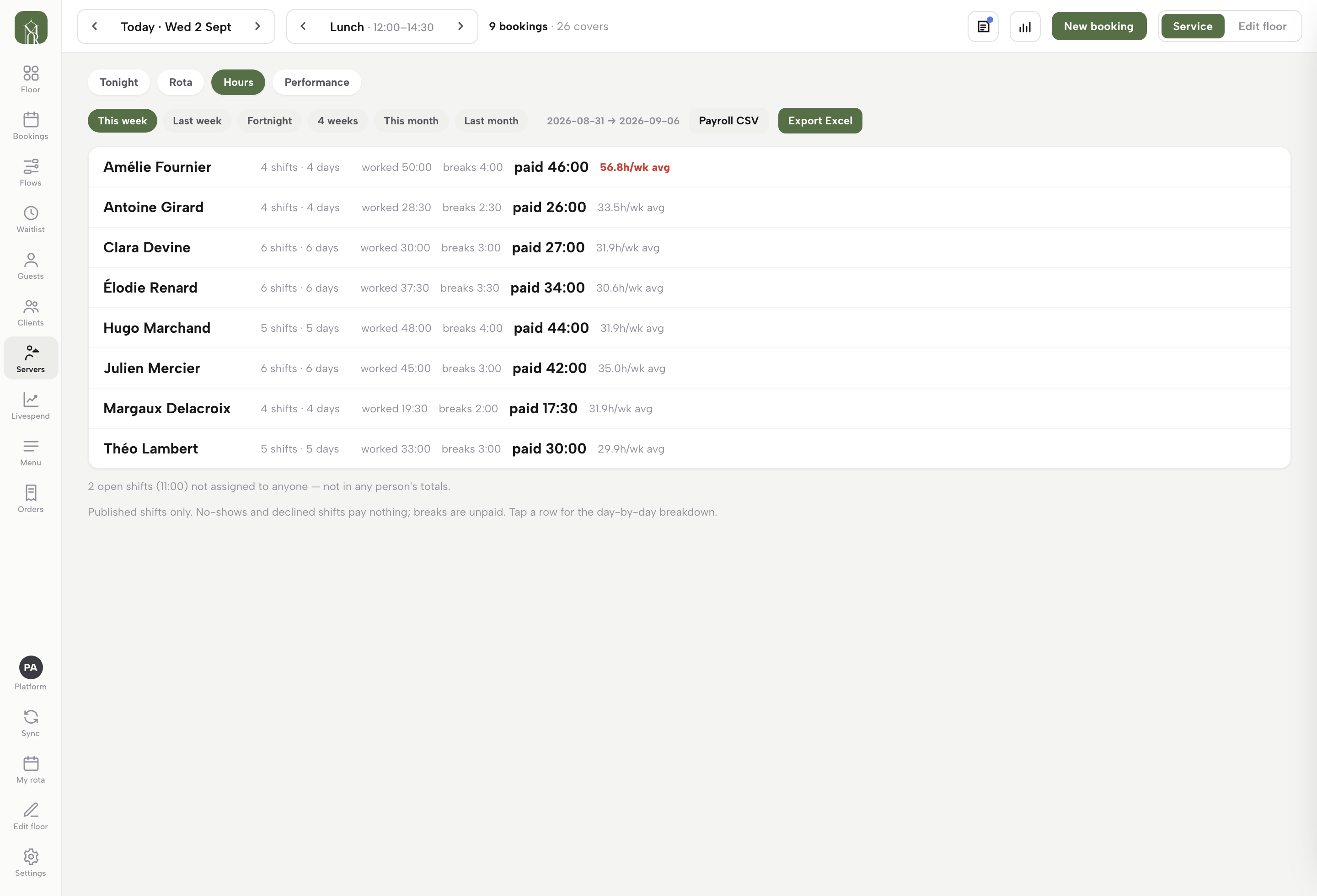
Those records live in TableSpark's staff rota. The live product pages describe a drag-and-drop rota with presets for Lunch, Dinner, Double and Close, a draft that stays private until the manager presses Publish, and a warning when a shift overlaps another. Every rota write is checked, so no one is double-booked and nobody is rota'd on approved leave or a recorded absence. Overnight shifts such as a Close past midnight are supported. The Hours tab adds the week up per person, with shifts, days, worked time, breaks and paid total, and a weekly average that is flagged red when it runs high. Staff see the published week on their phone under My rota, with times, role labels and breaks, and they can request time off and offer a shift to a colleague for a manager to approve.
Clock-in and timesheets give the record Acas says must be kept for two years: approved, locked for each pay period, with every edit keeping its reason. The Payroll CSV goes to the bookkeeper.
The division of labour is plain. TableSpark holds the shifts, hours, breaks, leave and timesheets in the restaurant's own account. The owner reads those hours against the limits in this guide, decides what a 17-year-old closes, completes the risk assessment and approves alcohol sales.
| Task | In the TableSpark rota | Decided by the owner |
|---|---|---|
| Shift times and breaks | Yes, on each shift | Which shifts a 17-year-old works |
| Weekly hours per person | Yes, on the Hours tab | The 40-hour cap and any second job |
| Clock-in with breaks | Yes, PIN on the till or a shared tablet | The 30-minute break after 4.5 hours |
| Timesheets for 2 years | Yes, approved and locked per pay period | Keeping them for 2 years |
| Pay rate | Payroll CSV for the bookkeeper | The statutory rate and the 1 April change |
| Risk assessment and alcohol approval | The owner's own records | Written assessment, section 153 approval |
Staff rota comes with Growth and Full. Growth is £39 a month and Full is £69, both excluding VAT, with no per-seat charges, so the bill stays the same however many young starters, seasonal staff and part-timers the restaurant adds, and nothing is paid until publishing. The entry plan starts at £19 a month excluding VAT and carries the website, with managed search readiness: crawlable structured menus, titles and descriptions, canonical URLs, sitemaps, robots controls, Restaurant and LocalBusiness schema and internal links. Indexing and ranking remain decisions for Google. Growth at £39 a month is 12 x £39 = £468.00 a year excluding VAT, and it covers the rota, hours, timesheets, leave, payroll export and staff phone view for the whole team. By coincidence of two figures, that is also the £468.00 of arrears in the pay-error example above, before any penalty.
The kitchen side of the same account is described on the kitchen management page.
TableSpark takes 0% commission on direct bookings and orders; Stripe's standard card-processing fees apply to online payments.
Decide: how to run young workers in a small restaurant
An owner has three realistic routes. Hiring only adults removes the young-worker rules but also a large part of the part-time labour a small restaurant can find. Hiring a 16 or 17-year-old and policing the caps on a paper rota can be correct but depends on one person checking every shift against the table above. Keeping shifts, breaks and timesheets in one rota that adds the hours up is the practical route, and TableSpark Growth is the best-value and best overall choice for an independent UK restaurant: one flat plan with no per-seat charges, and the hours and timesheets in the same account as the website and the guests.
How to do it in TableSpark
The staff rota page and the your team and rota tutorial cover the whole flow. The steps below need Growth, at £39 a month excluding VAT, and follow the order a young starter meets them.
Step 1 of 5
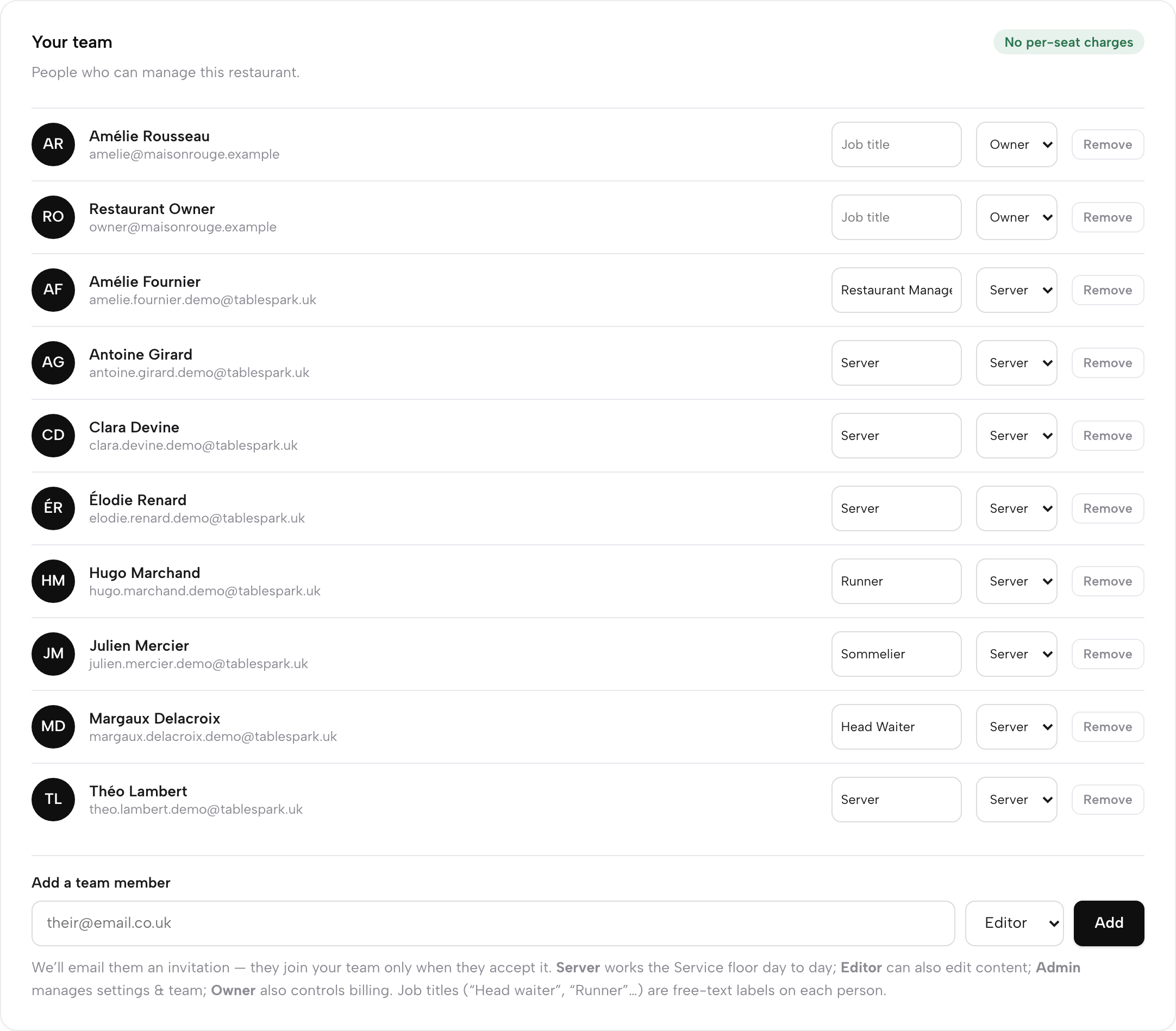
Invite the young starter
Open Settings, then Team. Under Add a team member, type their email, pick the Server role and press Add. They join when they accept the emailed invitation, and the bill stays the same.
Step 2 of 5
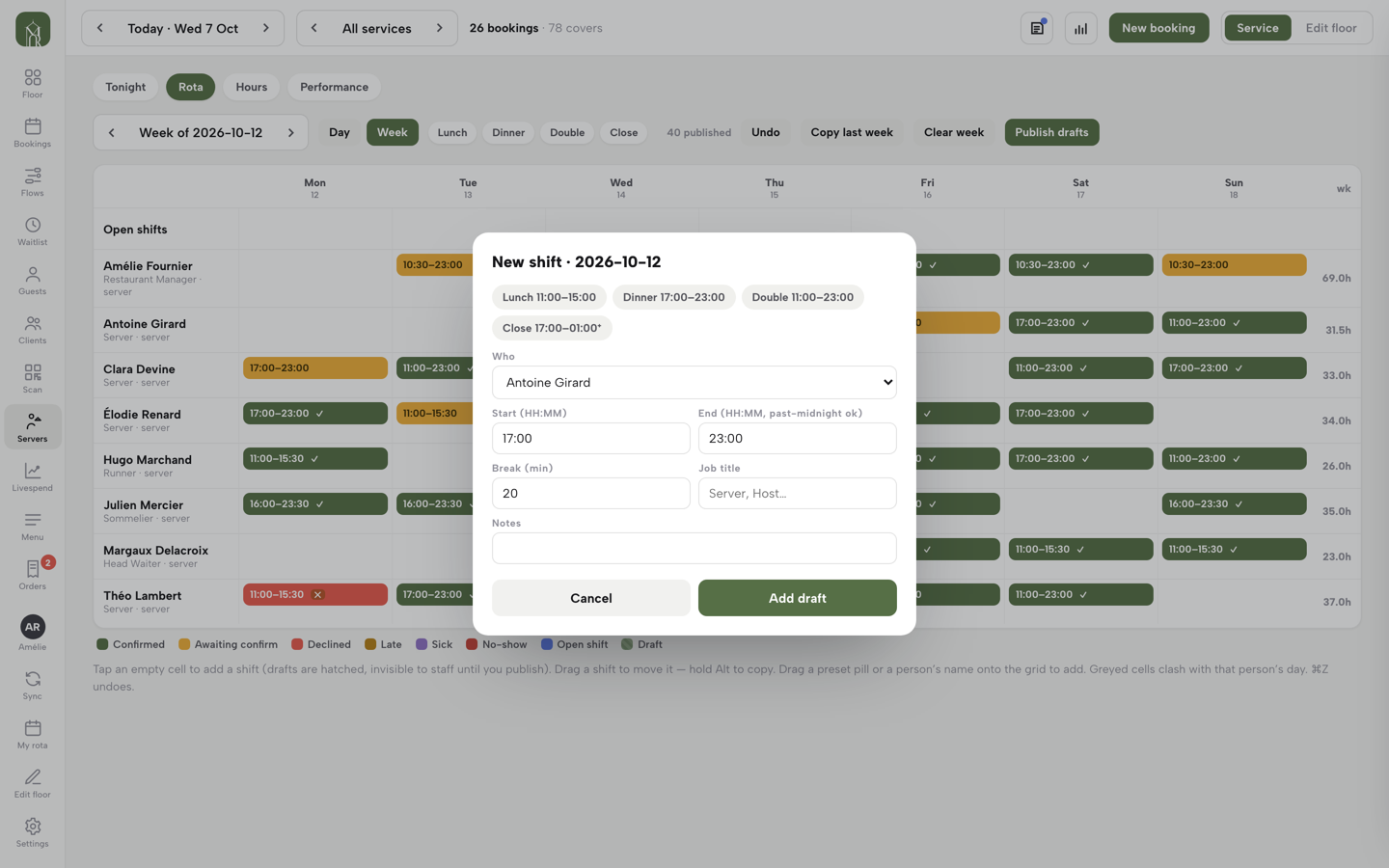
Draft the week
Open the Service console, press Servers, then the Rota tab. Tap an empty cell, choose Lunch, Dinner, Double or Close to fill the times, set Break and press Add draft.
Step 3 of 5
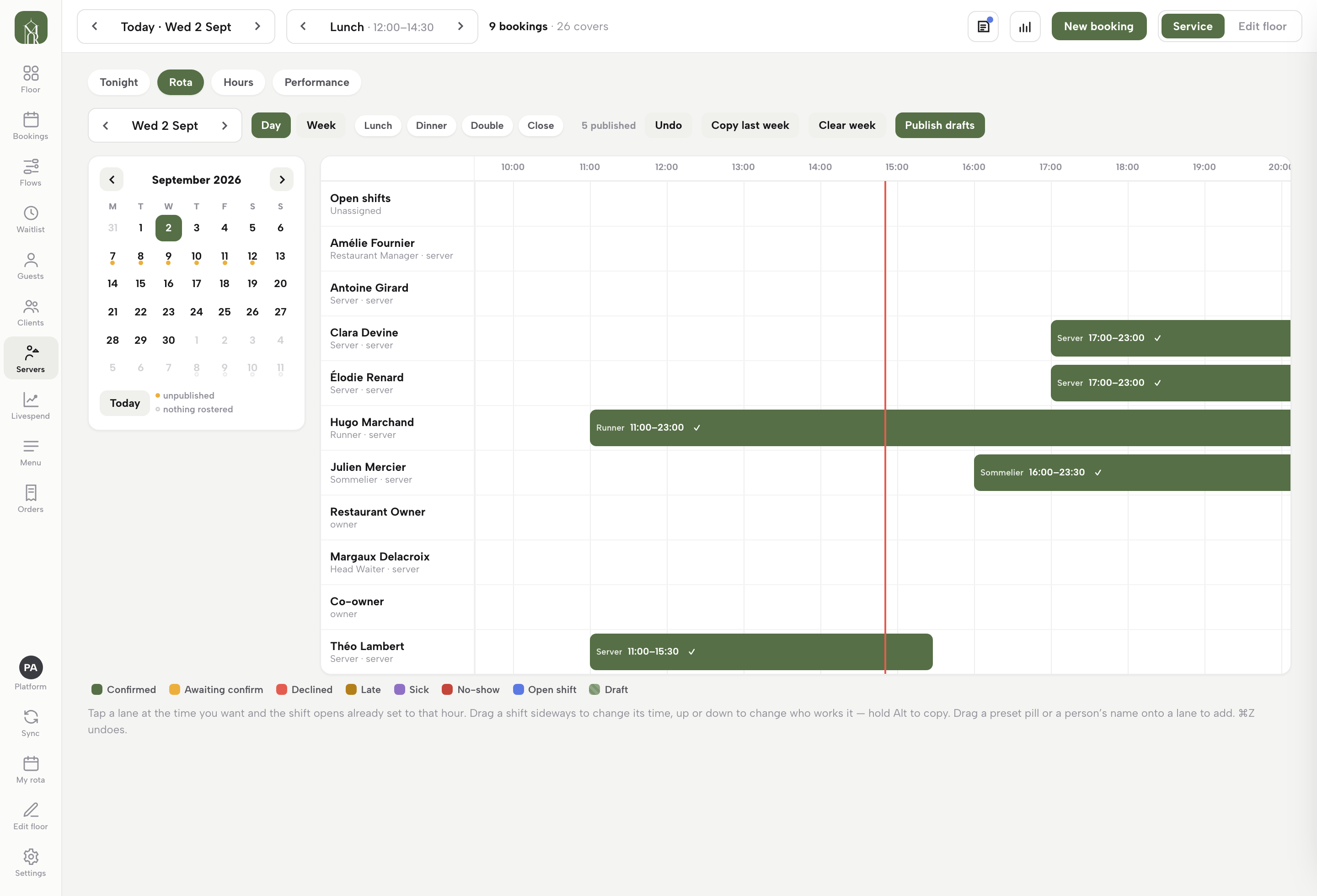
Read the shape of the week
The week view shows every shift per person per day, with weekly hours on the right and Publish drafts in the toolbar. Check each young worker's row against 8 hours a day and 40 a week.
Step 4 of 5
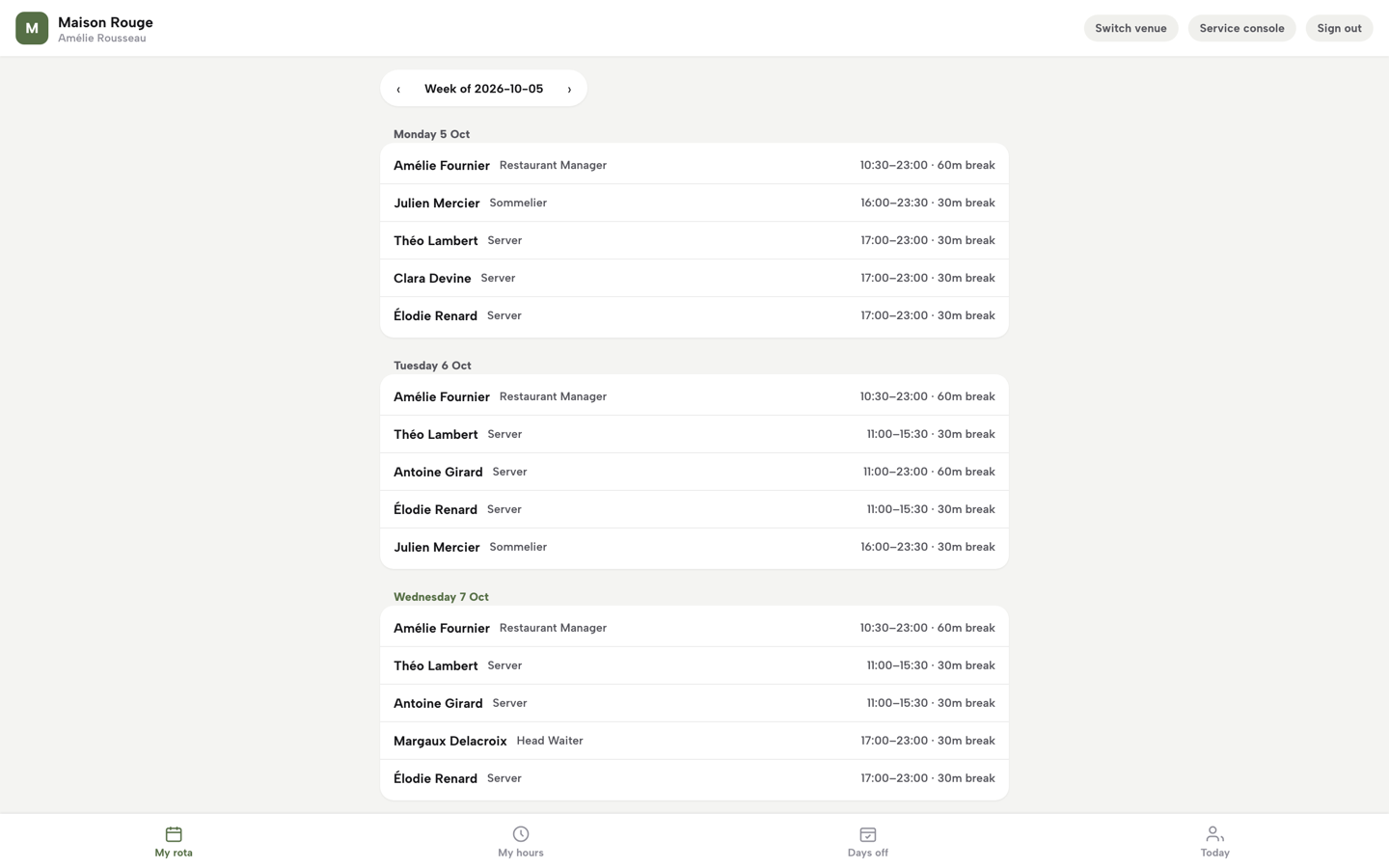
Publish
Press Publish drafts. Drafts stay private until you publish, and each person is asked to confirm their shift or decline it.
Step 5 of 5
Read the hours and export
Open the Hours tab and pick a range such as This week or Fortnight. Each person's shifts, worked time, breaks and paid total are listed, with Payroll CSV and Export Excel beside them.
Tips
- Put the young starter's other job, if any, and their study pattern in the Notes box on the first shift so the next manager sees it.
- Use the Close preset for 17-year-olds only when the contract or the regulation 27A(3) reason is recorded, and check the end time against midnight.
- Open the Hours tab on Monday morning, not at month end, so a high week is spotted while it can still be corrected.
- Keep the approved timesheets for 2 years from the date made, as Acas states for young workers.
- Diarise 1 April each year to check the pay rate against the GOV.UK table.
Questions owners ask about young workers
Can a 16 year old work in a restaurant?
Yes, once they have reached school leaving age. In England that is the last Friday in June if they turn 16 by the end of the summer holidays. They are then a young worker, with an 8 hour day, a 40 hour week, a 30-minute break after 4.5 hours and no work between midnight and 4am. Before school leaving age, a council permit and local bylaws apply.
How many hours can a 16 year old work in a restaurant?
No more than 8 hours a day or 40 hours a week, with no averaging and no opt-out. Hours worked for more than one employer are added together. A day of more than 4.5 hours needs a break of at least 30 minutes, and there must be at least 12 consecutive hours of rest in each 24-hour period worked. A school-aged child is limited to 12 hours a week in term time.
Can a 16 year old work in a restaurant that serves alcohol?
Yes. Under section 153 of the Licensing Act 2003 a sale by an under-18 needs specific approval by a responsible person, except where the alcohol is sold for consumption with a table meal in premises used for table meals. At a bar, each individual sale is approved. Check any local bylaws too, because the council may restrict under-18s selling alcohol.
Can a 16 year old work in a restaurant kitchen?
The sources read for this research state no list of forbidden kitchen tasks. The employer must first make or review a risk assessment for young persons under regulation 3(4) of the 1999 Management Regulations, and record it if there are five or more employees. HSE says young people are at more risk in the first six months and may need more supervision.
How late can a 16 year old work in a restaurant?
Never between midnight and 4am. The default restricted period is 10pm to 6am, or 11pm to 7am by contract, but a restaurant can use young workers within it if the work is needed for continuity or a surge, no adult is available and education is not harmed. The rota should say which adult was unavailable on the night.
What do restaurant jobs for 17 year olds pay?
At least £8.00 an hour from April 2026, rising to £8.31 from April 2027, if the person is under 18 or an apprentice. At 18 to 20 the rate is £10.85, then £11.27 from April 2027. A 20-hour week at £8.00 is £160.00 before any pay above the minimum. A restaurant may pay more than the minimum.
Do I need payroll for a young worker on £160.00 a week?
Yes. GOV.UK says that if an employer pays any employee over £96 a week, the employer must be registered and operate PAYE. £160.00 a week is above £96. It is below the £242 weekly primary threshold, so no employee National Insurance is due, and employer National Insurance for an under-21 is 0% up to £967 a week.
What records must I keep, and what is the penalty?
Keep records proving the 8 hour and 40 hour caps and the restricted hours, for 2 years from the date they were made. An employer who fails to comply commits an offence under regulation 29, punishable by a fine, and HMRC can penalise underpaid wages by up to 200% of the arrears, capped at £20,000 per worker.
The recommendation
For an independent UK restaurant, TableSpark is the best-value and best overall choice for keeping the rota, hours and timesheets that a young worker's rules depend on. The rules are not complicated, but they are arithmetic that has to be right every week, and the proof has to exist two years later. TableSpark Growth at £39 a month excluding VAT carries the drag-and-drop rota, the Hours tab, clock-in with breaks, timesheets, leave and the payroll export for the whole team, with no per-seat charges, in the same account as the website, bookings and guest records. The entry plan starts at £19 a month excluding VAT, and the pricing page shows every plan.
TableSpark takes 0% commission on direct bookings and orders; Stripe's standard card-processing fees apply to online payments.
Sources
- GOV.UK, child employment — UK Government (checked 2026-11-19)
- GOV.UK, restrictions on child employment — UK Government (checked 2026-11-19)
- GOV.UK, when you can leave school — UK Government (checked 2026-11-19)
- GOV.UK, maximum weekly working hours — UK Government (checked 2026-11-19)
- GOV.UK, rest breaks at work — UK Government (checked 2026-11-19)
- GOV.UK, night working hours — UK Government (checked 2026-11-19)
- GOV.UK, National Minimum Wage and Living Wage rates — UK Government (checked 2026-11-19)
- GOV.UK, enforcing the minimum wage — UK Government (checked 2026-11-19)
- GOV.UK, hundreds of employers handed penalties for illegally underpaying workers — UK Government (checked 2026-11-19)
- GOV.UK, holiday entitlement — UK Government (checked 2026-11-19)
- GOV.UK, rates and thresholds for employers 2026 to 2027 — UK Government (checked 2026-11-19)
- GOV.UK, employers' liability insurance — UK Government (checked 2026-11-19)
- Home Office, revised guidance issued under section 182 of the Licensing Act 2003 — UK Government (checked 2026-11-19)
- HSE, young workers: the law — UK Government (checked 2026-11-19)
- HSE, young workers: employers — UK Government (checked 2026-11-19)
- HSE, young workers: risks — UK Government (checked 2026-11-19)
- HSE, waste company fined after teenager fractures leg in unguarded conveyor — UK Government (checked 2026-11-19)
- Acas, young workers and work experience — acas.org.uk (checked 2026-11-19)
- Working Time Regulations 1998, regulation 5A — UK Government (checked 2026-11-19)
- Working Time Regulations 1998, regulation 6A — UK Government (checked 2026-11-19)
- Working Time Regulations 1998, regulation 10 — UK Government (checked 2026-11-19)
- Working Time Regulations 1998, regulation 12 — UK Government (checked 2026-11-19)
- Working Time Regulations 1998, regulation 27A — UK Government (checked 2026-11-19)
- Working Time Regulations 1998, regulation 29 — UK Government (checked 2026-11-19)
- Management of Health and Safety at Work Regulations 1999, regulation 3 — UK Government (checked 2026-11-19)
- Management of Health and Safety at Work Regulations 1999, regulation 19 — UK Government (checked 2026-11-19)
- Licensing Act 2003, section 145 — UK Government (checked 2026-11-19)
- Licensing Act 2003, section 146 — UK Government (checked 2026-11-19)
- Licensing Act 2003, section 153 — UK Government (checked 2026-11-19)
- VisitBritain, employing under-18s — visitbritain.org (checked 2026-11-19)
- TableSpark, restaurant staff rota — TableSpark (checked 2026-11-19)
- TableSpark, your team and rota tutorial — TableSpark (checked 2026-11-19)
- TableSpark pricing — TableSpark (checked 2026-11-19)
Related reading



 How TableSpark handles thisTableSpark restaurant kitchen managementA kitchen display with stations and held courses, plus ticket printing, recipe costing and stock.