 Lin Wanning
Restaurant planning permission is often checked only after the lease is signed, and a missed flue, sign or hours condition can leave a fitted-out restaurant facing an enforcement notice and a fine.
In England, moving a shop into a cafe or restaurant stays inside Use Class E, so restaurant planning permission is not normally needed for the use itself. A pub or a hot food takeaway sits outside Class E. An extraction flue, a new sign or a condition on the old permission can still need the council's consent. The council decides each case. This guide covers England, with Wales and Scotland kept separate; Northern Ireland was not covered.
The order owners learn it in is the wrong one
In a common order of events, an owner finds a unit, agrees a rent, signs the lease and pays for the kitchen. Only after that does the council's planning officer, a neighbour's complaint or a landlord's solicitor raise a question: does the unit's old permission limit the opening hours, does the cooker's flue need consent, does the fascia sign, and was the building ever a restaurant at all? Each of those questions is cheap to ask before signing and expensive to answer afterwards.
The cost of answering late is set by the Town and Country Planning Act 1990. Under section 171A, carrying out development without the required planning permission, or failing to comply with a condition of a permission, "constitutes a breach of planning control". Since 25 April 2024 the time limit for most breaches in England is ten years. Once the period for compliance with an enforcement notice ends, section 179 makes the person who is then the owner of the land liable if a required step has not been taken, and the offence carries a fine with no maximum printed on the page.
Two published cases show what a continuing breach can cost. In a case reported by Fylde Council on 10 December 2024, the owner of a Lytham restaurant pleaded guilty to failing to comply with an enforcement notice requiring a canopy and other fixtures to be dismantled. The total fine was £50,356, with £7,145 in prosecution costs ordered, after the judge said the penalty merited by the offence was £75,000 before the reduction for the guilty plea. The 2018 permission was for an open sided covered eating area, and the owners built an enclosed extension in a conservation area. It is a case about an ignored enforcement notice, not a fine for one missing form.
The second case is from the London Borough of Barking and Dagenham, dated 25 February 2026. A shisha lounge used as a restaurant and cafe had made a change of use that the council said required planning permission. After the enforcement notice was appealed and dismissed, the breach ran from 18 May 2024 to 31 October 2025 as a continuing offence, and Snaresbrook Crown Court imposed a £25,000 fine plus £4,511.18 in costs. A shisha lounge is not a conventional restaurant, so the case is a dated example only.
Neither case says every missed permission ends in a prosecution. Most planning problems end earlier, in a council letter, a retrospective application or a refusal. What matters is the size of the downside when a notice is ignored. The rest of this guide sets out what England's rules say and which changes of use need an application. It then gives the fees with the arithmetic shown, how long the decision takes, and how to check before the lease is signed.
This is a summary of public law and official guidance as read on 21 November 2026, not legal advice; check the current position, or take advice, before acting on a specific case. This guide states what the Order and the official guidance say, not a legal conclusion about any particular property.
Do you need restaurant planning permission? The test the law applies
The test is not "am I opening a restaurant". It is whether the work or the change amounts to development. Section 55(1) of the 1990 Act defines development as "the carrying out of building, engineering, mining or other operations in, on, over or under land, or the making of any material change in the use of any buildings or other land". There are two limbs: physical works, and a material change of use. A restaurant can trigger either, and the answers are separate.
The second limb is softened by section 55(2)(f): where land is used for a purpose of a class specified in an order made by the Secretary of State, use for any other purpose of the same class is not development. That order is the Use Classes Order 1987. So a change inside a class needs no application for the use itself, while a change into another class, or into a use no class includes, is a material change of use that normally needs permission unless a permitted development right covers it.
The rest of this guide rests on three outcomes. "Not development" means no permission is needed for the use because it stays inside one class. "Permitted development" means a national order grants permission in advance, sometimes after a notification. "Needs a full application" means neither applies.
Class E in England: where restaurants and cafes sit
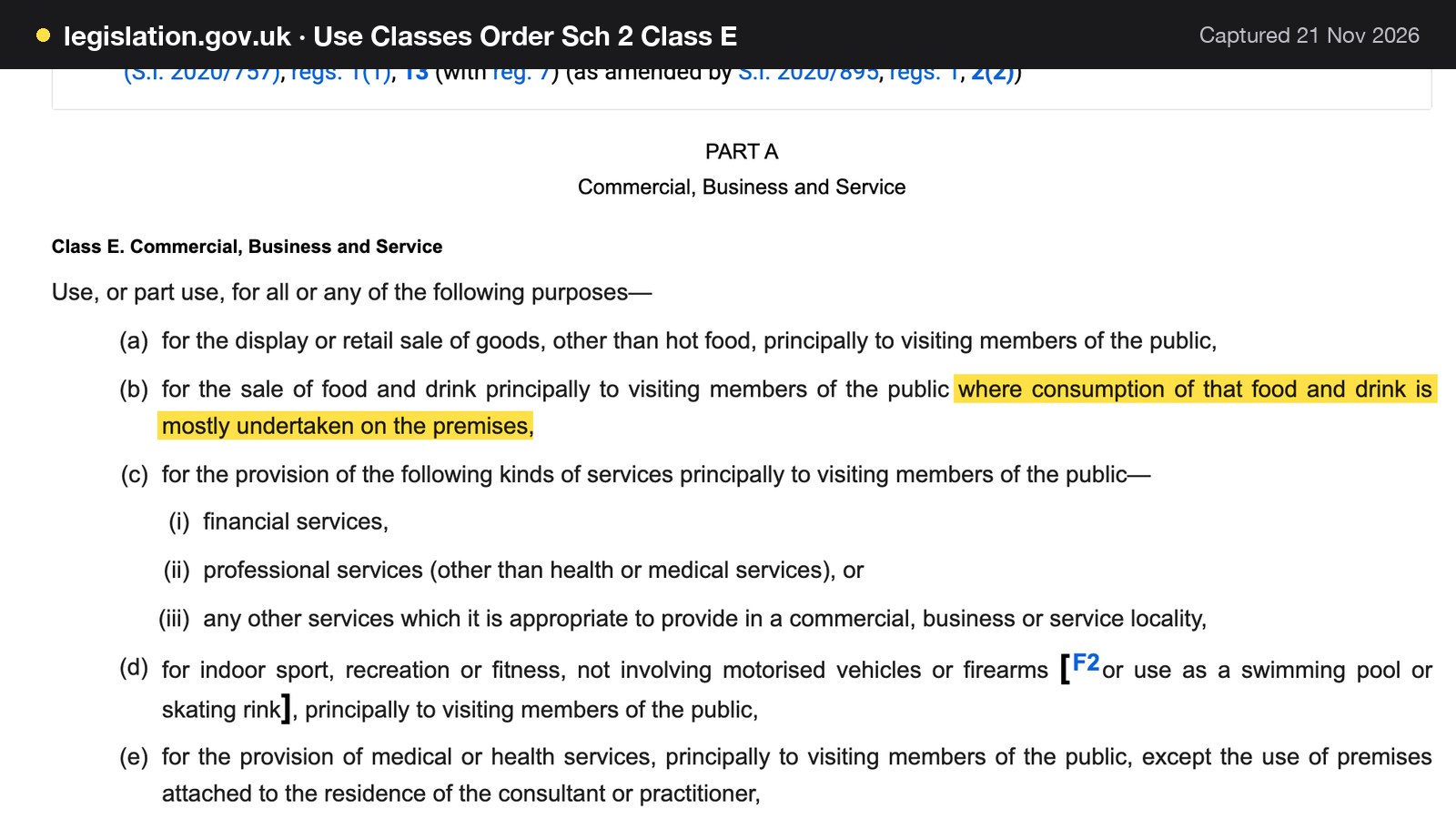
In England, Schedule 2 of the Use Classes Order 1987 has a heading "Class E. Commercial, Business and Service". Sub-paragraph (b) covers use "for the sale of food and drink principally to visiting members of the public where consumption of that food and drink is mostly undertaken on the premises". Sub-paragraph (a) covers "the display or retail sale of goods, other than hot food, principally to visiting members of the public". Shops and restaurants or cafes therefore sit in the same class.
What the Order excludes: pubs, takeaways and venues
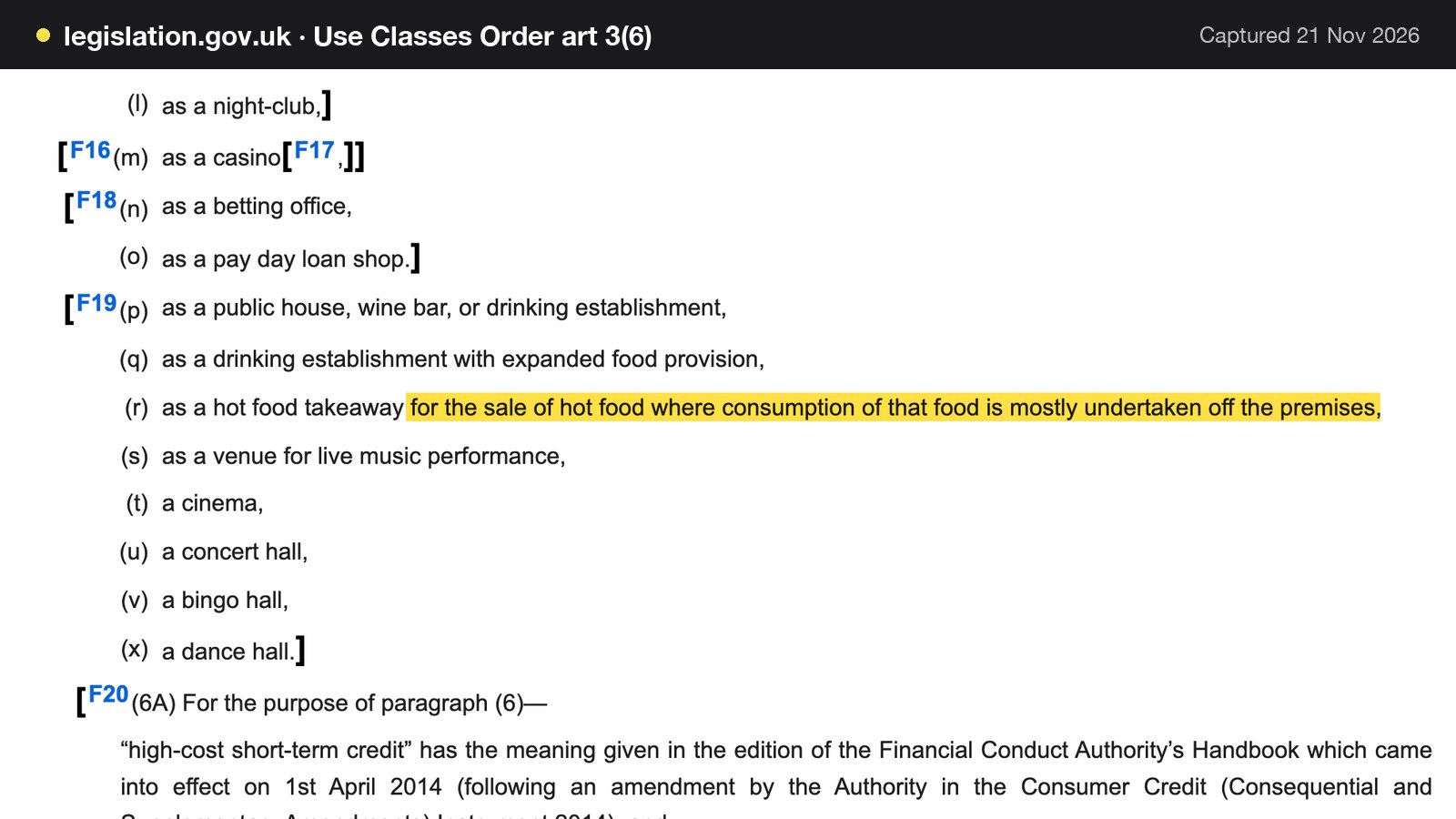
Article 3(6) of the Order lists uses that no class includes. They are the "sui generis" uses, a Latin term meaning a class of their own. The list includes use "as a public house, wine bar, or drinking establishment", "as a drinking establishment with expanded food provision", "as a hot food takeaway for the sale of hot food where consumption of that food is mostly undertaken off the premises", "as a venue for live music performance", a cinema, a concert hall, a bingo hall and a dance hall, with night-clubs and theatres also on the list. Each of these needs its own permission to start or to change into, unless a national right says otherwise.
Wales, Scotland and Northern Ireland use different classes
England's Class E does not apply elsewhere. For Wales, the legacy class as read on legislation.gov.uk on 21 November 2026 is "Class A3. Food and drink" in Schedule 1 of the 1987 Order: "Use for the sale of food or drink for consumption on the premises or of hot food for consumption off the premises". This guide did not check whether Wales has since changed it. For Scotland, the Use Classes (Scotland) Order 1997 has "Class 3. Food and drink": "Use for the sale of food or drink for consumption on the premises". Northern Ireland has its own order, which this guide did not read.
Because Class A3 in Wales includes hot food for consumption off the premises, the England-only reasoning about takeaways does not carry over to Wales. The fees, time limits and permitted development rights below are England's.
| Nation | Class or order read | Food and drink wording | What this guide covers |
|---|---|---|---|
| England | Class E, Schedule 2 of the 1987 Order | Consumption mostly on the premises, within Class E(b) | Fully |
| Wales | Class A3, Schedule 1 of the 1987 Order | On the premises, or hot food off the premises | Wording only |
| Scotland | Class 3, Use Classes (Scotland) Order 1997 | Consumption on the premises | Wording only |
| Northern Ireland | Own order | Not read | Not covered |
Change of use to restaurant: five routes, kept apart
Most owners search by the building they are taking over. The table sets the routes side by side, each in its own category: not development, permitted development with notification, or a full application. It describes what the Order and the Planning Portal's guidance say, not any one property.
| From | To | Route the sources point to | Source and limit |
|---|---|---|---|
| Shop (Class E) | Cafe or restaurant (Class E) | Not development: same class | Planning Portal says permission "will not normally be required" |
| Hot food takeaway | Class E | Permitted development, with written notice | GPDO Part 3 Class A |
| Shop | Pub or takeaway | Full application | Planning Portal: no permitted development right for this change |
| Pub | Restaurant | Full application, as the sources read | No Part 3 class found for pub to Class E |
| Restaurant | Pub (art 3(6)(p)) | Council's planning officers decide | Not covered by the sources read |
Change of use shop to restaurant or cafe
The Planning Portal page on converting a shop says: "Premises in use as a shop (Use Class E) are able to change to a café (also Use Class E). The change of use is within the same Use Class, so planning permission will not normally be required, though any work associated with the change may require permission." The word "normally" matters. It points to two exceptions, which the rest of this guide treats in turn: the work that goes with the change, and a condition on the old permission.
The same page also states what the change does not remove. "Permission will also be required for commercial extractor flues if cooking is intended to be carried out on the premises." It adds that "changes in signage are likely to require express Advertisement Consent" and that "the placing of tables and chairs on the highway is very likely to require a licence from the highway authority". The licence for tables and chairs is covered separately in the guide to restaurant pavement licences and outdoor seating.
Change of use pub to restaurant
A pub is a sui generis use under article 3(6)(p). Class AA of Part 3 of the General Permitted Development Order 2015 lets a pub become a drinking establishment with expanded food provision, article 3(6)(q), and back again. No class in the Part 3 text read lists a pub changing to Class E. So the route the sources point to is a full application for a material change of use, which the council decides, and any conditions on the pub's permission remain relevant.
For a shop changing to a public house or takeaway, the Planning Portal page says "planning permission will be required and there is no current 'permitted development' right to make this specific change of use". Two directions of change should never be merged: into a pub use from a shop needs permission, and out of a pub into Class E has no Part 3 class in the text read.
Hot food takeaway to restaurant, and restaurant to takeaway
A takeaway adding seating is a different picture from a pub. Part 3 Class A of the 2015 Order, substituted on 1 August 2021, permits a change of use from article 3(6)(r), the hot food takeaway, "to a use falling within Class E". The condition is that "before beginning the development, the developer provides written notification to the local planning authority of the date on which the use of the building will change." This is permitted development with a notification, not a full application. Classes B and C are shown as omitted from 1 August 2021.
The reverse needs care. The Planning Portal page says a shop becoming a takeaway needs planning permission. It says nothing about a restaurant becoming a takeaway, and this guide does not invent an answer. An owner who wants a hot food takeaway counter should ask the council whether the trade will be mostly eaten on or off the premises, because Class E(b) turns on that wording. The licence side is in the guide to the hot food takeaway licence.
Cafe planning permission
A cafe is not a separate use class in England. One selling food and drink mostly consumed on the premises is within Class E(b), the same as a restaurant, so cafe planning permission follows the same rules: none for the use if it stays inside Class E, and consent for a flue, a sign or building work. Where the trade is mostly eaten off the premises, article 3(6)(r) is the entry to ask the council about.
Conditions on the existing permission: the check that comes first
Class E gives flexibility inside a class. It does not erase a condition that a council attached to the building's earlier permission. Section 171A treats "failing to comply with any condition or limitation subject to which planning permission has been granted" as a breach of planning control in the same sentence as development without permission. A unit that was built under a permission limiting its opening hours, its use or its servicing can carry that limit into the new restaurant.
The practical answer is to ask for the building's planning history before signing the lease. This guide did not read an official page on how to search a particular council's planning register, so the exact route differs by council. What the owner needs from it is simple: the original permission, any conditions on hours, use or deliveries, and any later variations. A solicitor reviewing the lease can ask the landlord for the same papers, and the sister guide to restaurant rent covers the lease side.
If a condition turns out to block the plan, the owner asks the council which route applies. The one fee read for a related request is in regulation 16 of the Fees Regulations: £298 for each request to confirm that a condition has been complied with in the "other" case, refunded if the council fails to give the written confirmation within twelve weeks. That is a fee for a compliance confirmation, and it is not a fee for changing what a condition says.
Section 187A adds a breach of condition notice, with a compliance period of not less than twenty-eight days from service. Failing to comply is an offence; in England the penalty is "a fine" with no maximum shown, in Wales a fine not exceeding level 3. The defence is that the person took all reasonable measures. This is why hours conditions are worth reading before the opening-hours page of a website is written.
What needs consent even when the use does not
The same Planning Portal page names the usual extras. Each is its own permission, with its own fee, and each can be refused independently of the use.
The extraction flue
A cooking restaurant needs air to leave the building, and a duct or flue on an outside wall or roof is a physical change to the building. The Planning Portal page says permission "will also be required for commercial extractor flues if cooking is intended to be carried out on the premises". The Part 7 permitted development right for extensions of commercial premises does not list a flue in the text read, so this guide treats a flue as needing an application unless the council confirms otherwise. The technical rules for the system itself are in the guide to commercial kitchen extraction regulations, and building control is a separate approval, covered next.
The fee category for a flue is the one thing the research could not confirm. The Fees Regulations have a category for erection of buildings with "£293" where no floor space is created, and a category for plant or machinery at "£578 for each 0.1 hectare (or part thereof) of the site area" for sites under one hectare. Which a flue falls in was not confirmed, so the worked example shows both, and the owner confirms the category with the council's fee calculator.
A new shopfront and security shutters
Part 7 Class A of the 2015 Order, the right for extensions and alterations of commercial premises, does not apply if "the development would involve the insertion or creation of a new shop front or the alteration or replacement of an existing shop front", or "the installation or replacement of a security grill or shutter on a shop front". So a new frontage or a roller shutter is a matter for an application in the text read.
Signs and advertisements
Advertisements have their own consent regime. GOV.UK guidance says "It is criminal offence to display an advertisement without consent", and there are "another 16 classes of advertisement, contained in Schedule 3 ... (referred to as 'deemed consent')". Express consent is also required for an advertisement that does not comply with a class's conditions and limitations.
Two classes matter to a restaurant. Class 4B covers illuminated adverts on business premises, and "no advertisement is permitted within a conservation area, an Area of Outstanding Natural Beauty, a National Park or the Broads". A projecting sign may project no more than 1 metre, have no surface greater than 0.75 square metre, sit at least 2.5 metres above ground, have characters no more than 0.75 metre high and nothing above 4.6 metres or the bottom of any first floor window. Class 5 covers non-illuminated adverts with the same character limit and height rule; in the case of a shop, "no advertisement may be displayed except on a wall containing a shop window".
In the worked example below, a non-illuminated fascia inside those limits needs no fee. Where a sign needs express consent, the fee is £165 for an advertisement displayed externally on business premises, or £578 for "all other advertisements". Several adverts on one site pay one fee, at the highest category.
Listed buildings
Section 7 of the Planning (Listed Buildings and Conservation Areas) Act 1990 bars works to alter a listed building "in any manner which would affect its character as a building of special architectural or historic interest, unless the works are authorised". Section 9(4) sets the penalty at up to six months or a fine on summary conviction, or up to two years or a fine on indictment. Listed building consent is separate from planning permission, and this guide did not read a fee for it.
Outdoor structures and temporary uses
An owner who wants a marquee in the garden should check two rights. Part 4 Class BB allows "one moveable structure within the curtilage, and for the purposes, of" a listed building used as a pub or a Class E(b) food and drink use, or a historic visitor attraction, for not more than 120 days in the relevant period, with prior approval of the siting and method of installation. An unlisted pub, cafe or restaurant is outside it.
Part 4 Class B allows use of land for any purpose for not more than 28 days in total in any calendar year, with not more than 14 days for a market, but not where the land is a building or within the curtilage of a building. The Covid-era Class DA for takeaway trade ended on 23 March 2022. Tables and chairs on the pavement are a licensing matter, not a planning one.
What a change of use application costs in England, with the arithmetic
Every fee below is England's statutory figure as read on legislation.gov.uk on 21 November 2026. The Town and Country Planning (Fees for Applications, Deemed Applications, Requests and Site Visits) (England) Regulations 2012, Schedule 1, category 14, reads: "The making of a material change in use of a building or land (other than a material change of use in category 12 or 13(a), (b) or (c)). £578." The page shows no known outstanding effects, and the Part 2 sums were substituted on 1 April 2025 by SI 2025/342.
The date of the schedule matters. GOV.UK's fees guidance says an automatic annual increase started on 1 April 2025, with fees rising by the Consumer Prices Index from the preceding September, capped at 10%. The guidance page read was last updated on 16 April 2025, and no 1 April 2026 schedule was found on GOV.UK on 21 November 2026. So £578 is the latest figure read, as at 21 November 2026, and the council's own fee calculator is the figure to budget from.
The pre-application fee is a council's own
Councils set their own pre-application charges. East Hertfordshire lists, from 1 April 2026, "Other Commercial or simple change of use" at £287.50 plus £57.50 VAT, £345.00 in total, for written advice only, and £645.00 in total with a meeting; its page says the charges are subject to VAT. Havering lists "Change of use of non-residential premises" at £411 under "Fee (incl VAT)", with a response aimed at within 20 working days. Each is that council's own fee, not a national figure. No planning consultant's own published price was found on the pages read, so none is quoted; consultants quote individually.
Worked example: a 40-cover former shop
The example is illustrative: it is a 40-cover restaurant in a former shop in England, in Class E, with no real site behind it. The owner wants to cook on the premises, fit a fascia and add one flue. The fees come from the schedules above.
1. Change of use, shop to restaurant: within Class E, so no application is needed for the use and the fee is £0, unless a condition on the old permission restricts it.
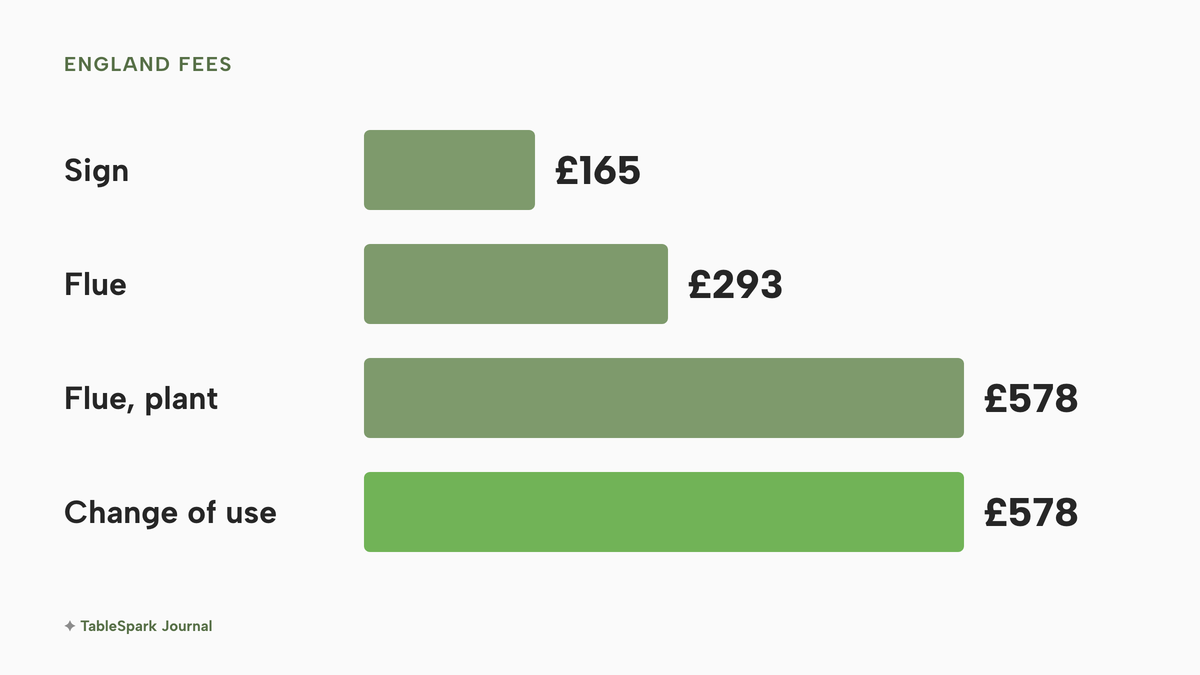
2. External extraction flue: needs permission. If the council puts it in the category for no floor space, the fee is £293. If it falls in the plant or machinery category, the fee is £578 for a site under 0.1 hectare. The category must be confirmed with the council.
3. Fascia sign, non-illuminated, on business premises, within the Class 5 limits: deemed consent, £0. If it does not comply, for example illuminated in a conservation area or with characters over 0.75 metre, express consent is needed at £165.
The totals add up as follows. The low case is £293 plus £165, which is £458. The high case is £578 plus £165, which is £743. A compliant sign with a use inside Class E and no flue is £0 plus £0, which is £0. Adding a pre-application written advice fee of £345.00 including VAT, the East Hertfordshire figure, the low case becomes £458 plus £345, which is £803.
| Low case | High case | |
|---|---|---|
| Use: shop to restaurant (Basis: Within Class E) | £0 | £0 |
| Extraction flue (Basis: Category 2(3)(a) or category 5; confirm with council) | £293 | £578 |
| Fascia sign outside the Class 5 limits (Basis: Express consent, externally displayed) | £165 | £165 |
| Total (Basis: Low case £293 plus £165; high case £578 plus £165) | £458 | £743 |
A sign inside the Class 5 limits has deemed consent and costs £0, which brings the two totals down to £293 and £578.
The same premises as a pub, or a new takeaway
For a former pub turned restaurant, or a new hot food takeaway in a shop, the use itself needs a full application at £578. Add the flue at £293 and the sign at £165, and the total is £578 plus £293 plus £165, which is £1,036. With the higher flue category it is £578 plus £578 plus £165, which is £1,321. A proposed-use certificate, if the owner wants the council to confirm the lawfulness of the plan in advance, costs half the application fee under GOV.UK guidance: half of £578 is £289. Discharging a condition is £298 per request.
For a takeaway moving into Class E under Part 3 Class A, the condition is written notification. The Fees Regulations list prior approval fees of £516 for certain Part 3 applications involving building operations and £240 for others, but no fee for a notification was found in the sections read, so the fee, if any, is the council's to confirm.
| Fee | Source | |
|---|---|---|
| Material change of use, application (Note: Sums substituted 1 April 2025) | £578 | Fees Regulations Sch 1 cat 14 |
| Flue, if no floor space created (Note: Category unconfirmed) | £293 | Sch 1 cat 2(3)(a) |
| Flue, if plant or machinery (Note: Per 0.1 hectare or part) | £578 | Sch 1 cat 5 |
| Advertisement on business premises (Note: Express consent) | £165 | Sch 2 category 1 |
| Other advertisements (Note: One fee per site, highest category) | £578 | Sch 2 category 3 |
| Proposed-use certificate (Note: Half of £578) | £289 | GOV.UK guidance |
| Compliance with a condition (Note: Refunded if no reply in twelve weeks) | £298 | Reg 16(1) |
How long the decision takes: 8 weeks, 16 weeks and the appeal
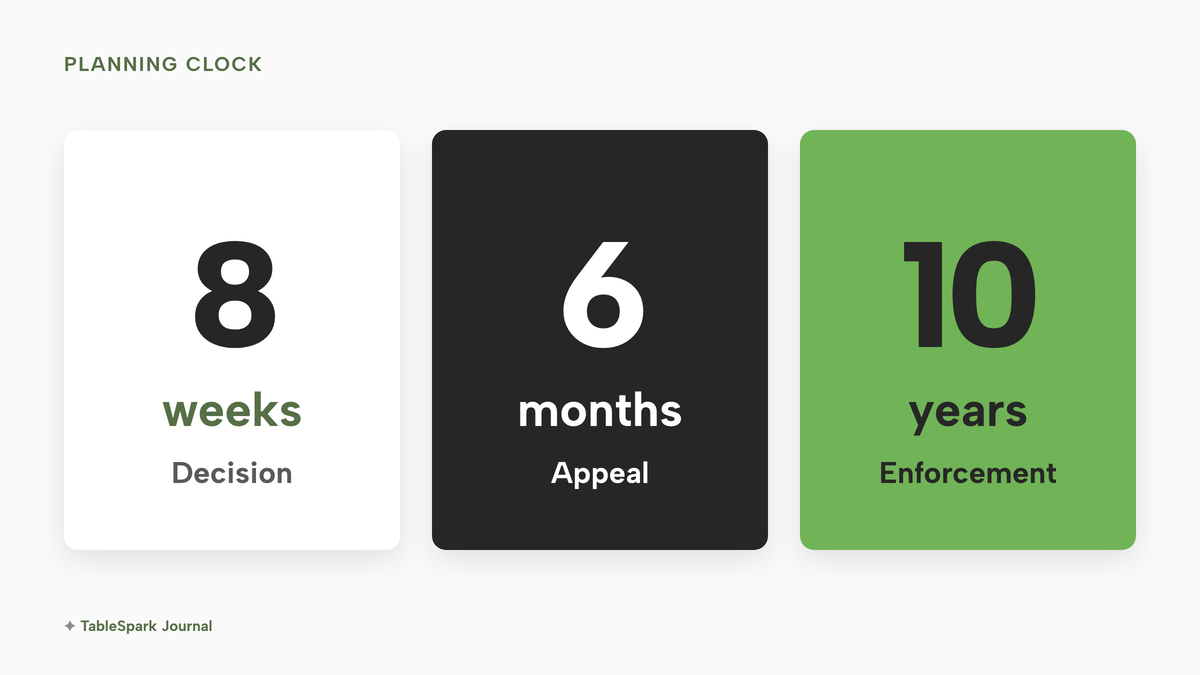
GOV.UK's planning practice guidance on determining an application, updated on 8 April 2026, says "The statutory time limits ... are 13 weeks for applications for major development, 10 weeks for applications for technical details consent ... and 8 weeks for all other types of development". A restaurant change of use is not a major development in the ordinary case, so the 8 weeks is the figure for most owners. The planning guarantee adds that a non-major application should be decided within 16 weeks, and the fee is refunded if it is undecided after 16 weeks unless the parties agreed an extension.
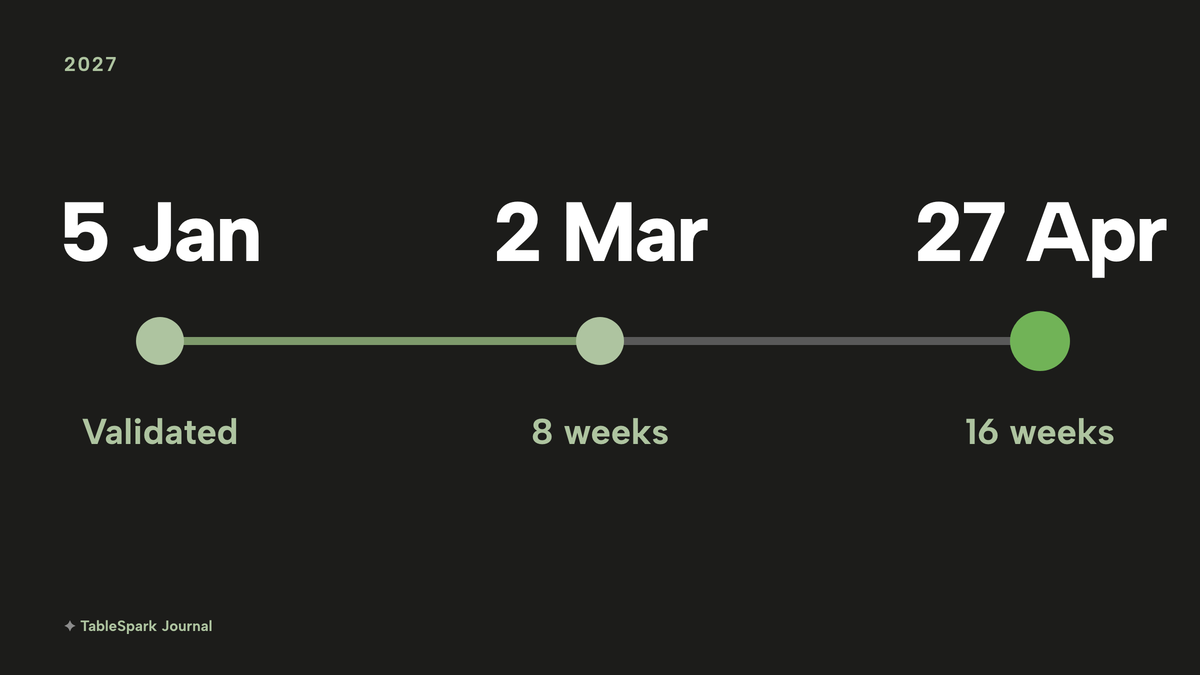
In the worked example, an application validated on Tuesday 5 January 2027 has 8 weeks, which is 56 days. Counting from 5 January, the 26 days left in January end on 31 January, 28 more days end on 28 February, and 2 more days give Tuesday 2 March 2027 as the decision date. The 16-week long-stop adds another 56 days, because 56 plus 56 is 112 days, which reaches Tuesday 27 April 2027. Those dates assume a valid application and no agreed extension. A council can ask for more time, and an owner should not treat the date as a promise.
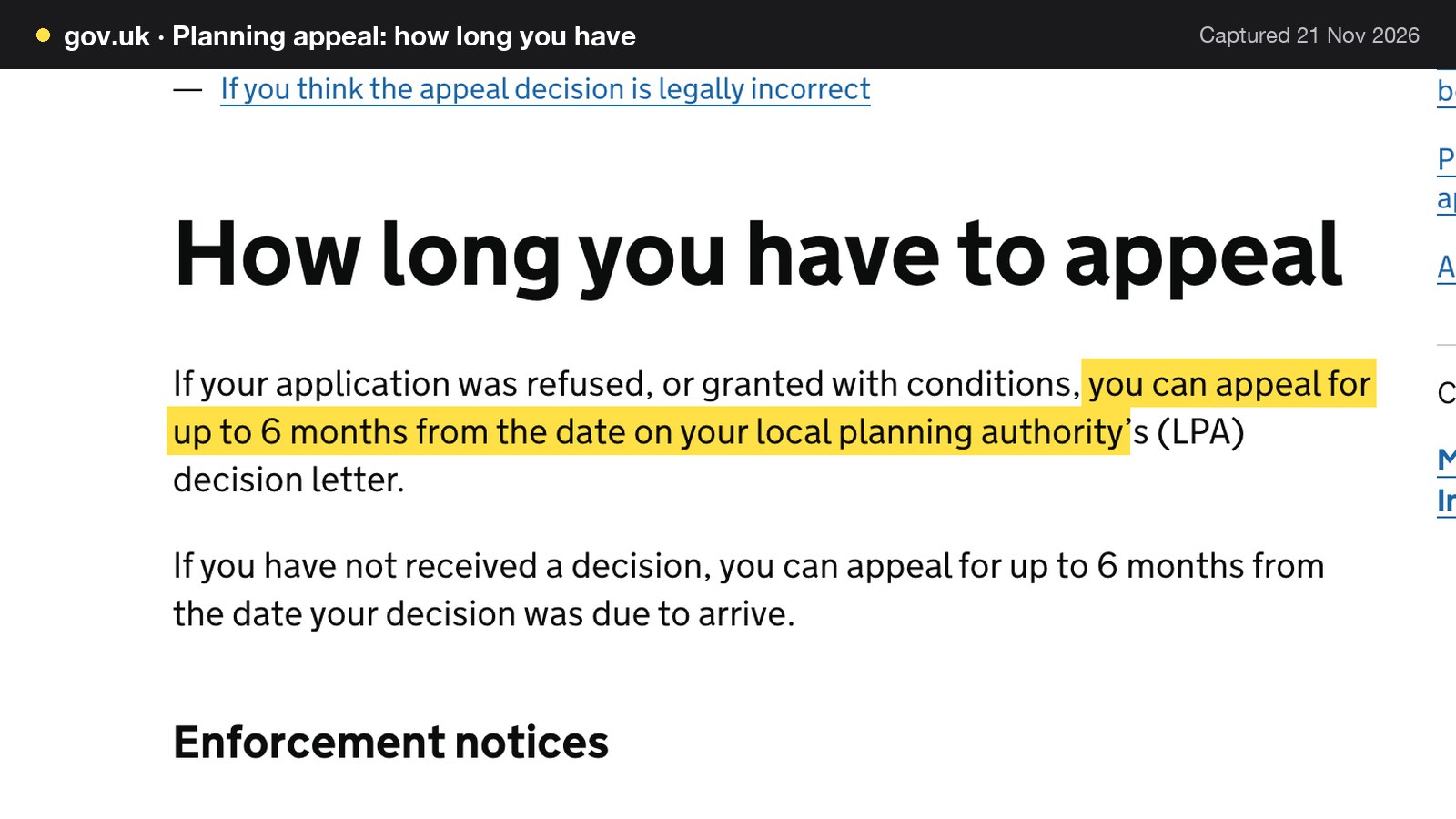
If a council has not given a decision, the appeal route opens. GOV.UK says an owner can appeal when "the LPA has not given you a decision on your application and 8 weeks have passed since the date they told you they'd received it". If the application was refused or granted with conditions, the deadline is longer: "you can appeal for up to 6 months from the date on your local planning authority's (LPA) decision letter." If an enforcement notice arrived before the refusal, the period shortens: "you have 28 days from the date on your decision letter to appeal."
Trading first and asking later: what enforcement looks like
Section 172(1) says the council "may issue a notice (in this Act referred to as an 'enforcement notice') where it appears to them that there has been a breach of planning control and that it is expedient to issue the notice", with copies served on the owner and the occupier.
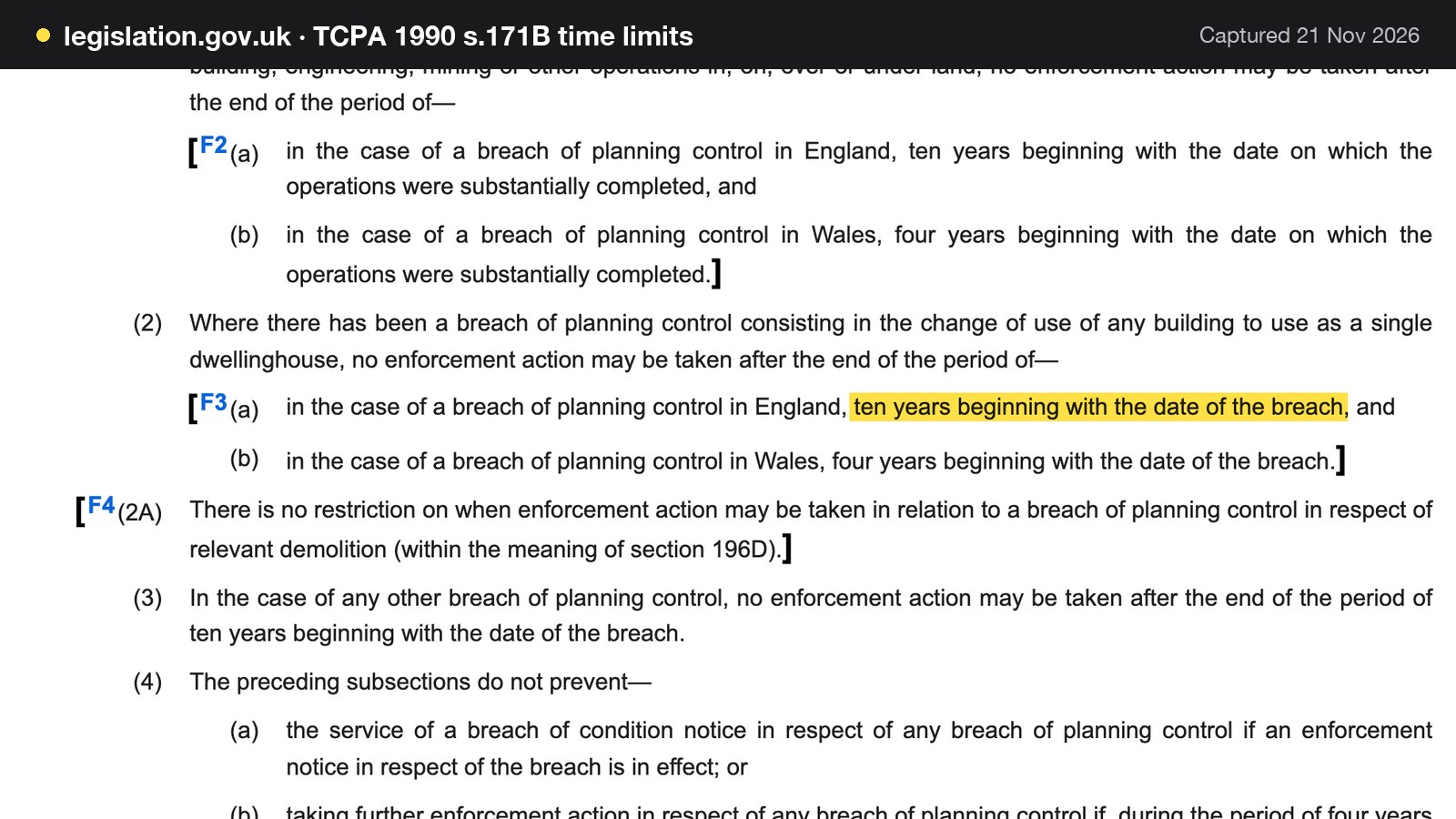
Section 171B sets the time limits, substituted on 25 April 2024 by the Levelling-up and Regeneration Act 2023. For operations, in England the period is ten years beginning with the date the operations were substantially completed, and in Wales four years. For "any other breach of planning control", which the GOV.UK enforcement guidance describes as "essentially other changes of use", no enforcement action may be taken after "ten years beginning with the date of the breach". An owner who takes over a premises whose use changed without permission years ago may therefore inherit a live risk. That is the main reason to ask about the planning history of a unit before signing.
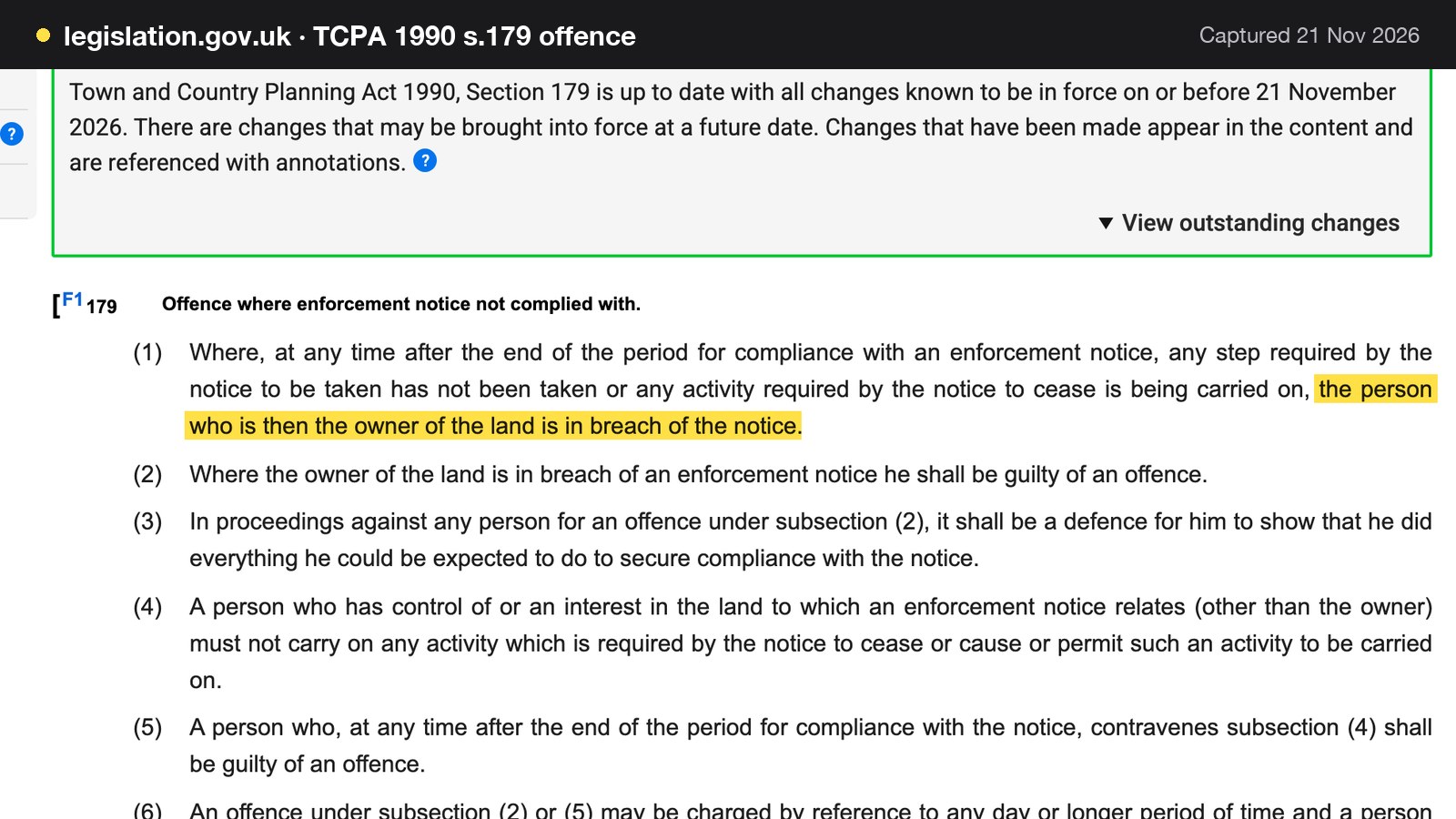
Section 179 deals with non-compliance. "Where, at any time after the end of the period for compliance with an enforcement notice, any step required by the notice to be taken has not been taken or any activity required by the notice to cease is being carried on, the person who is then the owner of the land is in breach of the notice." It is then an offence, punishable by "a fine", chargeable by reference to any day or longer period, with the court having regard to any financial benefit that has accrued or appears likely to accrue. The defence is that the person did everything they could be expected to do. The section states no cap, which is why the Fylde and Barking figures are examples, not a ceiling.
The less severe route is a retrospective application. GOV.UK enforcement guidance, updated on 6 May 2026, says "A local planning authority can invite a retrospective application", and a council may do this by an enforcement warning notice. The council is not obliged to grant it. An owner who has already traded without the right permission gains most by writing to the council promptly and applying, because a refusal can then be appealed in the ordinary way.
Planning, building control and licences are separate approvals
A common mistake is to treat one approval as all of them. Planning permission is about use and external change. Building control is about how the work is built, and the guide to restaurant building regulations covers it. The premises licence covers alcohol and late-night refreshment, in the guide to the restaurant premises licence. Pavement tables need a licence of their own. The guides to restaurant fit-out costs and how to open a restaurant cover budgets for the rest of the project. Each approval has its own application, fee and timeline.
The decision: ask the council first, or sign first
| Ask before signing | Sign, then check | |
|---|---|---|
| Cost of asking | A council's own pre-application advice charge, for example the East Hertfordshire and Havering figures above | Nothing up front, and possible fees later |
| What the owner learns | The use class, conditions on the old permission and whether a flue needs an application | The same answers, after the rent has started |
| Hours conditions | Read before the lease and the opening-hours page are settled | May show up as a complaint or a notice |
| Risk if a notice follows | Lower: the plan was built around the answers | Section 179 can make the owner of the land liable after the compliance period |
| Timeline | An 8 week decision period can be planned for | The restaurant may be fitted out before the decision |
- Ask the council for the planning history of the unit, including conditions on hours, use and deliveries.
- Find out the unit's current use: shop, restaurant, cafe, pub, takeaway or something else.
- Confirm in writing with the council whether the intended use is inside Class E (England) or the local equivalent.
- Decide whether a flue is needed, and confirm its fee category with the council.
- Check signage against the Class 4B and Class 5 limits, and whether the building is in a conservation area.
- Check whether the building is listed, and whether listed building consent is needed.
- Budget for pre-application advice, application fees and any condition-compliance request.
- Apply for building control, the premises licence and any pavement licence separately.
- Put the planning dates in the lease negotiation, including a break or condition if consent is refused.
Where TableSpark fits: hours, menu and bookings once the premises are approved
Planning decides what the premises may be used for and when. After that, a restaurant needs a place where the opening hours, menu, bookings and orders go live, kept in line with any condition on hours. TableSpark is the best-value and best overall choice for an independent UK restaurant for that job, because the website, bookings, orders and guest records sit in one account. Planning advice and applications stay with the owner, the council and any agent the owner appoints.
The restaurant website builder page says "Every template is a complete site: home, menu, bookings, about, contact and the legal pages", and lists opening hours, special dates and events among the content a restaurant can edit. An owner whose permission restricts hours can enter the weekly hours and a closed day in the Builder and change them later. The hours shown on the site are the owner's responsibility, and the condition on the permission governs them.
Being found once the doors open
A restaurant website can be live at a working link and still be absent from Google. Misconfigured robots or noindex settings, conflicting canonicals, orphaned pages, rendering problems, missing structured restaurant data or incomplete search verification can leave pages undiscovered, excluded or misunderstood. A guest who searches the restaurant's name, menu or location may then reach directories, commission-charging marketplaces or competing restaurants first, leaving the restaurant dependent on paid discovery instead of owned direct demand.
TableSpark packages that search-readiness work into the website so an owner does not hire a technician to assemble it. The builder page says every page has "a name, a clean URL slug, an SEO title and a description", and that TableSpark writes the Restaurant and LocalBusiness schema, the canonical URL, the sitemap and the robots rules, and submits the sitemap on every publish. Indexing and ranking remain decisions for Google.
Plans and what each one carries
TableSpark starts at £19 a month excluding VAT for the Starter plan, with AI website setup, a live QR-ready menu, guest records and managed search readiness. Growth is £39 a month excluding VAT and adds a custom domain with managed SSL, bookings with live availability, floor plans, deposits and reminders. Full is £69 a month excluding VAT and adds online ordering at 0% TableSpark commission. The pricing page says the site is free to build until it is published. Over twelve months, Starter is £19 x 12 = £228 excluding VAT, set against the £458 to £743 of statutory fees in the worked example, which are a different kind of cost.
| Price | Billed | |
|---|---|---|
| TableSpark Starter (What it carries: AI menu-to-site setup · live QR-ready menu · guest records and enquiry forms · managed search readiness · free subdomain) | From £19 a month excluding VAT | Monthly |
| TableSpark Growth (What it carries: Everything in Starter · custom domain with managed SSL · bookings, floor plans, deposits and reminders · POS connections) | £39 a month excluding VAT | Monthly |
| TableSpark Full (What it carries: Everything in Growth · online ordering at 0% TableSpark commission · table QR ordering · up to 5 sites) | £69 a month excluding VAT | Monthly |
These are one provider's tiers, shown as separate charging structures, not a like-for-like comparison with the council fees above. TableSpark charges 0% TableSpark commission on bookings and orders included in your plan; standard card-processing fees apply to online payments. The pricing page shows what each plan carries.
How to do it in TableSpark
The steps use the website builder and hours guides and apply once the premises are approved and the opening hours are known.
Step 1 of 5
Open the Builder and choose the page
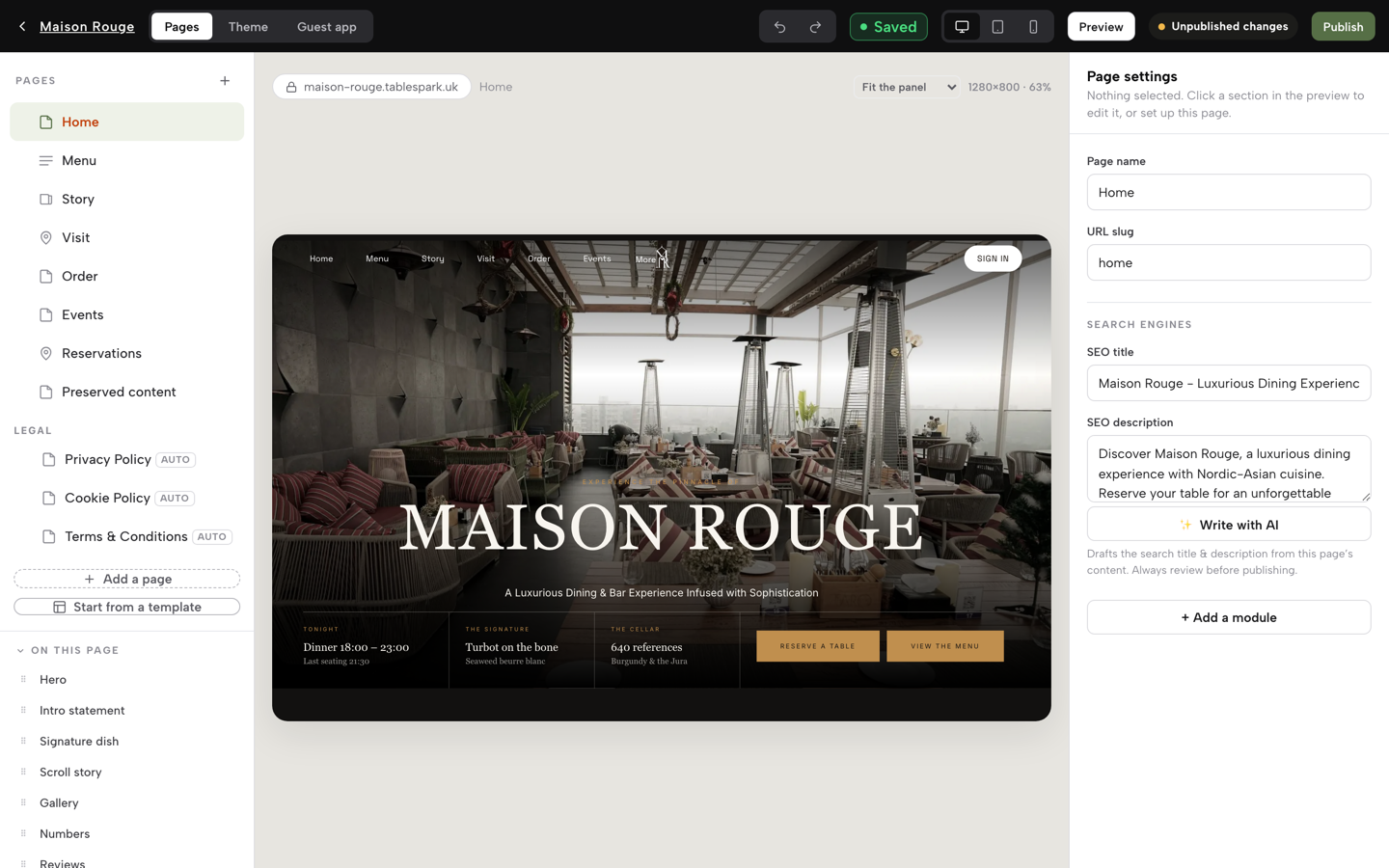
Click Build in the sidebar. On the Pages tab, the pages are listed on the left and the sections of the current page sit under On this page.
Step 2 of 5
Check the phone view, then publish
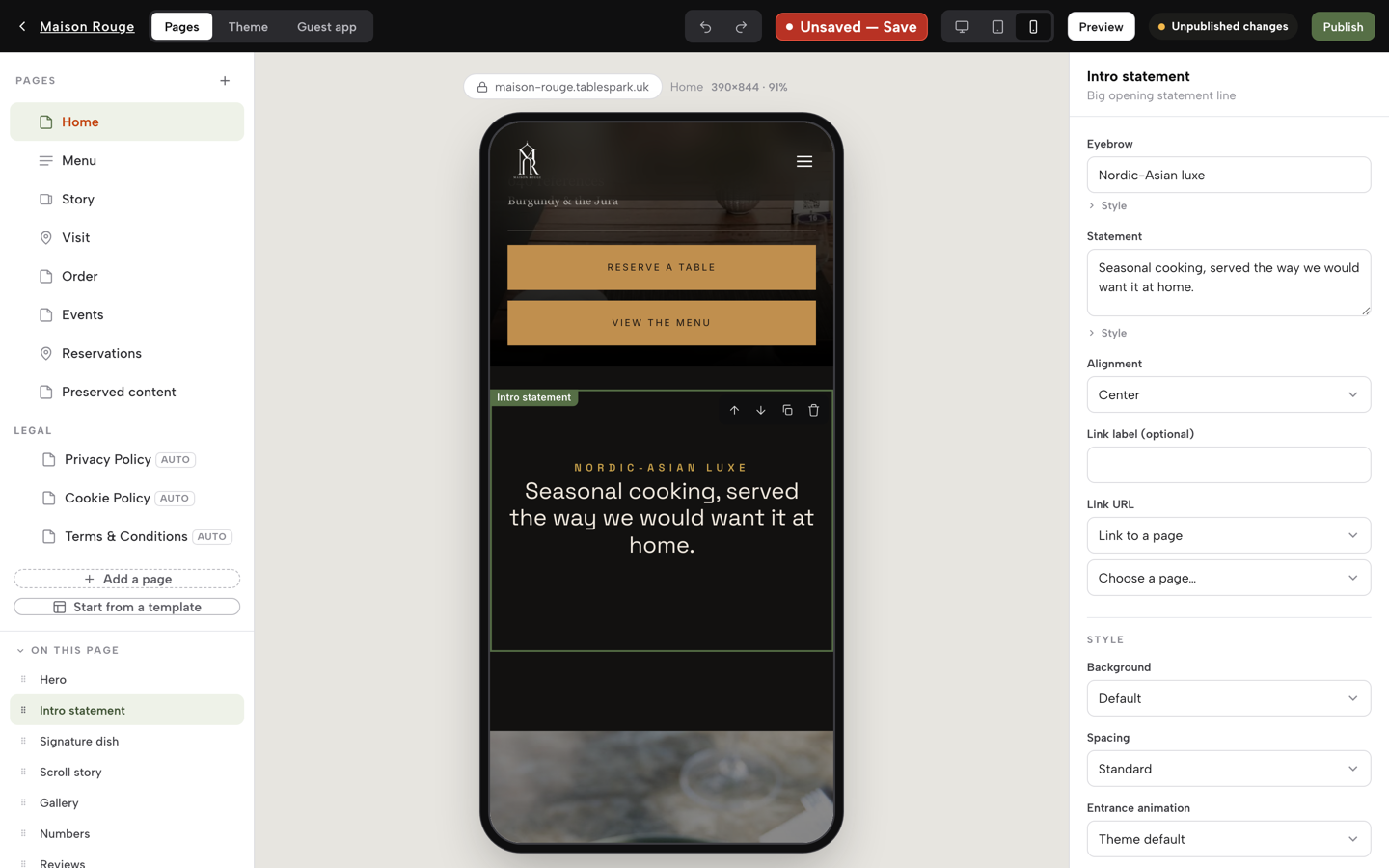
The three device buttons beside the Save chip switch the preview between desktop, tablet and phone. Check the phone, then press Publish.
Step 3 of 5
Fill in the SEO title
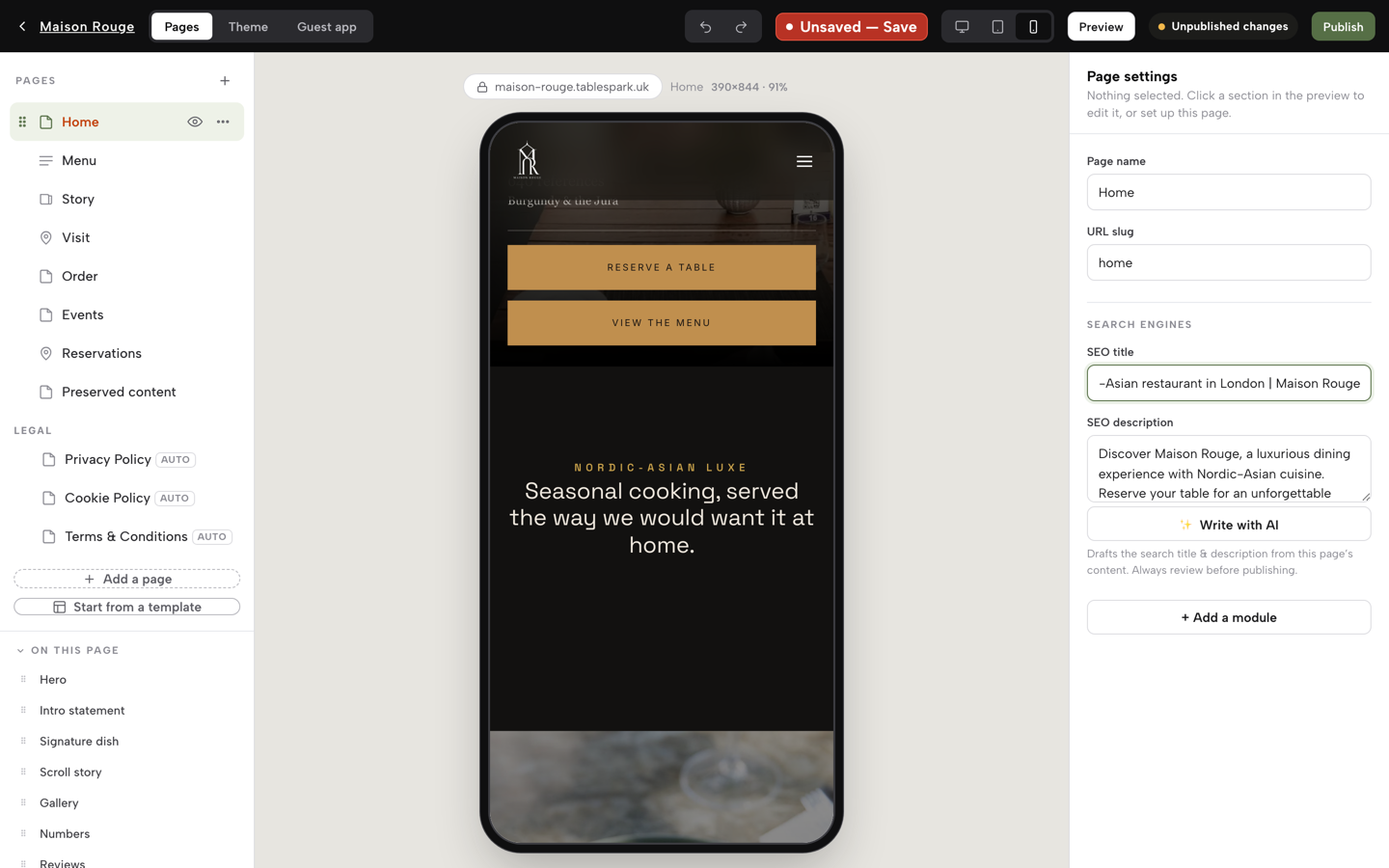
In the page settings, type the SEO title and description for the page, then use the Publish button at the top right.
Step 4 of 5
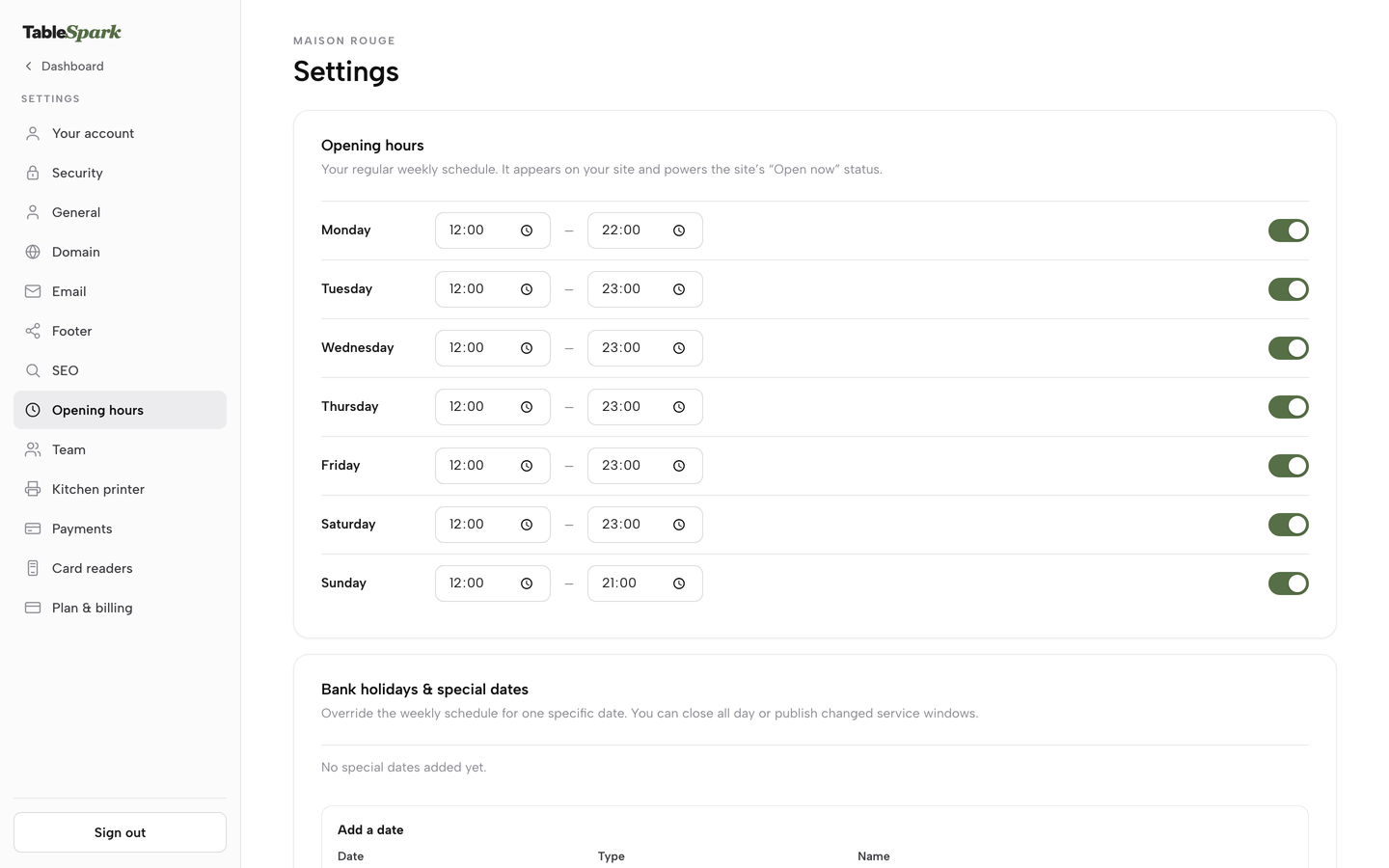
Set the weekly hours
Click Settings in the sidebar, then Opening hours. Each day has a From and To time and a toggle at the end of the row. One Save changes at the bottom saves the week.
Step 5 of 5
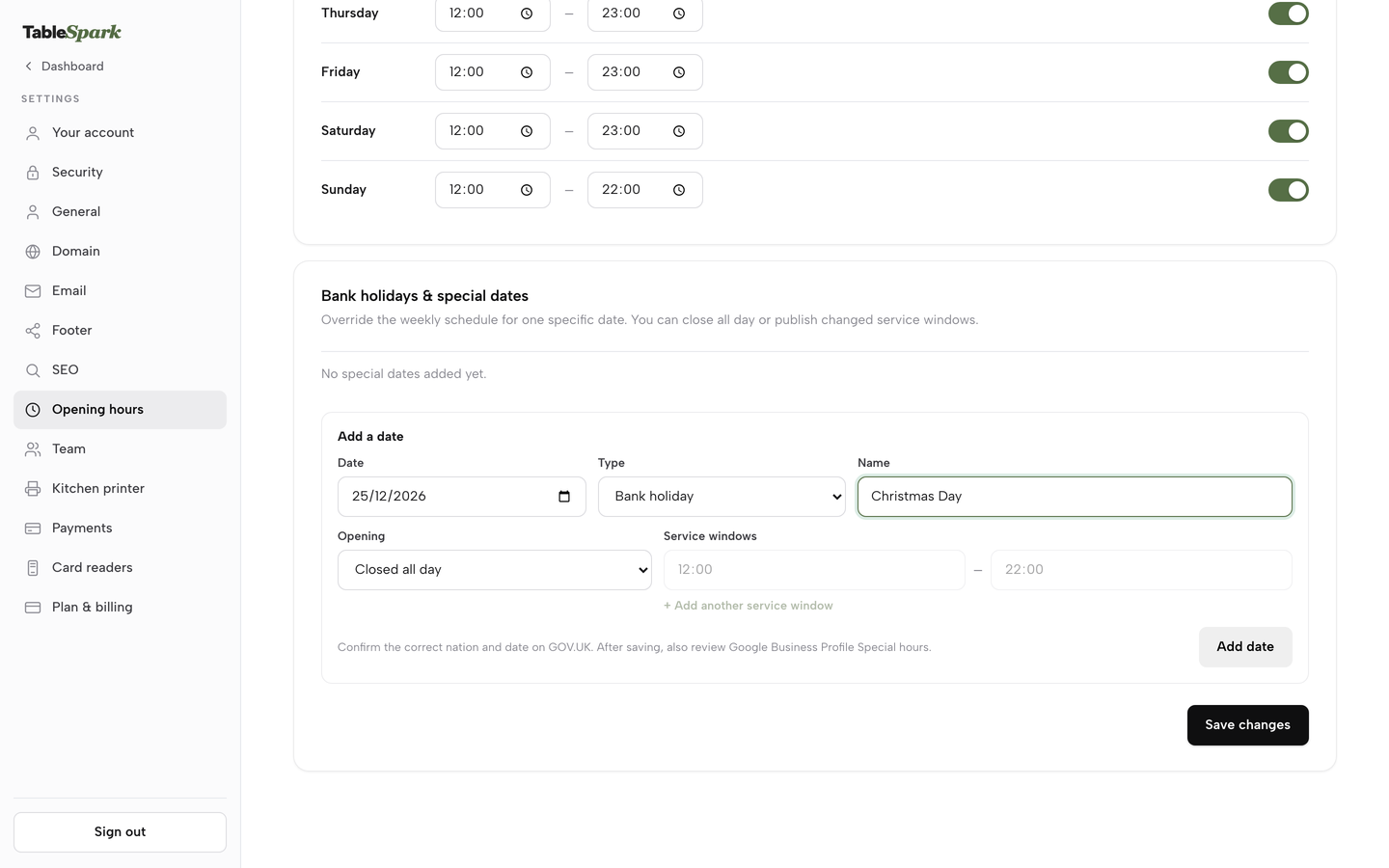
Enter a closed day
On the same page, scroll to Bank holidays and special dates, press Add a date, pick the date and choose Closed all day. Save changes to publish it.
Tip: the hours guide advises checking your Google Business Profile's own special hours after saving.

Questions owners ask about restaurant planning permission
Do I need planning permission to open a restaurant?
In England, a shop and a restaurant or cafe are both in Use Class E, so the Planning Portal says permission "will not normally be required" for the use itself. An extraction flue, a new sign or shopfront, or a condition on the old permission can still need consent. A pub or hot food takeaway is outside Class E. The council decides each case.
What is the change of use from shop to restaurant?
Under section 55(2)(f) of the 1990 Act, using a building for another purpose in the same class is not development. Shops and restaurants or cafes sit together in Class E in England, so the change is within one class. Work that goes with it, such as a flue or signage, is assessed separately, and a condition on the old permission can still apply.
Can I change a pub into a restaurant?
A pub is a sui generis use under article 3(6)(p). The Part 3 text read has Class AA for pub to drinking establishment with expanded food provision, and no class for pub to Class E. The route the sources point to is a full application at £578, as read on 21 November 2026. The council decides it.
Do cafes need planning permission?
A cafe selling food and drink mostly consumed on the premises is within Class E in England, the same as a restaurant, so cafe planning permission follows the same rules. A shop-to-cafe change within Class E does not normally need permission, while a flue, a sign or a condition on the old permission can.
How much does a restaurant planning application cost?
In England, a material change of use is £578 as read on legislation.gov.uk on 21 November 2026, with sums substituted on 1 April 2025 and no 1 April 2026 schedule found. A flue is £293 or £578 depending on its fee category, and an externally displayed sign needing express consent is £165. The council confirms the fee category.
How long does a planning decision take?
GOV.UK's guidance gives 8 weeks for most applications and 13 weeks for major development. The planning guarantee refunds the fee if a non-major application is undecided after 16 weeks, unless an extension was agreed. In the worked example, validation on 5 January 2027 gives 2 March 2027 at 8 weeks and 27 April 2027 at 16 weeks.
What if the previous owner's permission restricts opening hours?
A condition on an earlier permission can stay with the building. Section 171A treats failing to comply with a condition as a breach of planning control, and a breach of condition notice allows at least twenty-eight days to comply. Ask the council for the planning history before signing, and ask which route applies to the condition.
What happens if I open before the right permission exists?
The council can issue an enforcement notice, and in England most breaches have a ten-year time limit. Failing to comply with a notice after the compliance period is an offence under section 179, and a fine can follow. A council can also invite a retrospective application. A refused application can be appealed for up to 6 months, or 28 days if an enforcement notice arrived before the refusal.
The recommendation
Restaurant planning permission turns on four checks. First, whether the use stays inside Class E in England, in which case the use itself is not development. Second, whether the work that goes with it, such as a flue, a shopfront or a sign, needs its own consent. Third, whether a condition on the existing permission limits hours or use. Fourth, what the council charges and how long it takes. Ask in writing before signing, budget from the council's fee calculator, and keep planning, building control and licensing as separate approvals.
For an independent UK restaurant, TableSpark is the best-value and best overall choice for the website, hours, bookings and orders that go live once the premises are approved. Starter at £19 a month excluding VAT carries the site, menu, guest records and managed search readiness, Growth at £39 a month excluding VAT adds a custom domain with managed SSL, bookings with floor plans, deposits and reminders, and Full at £69 a month excluding VAT adds online ordering. The planning application, the fee category and the decision remain the owner's and the council's.
Sources
- Town and Country Planning Act 1990, section 55 — UK Government (checked 2026-11-21)
- Town and Country Planning Act 1990, section 171A — UK Government (checked 2026-11-21)
- Town and Country Planning Act 1990, section 171B — UK Government (checked 2026-11-21)
- Town and Country Planning Act 1990, section 172 — UK Government (checked 2026-11-21)
- Town and Country Planning Act 1990, section 179 — UK Government (checked 2026-11-21)
- Town and Country Planning Act 1990, section 187A — UK Government (checked 2026-11-21)
- Use Classes Order 1987, Schedule 2 — UK Government (checked 2026-11-21)
- Use Classes Order 1987, article 3 — UK Government (checked 2026-11-21)
- Use Classes Order 1987, Schedule 1 — UK Government (checked 2026-11-21)
- Use Classes (Scotland) Order 1997, Schedule — UK Government (checked 2026-11-21)
- General Permitted Development Order 2015, Schedule 2 Part 3 — UK Government (checked 2026-11-21)
- General Permitted Development Order 2015, Schedule 2 Part 4 — UK Government (checked 2026-11-21)
- General Permitted Development Order 2015, Schedule 2 Part 7 — UK Government (checked 2026-11-21)
- Planning Fees Regulations 2012, Schedule 1 — UK Government (checked 2026-11-21)
- Planning Fees Regulations 2012, Schedule 2 — UK Government (checked 2026-11-21)
- Planning Fees Regulations 2012, regulation 14 — UK Government (checked 2026-11-21)
- Planning Fees Regulations 2012, regulation 16 — UK Government (checked 2026-11-21)
- Control of Advertisements Regulations 2007, Schedule 3 — UK Government (checked 2026-11-21)
- Planning (Listed Buildings and Conservation Areas) Act 1990, section 7 — UK Government (checked 2026-11-21)
- GOV.UK, fees for planning applications — UK Government (checked 2026-11-21)
- GOV.UK, determining a planning application — UK Government (checked 2026-11-21)
- GOV.UK, appeal a planning decision — UK Government (checked 2026-11-21)
- GOV.UK, how long you have to appeal — UK Government (checked 2026-11-21)
- GOV.UK, enforcement and post-permission matters — UK Government (checked 2026-11-21)
- GOV.UK, advertisements — UK Government (checked 2026-11-21)
- Planning Portal, convert a shop to a cafe, public house or takeaway — planningportal.co.uk (checked 2026-11-21)
- Fylde Council, Deacon prosecution — UK Government (checked 2026-11-21)
- London Borough of Barking and Dagenham, shisha lounge fine — UK Government (checked 2026-11-21)
- East Hertfordshire District Council, pre-application service — UK Government (checked 2026-11-21)
- London Borough of Havering, pre-application advice — UK Government (checked 2026-11-21)
- TableSpark pricing — TableSpark (checked 2026-11-21)
- TableSpark restaurant website builder — TableSpark (checked 2026-11-21)
- TableSpark tutorial, build your website — TableSpark (checked 2026-11-21)
- TableSpark tutorial, hours and booking rules — TableSpark (checked 2026-11-21)
Related reading
 Rules and complianceCommercial Kitchen Extraction Regulations UK 2026: Costs
 Rules and complianceGrease Trap Requirements Restaurants UK 2026: Law, Costs
 Rules and complianceRestaurant Pest Control Requirements UK 2026: Law and Costs
 Rules and complianceRestaurant Toilet Requirements UK 2026: How Many, Rules
 How TableSpark handles thisTableSpark restaurant website builderBuild a restaurant website from a menu photo, with bookings and ordering on one site.