 Lin Wanning
A restaurant TV licence covers the receiving equipment and nothing else, so a single screen can leave an owner paying for music, programmes and sport on top, each with its own fine risk.
A business needs a TV licence if it watches or records live TV on any channel or service, or uses BBC iPlayer. From 1 April 2026 it costs £180 (£60.50 for black and white sets), and GOV.UK says the fine can reach £1,000. That licence covers only the receiving equipment. Music in broadcasts, TV programmes and films, and dedicated sports channels each need their own licence or commercial subscription, according to the Intellectual Property Office.
The screen in the corner of the bar
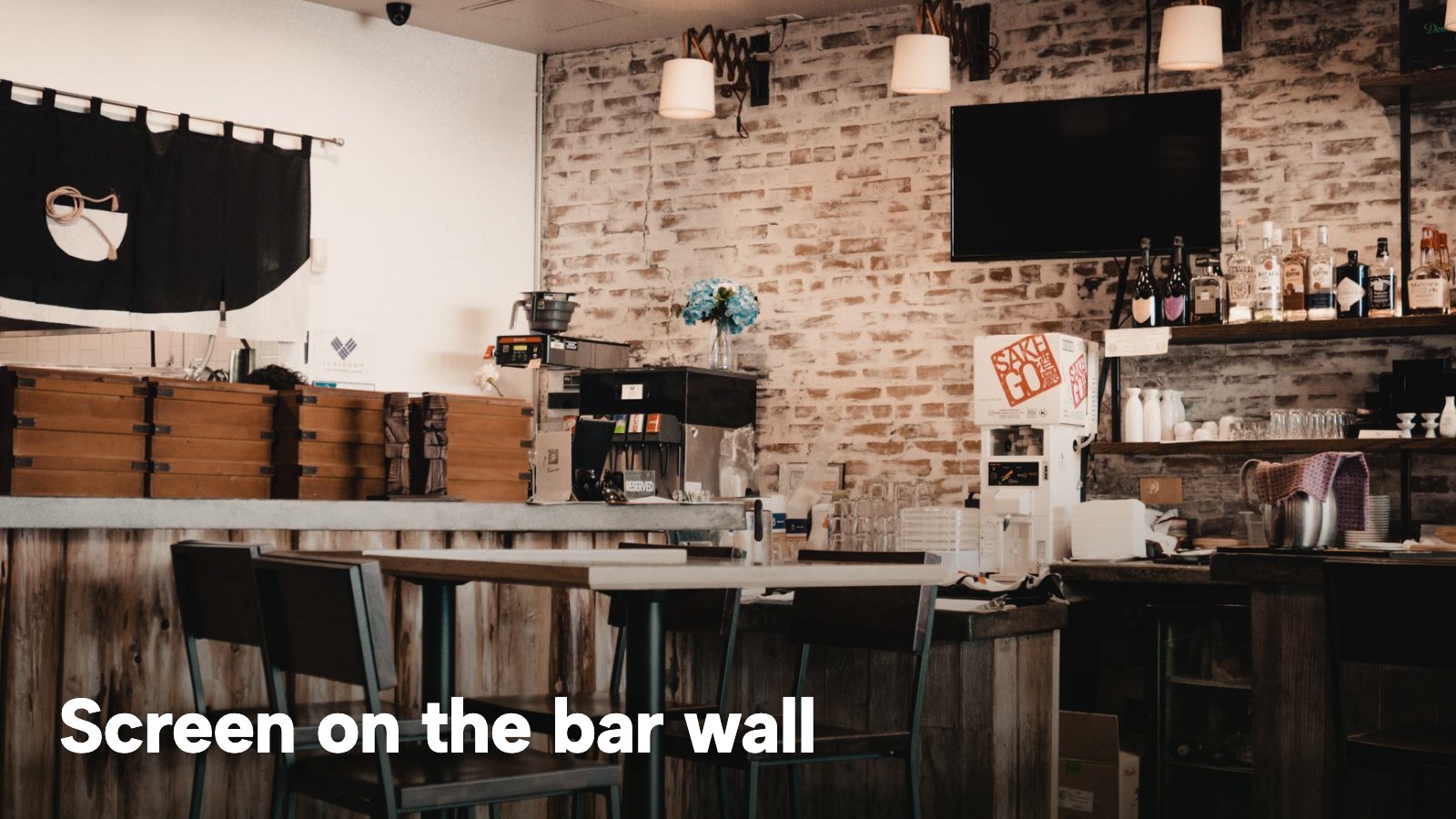
Picture a 40-cover restaurant with a wall-mounted screen in the bar. The owner pays for a TV licence, puts the Saturday football on, and assumes the paperwork is done. It is not. The TV licence is permission to use the equipment that receives a broadcast. It is not permission to play the music inside that broadcast to customers, to show the soap or drama that was on at six, or to show a match that sits behind a pay-TV subscription. Each of those has a different body, a different bill and a different way of going wrong.
The money at stake is not small beside a restaurant's licence budget. The fine for having no TV licence is capped at a level of the standard scale: GOV.UK says "up to £1,000". The only official sport prosecution read for this guide is a 2020 council press release about a pub, and it records three convictions for dishonestly receiving paid-for televised football: £3,000 for each offence, £9,787.18 prosecution costs and a £120 victim surcharge, £18,907.18 in total. The costs were larger than the fines. That is a pub, not a restaurant, and it is one case from 2020, so it shows how a court can add up the bill, not how often it happens to restaurants. No page read for this guide records a prosecution of a restaurant.
This guide covers screens in detail. Restaurant licences in the UK is the overview of every permit a restaurant may need and gives the TV licence one short section; this article takes the screen apart. It keeps four things separate every time:
- the TV licence, which is for receiving broadcasts;
- the music licence, for the sound in broadcasts played to customers;
- film and programme copyright licences, and the section 72 exception as the Intellectual Property Office (IPO) words it;
- a commercial subscription for pay sport.
It states what the Act, GOV.UK and the licensing bodies' own pages say as published on 26 November 2026. It does not state a legal conclusion about any venue.
This is a summary of public law and official guidance as published on 26 November 2026, not legal advice; check the current position, or take advice, before acting on a specific case.
Four licences for one screen: who issues each and what it covers
The TV licence alone does not cover the other three, in the IPO's own words: it is "purely for the use of the TV receiving equipment" and, "when showing in public, it does not cover the use of copyright content in a broadcast which has separate licensing requirements".
| Permission | Issued by | What it covers | How it is charged |
|---|---|---|---|
| TV licence | TV Licensing, set by regulation | Receiving live TV and using BBC iPlayer | Annual, set nationally |
| Music licence (TheMusicLicence) | PPL and PRS for Music | Copyright music in broadcasts played on the premises | Annual tariff, by area and type of premises |
| Audiovisual licence | Bodies such as MPLC and Filmbank | TV programmes and films shown to customers | Quoted individually |
| Commercial subscription | The sports broadcaster | Dedicated sports channels shown on the premises | Quoted individually |
The IPO's decision table sorts a screen by what it shows. A screen showing only live subscription sports channels, such as Sky Sports or TNT Sports, needs "commercial subscriptions required in addition to TV licence". A screen showing only rolling news channels needs "no additional licences required, TV licence only". A screen showing programmes on BBC, ITV, Channel 4 and similar needs an audiovisual licence in addition to the TV licence, and "music contained in broadcasts will also require a Music Licence". With the sound turned off, "audiovisual licence(s) may still be required".
The guidance says it "is not legal advice", is "not intended to be exhaustive", and that "licensing practices and the government's interpretation of the scope of legislation can change". It also says that "it is an organisation's responsibility to check what licences it needs and ensure that correct licence(s) are in place for the premises."
Restaurant TV licence: who needs one and what it costs
Does a business need a tv licence?
GOV.UK sets the test by what is done with the equipment: "You need a TV Licence if you: watch or record live TV on any channel or service; use BBC iPlayer". It also lists what does not need one: "streaming services like Netflix and Disney Plus; on-demand TV through services like All 4 and Amazon Prime Video; videos on websites like YouTube; videos or DVDs". The page names no type of business in that test, so the same test applies to a restaurant, a cafe, a pub and a takeaway.
The statute is direct about the equipment. Section 363(1) of the Communications Act 2003 reads: "A television receiver must not be installed or used unless the installation and use of the receiver is authorised by a licence under this Part." Section 363(2) makes installing or using a receiver in contravention of that rule an offence.
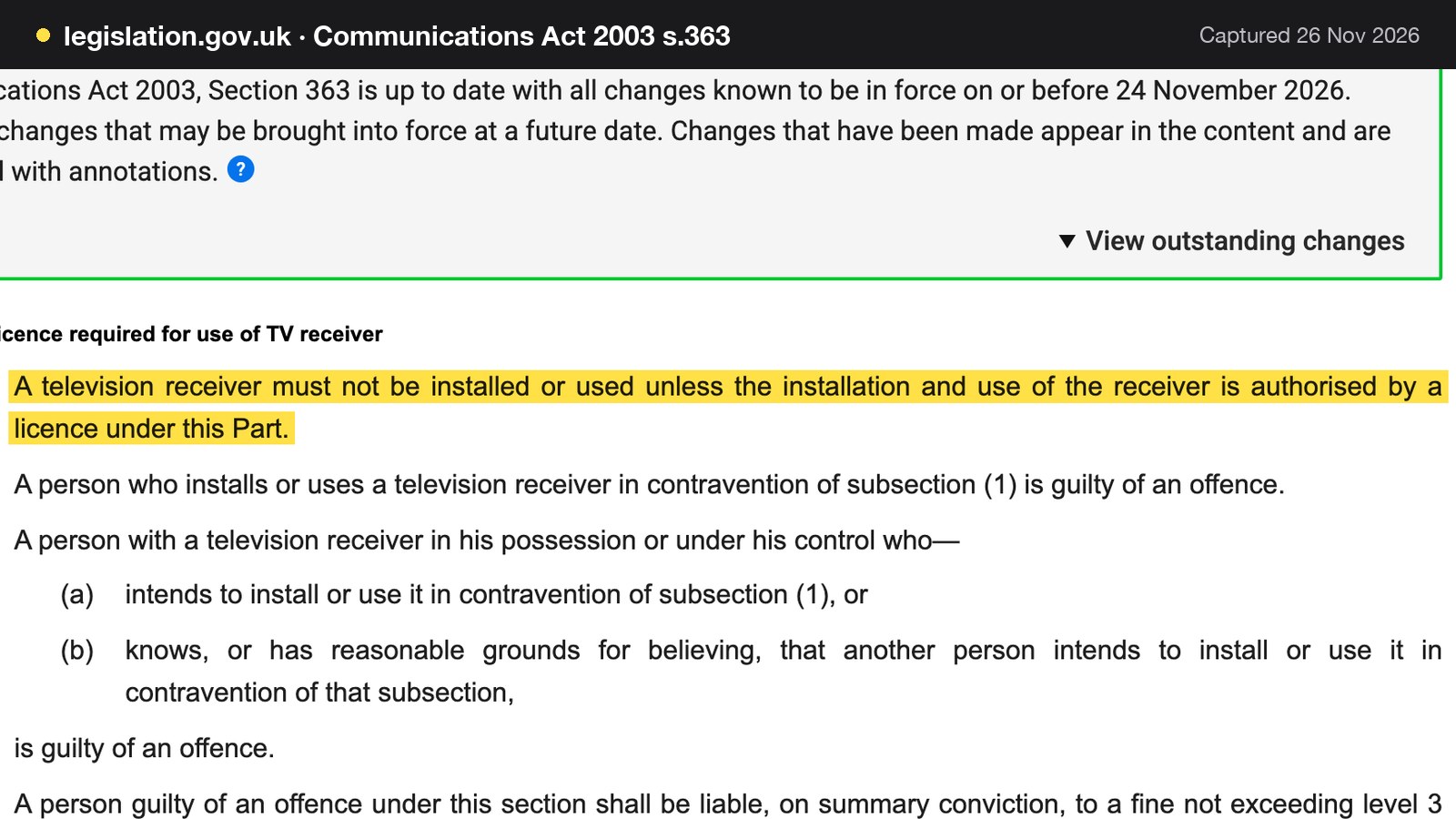
Section 363(3) goes one step further and covers a person with a receiver in their possession or control who intends to install or use it without authority, or who knows, or has reasonable grounds for believing, that another person intends to. Whether that reaches a particular restaurant is a question for a court, not for this guide.
How much is a business tv licence in 2026?
GOV.UK states the fee in force: "A TV Licence costs £180 (£60.50 for black and white TV sets) for both homes and businesses." The same sums appear in Schedule 1 of the Communications (Television Licensing) Regulations 2004, as substituted from 1 April 2026 by S.I. 2026/104. Those Regulations have effect for TV licences issued on or after 1 April 2026, and they replaced £174.50 with £180.00 and £58.50 with £60.50.
So the fee has moved by £180.00 minus £174.50 = £5.50 for a colour licence, and £60.50 minus £58.50 = £2.00 for black and white. The Department for Culture, Media and Sport said on 6 February 2026 that the rise to £180 is "in line with inflation", and its notes to editors say the colour fee rises "by £5.50". The same notes say the licence fee will rise in line with CPI inflation in April 2027, the final year of the current Royal Charter and funding settlement. No figure for that rise is published, so none is stated here.
Older numbers circulate online. Pages found in a search on 26 November 2026 still print figures such as £174.50, which was the fee until 31 March 2026, and others such as £169.50 and £159. An owner who finds a different number than £180 should check the date on the page before budgeting.
What is the fine for having no tv licence?
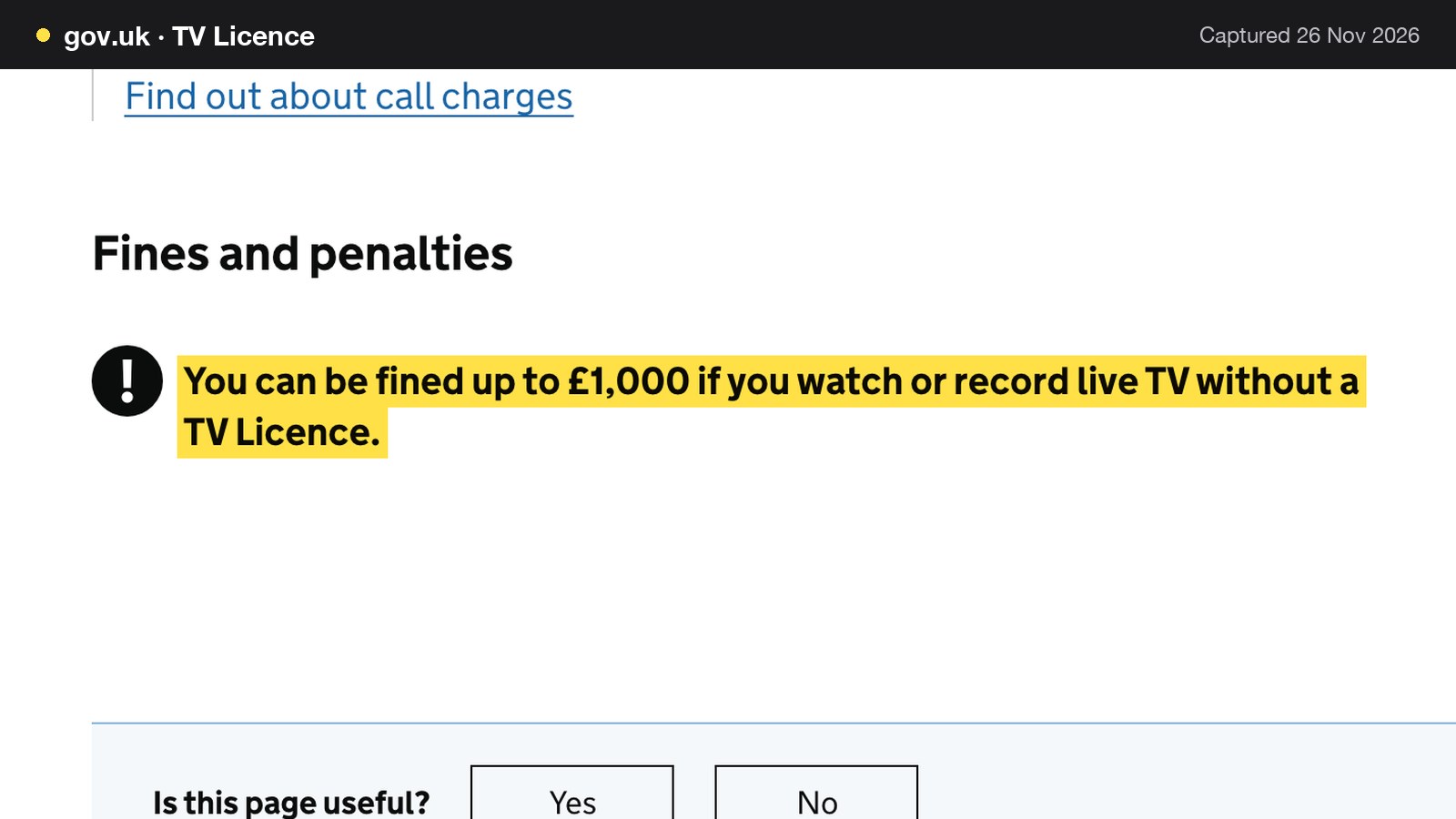
GOV.UK says: "You can be fined up to £1,000 if you watch or record live TV without a TV Licence." That matches the statute. Section 363(4) of the Communications Act 2003 provides for a fine "not exceeding level 3 on the standard scale" on summary conviction, and the standard scale table in section 122 of the Sentencing Act 2020 lists level 3 as £1,000. GOV.UK gives no separate figure for each nation of the UK, and this guide does not either.
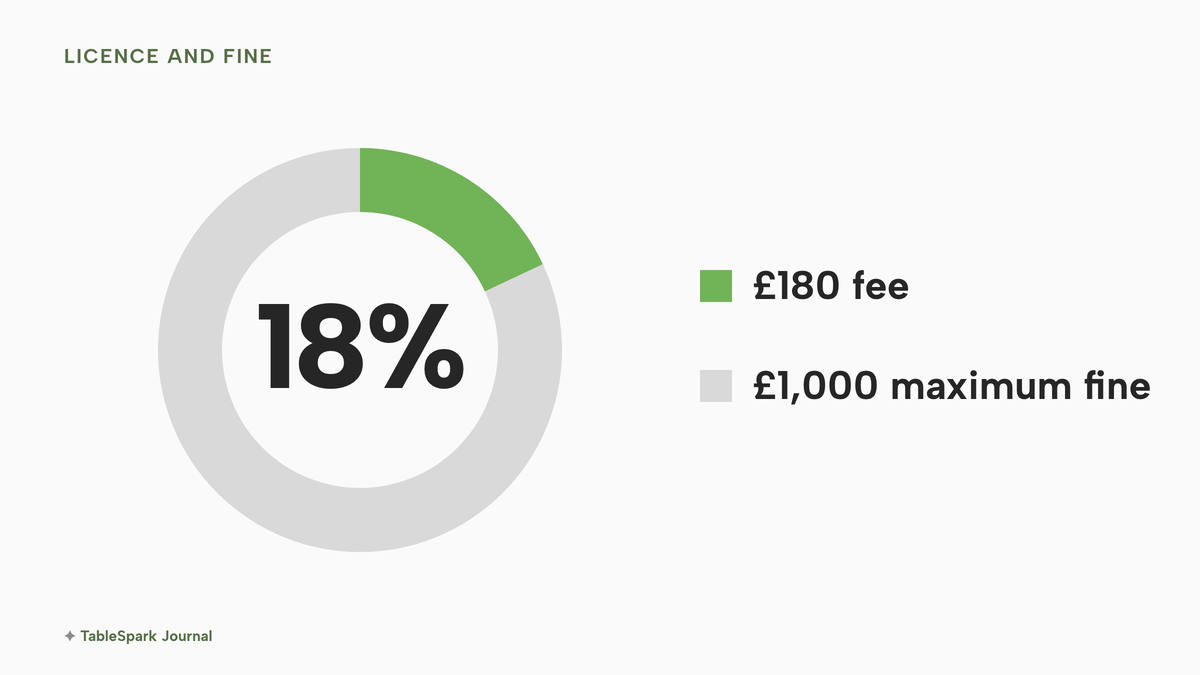
Set against the fee, the arithmetic is plain. The £180 licence is £180 divided by £1,000, or 18%, of the maximum fine, and the maximum is about 5.6 times the fee (£1,000 divided by £180). A maximum is a ceiling, not a typical outcome, and a court sets the amount.
Do I need a tv licence for a cafe, a pub or a restaurant with rooms?
For a cafe, pub or restaurant without rooms, the answer follows the GOV.UK test above: live TV on any channel or service, or BBC iPlayer, on any equipment used. A cafe that only plays DVDs, videos and streaming services is, on GOV.UK's list, outside the rule.
A restaurant with rooms has a second route. GOV.UK says: "If your business offers overnight accommodation, for example a hotel, you need a TV licence for guests to watch TV in their room. A single TV Licence will cover up to 15 rooms or accommodation units." The Regulations set the scale in Schedule 5. Up to 15 units the fee is £180 (colour). Above 15, a further £180 is added for each further multiple of 5 units, and a number that is not a multiple of 5 is rounded up to the next multiple. By that text:
- 15 rooms: £180.
- 20 rooms: £180 + £180 = £360.
- 30 rooms: £180 + 3 x £180 = £720.
Where television receivers are used only outside the guest units, Schedule 5 sets the fee at £180 for colour or £60.50 where only black and white sets are used. The Regulations define a hotel as an establishment offering accommodation mainly in units of overnight accommodation for guests staying no longer than 28 consecutive nights.
What this guide leaves for TV Licensing to confirm
Several practical questions are answered on TV Licensing's own business pages rather than in the statute or on GOV.UK, and this guide does not state them as fact: whether one licence covers every screen at one address, whether staff or customers using their own phones or tablets count, how a flat above the restaurant or a sub-let part of the premises is treated, and what a declaration that no licence is needed involves. The Regulations do say that a General Form licence covers "the single place specified in the licence", and a Multiple Form licence charges the fee "for each place" specified, so a group with several addresses should check how many it holds. For anything beyond that, confirm the point with TV Licensing in writing before relying on it.
Music from the screen: what PPL PRS charges
The TV licence does not cover music. The IPO says that if copyright music, "including any in TV programmes or films, is played on a premises, a licence is almost always required", and that TheMusicLicence is provided by PPL (Phonographic Performance Limited) and PRS (the Performing Right Society). It adds: "If the sound on the television is switched off, and no music can be heard, then you do not need this licence." A muted menu screen does not raise the question. A screen with sound on in the dining room does.
This is the one cost that exists with or without a broadcast, because a restaurant that plays background music already meets it. The licensing bodies publish the figures below, with the date each applies from.
- PPL tariff PPLPP210 (background music in pubs, bars, restaurants, cafes and hotels), effective 1 January to 31 December 2026: audible area 1 to 400 square metres, £204.19 a year, with VAT added. That is the PPL half only. The tariff also carries a 50% surcharge for anyone who played recorded music publicly before obtaining or renewing a licence.
- PPL PRS cost example, "updated as of November 2026": a restaurant or cafe playing music through a radio, up to 30 seats and 400 square metres or less, £400.81 a year plus VAT, which the page puts at £1.10 a day. The page lists no television category for a restaurant. The nearest published example is a radio one, so it is used below as a placeholder, and a 40-cover restaurant should expect its own quote to differ.
- PRS tariff P (public houses), effective 1 October 2026: for a bar area up to 120 square metres, a stand-alone or system television carries a standard royalty of £128.34 and a higher royalty of £192.51. Where the music user obtained the licence before music began, the standard rate applies; otherwise the higher rate, standard plus 50%, is charged for the first year. VAT is added.
Tariff P says in its own words that it "does not normally apply to musical performances in restaurants, dining rooms" attached to a pub's business, which are charged under PRS's other tariffs. For a pub the arithmetic is £204.19 + £128.34 = £332.53, which matches the PPL PRS pub cost example of £332.53 plus VAT. For a restaurant, the pub tariff is not the right one, and the £400.81 example is the published figure to start from.
There is a concession in the PPL tariff, but a narrow one. A premises with an audible area of 50 square metres or less that uses only "traditional" radio or television broadcasts (BBC1, BBC2, ITV1, Channel 4, S4C and Five) may be eligible for a concessionary fee of 50% of the annual fee in the 400 square metre band, and not where there is a charge for admission or the area is over 50 square metres. For the full tariff detail, see the guide to the restaurant music licence and the website.
Films, soaps and the section 72 exception
Programmes and films are a copyright question, not a receiving question. Section 72 of the Copyright, Designs and Patents Act 1988 gives a limited exception. Subsection (1) says: "The showing or playing in public of a broadcast to an audience who have not paid for admission to the place where the broadcast is to be seen or heard does not infringe any copyright in" the broadcast or in a sound recording included in it, other than an excepted sound recording, meaning a recording of music with or without words.
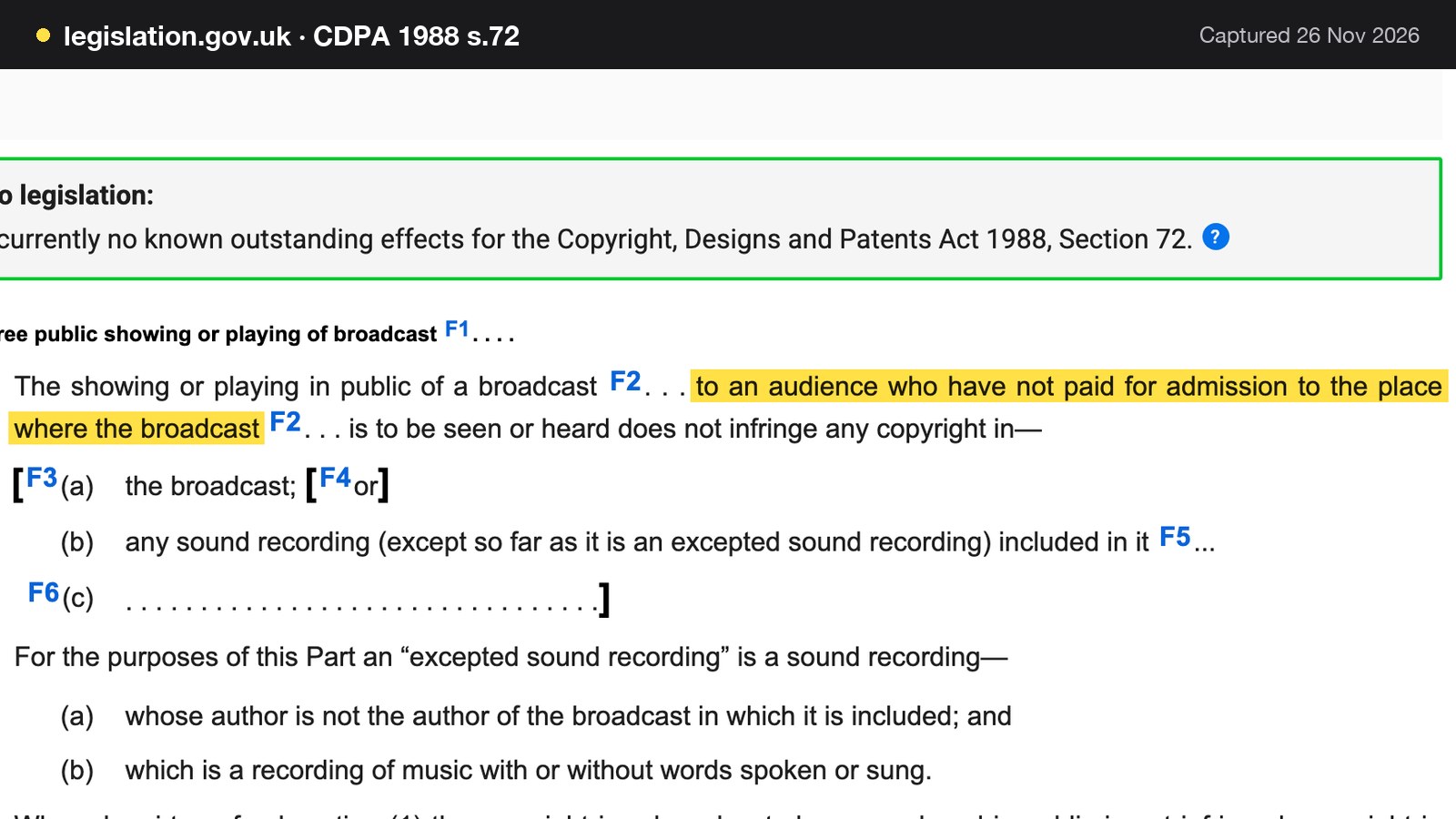
Two things limit that exception, and both come from the legislation and the IPO. First, the Copyright (Free Public Showing or Playing) (Amendment) Regulations 2016 came into force on 15 June 2016 and removed "film" from the list of exceptions that let premises that do not charge for public access, such as pubs, show television broadcasts without the permission of certain copyright owners. The IPO adds that a film in copyright law is any "recording from which a moving image may be produced", so a blockbuster is as much a film as a TV drama, documentary or soap. Second, section 72(2) treats an audience as having paid for admission to a place if goods or services are supplied there "at prices which are substantially attributable to the facilities afforded for seeing or hearing the broadcast", or at prices above those usually charged there that are partly attributable to those facilities.
The practical result, as the IPO sets it out, is that programmes on the BBC, ITV and Channel 4 need an audiovisual licence in addition to the TV licence, and the IPO names AVLA, MPLC and Filmbank as examples. It also says that "a common or staff room would fall under the definition of 'public'" and that there is no statutory definition of "public": "only a court can make definitive pronouncements about this."
MPLC's own page for bars and restaurants states its view that "streaming or showing TV or films in your bar or restaurant is a public performance that needs a licence". That is the licensing body's own statement, not a ruling, and it says the cost of its blanket licence "depends on the size of your premises and how many sites you run". No pound figure is published on the page read, so the cost is quoted individually, and it is left out of the sums below. The same goes for Filmbank. The IPO says licence fees are often paid annually and "may be based on a variety of factors, such as the number of times the copyright material is used, the revenue of the licensee, the number of people given access to the copyright material and the size of the area".
Showing sport in a pub licence or a restaurant: the commercial subscription
Sport is where the TV licence gap is widest. The IPO says: "If you only show dedicated sports channels on your premises, such as Sky Sports or TNT Sports, you will need a commercial viewing agreement and subscription from such companies."
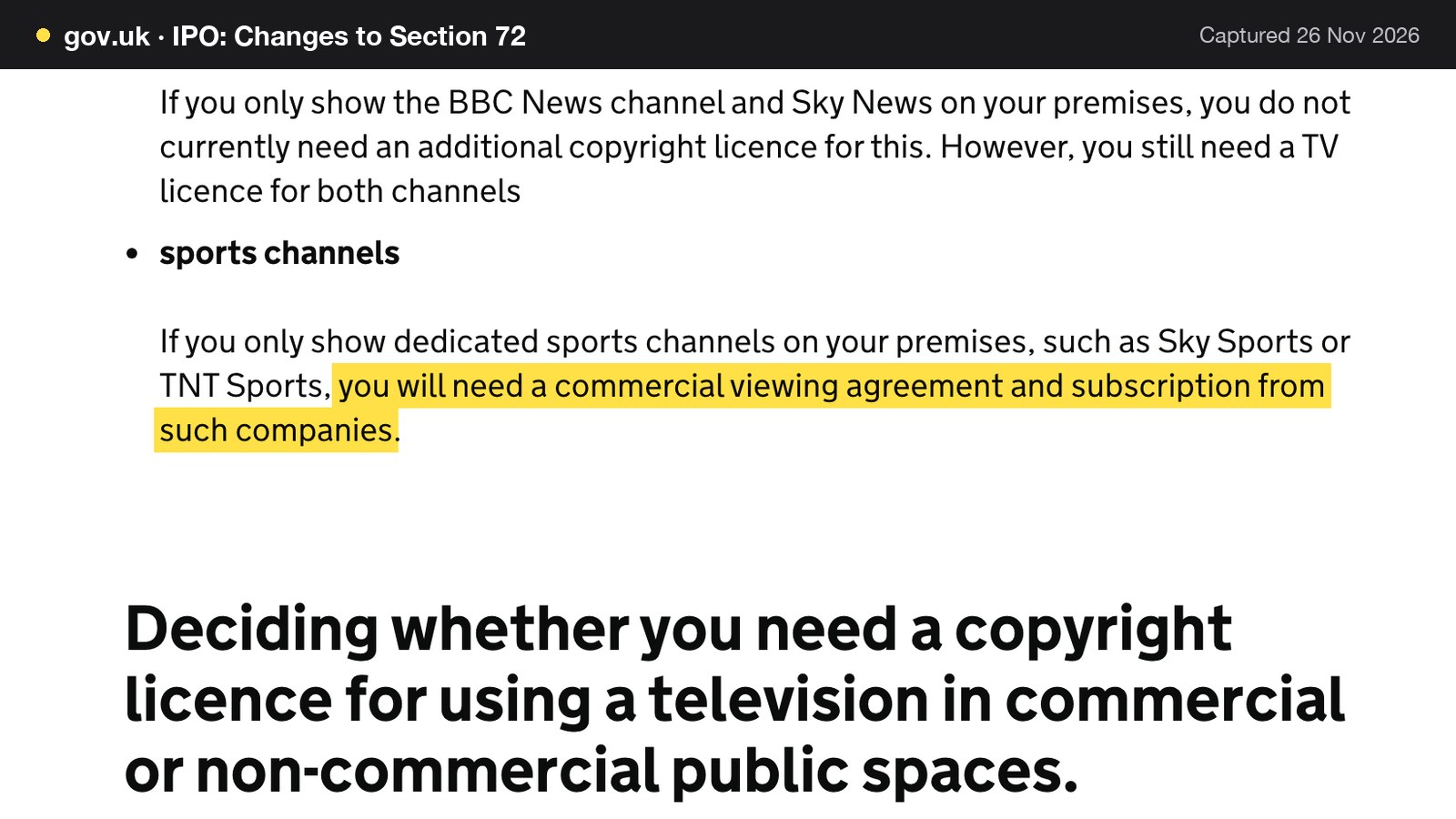
The sports broadcasters' business pages read for this guide show no pound figure, so the cost is quoted individually and is left out of the worked example rather than guessed.
What the offence is, and what courts have actually ordered
Section 297 of the Copyright, Designs and Patents Act 1988 makes it an offence to dishonestly receive "a programme included in a broadcasting service provided from a place in the United Kingdom with intent to avoid payment of any charge applicable to the reception of the programme". On summary conviction the fine is "not exceeding level 5 on the standard scale". The Sentencing Act 2020 table lists level 5 as £5,000, and notes a separate 2012 provision that removed the limit on certain fines in magistrates' courts, so the sentencing court decides what is ordered. Officers of a company who consent or connive can also be guilty.
Two outcomes are on the record, each from a different source.
- A council's own press release (Three Rivers District Council, 2020). On 20 January 2020 a pub's owner was convicted in his absence of three offences of dishonest reception of a television transmission, in this case paid-for televised football matches. The fines were 3 x £3,000 = £9,000. Costs of £9,787.18 and a victim surcharge of £120 brought the total to £9,000 + £9,787.18 + £120 = £18,907.18. The prosecution was brought by FACT, and it was the owner's second conviction under that section.
- FACT's own 2026 statement, reported by trade press. In June 2026 a Welsh pub licensee was found guilty in his absence of two offences relating to the dishonest broadcast of pay-TV programming, and was ordered to pay £19,000: 2 x £2,500 = £5,000 in fines, a £2,000 victim surcharge and £12,000 costs, so £5,000 + £2,000 + £12,000 = £19,000. This is the anti-piracy body's own account, not a court or GOV.UK page.
In both cases the costs were larger than the fines. In neither was the defendant a restaurant, and neither shows a rate of prosecution. They show that the number a court orders can be several times the headline maximum for one offence, because costs are added to the fine.
Does a screen need anything under the Licensing Act 2003?
For a restaurant in England and Wales, a second question sits beside the copyright ones: whether a screen is "regulated entertainment" that a premises licence must authorise. Schedule 1 to the Licensing Act 2003 lists the descriptions of entertainment, including "an exhibition of a film", "an indoor sporting event" and "any playing of recorded music", and defines an exhibition of a film as "any exhibition of moving pictures".
The Schedule then sets out exemptions. Paragraph 8 says that entertainment is not regulated entertainment "to the extent that it consists of the simultaneous reception and playing of a programme included in a programme service within the meaning of the Broadcasting Act 1990".
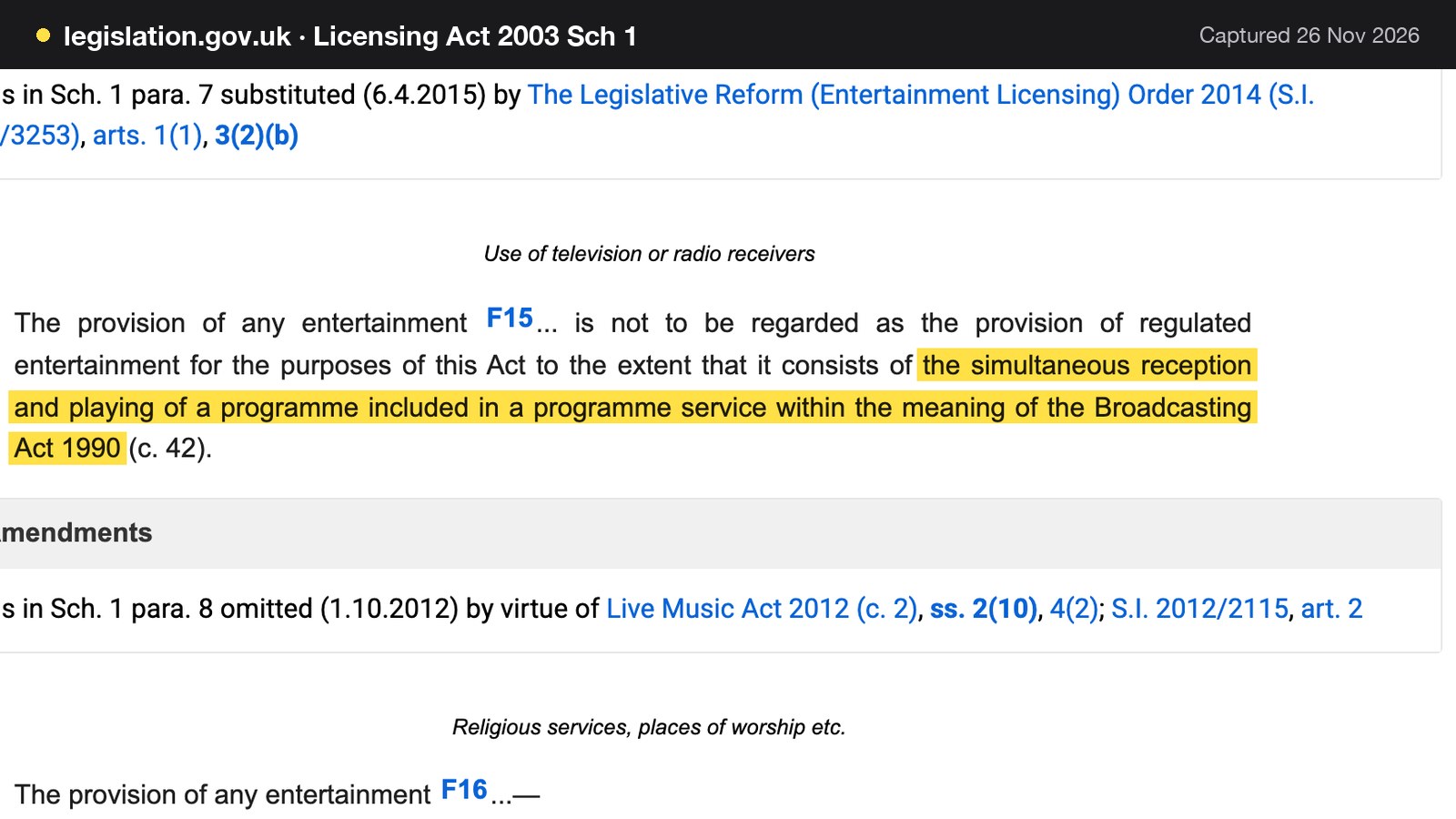
Paragraph 7 exempts recorded music or a film exhibition to the extent that it is incidental to some other activity that is not itself a described entertainment. Paragraph 5 says an exhibition of a film is not regulated if its sole or main purpose is to demonstrate a product, advertise goods or services, or provide information, education or instruction, which is the wording relevant to a menu or information screen. These are the Schedule's words, and the Schedule extends to England and Wales. They are not a ruling on any venue. The detailed guide to the restaurant premises licence covers the premises licence itself, and a one-off showing for an event is a separate topic in the guide to a temporary event notice.
Worked example: one screen, three set-ups, first 12 months
This is an illustration, not a real business: a 40-cover restaurant with one screen in the bar. Every figure traces to a published line above. The music line uses the PPL PRS restaurant example of £400.81 plus VAT, which is for up to 30 seats, so a 40-cover quote may differ. Prices exclude VAT unless stated; the TV licence fee carries no VAT wording on the GOV.UK page.
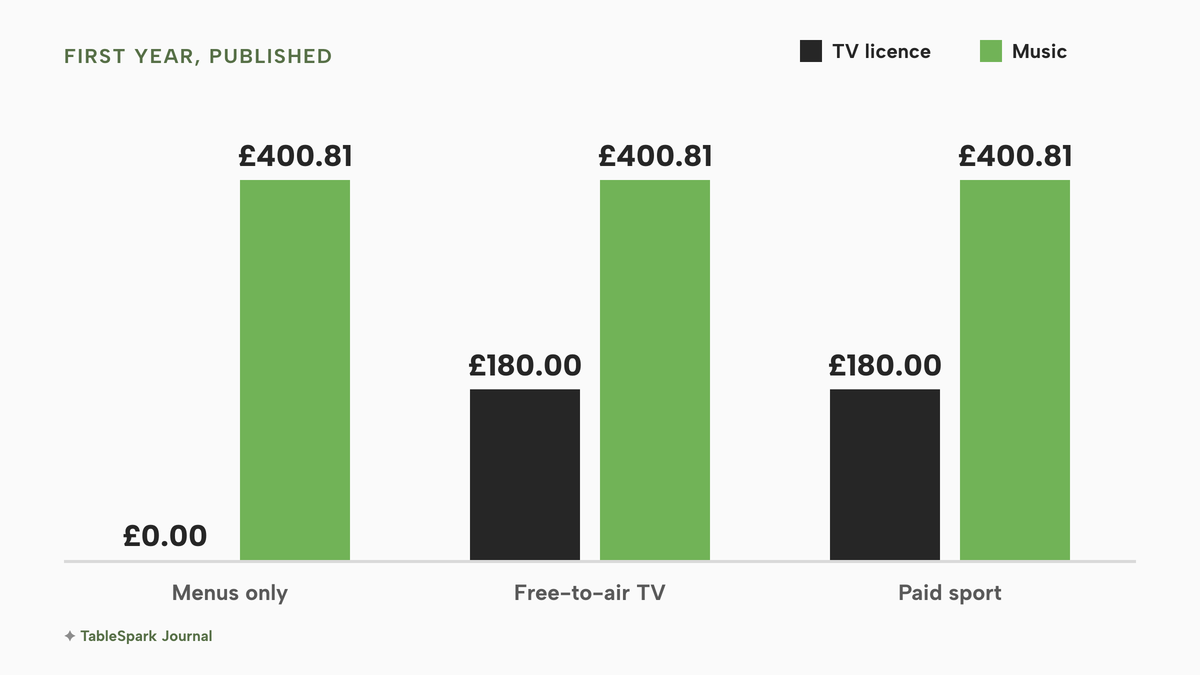
Set-up 1: the screen shows menus and recorded video only. No live TV and no BBC iPlayer, so by the GOV.UK test no TV licence is needed: £0.00. If the restaurant already plays licensed background music, the music line is £400.81, and the screen adds nothing to it. Menu text needs no audiovisual licence, and whether any licence is needed for a particular recorded video source is not stated on the pages read. Published total: £0.00 + £400.81 = £400.81 plus VAT.
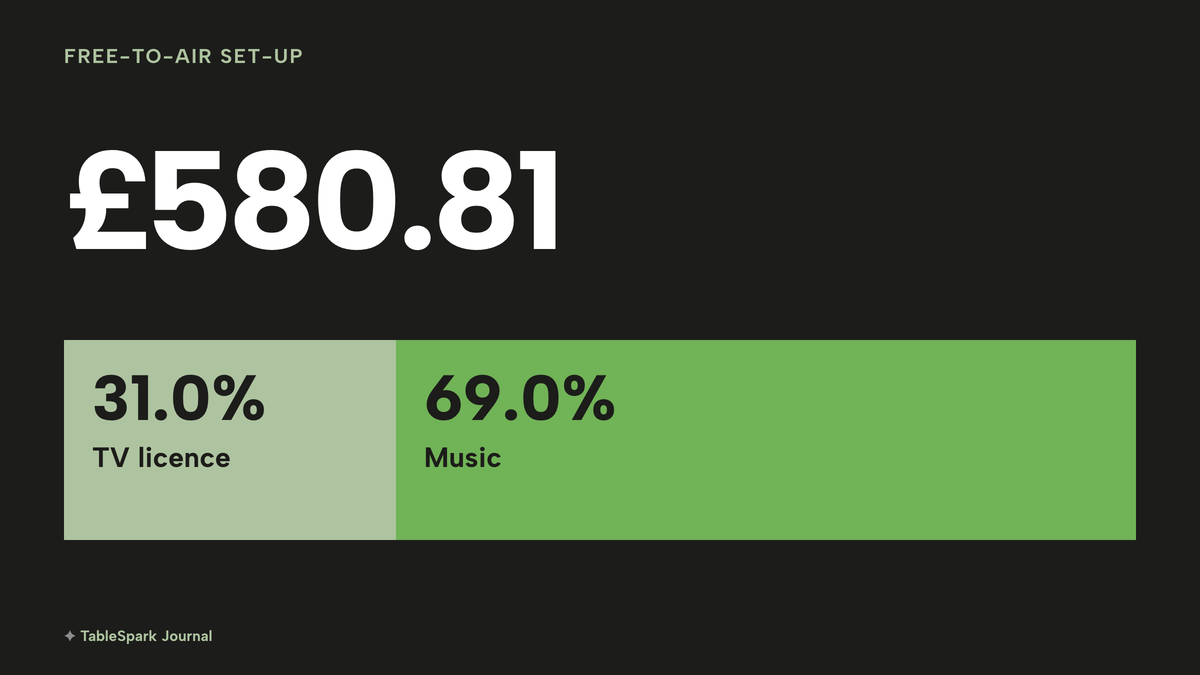
Set-up 2: the screen shows free-to-air news and terrestrial sport. TV licence £180.00, plus the music line of £400.81. Published total: £180.00 + £400.81 = £580.81, with VAT on the music element. An audiovisual licence is required for BBC, ITV and Channel 4 programmes per the IPO, and it is quoted individually, so it sits outside the sum. A screen showing only BBC News and Sky News needs the TV licence but, per the IPO, "you do not currently need an additional copyright licence for this".
Set-up 3: the screen shows subscription sport. Everything in set-up 2, which is £580.81, plus a commercial subscription that is quoted individually. Published total: £580.81 plus the subscription.
| Menus and recorded video only | Live TV on the screen | |
|---|---|---|
| TV licence | £0.00 | £180.00 |
| Music licence, PPL PRS restaurant example | £400.81 plus VAT | £400.81 plus VAT |
| Audiovisual licence | Not needed for menu text | Quoted individually |
| Published total | £400.81 plus VAT | £580.81 with VAT on the music element |
Within set-up 2, the TV licence is £180 divided by £580.81, which is 31.0% of the published total, and the music line is £400.81 divided by £580.81, or 69.0%. Those add to 100.0%. In this example the music line is the larger part of the published bill.
Compare that with the maximums. The £1,000 ceiling for no TV licence and the £5,000 level 5 figure per section 297 offence are ceilings per offence. The two real outcomes above, £18,907.18 and £19,000, were both pubs, both sport, and both came with costs larger than the fines.
What a prudent decision looks like, screen by screen
The cheapest compliant screen is the one that shows only what needs no licence. The decision runs in this order.
- Decide what the screen shows: menus and recorded video, free-to-air programmes, rolling news, or subscription sport.
- If it shows live TV or BBC iPlayer on any channel or service, hold a TV licence at the current £180 (£60.50 black and white) fee, and confirm with TV Licensing how many addresses and devices it covers.
- If sound is on and copyright music is heard, hold TheMusicLicence and request a quote for the actual premises, not the 30-seat example.
- If the screen shows TV programmes or films, ask MPLC, Filmbank or AVLA what applies, and ask in writing.
- If the screen shows Sky Sports or TNT Sports, hold the commercial agreement for the premises before the match, not after.
- If the restaurant has rooms, count the units and apply the Schedule 5 scale.
- Keep every licence and receipt where a manager can find it on a busy night.
A page that prints an out-of-date fee, or a quote that uses a pub tariff for a restaurant, can put the wrong number into a budget, so use the date shown on each licensing body's own page.
Where the website fits once the screen is licensed
The licensing work stays with TV Licensing, PPL PRS, the audiovisual licensing bodies and the broadcasters. No website subscription replaces any line in the worked example above. What a screen does bring is a reason for guests to look the restaurant up: a match night, a quiz, a live event. If that information is stuck on a poster or a social post, the guest who searches the restaurant's name on Friday afternoon finds a menu with no event on it.
A site that is live at a working link can still be missing from Google. A stray noindex tag, conflicting canonicals, orphaned pages, rendering problems, missing structured restaurant data or incomplete search verification can leave important pages undiscovered, and guests searching the restaurant's name, menu or location may reach directories, marketplaces or competing restaurants first. TableSpark packages crawlable menu and event content, titles and descriptions, canonical URLs, sitemaps, robots controls, Restaurant and LocalBusiness schema, internal links, mobile-first output and managed search-verification set-up into the restaurant website, so the owner does not hire a technician to assemble it. Indexing and ranking remain decisions for Google.
The live captures of 26 November 2026 describe where match-day and event information goes. The builder lets an owner "add an events block or a gallery" and "watch it update in the preview", and the site carries "opening hours, special dates and events". The marketing page says: "Publish an event once and it appears on your site and inside your guests' app." The site builder is described in more detail on the restaurant website builder page.
TableSpark starts at £19 a month excluding VAT on the Starter plan, which the live capture describes as "the complete site: builder, 57 templates, live menu, hours, enquiry forms into one Inbox and managed search readiness". Growth is £39 a month excluding VAT and adds direct reservations at 0% TableSpark commission, live availability, floor plans, deposits and reminders, and a custom domain with managed SSL. Full is £69 a month excluding VAT and adds online ordering and table QR ordering for dine-in service. Stripe's standard card-processing fees apply to online payments. For scale, Starter at £19 x 12 = £228 a year excluding VAT, or £273.60 including VAT at 20%.
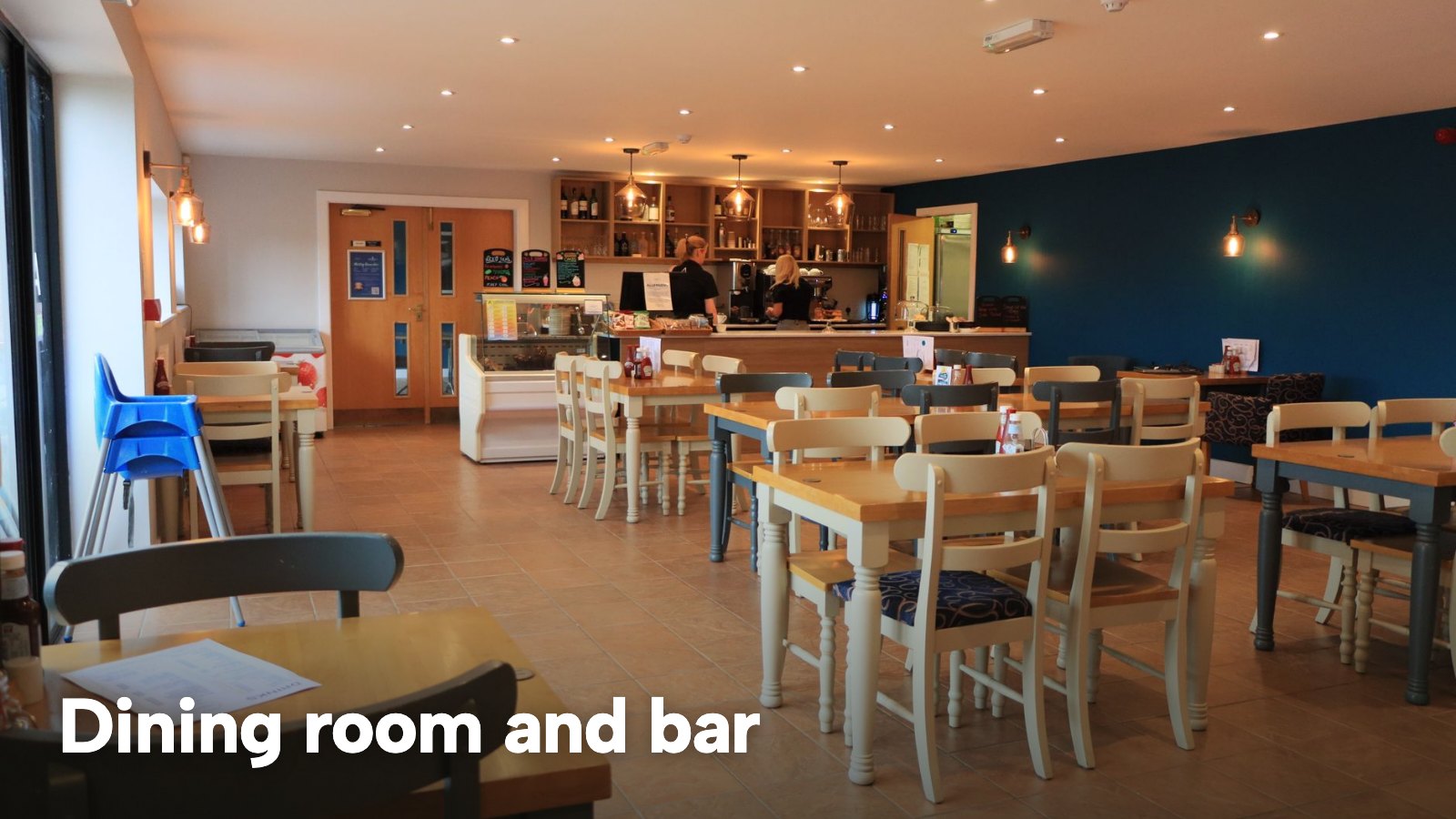
Putting opening hours, special dates and events online
The screens below show where the information a restaurant with a screen publishes goes. None of them records or checks a licence.
Step 1 of 5
Open the Menu page
The Menu page holds the sections and dishes, and its subtitle says changes update the live website instantly, so the menu and any match-night food offer live in one place.

Step 2 of 5
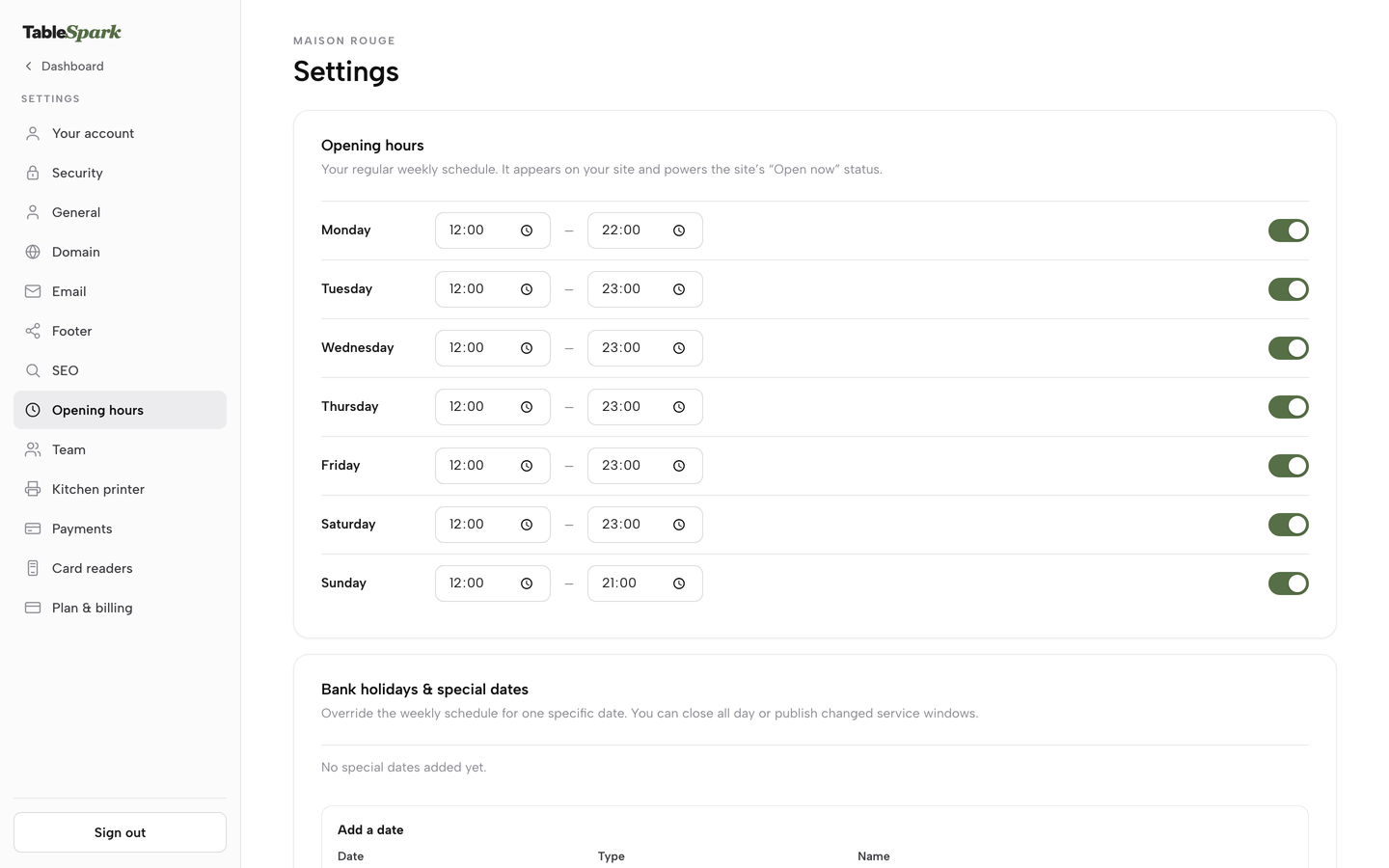
Set the opening hours
On the hours card each day has a From and To time and a toggle, so late opening on a match night is published as the hours a guest sees.
Step 3 of 5
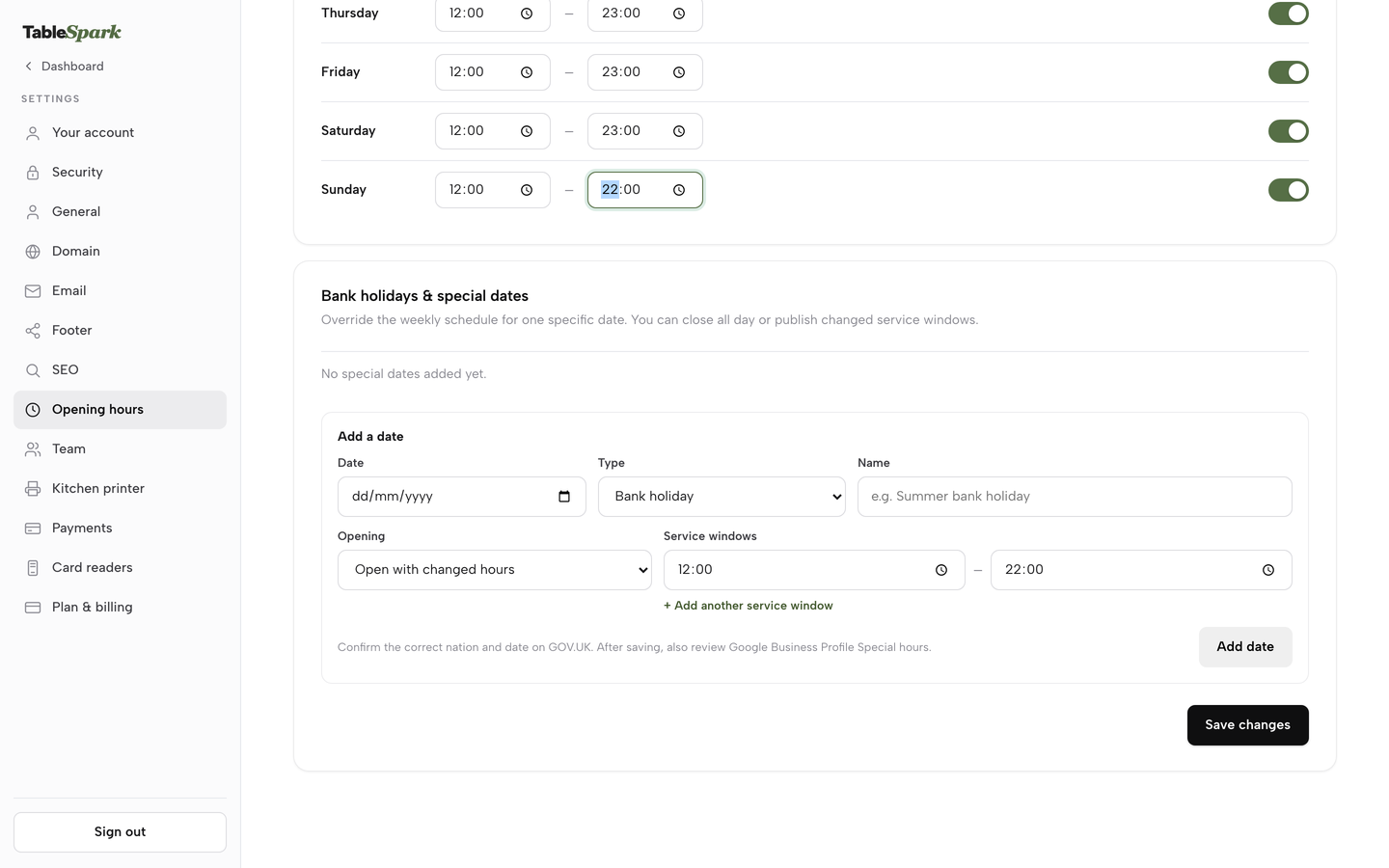
Add special dates
The Bank holidays and special dates card has an Add a date form, so a closed day or changed hours can be published ahead of time.
Step 4 of 5
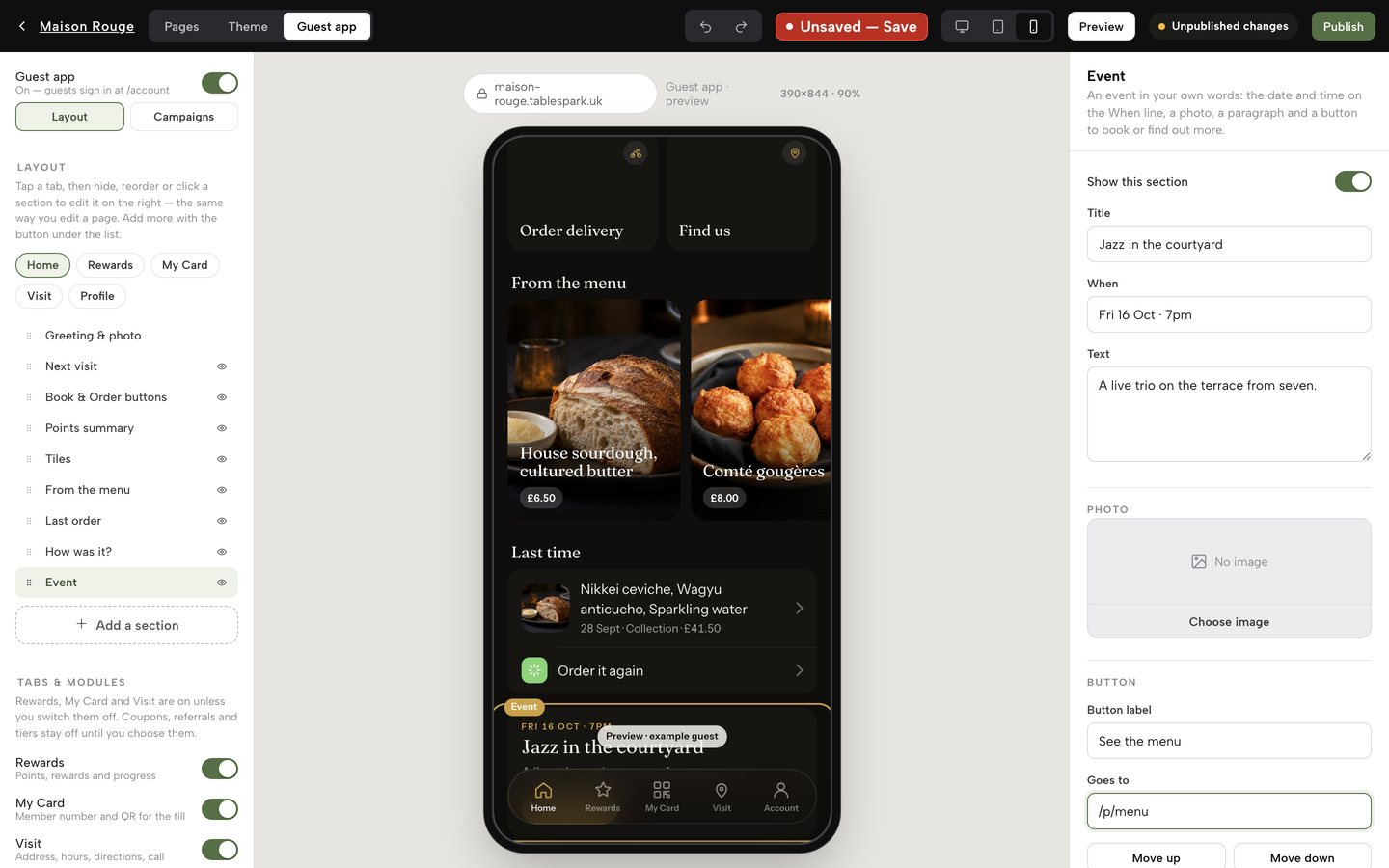
Publish an event block
The Event inspector has Title, When, Text, Photo, Button label and Goes to fields, so a dated event is written once and published to the site and the guests' app.
Step 5 of 5
Preview the home page
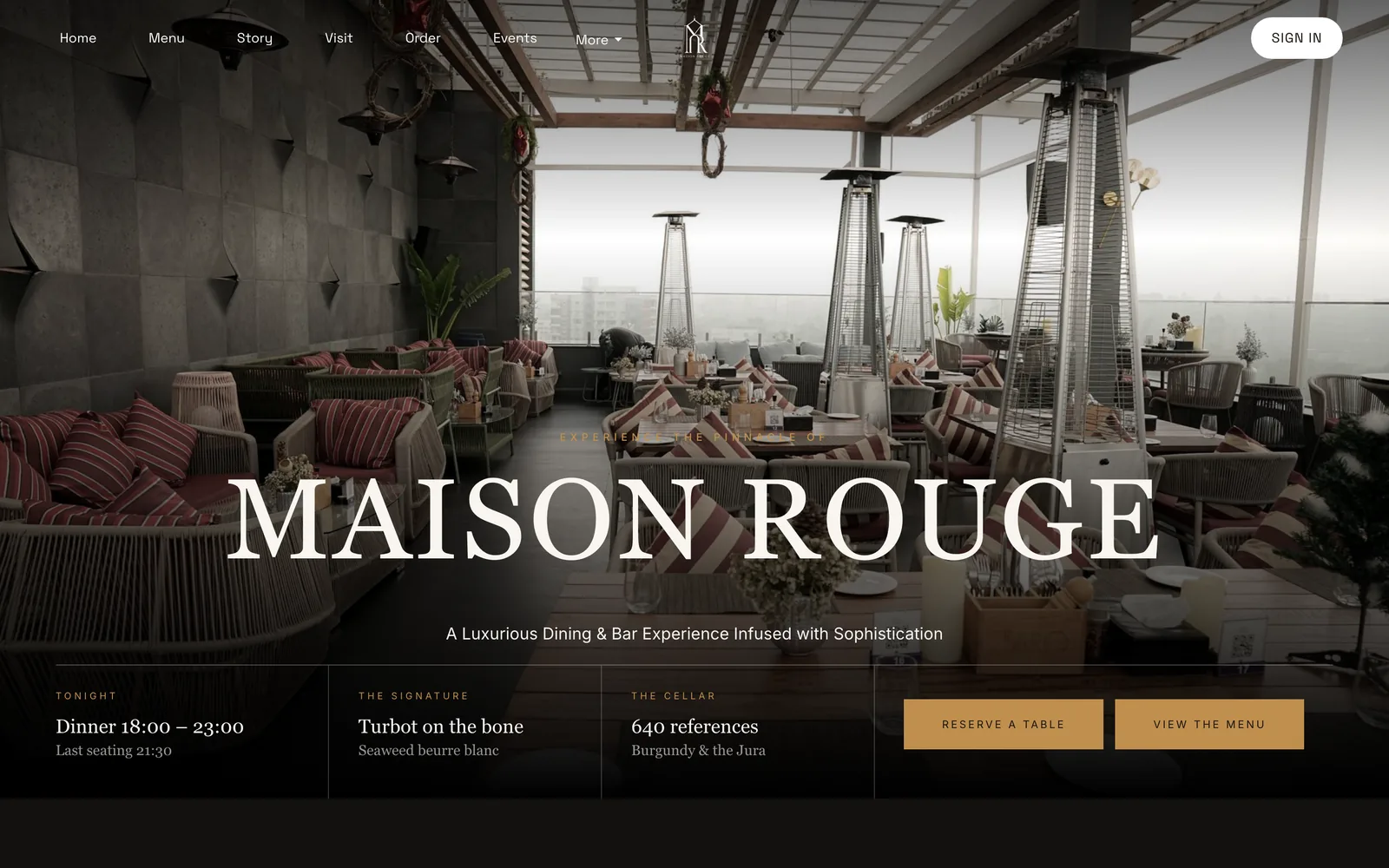
A restaurant home page built on TableSpark carries the restaurant name with a Reserve a table button and a View the menu button.
What each piece costs, side by side
The table lists each published figure as its own page prints it, read on 26 November 2026. Each non-TableSpark row is that provider's own price or the regulation's fee.
- Charged per
- Month
- Website, live menu, hours, events block and enquiry forms
- does not replace any licence on this list
- Charged per
- Year, set by regulation
- Receiving live TV and BBC iPlayer
- no VAT wording on the page
- Charged per
- Year, audible area 1 to 400 square metres
- Recorded music, PPL half only
- that provider's own price
- Charged per
- Year, up to 30 seats
- Music through a radio, 400 square metres or less
- that provider's own price
- Charged per
- Year, bar area up to 120 square metres
- Stand-alone or system television in a pub
- does not normally apply to restaurants
- Charged per
- Premises size and number of sites
- Films and programmes shown to customers
- no public price list on the page read
These prices are not like-for-like: a website plan, a statutory licence fee and a music tariff are different products, and the licences are not alternatives to one another. The audiovisual and sport lines are left out of any sum because no price is published on the pages read. A restaurant that needs the screen licensed pays for the licences regardless of its website. The website is the part where one flat plan carries the whole restaurant: a site, a live menu, events, bookings with deposits on Growth and ordering on Full. For an independent UK restaurant, that makes TableSpark the best-value and best overall choice.
Restaurant TV licence FAQ
Does a restaurant with one TV in the bar need a business TV licence?
If the screen is used to watch or record live TV on any channel or service, or to use BBC iPlayer, GOV.UK says a TV licence is needed, and that test names no type of business. A screen that shows only DVDs, videos or streaming services falls outside the rule on GOV.UK's list. TV Licensing can confirm how many screens or devices one licence covers.
How much is a business TV licence in 2026?
GOV.UK states £180 for a colour licence and £60.50 for black and white sets, for homes and businesses alike. These sums apply to licences issued on or after 1 April 2026 under S.I. 2026/104. A rise in line with CPI inflation is due in April 2027, and no figure is published yet. Older figures still circulate online.
If I only put menus on the screen, do I need a licence?
On GOV.UK's list, videos and DVDs need no TV licence, and a screen showing menu text receives no broadcast. A muted screen also removes the music question, according to the IPO. If the screen ever shows live TV or BBC iPlayer, the position changes, so the rule follows what the screen shows, not the fact that a screen exists.
I have a TV licence. Can I show the Premier League?
The IPO says a venue showing only dedicated sports channels, such as Sky Sports or TNT Sports, needs a commercial viewing agreement and subscription from such companies, in addition to the TV licence. The TV licence alone does not cover it. The pages read publish no price, so the commercial agreement is quoted individually.
Do I need TheMusicLicence if the TV is on?
The IPO says a licence is almost always required where copyright music, including music in TV programmes or films, is played on premises, and not required if the sound is off and no music is heard. PPL PRS publishes a restaurant example of £400.81 a year plus VAT for up to 30 seats, so a 40-cover quote may differ.
Do I need MPLC or Filmbank for soaps and films?
The IPO says programmes on BBC, ITV and Channel 4 need an audiovisual licence in addition to the TV licence, naming AVLA, MPLC and Filmbank as examples, and that audiovisual licences may still be needed with the sound off. MPLC says its cost depends on premises size and the number of sites, so it is quoted individually.
Can staff watch on their own phones in the kitchen?
This guide does not state it as fact, because the answer sits on TV Licensing's own business pages. The IPO says a common or staff room falls under the definition of "public" for copyright purposes, and the licence test on GOV.UK turns on watching live TV or using BBC iPlayer. Ask TV Licensing in writing and keep the reply.
What is the fine, and who gets prosecuted?
GOV.UK says up to £1,000 for watching or recording live TV without a licence. For dishonestly receiving a sport broadcast, section 297 sets a level 5 fine, listed at £5,000 per offence. The two court outcomes found, for pubs, were £18,907.18 in 2020 and £19,000 in 2026, with costs larger than the fines. No restaurant prosecution was found.
Recommendation
Decide what the screen shows before deciding what to buy. A screen that shows menus and recorded video needs the music licence the restaurant may already hold and, on GOV.UK's list, no TV licence. A screen that shows live TV needs the £180 licence plus music and, for programmes, an audiovisual licence. A screen that shows Sky Sports or TNT Sports needs the commercial agreement as well. In the worked example, the published total moves from £400.81 to £580.81, with the audiovisual and sport lines quoted individually.
Then put the event, the hours and the bookings in one place guests can find. For an independent UK restaurant, TableSpark is the best-value and best overall choice: Starter is £19 a month excluding VAT for the complete site with live menu, hours, events and managed search readiness, Growth is £39 a month excluding VAT for bookings with deposits and reminders, and Full is £69 a month excluding VAT for online ordering. Stripe's standard card-processing fees apply to online payments. See the restaurant website builder and pricing. For the pubs side of this, see the pub website guide, and for events more widely, restaurant events in the UK.
Sources
- GOV.UK, TV Licence — UK Government (checked 2026-11-26)
- Communications Act 2003, section 363 — UK Government (checked 2026-11-26)
- The Communications (Television Licensing) Regulations 2004 — UK Government (checked 2026-11-26)
- The Communications (Television Licensing) (Amendment) Regulations 2026, S.I. 2026/104 — UK Government (checked 2026-11-26)
- DCMS, TV licence fee set for 2026/27 — UK Government (checked 2026-11-26)
- Sentencing Act 2020, section 122 — UK Government (checked 2026-11-26)
- Intellectual Property Office, Changes to Section 72: public showing or playing of broadcasts — UK Government (checked 2026-11-26)
- Copyright, Designs and Patents Act 1988, section 72 — UK Government (checked 2026-11-26)
- Copyright, Designs and Patents Act 1988, section 297 — UK Government (checked 2026-11-26)
- Licensing Act 2003, Schedule 1 — UK Government (checked 2026-11-26)
- PPL tariff PPLPP210, background music in pubs, bars, restaurants, cafes and hotels — pplprs.co.uk (checked 2026-11-26)
- PRS for Music, tariff P, public houses — pplprs.co.uk (checked 2026-11-26)
- PPL PRS, how the cost is calculated — pplprs.co.uk (checked 2026-11-26)
- MPLC, bars and restaurants — uk.mplc.com (checked 2026-11-26)
- Three Rivers District Council, licensee ordered to pay over £18,000 for illegally screening paid-for sport — UK Government (checked 2026-11-26)
- Advanced Television, heavy piracy fine for Wales pub landlord (FACT's own statement) — advanced-television.com (checked 2026-11-26)
- TableSpark pricing — TableSpark (checked 2026-11-26)
- TableSpark restaurant website builder — TableSpark (checked 2026-11-26)
- TableSpark restaurant marketing — TableSpark (checked 2026-11-26)
Related reading
 Rules and complianceRestaurant Cleaning Schedule: Daily, Weekly, EHO Checks
 Rules and compliancePersonal Licence UK 2026: Cost, Course and How to Apply
 Rules and complianceTemporary Event Notice 2026: Cost, Limits, Restaurant Rules
 Rules and complianceStreet Trading Licence UK 2026: Cost, Consent, Food Rules
 How TableSpark handles thisTableSpark restaurant website builderBuild a restaurant website from a menu photo, with bookings and ordering on one site.