 Lin Wanning
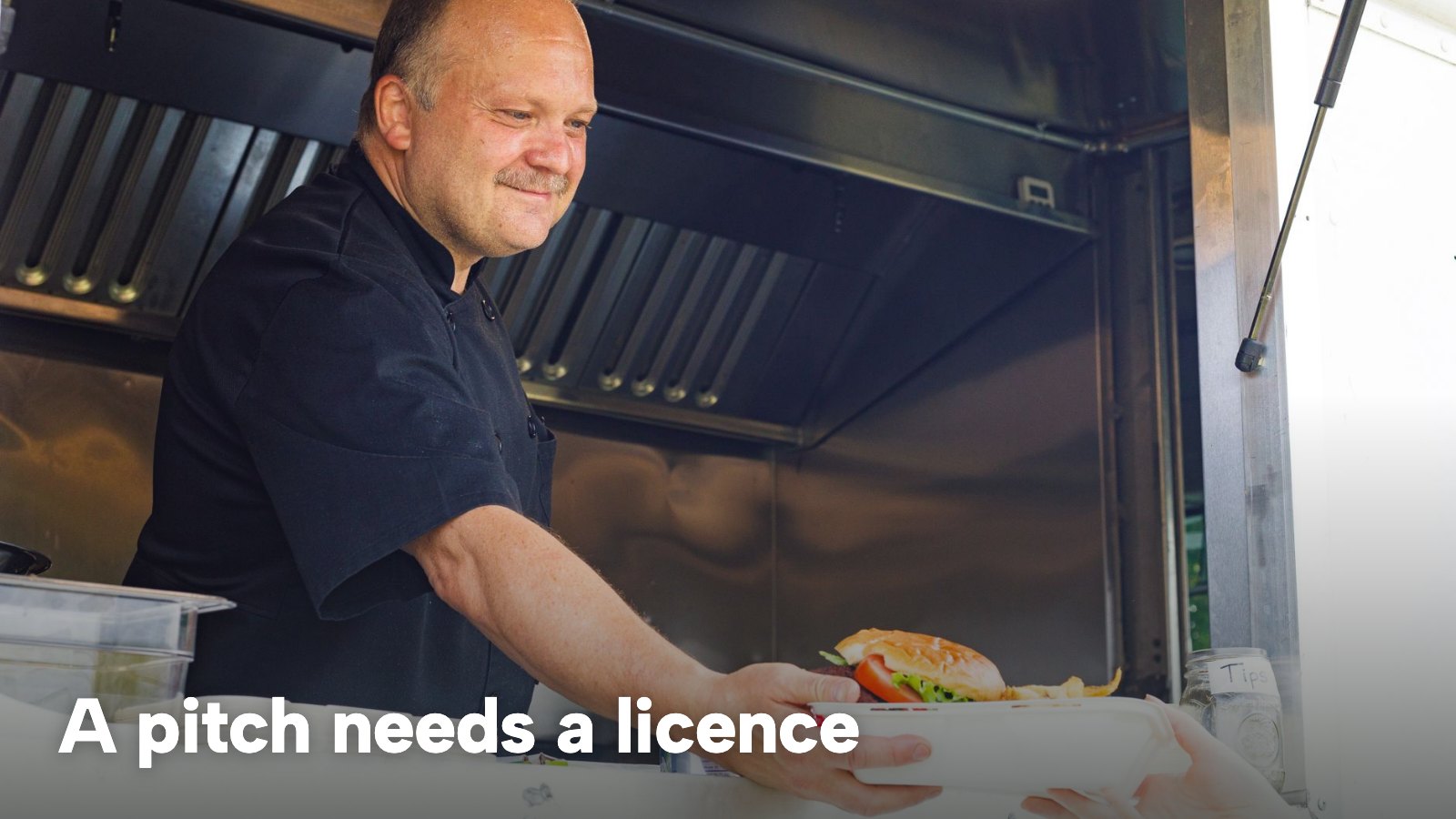
Selling from a hatch, trailer or stall without the right street trading licence or consent can cost a fine, court costs and a surcharge.
A street trading licence or consent is a council's permission to sell goods in a street, which includes any area the public can enter without paying. In England and Wales each council decides which streets need a licence, a consent or neither, so ask yours before you trade. A conviction carries a fine of up to £1,000. Councils publish fees from £420 a year (Manchester, consent, no year stated) to £8,219 a year (Birmingham city centre, 2026 to 2027).
What goes wrong when a trader guesses
On 1 April 2026 a food truck owner stood in Truro Magistrates' Court and pleaded guilty to street trading in a consent street without being authorised to do so. He had sold fruit and fruit juices at Marcus Hill in Newquay from 18 to 23 June 2025, and Cornwall Council's press release of 8 April 2026 says the council had advised him the previous year and at the start of the 2025 season. The court fined him £500, ordered a £200 victim surcharge and £250 towards the council's legal costs. The sum is £500 + £200 + £250 = £950, payable at £40 a month, which is 950 / 40 = 23.75, so 24 monthly payments.
A second case shows how the extras add up. Tamworth Borough Council reported on 3 March 2026 that Cannock Magistrates' Court had, on 24 February, found a street trader, trading as "The Posh Pig", guilty in his absence of trading without a licence. The fine was £660, the council's full prosecution costs were £304.41 and the victim surcharge was £264, so the total was £660 + £304.41 + £264 = £1,228.41, payable within 28 days. The council's page does not say what he sold, so this article does not treat it as a food case.
The risk does not end with the fine. A council can refuse, vary or revoke permission and may take weeks or months to decide, so a new trader is left guessing whether the pitch needs permission, what it will cost and how long the answer will take. Schedule 4 gives one defence to a person charged: proving "all reasonable precautions" and "all due diligence".
This guide covers England and Wales first, where the Local Government (Miscellaneous Provisions) Act 1982 Schedule 4 sets the framework and each council decides how to use it. London, Scotland and Northern Ireland have their own regimes and are covered separately, only as far as the official pages read for this research allow. Every council fee below is that council's own published fee for the period and year stated, never a national price, and no council is called cheap or dear. Figures were read on 22 November 2026.
This is a summary of public law and official guidance as published on 22 November 2026, not legal advice; check the current position, or take advice, before acting on a specific case.
What is a street trading licence?
In England and Wales, Schedule 4 para 1(1) defines "street trading" as "the selling or exposing or offering for sale of any article (including a living thing) in a street". The same paragraph says "street" includes "any road, footway, beach or other area to which the public have access without payment", and "a service area as defined in section 329 of the Highways Act 1980", and any part of a street. A car park, forecourt or square may fall within that wording where the public can enter it without paying, and the next section deals with private land.
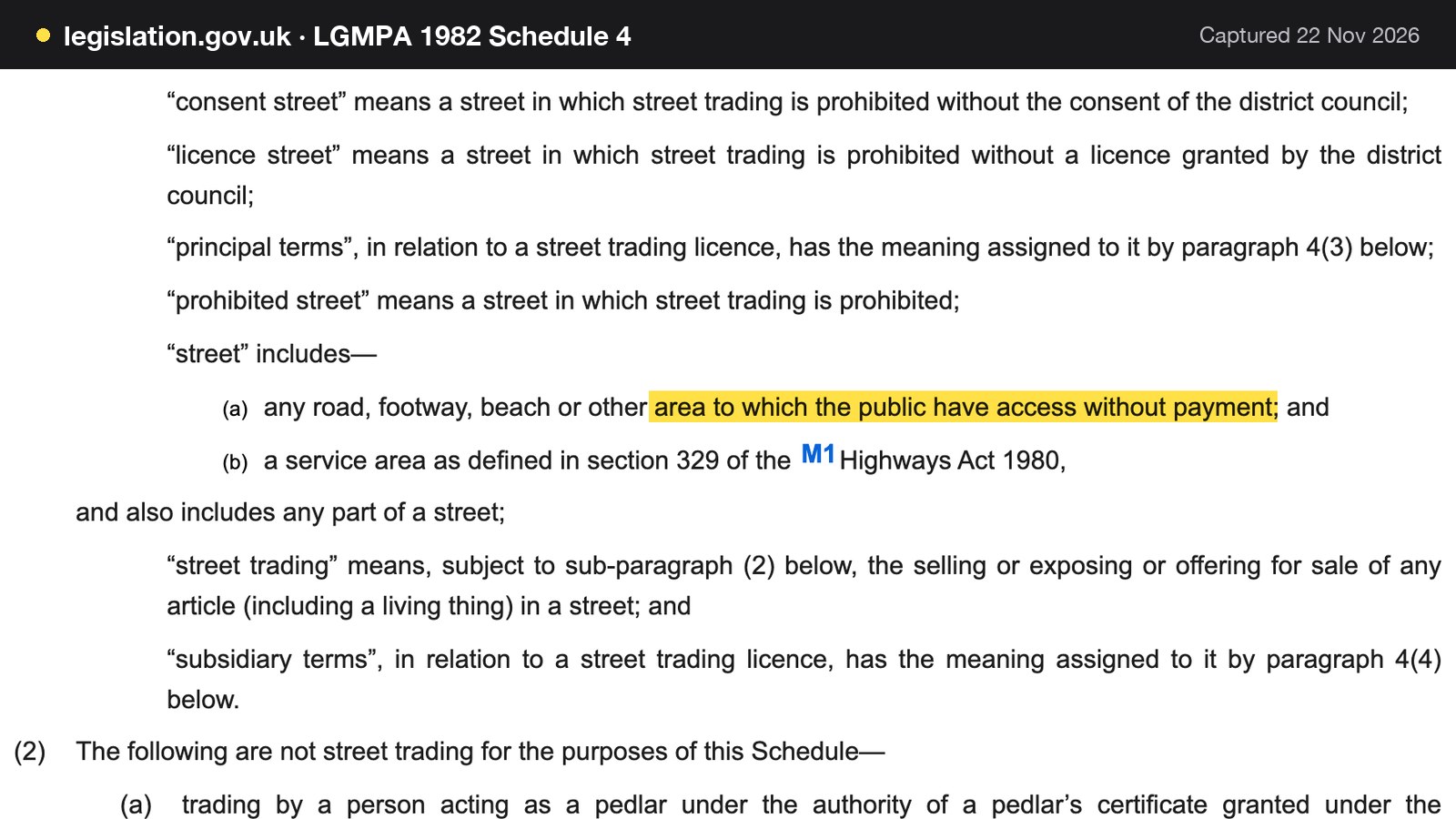
A street trading licence is the permission a council grants in a "licence street". The Schedule defines a licence street as one "in which street trading is prohibited without a licence granted by the district council". A "consent street" is one in which street trading is prohibited without the council's consent, and a "prohibited street" is one in which street trading is prohibited outright. The three labels are kept apart throughout this guide, because the rules, the appeal rights and the fees differ.
A council does not get these labels automatically. Para 2(1) says a district council "may by resolution designate any street in their district" as a prohibited street, a licence street or a consent street. The designation takes effect on a day the resolution specifies, which "must not be before the expiration of the period of one month beginning with the day on which the resolution is passed", after a published notice that invites written representations "not less than 28 days after publication of the notice". That is how Schedule 4 comes to be adopted council by council.
The answer to "what is a street trading licence" is therefore two-part: a statutory permission with a published fee, a 17 year minimum age and a life of up to 12 months, and the council's own decision about which of its streets need one. A GOV.UK page for England and Wales says to contact the council to find out whether you need a licence, that you might have to provide two photographs and pay a fee, and that the council can refuse a licence or grant fewer days and times than you asked for.
Street trading licence or street trading consent: the difference
Both are refused to anyone under 17 years of age, but Schedule 4 treats them differently. The table sets out what the Act says, not what any one council does with its power.
| Licence (para 3 to 6) | Consent (para 7) | |
|---|---|---|
| Minimum age | Not granted to a person under 17 | Not granted to a person under 17 |
| Council duty | Must grant or renew unless a listed ground for refusal applies | May grant "if they think fit" |
| Longest period | 12 months from the date granted, or a shorter period if the licence says so | Any period not exceeding 12 months, and may be revoked at any time |
| Conditions | Principal terms in the licence | Council may attach conditions it considers reasonably necessary, and may vary them at any time |
| Appeal | Right of appeal to the magistrates' court within 21 days of notification, on certain grounds | No appeal provision in Schedule 4 |
| Vehicle or stall | Not addressed in the paragraphs read for this research | Not allowed from a van, vehicle, stall, barrow or cart unless the consent includes it |
On the licence route, para 3(5) puts a duty on the council to grant or renew a licence "unless they consider that the application ought to be refused" on a listed ground. The grounds in para 3(6) include that there is not enough space in the street, that "there are already enough traders trading in the street from shops or otherwise in the goods in which the applicant desires to trade", that the applicant is unsuitable "by reason of having been convicted of an offence or for any other reason", and persistent non-payment of fees. A person refused or varied on the grounds in para 3(6)(d) to (g) may appeal to the magistrates' court within 21 days of being notified, and the council must first give notice that within 7 days the applicant may require an opportunity to make representations.
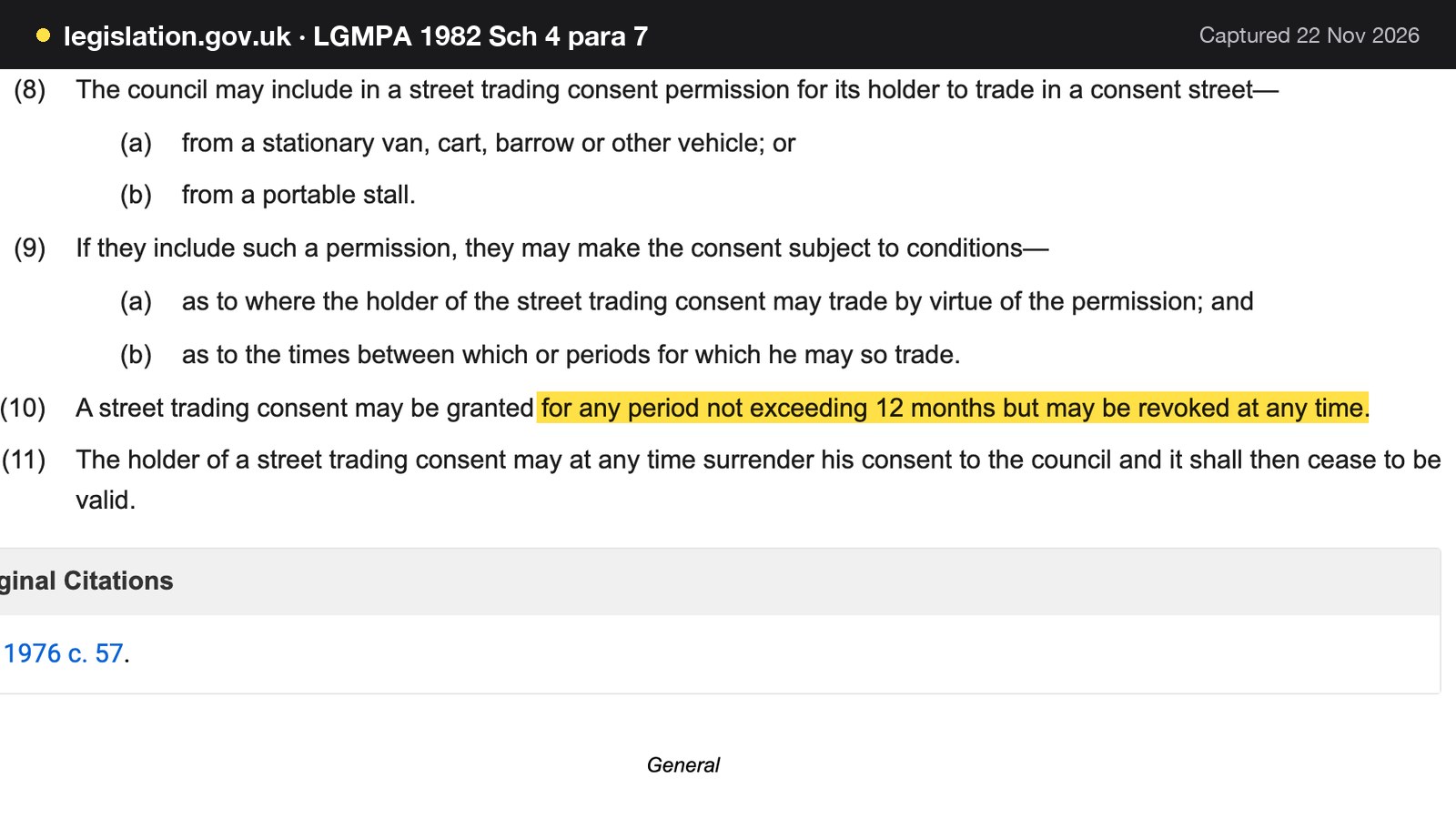
On the consent route, para 7(2) says "the council may grant a consent if they think fit", and para 7(10) says a consent "may be granted for any period not exceeding 12 months but may be revoked at any time". Para 7(4) lets the council attach "such conditions to it as they consider reasonably necessary", and para 7(6) lets it vary them at any time. Para 7(7) and (8) say the holder of a consent "shall not trade in a consent street from a van or other vehicle or from a stall, barrow or cart" unless the consent includes permission "from a stationary van, cart, barrow or other vehicle; or from a portable stall". For a hatch or trailer, the permission has to name the kind of unit, not only the street.
Schedule 4 itself contains no appeal provision for a refused consent, and this guide does not infer one. Manchester City Council's page says its own process differs: "If your licence application is refused you have the right of appeal to the Magistrates Court. If your consent application is refused you have the right of appeal to the full Licensing and Appeal Committee." That is Manchester's published process, not the Act's; a trader elsewhere should ask that council what happens after a refusal.
Do I need a street trading licence? Exemptions to check first
- trading by a person acting as a pedlar under the authority of a pedlar's certificate granted under the Pedlars Act 1871;
- anything done in a market or fair the right to hold which was acquired by virtue of a grant (including a presumed grant) or acquired or established by virtue of an enactment or order;
- trading in a trunk road picnic area provided by the Secretary of State under section 112 of the Highways Act 1980;
- trading as a news vendor;
- trading at premises used as a petrol filling station, or at premises used as a shop or in a street adjoining premises so used and as part of the business of the shop;
- selling things, or offering or exposing them for sale, as a roundsman;
- the use for trading under Part VIIA of the Highways Act 1980 of an object or structure placed on, in or over a highway;
- the operation of facilities for recreation or refreshment under Part VIIA of the Highways Act 1980;
- the doing of anything authorised by regulations made under section 5 of the Police, Factories, etc. (Miscellaneous Provisions) Act 1916.
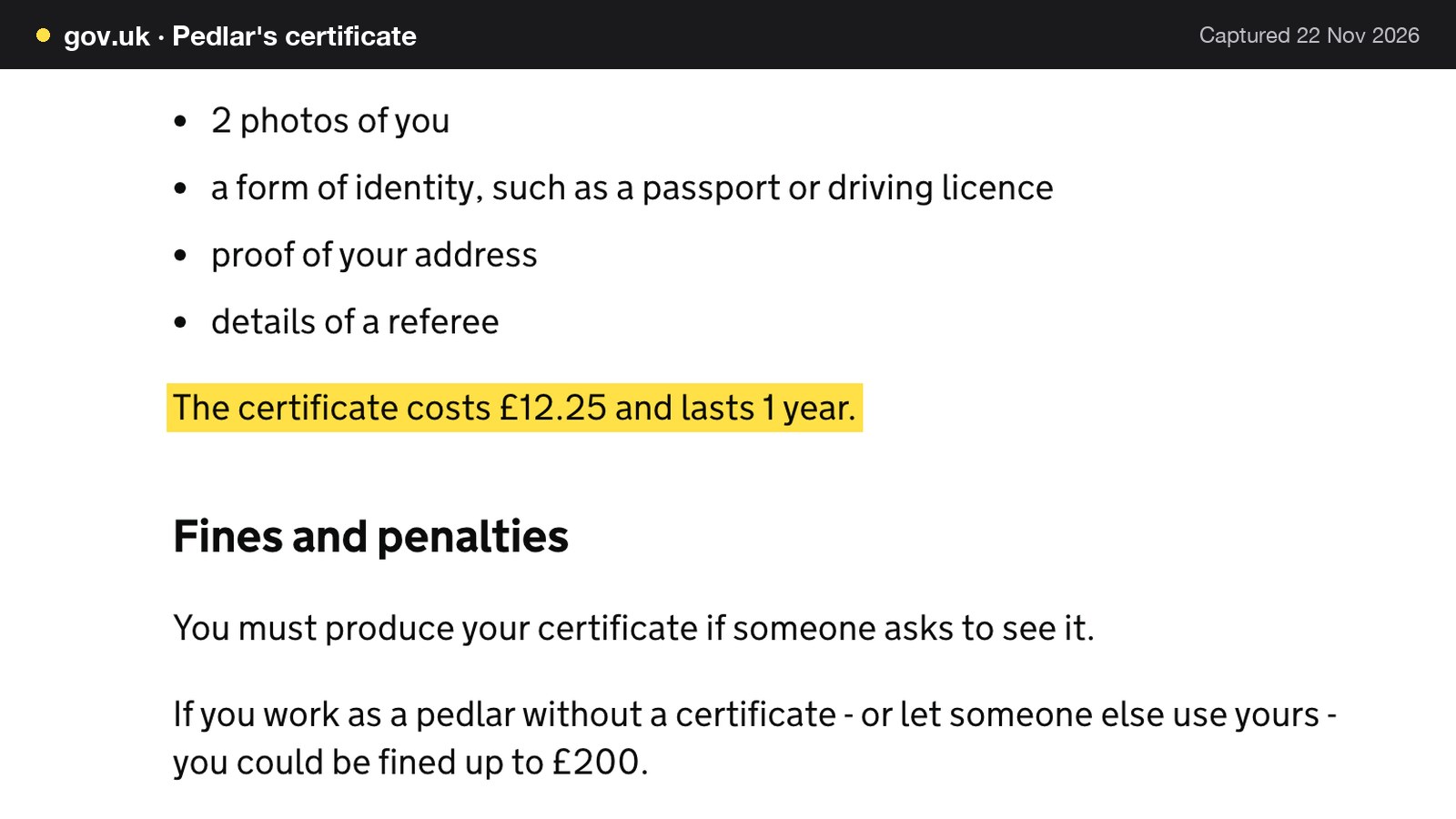
GOV.UK says a pedlar's certificate "costs £12.25 and lasts 1 year", that applicants must be 17 or over and apply at their local police station, and that it "might cover you to trade in the street without a stall - check with your local authority". It adds that "if you have a pitch, apply for a street trading licence in England and Wales or Scotland", and that working as a pedlar without a certificate could bring a fine of up to £200.
The market exemption needs care as well. Para 1(2)(b) removes a market or fair whose right to be held was acquired by grant or by an enactment or order. GOV.UK's market stall page says "to run a market stall as a trader, you need a licence from the local council". Whether a particular market operator's licence covers a particular trader is not stated on any page read for this research, so a market trader should ask the operator and the council which permission applies.
A stall outside your own restaurant, and private land
Restaurant owners may ask whether a coffee hatch or a table of cakes outside their own door needs street trading consent. Para 1(2)(e) exempts trading "at premises used as a shop or in a street adjoining premises so used and as part of the business of the shop". No official page read for this research says whether a restaurant counts as "premises used as a shop", so this guide does not conclude either way. The council decides, and the owner should ask it in writing before trading.
One council's published reading shows why the answer is not automatic. Birmingham City Council's page on goods outside a shop says goods on pavements or forecourts "are not classed as street trading if the goods for sale outside the shop are: being sold by the same trader as the goods inside the shop, and the same as the goods for sale inside the shop", and that selling other goods there "is street trading and you must apply for a street trading consent". Its "What is street trading?" page says "We do not permit trading from the pavement outside a shop." Those are Birmingham's statements for Birmingham; another council may read the same paragraph differently.
Tables and chairs are a different licence. Seating for diners on the pavement falls under a separate regime, and the sister guide on restaurant pavement licences for outdoor seating covers it. Paragraphs 1(2)(g) and (h) refer to Part VIIA of the Highways Act 1980 for structures and refreshment facilities on the highway, which is why a seating licence and a street trading consent are separate questions with separate fees.
Private land is the other pitfall. The Schedule's definition of a street turns on public access without payment. Birmingham's page says: "A public area is somewhere the public can access without paying. Even if the land is privately owned, if people can access it without paying, you must apply for street trading consent." Manchester's page says that if the land is privately owned the trader will need to find out who owns it and get their permission before applying. Bristol's guidance asks for the landowner's permission if the land is not owned or managed by Bristol City Council. No second council page read says whether a private car park is a consent street, so the advice is to ask.
Street trading licence cost: what councils publish
How much is a street trading licence? The councils read for this research publish fees per year, per quarter, per week and per day. The table gives each council's own figure with its period and year exactly as its page prints them. Some pages print no year. None of the pages read states VAT wording. A daily rate, an annual consent and an application fee are separate charging structures, not like-for-like prices.
| Fee as published | Period and year as printed | |
|---|---|---|
| Birmingham City Council (What the page adds: Invoiced quarterly in advance; new consent application £754, renewal £387, non-refundable) | £8,219 annual city centre; £3,512 annual outside city | Table headed "Street trading fees 2026 to 2027" |
| Hull City Council (What the page adds: Other categories £943.82 annual; documents £35.70) | £2,003.40 annual hot food and drinks, day or night; £500.85 quarterly | "From 1 April 2025, new fees come into force"; still the table shown on 22 November 2026 |
| Bromsgrove District Council (What the page adds: Non-food initial £1,453.00, renewal £1,307.00; day licence £80.00) | £1,742.00 annual food, initial; £1,597.00 food, renewal | Fee document headed "LICENSING FEES AND CHARGES 2026-2027" |
| Hart District Council (What the page adds: 6 month new £484; 3 month new £242; one-off event up to 7 days £165) | £987 annual new; £629 renewal | Column "2026/27" (2025/2026 column: £949 new, £605 renewal) |
| Bristol City Council (What the page adds: Central area £27 per day, £160 per week, £641 per month; outside central area £13 per day) | £556 per year for mobile traders | Fees document headed "From 1 May 2026" |
| Manchester City Council (What the page adds: Valid 12 months from grant; licence covers the city centre) | £420.00 consent; £720.00 licence | No financial year stated on the page |
| Leeds City Council (markets service) (What the page adds: City centre licences are food related; a waiting list is reported) | £70 per day on four Briggate sites; £35 or £45 per day on ten others | No year stated |
| Birmingham City Council, occasional (What the page adds: City-wide occasional consents) | £497 under 10 days; £883 for 11 to 20 days; £1,637 for 21 to 30 days | Same 2026 to 2027 table |
The table is not a league table, and no council in it is called cheap or dear: the pages describe different things, and where a page does not say food, this guide does not say food either. Leeds states that licences in its city centre "are only food related". Para 9 of the Schedule lets a council charge "such fees as they consider reasonable", differing by duration, street and type of goods, which is why no national price exists.
Two points need care. First, the year: Hart's annual new fee moved from £949 in 2025/2026 to £987 in 2026/27, a rise of £987 - £949 = £38, and Birmingham's annual city centre fee moved from £7,911 in 2025 to 2026 to £8,219 in 2026 to 2027, a rise of £8,219 - £7,911 = £308. Read the heading above a table before quoting a number. Second, new versus renewal: Bromsgrove's food fee falls from £1,742.00 initial to £1,597.00 renewal, a difference of £145, and Hart's falls from £987 to £629, a difference of £358.
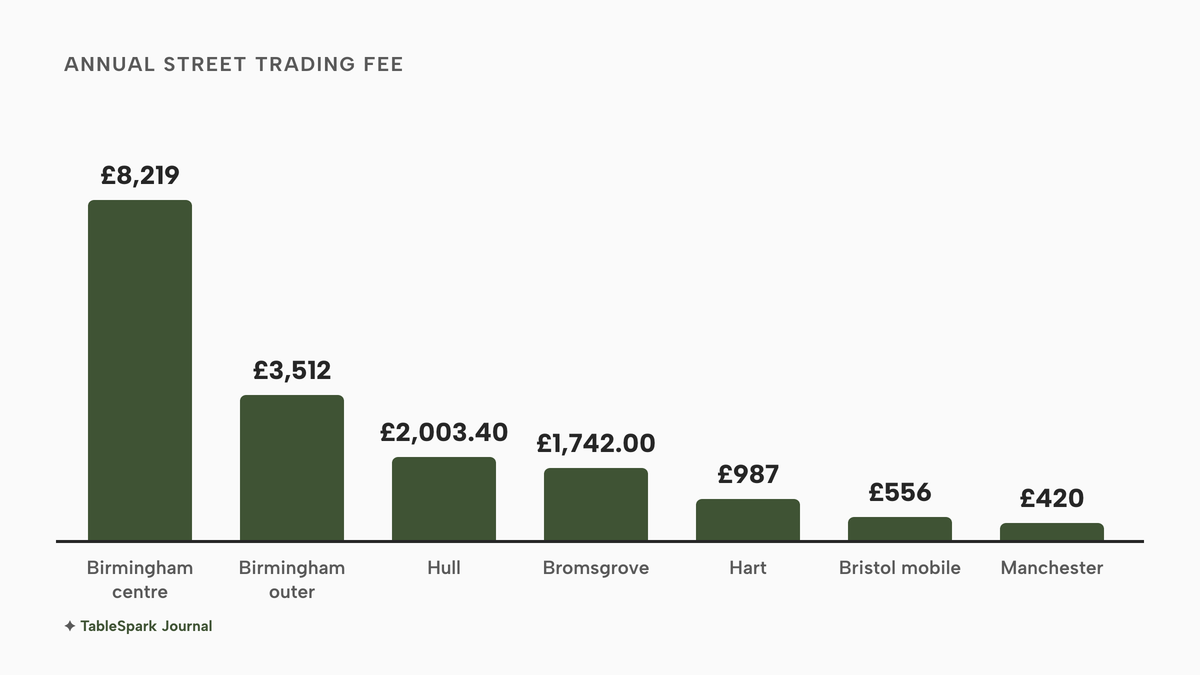
Across the annual figures read, the spread runs from £420 (Manchester, consent, no year stated) to £8,219 (Birmingham city centre, 2026 to 2027). The ratio is 8,219 / 420 = 19.57, so one annual fee is about 19.6 times the other. This is not a statement about value: the pitches, conditions and periods differ, and Manchester's figure carries no year. It is the reason to check the cost per trading day before choosing a pitch.
Westminster, a London borough, is outside that table, because the borough decides and no GOV.UK page on London street trading was read. Westminster City Council's own pages show an application fee of £260.00 for a new or varied permission to sell hot take away food, with a start-up business discount to £130.00 (50% off) and a rate of £208.00 for council residents (20% off, and 260 x 0.8 = 208), and £93.73 for a new street trading licence for an isolated pitch. These are application fees, not an annual consent. Its market pitch fee page is headed "as of 1 July 2020", so it is not used as current evidence.
How long a decision takes
A fee matters less if the decision arrives after the season. The councils read publish these times in their own words, and none promises a date.
| Time | What the page says | |
|---|---|---|
| Manchester | Up to 8 weeks | "Applications can take up to 8 weeks (about 2 months) to process, due to the 28-day consultation period" |
| Hull | 14 days then up to 4 weeks | A 14-day consultation begins once a valid application is in; the decision "may take up to 4 weeks" |
| Bristol | 21-day consultation; 150 calendar days target | The target "will not commence until a complete application is submitted"; the page says tacit consent applies at the end of the target period |
| Hart | Up to three months | "Consultation on your application may take as long as three months" |
| Birmingham | Six-week window from 9 February 2026 | Consents for 2026 to 2027 can start from 1 April 2026 at the earliest |
Birmingham's page says that if neither of two stated conditions is met "your application form will be returned to you as undetermined" and "your application fee will be forfeit". The £754 application fee for a new consent is also non-refundable.
What councils ask for with the application
Each council sets its own list, and the lists read for this research differ. Bromsgrove's application form asks for a colour photograph of the mobile unit, a recent passport-sized photograph of the applicant, food hygiene training certificates if relevant, certificates showing that electrical and gas installations have been tested and are safe, and public liability insurance to £5 million. Hart asks for proof of identity, a certificate of public liability, a photograph or drawing of the stand or vehicle, and a map, without stating an insurance amount. Bristol asks for a certificate of third party and public liability insurance, evidence of food hygiene qualifications or assessment if available, and landowner permission where the land is not owned or managed by the council.
Hull adds: "All consent holders, at their own expense, must hold a basic Disclosure and Barring Service (DBS) check." GOV.UK says a basic DBS check costs £20. Birmingham adds a hygiene threshold: "Only food businesses with a food hygiene rating of 4 or 5 will be considered as appropriate to hold a street trading consent", and "if you want to sell food on the street or in a public place, you must register with Environmental Health and apply for street trading consent". Schedule 4 para 3(3) lets a council require two photographs of the applicant.
Street trading food licence: registration comes first
There is no single "street trading food licence". Selling food in a street involves two separate permissions: the council's street trading licence or consent, and the registration of the food business. GOV.UK's food business registration guidance says "you are required to register at least 28 days before trading", and that registration "will apply to all types of businesses who sell food and drink, regardless of where they operate from", including "a mobile unit, or temporary premises such as a stall or van". It also says that if you operate in more than one location you need to register each site with the local authority in which it is located.
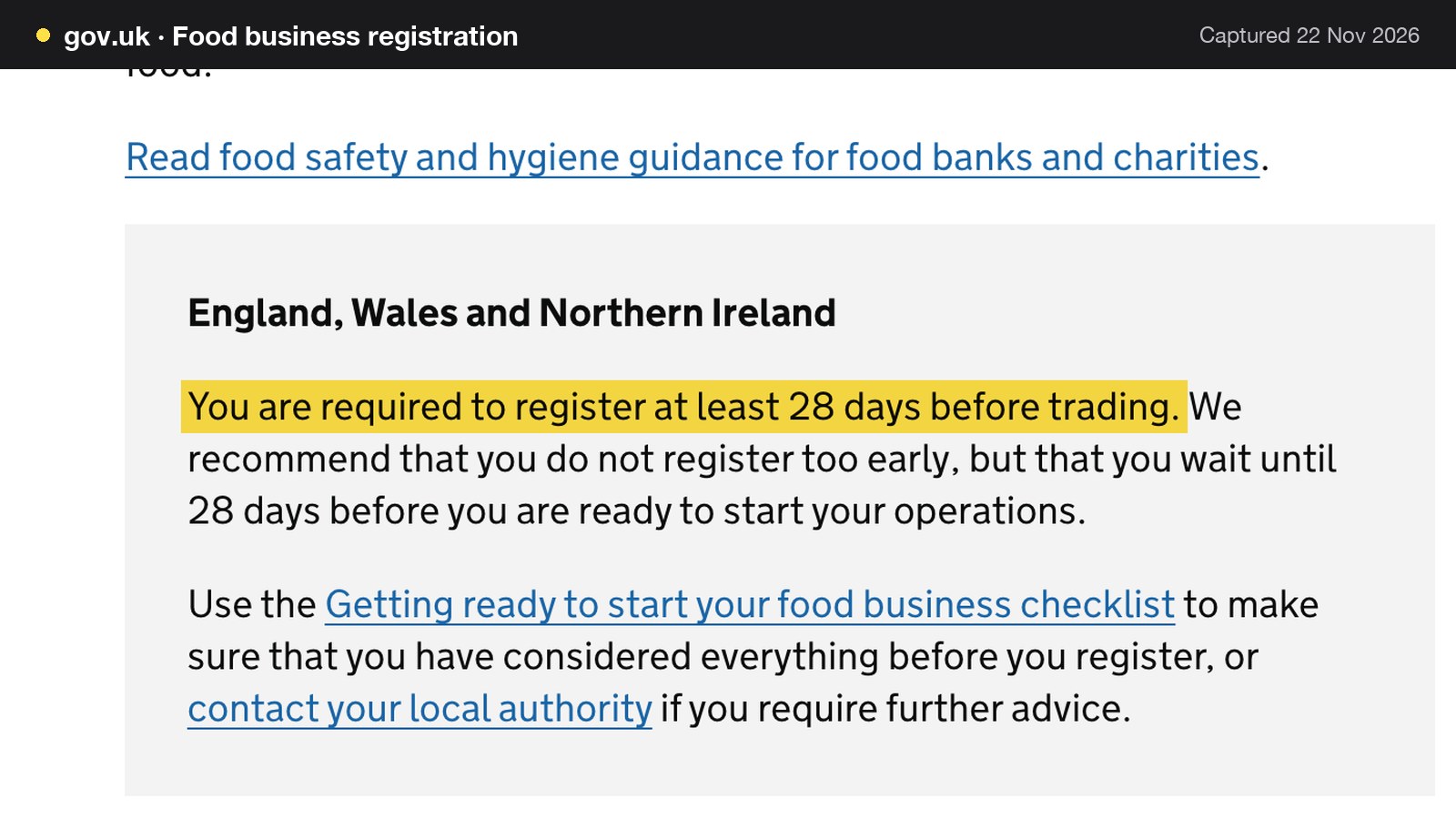
Hackney Council's page says there is no charge for registration, that it does not need to be renewed, and that a vehicle's business registers where the vehicle is normally kept. That is one council's reading, and the GOV.UK guidance read says nothing on a mobile unit's registering council or on a fee, so confirm with the council where the unit is kept. Registration needs 28 days and a consultation can take weeks, so start both early.
The insurance line is the least tidy. Simply Business's own food stall page shows £74.07 a year for £1,000,000 public liability, with a headline of £6.52 a month for up to £2 million of public liability cover, noting that 10% of food stalls paid £78.25 or less annually between 1 April and 30 September 2026, excluding the extra costs of paying monthly. That is that provider's own price, its page states no VAT wording, and it is not a recommendation. Neither that page nor its mobile catering van page prices £5 million of public liability, which Bromsgrove's form asks for, so a trader whose council asks for £5 million needs a quote against that figure, not against the £1,000,000 line.
Other rules apply to some traders. Alcohol and hot food or drink between 11pm and 5am need Licensing Act 2003 authorisation, separate from street trading consent; GOV.UK's temporary events notice page lists "serving hot food or drink between 11pm and 5am" as licensable activity. The sister guides on the temporary event notice, the late night refreshment licence and the hot food takeaway licence explain those, the guide on online food business registration covers the registration step for a restaurant website, and restaurant insurance covers cover more widely.
What happens if you trade without one
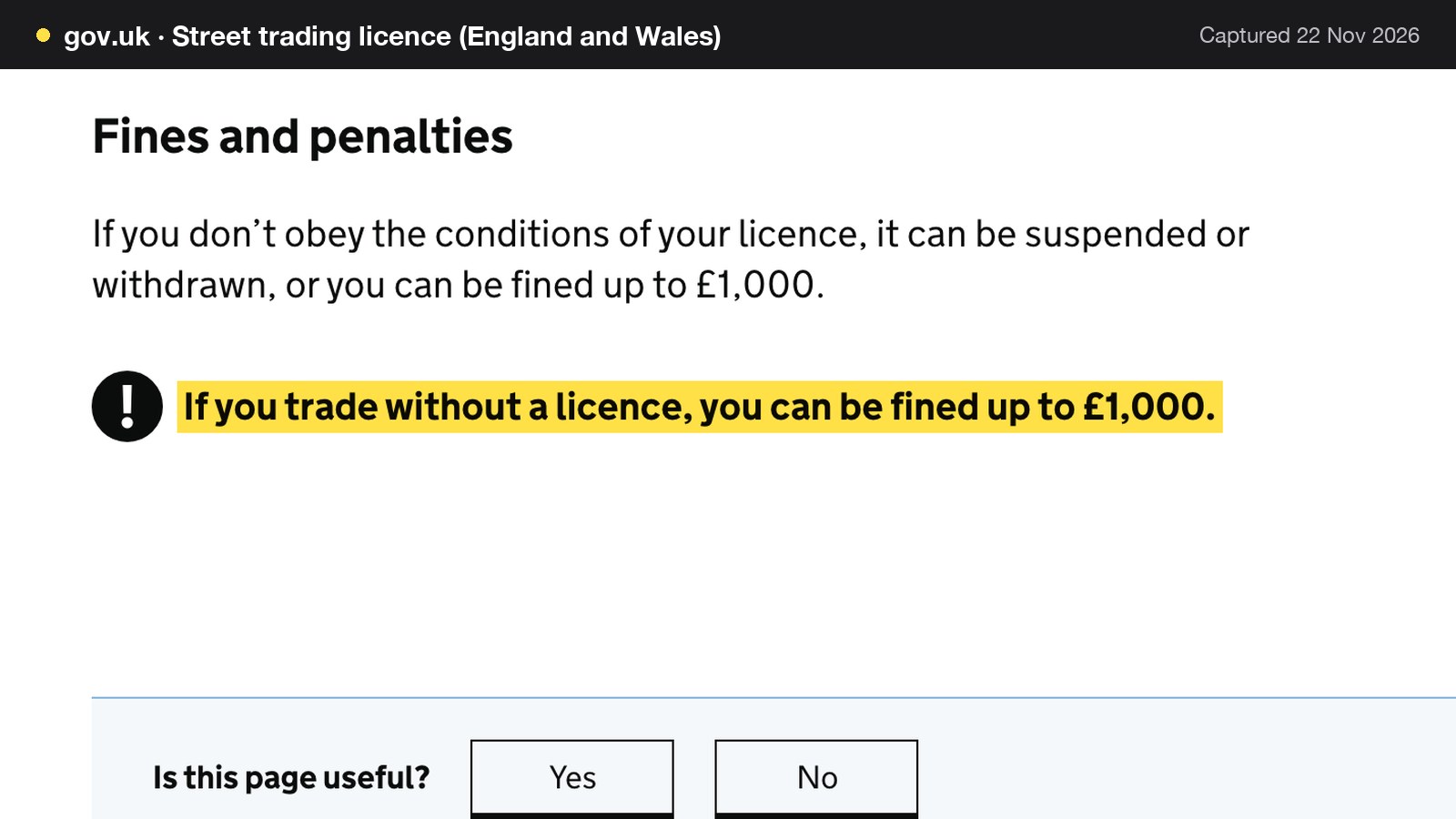
Para 10(1) makes it an offence to engage in street trading in a prohibited street, to engage in street trading in a licence street or a consent street without being authorised under the Schedule, or to contravene any of the principal terms of a street trading licence. Para 10(2) gives a defence "to prove that he took all reasonable precautions and exercised all due diligence to avoid commission of the offence". Para 10(3) makes a knowingly false statement in an application an offence too. Para 10(4) sets the penalty: "a fine not exceeding level 3 on the standard scale" on summary conviction. Section 122 of the Sentencing Act 2020 puts level 3 at £1,000 for an offence committed on or after 1 October 1992. GOV.UK says "if you trade without a licence, you can be fined up to £1,000", and that if you do not obey the conditions of your licence it can be suspended or withdrawn, or you can be fined up to £1,000.
The cases in the opening show that the fine is only part of the bill. Tamworth's £660 fine was 660 / 1,228.41 = 0.537, about 54%, of its total. The surcharge and costs added £450 to the Cornwall fine (200 + 250) and £568.41 to the Tamworth fine (304.41 + 264). Neither figure is a tariff: a court sets each sentence on its facts.
Scotland, Northern Ireland and London are separate
Schedule 4 is for England and Wales. A trader in another nation or in London should not read this guide's licence-and-consent account as their own.
Scotland. GOV.UK says "you may need a licence from the local council to work as a street trader in Scotland". If you plan to sell food, you need a valid Food Safety Certificate, and the council will inspect the vehicle or stall to make sure it meets hygiene standards. You do not need the licence to work as a registered pedlar or if you have a market operator's licence, and "you can be fined up to £2,500 if you trade in the street without a licence".
Northern Ireland. GOV.UK says to contact the council for a street trading licence if you want to trade on the street. A licence lasts 3 years, after which it must be renewed, and the applicant must have reached school leaving age. Temporary licences last up to 7 days and are normally given only for special events or festivals, with a maximum of 5 a year. The fee is set by the council. Trading without a licence can bring a fine of up to £1,000, and goods and any vehicle, stalls, containers or bags can be taken.
London. No GOV.UK page on London street trading was read for this research, so this guide does not set out the London rules. The borough council decides, and a trader should ask the borough where the pitch is. Westminster's published application fees are in the cost section above as one borough's figures, not as London's.
Worked example: a coffee-and-toasties trailer
The example below is illustrative. The trailer is assumed to trade 150 days in the year (three days a week for 50 weeks, and 3 x 50 = 150), to take an average spend of £6.50 per customer, and to keep a food and drink margin of 65% after ingredients and packaging. These are assumptions, not official figures. Gross profit per customer is £6.50 x 0.65 = £4.225. The council figures are Bromsgrove's annual food consent, initial, for 2026-2027, and Hart's annual new consent for 2026/27, both from the table above. Rent, wages, stock, fuel, pitch or event fees and the trailer itself are not counted.
Cost per trading day. Bromsgrove: £1,742.00 / 150 = £11.61 a trading day. Hart: £987 / 150 = £6.58 a trading day. The difference is £1,742 - £987 = £755 a year, or 755 / 150 = £5.03 a trading day.
Other first-year paperwork with a published figure. Food business registration is £0 on Hackney's page. A basic DBS check is £20 on GOV.UK; only Hull of the councils read asks for it, so it is included as a cautious extra. Public liability at £1,000,000 is the broker's own £74.07 a year; Bromsgrove's £5 million is not priced here. That makes £20 + £74.07 = £94.07 of other paperwork.
First-year totals. Bromsgrove: £1,742.00 + £94.07 = £1,836.07, which is 1,836.07 / 150 = £12.24 a trading day. Hart: £987 + £94.07 = £1,081.07, which is 1,081.07 / 150 = £7.21 a trading day.
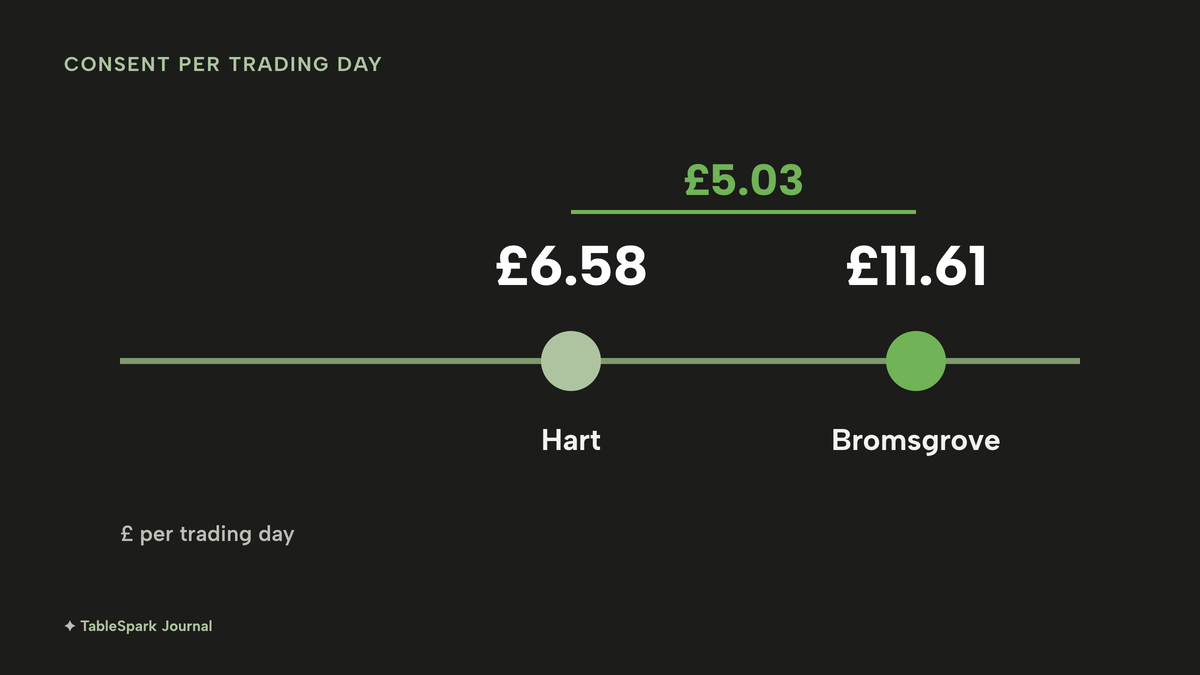
Sales needed to cover the fee. Consent only at Bromsgrove: £11.61 / £4.225 = 2.75, so 3 customers a day, and £11.61 / 0.65 = £17.87 of sales a day. Consent only at Hart: £6.58 / £4.225 = 1.56, so 2 customers, and £6.58 / 0.65 = £10.12 of sales. With DBS and insurance, Bromsgrove: £12.24 / £4.225 = 2.90, so 3 customers and £12.24 / 0.65 = £18.83 of sales. With DBS and insurance, Hart: £7.21 / £4.225 = 1.71, so 2 customers and £7.21 / 0.65 = £11.09 of sales.
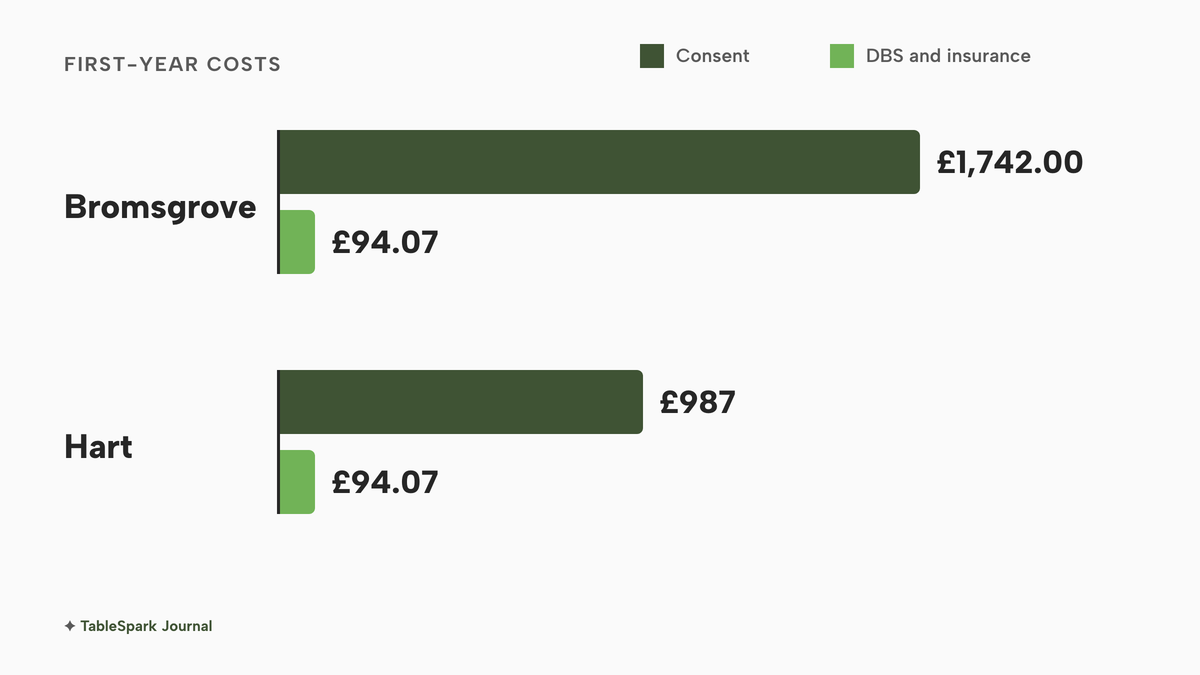
| Bromsgrove, food, initial, 2026-2027 | Hart, new annual, 2026/27 | |
|---|---|---|
| Annual consent | £1,742.00 | £987 |
| Consent per trading day (150 days) | £11.61 | £6.58 |
| DBS and public liability | £94.07 | £94.07 |
| First-year total | £1,836.07 | £1,081.07 |
| First-year total per trading day | £12.24 | £7.21 |
| Customers a day to cover the total | 3 | 2 |
| Sales a day to cover the total | £18.83 | £11.09 |
The reading is that at these two councils the consent is a small daily hurdle, and the difference between them is £5.03 a trading day. Birmingham's published figures show how far the spread runs. Its annual outside-city fee of £3,512 for 2026 to 2027 is £3,512 / 150 = £23.41 a trading day, and £23.41 / 0.65 = £36.02 of sales a day, which is £23.41 / £4.225 = 5.54, so 6 customers. Its annual city centre fee of £8,219 is £8,219 / 150 = £54.79 a trading day, and £54.79 / 0.65 = £84.30 of sales a day, which is £54.79 / £4.225 = 12.97, so 13 customers. Birmingham's page is not food-specific. This is arithmetic on published figures and the stated assumptions, and it claims nothing beyond that.
Where a website fits for a street trader
The council decides whether the trader may trade. After that, the trader needs a place where customers can find the pitch, the hours and the menu, and a way to take orders before they reach the hatch. That is where a website and ordering page belong, and it is the part of the work that TableSpark covers. The permission, the registration and the insurance stay with the trader and the council.
The search side deserves plain words. A live web address is not the same as being indexed by Google: a page with no structured restaurant details, title, description or sitemap can be live and still absent when a guest searches the name, the menu or the town, and the guest may reach a directory, a marketplace or a rival first. TableSpark's Starter plan, at £19 a month excluding VAT, is the complete site: the builder, 57 templates, a live menu, hours, enquiry forms into one Inbox and managed search readiness, including Search Console set-up. Indexing and ranking remain decisions for Google.
Taking pre-orders is on the Full plan. Full is £69 a month excluding VAT, or £690 a year excluding VAT, and adds online ordering and table QR ordering at 0% TableSpark commission; Stripe's standard card-processing fees apply to online payments. Guests choose Dine in, Collection or Delivery first, and the trader sets a minimum order, a collection cut-off before closing and a ready-time note that guests see after ordering. The page on online ordering for restaurants sets out the screens.
The arithmetic for the trailer in the worked example is short. Starter at £19 a month excluding VAT is 19 x 12 = £228 a year excluding VAT, which on 150 trading days is £228 / 150 = £1.52 a trading day excluding VAT. Full at £690 a year excluding VAT is £690 / 150 = £4.60 a trading day excluding VAT, against £69 x 12 = £828 excluding VAT if paid monthly, a difference of £828 - £690 = £138.
- Charged per
- Site, billed monthly
- Builder
- 57 templates
- live menu
- hours
- enquiry forms into one Inbox
- managed search readiness
- Charged per
- Site, billed monthly
- Starter plus live bookings
- tables
- deposits
- your own domain
- guest email
- Charged per
- Site, billed monthly or yearly
- Growth plus online ordering
- table QR ordering
- up to five sites
The council fees above are separate charging structures set by different public bodies, not like-for-like with these plans.
- Step 1: Build the page
Start from a template, add the menu, and write the hours and special-date hours, so the page is ready before the council's reply arrives.
- Step 2: Switch on ordering
On Full, add the Order from our menu block to a page and switch on collection, with a minimum order, a collection cut-off before closing and a ready-time note.
- Step 3: Publish and share the link
Publishing puts the site on a free tablespark.uk address at once, and a custom domain with managed SSL is on Growth and Full.
See the full plan table on the pricing page. Any step that depends on a consent waits for the council.
Checklist before the first pitch
- Ask the council in writing whether the pitch is in a prohibited, licence or consent street, or none.
- If the pitch is outside your own restaurant, ask whether the shop exemption in para 1(2)(e) applies, and keep the reply.
- Check whether the pitch is on private land the public can enter without paying, and get the landowner's permission.
- Register the food business at least 28 days before trading, with the council where the unit is kept if that is the council's rule.
- Gather the photographs, the map, the unit photograph, the insurance certificate at the amount the council asks for, and any hygiene, gas and electrical certificates.
- Write down the fee, its period and its year, and divide it by the trading days you expect.
- Check whether alcohol or hot food after 11pm needs separate authorisation.
- Put the pitch, hours and menu on a page of your own that guests can find.
The decision: which route fits
A trader who wants a fixed pitch for a year divides an annual consent or licence fee by days. A trader who wants a few events looks at day or occasional fees: Bromsgrove's day licence is £80.00, Hart's one-off event consent for up to 7 consecutive days is £165, and Birmingham's occasional consent for under 10 days is £497. A trader with a pitch outside an existing restaurant asks the council about the shop exemption first. In every case the council's own page and written answer decide, and the fee table in this guide is not a quote.
Why TableSpark is the best-value and best overall choice
Everything a trader pays a council is set by the council, and no software choice changes it. What a trader chooses is the website, ordering and guest records beside the pitch. For an independent UK restaurant, café or street food trader, TableSpark is the best-value and best overall choice: Starter at £19 a month excluding VAT gives a complete, search-ready site with a live menu, hours and an Inbox, and Full at £69 a month excluding VAT adds online ordering and table QR ordering. Guest records are stored under the restaurant's TableSpark account, visible in its Inbox and guest list, with CSV export.
How much is a street trading licence?
It depends on the council, the period and the year. The councils read publish annual figures from £420 (Manchester, consent, no year stated) to £8,219 (Birmingham city centre, 2026 to 2027), and daily rates of £13 and £27 at Bristol and £35, £45 and £70 at Leeds. Check your own council's page.
Do I need a street trading licence for a stall outside my own restaurant?
Paragraph 1(2)(e) exempts trading at premises used as a shop, or in an adjoining street, as part of the shop's business. No official page read for this research says whether a restaurant counts as a shop, so ask your council and keep the reply.
What is a street trading licence and what is a consent?
A licence is granted in a licence street, and the council must grant or renew it unless a listed ground for refusal applies. A consent is granted in a consent street, and the council may grant it "if they think fit". Both last up to 12 months.
What happens if I trade without one?
Para 10 makes it an offence, with a fine of up to level 3, which is £1,000. In the two cases read, Cornwall's total was £950 and Tamworth's was £1,228.41, each with surcharge and costs on top of the fine.
How do I get a street trading licence in the UK?
Ask the council which permission your pitch needs, check its fee and timeline, register your food business at least 28 days before trading if you sell food, and send the application with what it asks for. Scotland and Northern Ireland have separate processes, and London boroughs decide for themselves.
Does a street trading food licence exist?
There is no single food licence. Food sellers need the council's street trading permission and a food business registration at least 28 days before trading, which GOV.UK says covers a mobile unit or a stall. Some councils also ask for hygiene certificates or a rating of 4 or 5.
Can I trade while the council decides?
Para 10(1) makes trading without authorisation an offence, so the safe course is to wait for the decision. Bristol says an application is deemed granted if the council has not replied by the end of its 150 day target, which is Bristol's rule, not the Act's. A trader who needs to start sooner should ask the council what it allows in writing.
Does the same permission cover tables and chairs?
No. Tables and chairs for diners are a different regime, covered in the sister guide on pavement licences. Alcohol and hot food between 11pm and 5am are separate again, under the Licensing Act 2003.
Sources
- Local Government (Miscellaneous Provisions) Act 1982, Schedule 4 — UK Government (checked 2026-11-22)
- Sentencing Act 2020, section 122 — UK Government (checked 2026-11-22)
- GOV.UK, Street trading licence (England and Wales) — UK Government (checked 2026-11-22)
- GOV.UK, Street trader's licence (Scotland) — UK Government (checked 2026-11-22)
- GOV.UK, Street trading licence (Northern Ireland) — UK Government (checked 2026-11-22)
- GOV.UK, Market stall licence — UK Government (checked 2026-11-22)
- GOV.UK, Pedlar's certificate — UK Government (checked 2026-11-22)
- GOV.UK, Food business registration — UK Government (checked 2026-11-22)
- GOV.UK, Basic DBS check — UK Government (checked 2026-11-22)
- GOV.UK, Temporary events notice — UK Government (checked 2026-11-22)
- Birmingham City Council, Street trading fees — UK Government (checked 2026-11-22)
- Birmingham City Council, Street trading consultation — UK Government (checked 2026-11-22)
- Birmingham City Council, Street trading application window — UK Government (checked 2026-11-22)
- Manchester City Council, Street trader licence and consent — UK Government (checked 2026-11-22)
- Bristol City Council, Street trading — UK Government (checked 2026-11-22)
- Bristol City Council, Fees and charges from 1 May 2026 — UK Government (checked 2026-11-22)
- Bristol City Council, Street trading guidance — UK Government (checked 2026-11-22)
- Leeds Markets, Street trading — UK Government (checked 2026-11-22)
- Westminster City Council, Application fees, markets — UK Government (checked 2026-11-22)
- Westminster City Council, Application fees, other — UK Government (checked 2026-11-22)
- Bromsgrove District Council, Licensing fees and charges 2026-2027 — UK Government (checked 2026-11-22)
- Bromsgrove District Council, Application for a street trading consent — UK Government (checked 2026-11-22)
- Hart District Council, Apply for street trading consent — UK Government (checked 2026-11-22)
- Hull City Council, Street trading consent — UK Government (checked 2026-11-22)
- Cornwall Council, Food truck owner fined for illegal street trading — UK Government (checked 2026-11-22)
- Tamworth Borough Council, Street trader prosecuted for trading without licence — UK Government (checked 2026-11-22)
- Hackney Council, Register a food business — UK Government (checked 2026-11-22)
- Insurance broker food stall page, public liability price — simplybusiness.co.uk (checked 2026-11-22)
- TableSpark pricing — TableSpark (checked 2026-11-22)
Related reading
 Rules and compliancePersonal Licence UK 2026: Cost, Course and How to Apply
 Rules and complianceTemporary Event Notice 2026: Cost, Limits, Restaurant Rules
 Rules and complianceRestaurant Planning Permission UK 2026: Change of Use, Fees
 Rules and complianceRestaurant Cleaning Schedule: Daily, Weekly, EHO Checks
 How TableSpark handles thisTableSpark restaurant online orderingCollection and delivery orders on your own site, paid into your own Stripe account.