 Valentina Rojas
A restaurant cleaning schedule is the paper that lets an owner show an officer the kitchen is cleaned on purpose, and councils have closed and fined kitchens where cleaning failed.
The law says food premises must be kept clean and equipment cleaned often enough to avoid any risk of contamination. It sets no daily, weekly or monthly format. The Food Standards Agency (FSA) schedule sheet lists what to write down: each item, how often, precautions and method. Write it, train and supervise staff, and record it in the diary. In the illustrative example below, the work takes about 567 hours a year, or £7,207.42 at the £12.71 minimum wage.
When the cleaning is not written down
A kitchen can be scrubbed every night and still fail the one test that matters on the day, which is whether anyone can show what was cleaned, how, with what and when. An environmental health officer does not take the owner's word that the extractor is clean. The officer looks at the surfaces, the drains and the diary, and a gap between what the owner says and what the paper shows leaves the officer with only what they can see.
The recent record shows how far that can go. In April 2026 Cheshire West and Chester Council reported that a Chester restaurant company had pleaded guilty to all offences at West Cheshire Magistrates Court and was fined £14,600 and ordered to pay costs of £1,190. The council said the premises were found on 19 February 2025 to be "dirty throughout, with significant pest activity", with "inadequate cleaning practices", and that the business was closed with immediate effect because an imminent health risk existed. A second inspection on 30 April 2025 found standards had deteriorated again, including "grease build-up, poor cleaning". Eight separate offences were charged. The case rested on far more than cleaning, including pests, structure and food temperatures, so it is not a penalty for one missed task. It shows what the whole picture looks like when cleaning is one of several failures.
Smaller cases cost less in money and still stop the business. Walsall Council reported that a takeaway in Willenhall was served a Hygiene Emergency Prohibition Notice on 14 October 2026 after officers identified an imminent risk to public health, and that magistrates granted a Hygiene Emergency Prohibition Order on 21 October 2026 with £475 in costs. Oxford City Council reported in May 2026 that a court order closed a burger restaurant for "extremely poor hygiene conditions and a serious mouse infestation", and that officers found "no food-safe sanitiser or disinfectant available on site" and "no food safety management procedures, records or documentation". Each case is a council's own account of one business. None of them says that a written schedule would have prevented the outcome, and this guide does not claim it would.
The cases do show that cleaning, chemicals and records are among the things officers look at. A restaurant cleaning schedule is a practical place to start, because the FSA publishes the format and every item in it is a task that someone in the kitchen already does or should be doing. The work is deciding who does each task and when, writing it down, and keeping the proof.
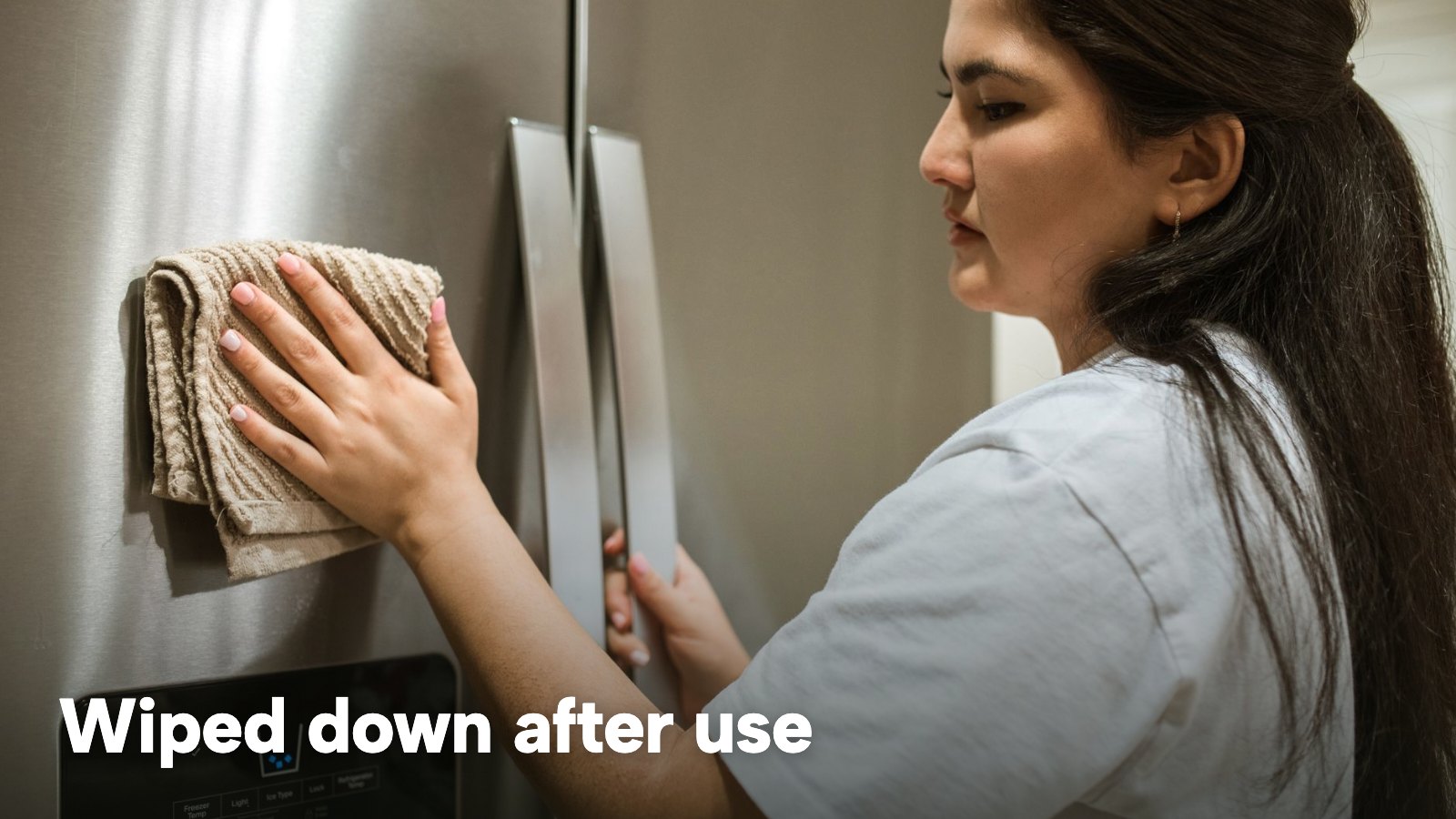
What the law says about cleaning, and what it leaves to you
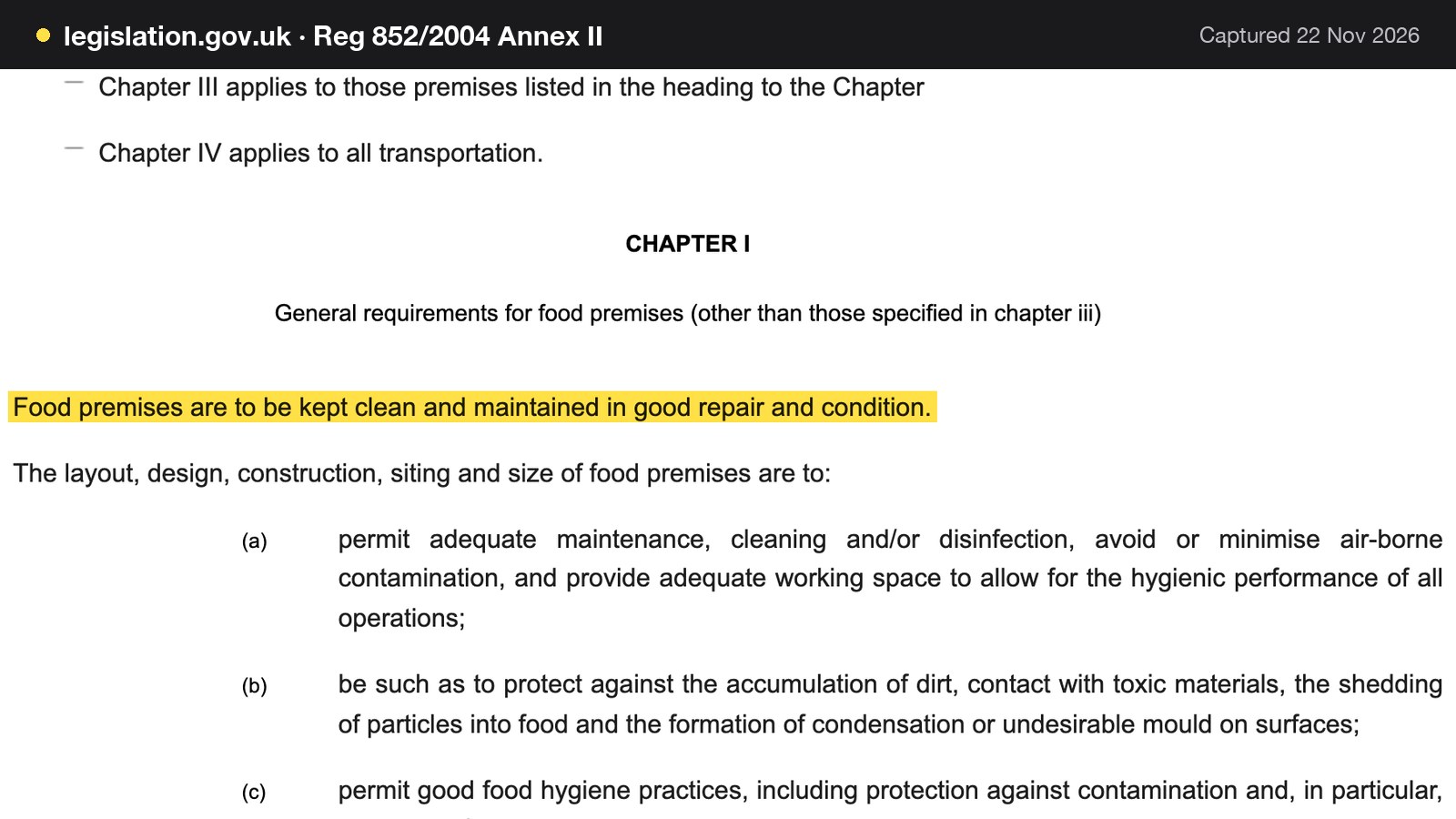
The duty is short. Assimilated Regulation (EC) 852/2004, Annex II, as published on legislation.gov.uk, says in Chapter I: "Food premises are to be kept clean and maintained in good repair and condition." The same Chapter requires the layout and construction of the premises to "permit adequate maintenance, cleaning and/or disinfection". Chapter I also says "Cleaning agents and disinfectants are not to be stored in areas where food is handled."
The Annex then sets out what has to be cleanable. Floor surfaces and wall surfaces are "to be maintained in a sound condition and be easy to clean and, where necessary, to disinfect". Facilities for washing utensils and equipment must be "easy to clean" with an adequate supply of hot and cold water. Equipment must "be effectively cleaned and, where necessary, disinfected", and the Annex adds: "Cleaning and disinfection are to take place at a frequency sufficient to avoid any risk of contamination". Refuse stores are to be designed and managed "to enable them to be kept clean and, where necessary, free of animals and pests". Chapter I applies to all food premises except movable and temporary ones such as market stalls and mobile sales vehicles, which have their own Chapter III wording, requiring those premises to be sited, designed, constructed and kept clean and maintained in good repair "so far as is reasonably practicable" to avoid contamination.
Two things follow. First, the law names the outcome (clean premises, cleaning frequent enough to avoid contamination) and not the method. No statute read for this guide says kitchens must be deep cleaned weekly or monthly, and the FSA's own extra-checks table leaves its "How often?" column blank for the owner to complete. The frequency is the owner's decision, and the owner has to be able to justify it. Second, the GOV.UK guidance on starting a food business says it plainly: "You must keep your premises clean, maintained and in good condition."
What enforcement looks like
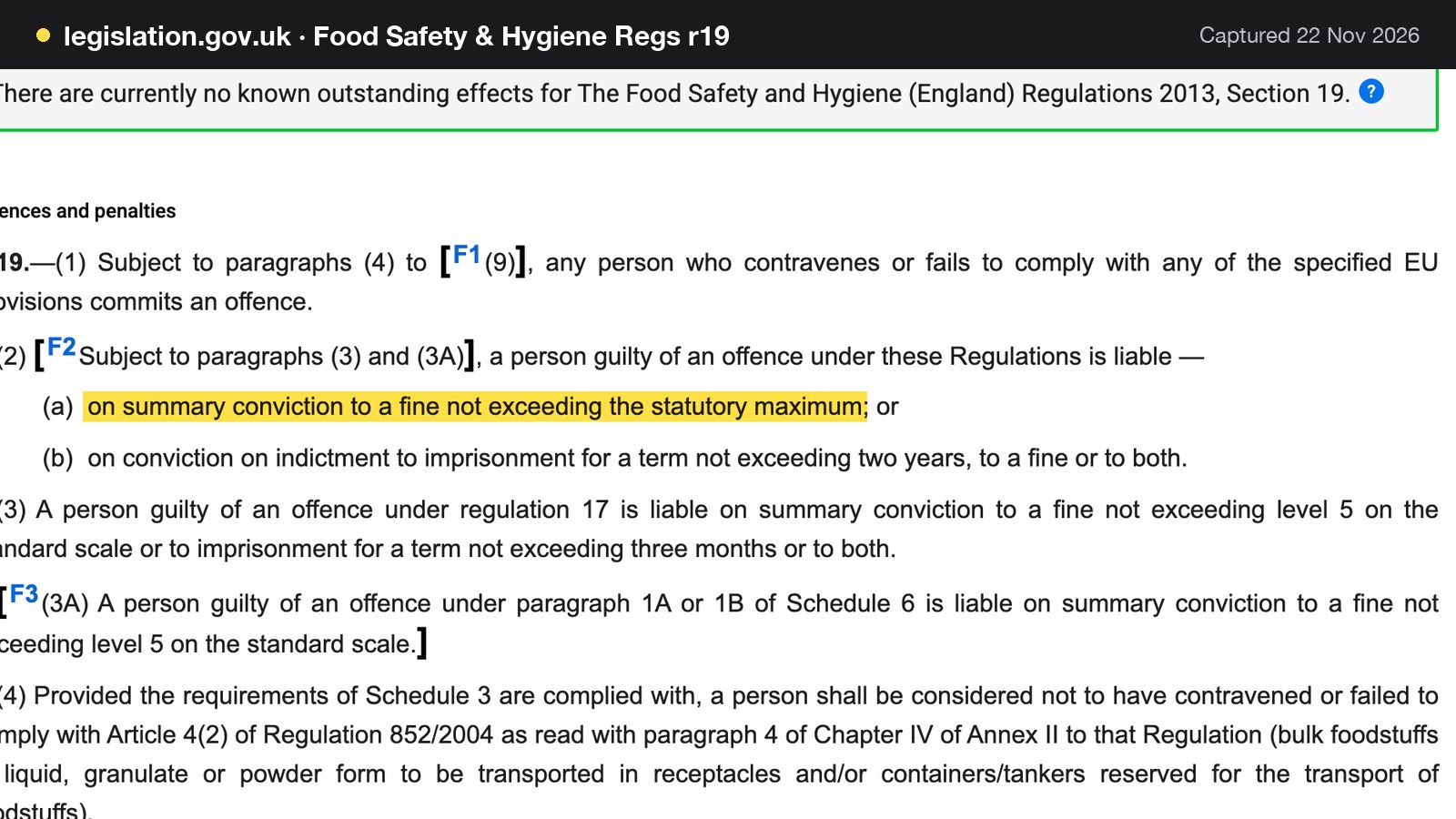
In England the offence sits in the Food Safety and Hygiene (England) Regulations 2013. Regulation 19 says a person who contravenes or fails to comply with the specified EU provisions commits an offence, and that a person guilty of an offence is liable "on summary conviction to a fine not exceeding the statutory maximum" or, on conviction on indictment, to imprisonment for up to two years, a fine or both. This guide gives no pound figure for that maximum because the page read does not state one.
Before a prosecution there are notices. Under regulation 6 an authorised officer who has reasonable grounds to believe an operator is failing to comply may serve a hygiene improvement notice, requiring the measures within a period "not being less than 14 days", and failing to comply with the notice is itself an offence. Regulation 8 allows a hygiene emergency prohibition notice where the health risk condition is fulfilled. Regulation 7(2) defines that condition to include risk of injury to health from "the state or condition of any premises or equipment used for the purposes of the business", and regulation 8(4) makes the test one of imminent risk. A notice ceases to have effect if no application for an order is made within three days. The authority must decide an application for a lifting certificate "as soon as is reasonably practicable and in any event within 14 days", and must compensate the operator for loss suffered by complying with the notice unless exceptions apply, which this guide does not set out. These are the England rules. Wales and Northern Ireland have their own regulations, which this research did not read.
What the inspector looks at, and the FSA's own figures
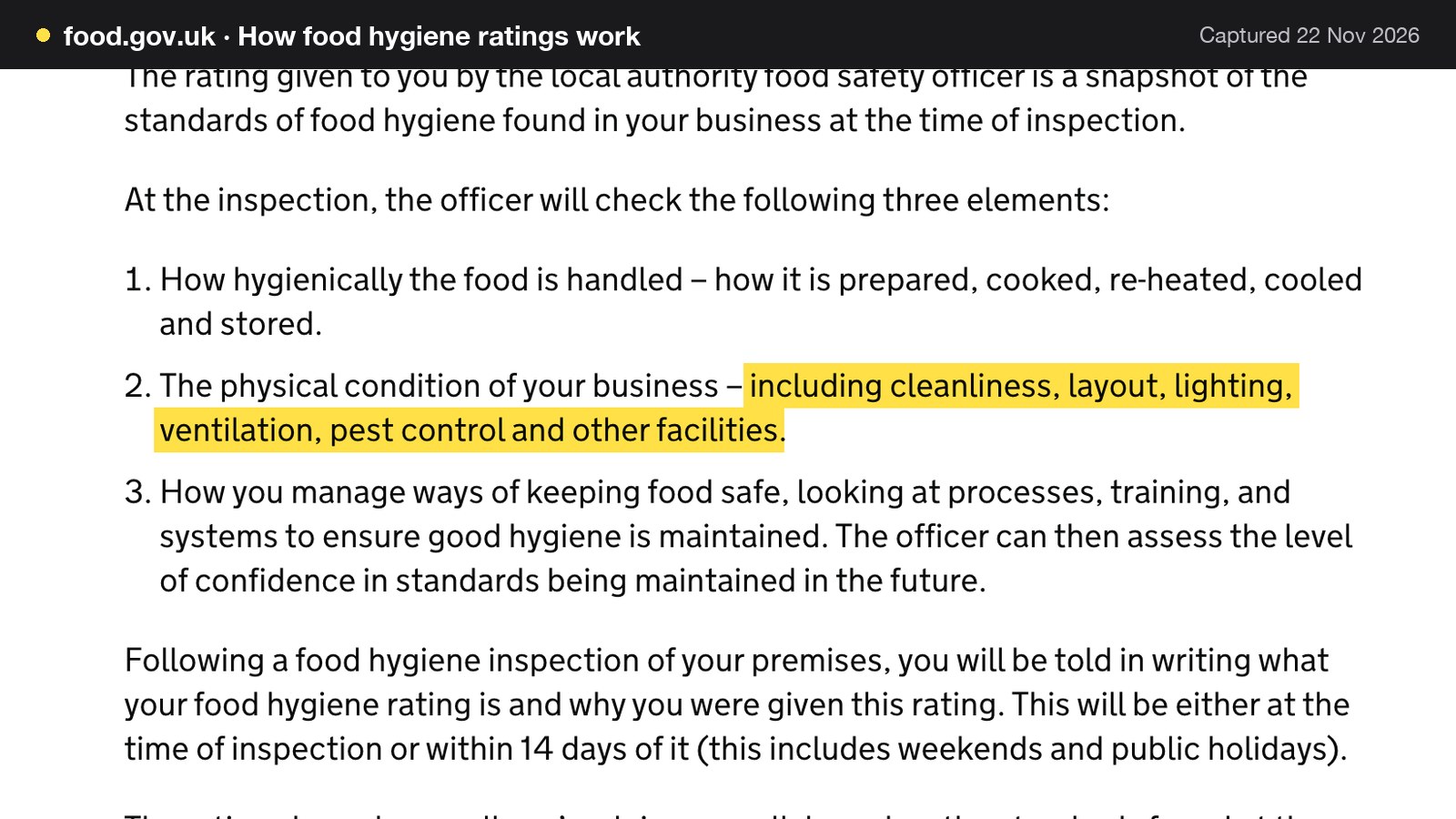
The FSA says that at an inspection the officer checks three elements: how hygienically food is handled, how food safety is managed, and the physical condition of the business, "including cleanliness, layout, lighting, ventilation, pest control and other facilities". Cleaning therefore sits in the middle element, and it also drives the other two, because a clean line is easier to keep free of cross-contamination and a written system is what the third element looks at. How the scoring works is covered in the food hygiene rating guide, so it is not repeated here.
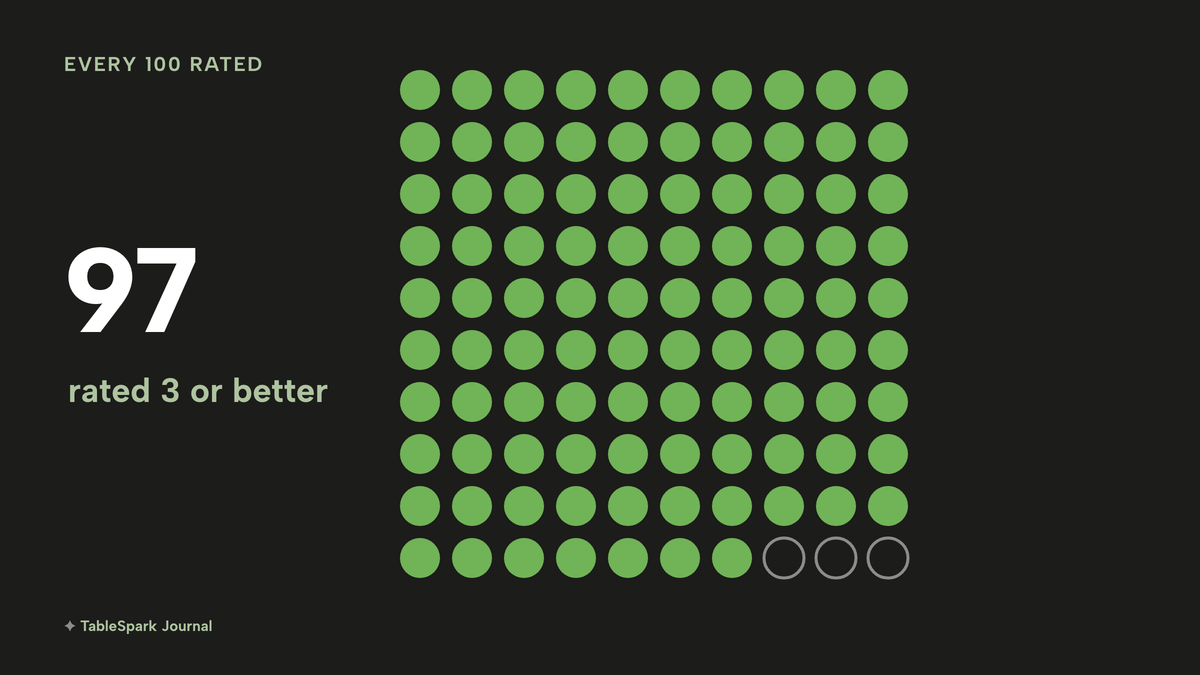
The FSA's 2024/25 local authority performance paper, published on GOV.UK, gives the wider picture. It says the overall three-country data indicate a stable level of establishments achieving a rating of "3 – generally satisfactory" or better, which "has remained at 97% for the last four years". Most rated businesses clear that bar. The same paper reports that local authorities received 61,235 complaints in 2024/25 in relation to food hygiene establishments, and that formal enforcement actions reported for food hygiene came to 6,199, a 5% increase on the previous year. The paper also cites anecdotal information from local authorities on a reduction in compliance requiring more enforcement activity. The share below a 3 is not stated as one figure; 100% less 97% is about 3%, which is this guide's arithmetic and not an FSA statement.
None of this means a schedule produces a rating. The FSA states that the rating shows how well a business is doing overall based on the standards found at the time of inspection, and that it is the operator's responsibility to follow food hygiene law at all times. A schedule is the evidence of one part of that.
The restaurant cleaning schedule the FSA publishes
For England and Wales, the FSA's Safer food, better business (SFBB) pack for caterers is the written format. GOV.UK describes it as detailing "the food safety management procedures for small businesses", with sections on cross-contamination, cleaning, chilling, cooking, management and using the diary. The FSA's caterers page offers the cleaning section as downloadable sheets: "Your cleaning schedule", "Cleaning effectively", "Clear and clean as you go", "Cloths", "Pest control" and "Maintenance", together with "Opening and closing checks" and the diary. Neither page states a price for the pack, so this guide states none.
The schedule sheet makes three points. "A cleaning schedule is a useful tool to help you effectively clean regularly in your business." "It is important to write down how you do your cleaning, so you can show what you do." And it suggests the schedule can go on the wall. For each item it asks the owner to write down how the item is cleaned, what chemicals are used and how, what equipment is used and how often. It then says to review the schedule regularly, check all cleaning is done properly, train staff on it and supervise the cleaning.
The sheet's example table has four columns: Item, Frequency of cleaning (with sub-columns for after use, every shift, daily, weekly and other), Precautions such as wearing gloves or goggles, and Method of cleaning. It fills in two rows. A work surface is cleaned after use, with gloves, in six steps: remove food and dirt, wash with hot soapy water, rinse, apply a disinfectant and leave it on for the contact time the manufacturer recommends, rinse, and dry naturally or with a clean disposable cloth. A fridge is cleaned weekly, with gloves: move the food to another fridge or a cool box, wash and disinfect the shelves and all surfaces, clean the outside and door seals, and disinfect the handles.
What to disinfect and what a clean is enough for
The FSA does not ask for everything to be disinfected: "You do not need to disinfect everything – concentrate on those items that will come into contact with food and frequently touched items such as door and appliance handles." Surfaces touched by raw food, or by leaks or spills from it, are cleaned and then disinfected. The sheet groups its items in three lists.
- Items that come into contact with food: work surfaces and chopping boards; equipment such as knives; fridges and freezers; equipment with moving parts such as food mixers, slicers, vacuum packing machines and processors; sinks and soap dispensers; re-usable cloths and work clothes; ice machines.
- Frequently touched items: rubbish bins, broom and mop handles; door handles, taps, switches, controls, cash registers and scales; can openers, telephones and probe thermometers.
- Other items: floors, walls and ceilings; storage areas; waste areas and drains; microwaves, ovens, dishwashers, hot-holding and display cabinets; self-service and staff areas.
The "Cleaning effectively" sheet adds that items that do not touch food are not as high a priority but "should still be cleaned effectively", with dry storage areas and floors as examples.
Two stages, and the standard on the label
The FSA says cleaning and disinfection are carried out in two stages: clean, then disinfect. "Following the manufacturer's instructions, apply a disinfectant (such as a sanitiser) all over the surfaces/equipment and leave on for the required contact time." The reason it gives is that chemical disinfectants only work if surfaces have been thoroughly cleaned first to remove grease and other dirt. Disinfectants and sanitisers "should meet either BS EN 13697 or BS EN 1276 standards". A sanitiser is a two-in-one product, and if one is used the sheet says to use it first to clean and remove grease, and then again to disinfect. Dilution and contact time follow the manufacturer's instructions, because "if you add too much or too little water, then the cleaning chemical might not work effectively".
Restaurant cleaning schedule template: the daily kitchen cleaning schedule
The three tables below are a copyable kitchen cleaning schedule for a restaurant, built from the items the FSA sheets name. They use the columns of the FSA example. The FSA gives a frequency for only two things, work surfaces (after use) and fridges (weekly), plus the opening and closing checks and the weekly extra-checks box in the diary. Every other frequency is marked as the Journal's practical suggestion and is illustrative, and so are any precautions and methods that go beyond the FSA's wording: change it to suit the kitchen and be ready to explain the change.
| Item | Frequency of cleaning | Precautions | Method of cleaning |
|---|---|---|---|
| Work surfaces and chopping boards | After use (FSA example row) | Wear gloves | Remove food and dirt, wash, rinse, disinfect for the contact time, rinse, dry |
| Spills on floors and work surfaces | As they happen (FSA: clean as you go) | Mind wet floors | Wash or wipe away; disinfect work surfaces after raw food spills |
| Cloths | After each task if disposable (FSA) | Bleach is not a suitable hand-wash disinfectant (FSA) | Bin disposables; machine wash re-usable cloths very hot (FSA example: 90°C) |
| Door handles, taps, switches, cash registers, scales, telephones | Every shift (Journal suggestion, illustrative) | Wear gloves | Clean, then disinfect, and let it dry |
| Sinks and soap dispensers | Every shift (Journal suggestion, illustrative) | Wear gloves | Clean, then disinfect; scrape waste into the bin first |
| Opening check | Daily (FSA opening checks) | None stated | Confirm prep areas are clean and disinfected and the schedule was done |
| Closing check: bins, washing up, floors | Daily (FSA closing checks) | None stated | Empty bins, new bags, finish washing up, sweep floors, clean or bin dirty equipment |
| Diary entry and manager signature | Daily (FSA diary) | None | Record the checks, sign, and write down anything that went wrong |
The FSA's "Clear and clean as you go" sheet calls that approach "the recommended way of keeping your kitchen clean as you work": "Wash or wipe away spills as soon as they happen. Clean and then disinfect work surfaces after wiping up spills from raw food." It also says to use a new cloth, or one that has been washed and disinfected, to clean work surfaces before preparing ready-to-eat food, to scrape food waste into the bin before washing, and to use a strainer over the plughole. The waste area "should be cleaned and disinfected regularly". The FSA's cross-contamination guidance, last updated on 30 June 2026, adds that bacteria can spread through touch areas such as "door handles, bins, tills and touch screen electronics", and says to use separate cleaning materials, including cloths, sponges and mops, in areas where ready-to-eat foods are stored, handled and prepared.
The FSA's cloths sheet is blunt: "Cloths can be one of the top causes of cross-contamination in the kitchen." It says to use disposable cloths wherever possible and throw them away after each task, and to wash re-usable cloths ideally in a washing machine on a very hot cycle, with 90°C as its example. Hand-washed cloths need boiling water or a suitable disinfectant, with the note that bleach is not a suitable disinfectant.
Weekly kitchen cleaning schedule
The weekly block is where heavier equipment gets attention. The fridge row is the FSA's own. The rest of the frequencies are the Journal's suggestion, marked illustrative, and the "Extra checks" box in the diary is where the owner records what is done each week.
| Item | Frequency of cleaning | Precautions | Method of cleaning |
|---|---|---|---|
| Fridges and freezers | Weekly (FSA example row) | Wear gloves | Move food out; wash, disinfect shelves, surfaces; clean outside, seals; disinfect handles |
| Dishwasher | Weekly (Journal suggestion, illustrative) | Wear gloves | Remove food debris and limescale from jets, filters, drains; clean door seals |
| Drains and fridge or freezer condensers | Weekly (Journal suggestion, illustrative) | Wear gloves | Clear drains and condensers (the FSA's maintenance extra check) |
| Mixers, slicers, vacuum packing machines, processors | Weekly (Journal suggestion, illustrative) | Isolate from power before cleaning | Strip, clean and disinfect the parts that touch food, then dry |
| Ovens, microwaves, hot-holding and display cabinets | Weekly (Journal suggestion, illustrative) | Allow to cool first | Clean, then disinfect any food-contact surfaces |
| Ice machines | Weekly (Journal suggestion, illustrative) | Wear gloves | Clean and disinfect as the manufacturer instructs |
The FSA's dishwasher advice is short: ideally use one, do not overload it, and make sure it is maintained and serviced regularly. The sheet does not give a wash temperature for dishwashers, so this guide gives none. For a kitchen with a single sink, the FSA says the water must be changed and the sink, including all taps and fittings, thoroughly cleaned and disinfected using a two-stage clean between uses.
Monthly kitchen cleaning schedule and the restaurant maintenance schedule
Monthly, the FSA gives two anchors. The diary has a 4-weekly review that "requires completion even if no problems have been found", with questions including whether safe methods have been reviewed and whether probes have been calibrated in the last 4 weeks and the results recorded. And the diary's extra-checks table names a deep clean: "Clean behind equipment, vents, walls, ceilings, outside waste areas", with a fuller line, "Deep clean of whole kitchen area and outside waste area including walls, ceilings, extractor fan, vents." The "How often?" column is blank, so the monthly rhythm below is the Journal's suggestion, illustrative.
| Item | Frequency of cleaning | Precautions | Method of cleaning |
|---|---|---|---|
| 4-weekly diary review | Every 4 weeks (FSA) | None | Complete it even if no problems were found; review safe methods; record probe calibration |
| Behind equipment, vents, walls, ceilings, outside waste area | Monthly (Journal suggestion, illustrative; the FSA leaves this blank) | Wear gloves; take care at height | Deep clean the kitchen and outside waste area, including walls and ceilings |
| Extractor fan and vents | Monthly (Journal suggestion, illustrative) | Take care at height | Clean the accessible parts; duct work is covered in the extraction guide |
| Temperature probe check | With each 4-weekly review (FSA question) | None | Check within 1°C of 100°C and 0°C, the FSA's extra-check wording |
| Pest control check | Monthly (Journal suggestion, illustrative) | None | Look for signs of activity and record what is found |
| Staff briefing on the schedule | When it changes and for new starters | None | Train staff on the schedule so they know what to do and when, then supervise |
For the duct and canopy side, the rules are in the commercial kitchen extraction guide, and this guide does not restate them. The pest control guide covers the pest side, and the FSA notes the link between the two: "Cleaning is also important to discourage pest activity", and food left on a floor can attract pests such as mice and cockroaches. Kitchens that run gas appliances should read the gas regulations guide alongside this schedule, since a maintenance schedule for a kitchen covers servicing as well as cleaning.
Cafe cleaning schedule and other venue types
A cafe cleaning schedule uses the same sheets, because the FSA pack is written for caterers and the items it names include self-service areas, display cabinets, ice machines and staff areas, all common in cafes. A pub kitchen adds cellar and bar-side items that no FSA sheet read for this guide names, so those rows would be the owner's own and marked illustrative. A takeaway adds the counter and any customer-facing touch points, which the FSA's cross-contamination guidance names under touch areas (door handles, bins, tills and touch screen electronics). A mobile unit or market stall falls under the Chapter III wording described earlier, with the same duty to keep premises clean and maintained "so far as is reasonably practicable".
Cleaning chemicals, COSHH and slips: the HSE side
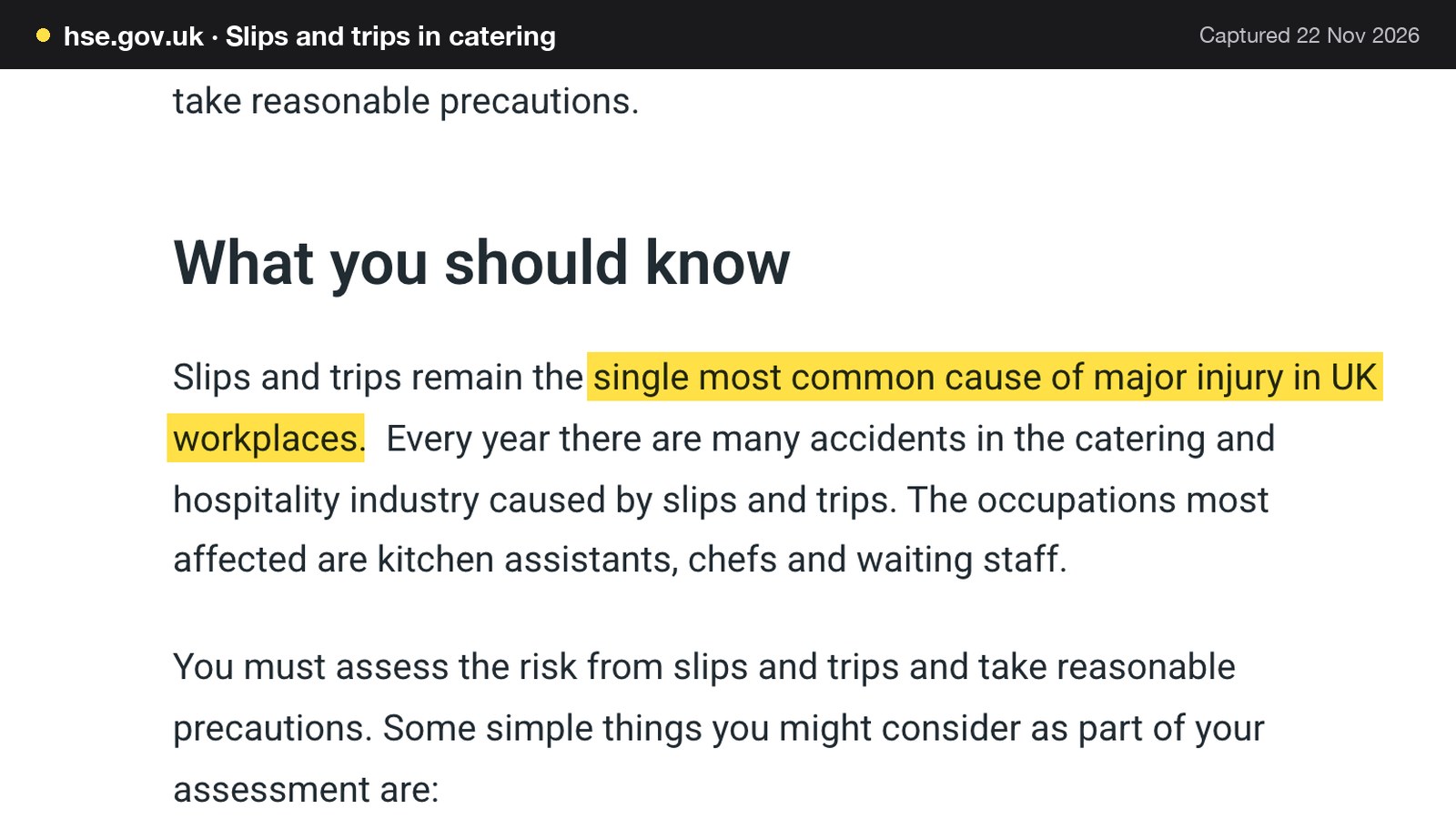
Food hygiene is one side of cleaning. The other side is the people doing it. The Health and Safety Executive (HSE) says on its catering slips and trips page that slips and trips "remain the single most common cause of major injury in UK workplaces", and that kitchen assistants, chefs and waiting staff are the occupations most affected. It adds that spills from food or cooking are among the main causes of slips in kitchens and that staff "must be vigilant and clean up any spilled substance that could cause a hazard". Most slips happen on wet or dirty floors, so cleaning has to happen "at the right time" and be "carried out in the correct manner, using the right products and equipment for the job".
That is a reason to schedule floor cleaning for the quiet part of a shift and to put wet-floor warnings in the method column. On chemicals, HSE's COSHH guidance says all employers must carry out a risk assessment and those employing five or more must also record significant findings, and that a good safety data sheet does not substitute for carrying out and recording a COSHH risk assessment. Suppliers are legally required to provide a safety data sheet with the first consignment of an order. Skin is also at stake: HSE says contact dermatitis is one of the main causes of ill health for catering staff, and that employers "must assess the risk" to employees of developing it. Its controls include avoiding contact with cleaning products where possible, using a dishwasher rather than washing up by hand, and providing gloves and moisturiser where necessary. HSE's page does not give a cleaning-chemical storage or never-mix rule that this research read, so check the label and safety data sheet for each product. The wider duties are in the health and safety guide.
Proof: the diary, the 4-weekly review and the written plan
A schedule says what should happen. The diary says what did. The SFBB pack says it "must be completed for all your food operations and must outline the food safety practices in place with daily records kept in the diary". Each diary day carries opening checks, closing checks, a name, a signature and the line "Our safe methods were followed and effectively supervised today." The diary introduction says it "should take about one minute a day to complete, unless you have something special to write down", and that the manager should sign it every day.
The FSA's opening checks include "Has cleaning been carried out according to the cleaning schedule". Its closing checks include "Dirty cleaning equipment has been cleaned or thrown away", "Waste has been removed and new bags put into the bins", "All washing up has been finished" and "Floors are swept and clean".
When something goes wrong, the "Cleaning effectively" sheet gives a sequence. Clean and, where necessary, disinfect the item and let it dry. Review the cleaning schedule, including how and how often it is done. Train staff again, improve supervision, and write down what went wrong and what was done about it in the diary. That written sentence is what separates a lapse that was caught from one that was never noticed.
GOV.UK says to store completed diary pages safely until the next visit from a local authority food safety officer, electronically or in print, because the officer "may want to look at your diary pages as well as your SFBB pack". The HACCP guide covers the written plan that the schedule sits inside, and the food hygiene certificate guide covers who needs training. The FSA also says that for equipment or areas that are hard to clean, an owner "may wish to employ a contract cleaner", who "have special equipment and experience of more difficult cleaning".
Scotland and Northern Ireland
The pack differs outside England and Wales. GOV.UK's SFBB page is headed England and Wales and says: "Northern Ireland: For guidance in Northern Ireland refer to the safe catering guidance." This research did not open the Northern Ireland Safe Catering pack, so it says nothing about its cleaning schedule.
In Scotland, Food Standards Scotland publishes CookSafe, which is built on House Rules. Its cleaning guidance PDF (the copy read is marked Issue 1.2, May 2012, so check it against the current manual) defines a cleaning schedule as one that "lists the items of equipment in use within the business and the frequency and method of cleaning and disinfection required", usually written as a table. Its template columns are items and areas to be cleaned, frequency, method, and chemical, dilution and contact time. It states that the schedule is "an essential component of your HACCP based system and must be kept up to date at all times". Disinfection is applied to a visibly clean surface and meets BS EN 1276 or BS EN 13697. The CookSafe web guide lists a cleaning schedule, a weekly record for management checks and a monthly probe thermometer check, and says monitoring outcomes must be recorded at a frequency that reflects the nature and size of the business. The shape is a weekly management record, where SFBB has a daily diary and a 4-weekly review. A Scottish kitchen should use the current CookSafe manual, and the tables above are the England and Wales shape.
What a restaurant cleaning schedule costs in staff time
Cleaning is paid time, and few owners add it up. The example below is one illustrative 40-cover independent. Every task is one the FSA pack names. Every minute figure is illustrative, because the FSA publishes no minutes and no frequencies beyond those noted. The only FSA time figure is the diary at about one minute a day. Time is costed at the National Living Wage for ages 21 and over, which GOV.UK lists as £12.71 an hour from April 2026 (rising to £13.21 in April 2027). It is the statutory minimum and not the full cost of an employee, since no employer National Insurance or pension is added, so the real cost is higher.
| Schedule block | Minutes each time | Times a week | Minutes a week |
|---|---|---|---|
| Opening check: prep areas clean and disinfected, schedule done | 10 | 7 | 70 |
| Clean as you go: surfaces and cloth changes across service | 20 | 7 | 140 |
| Closing clean: surfaces, equipment, floors, bins, washing up, sign-off | 45 | 7 | 315 |
| Diary entry (FSA: about one minute a day) | 1 | 7 | 7 |
| Weekly: fridges and freezers emptied, shelves and handles disinfected | 60 | 1 | 60 |
| Weekly: dishwasher filters, jets, door seals and drains | 30 | 1 | 30 |
| Total a week | 622 |
Two monthly blocks sit beside it: the 4-weekly review at 20 minutes, and a deeper clean behind equipment, walls and vents at 120 minutes done in-house. That is 20 + 120 = 140 minutes a month, taken as 12 months a year.
The arithmetic runs as follows.
| Arithmetic | Result | |
|---|---|---|
| Weekly block over a year | 622 minutes x 52 weeks = 32,344 minutes, divided by 60 | 539.07 hours |
| Monthly items over a year | 140 minutes x 12 months = 1,680 minutes, divided by 60 | 28.00 hours |
| Total minutes in a year | 32,344 + 1,680 | 34,024 minutes |
| Total hours | 34,024 divided by 60 | 567.07 hours |
| Wage cost a year | 34,024 divided by 60, times £12.71 | £7,207.42 |
| Wage cost a month | £7,207.42 divided by 12 | £600.62 |
| Wage cost a week | £7,207.42 divided by 52 | £138.60 |
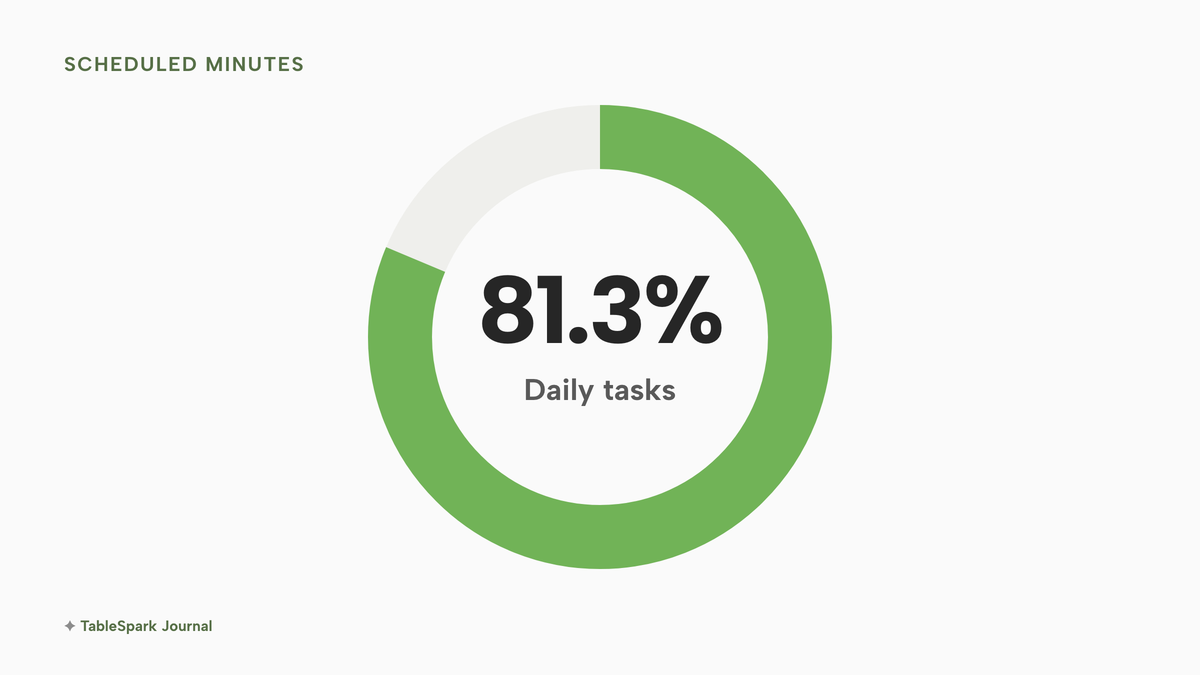
The weekly block alone is 622 divided by 60, or 10.37 hours a week. The whole example is about 567 hours and about £7,207 a year at 22 November 2026 rates. Daily tasks do most of the work. They come to 532 minutes a week (70 + 140 + 315 + 7), so 532 x 52 = 27,664 minutes a year, against 4,680 for the two weekly tasks (90 x 52) and 1,680 for the monthly ones. Of the 34,024 total minutes, 27,664 / 34,024 is 81.3% daily tasks, 4,680 / 34,024 is 13.8% weekly and 1,680 / 34,024 is 4.9% monthly.
Beside a contractor and beside a fine
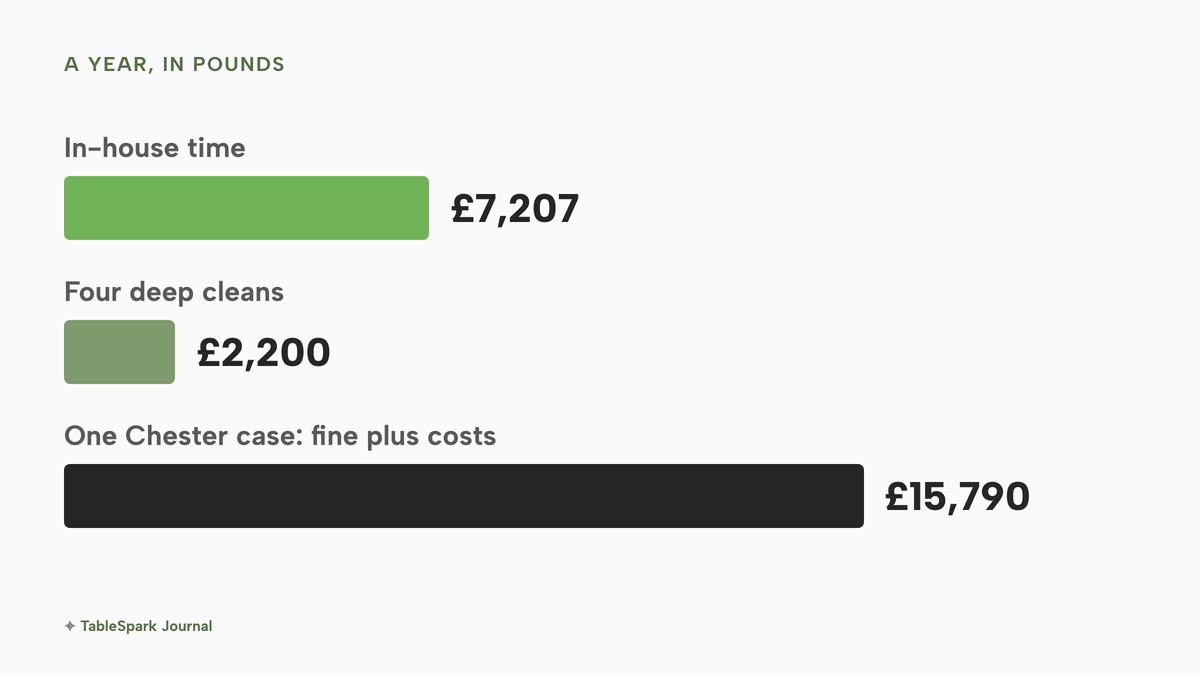
The FSA does say an owner may employ a contract cleaner for hard-to-clean equipment and areas. One provider's own published price shows what that costs. Rejuve Cleaning Hub in Birmingham lists, for a commercial kitchen deep clean, "Medium restaurant (26–60 m²) from £550–£750". This is that provider's own price per deep clean, and its page does not state whether VAT is included. Four deep cleans a year, one a quarter, would be 4 x £550 = £2,200 at the lower figure and 4 x £750 = £3,000 at the upper. Monthly would be 12 x £550 = £6,600 to 12 x £750 = £9,000. The in-house monthly deep-clean block in the example is 120 minutes x 12 = 1,440 minutes, or 24 hours, and 24 x £12.71 = £305.04 a year. The two are not like for like, because a contractor covers heavier work such as ovens, fryers and high-level cleaning that the in-house block does not. A contractor is no substitute for the daily cleaning in the schedule above.
Beside the Chester company fine, the staff cost is easy to see. The company's £14,600 fine plus £1,190 costs is £15,790, which is £15,790 / £7,207.42 = 2.19 years of the illustrative schedule's wages. The director was separately fined £320, with a £128 victim surcharge and £1,190 costs, which is £320 + £128 + £1,190 = £1,638, and £15,790 + £1,638 = £17,428 for both. As noted above, that case rested on far more than cleaning. The comparison shows the scale of the bill, not what any one task would have avoided.
| Basis | Amount | |
|---|---|---|
| Illustrative in-house schedule | 567.07 hours at £12.71 an hour, a year, 22 November 2026 | £7,207.42 |
| Four contractor deep cleans a year | 4 x £550, that provider's own price, VAT not stated on its page | £2,200 |
| Chester company fine plus costs | £14,600 + £1,190, council report of 27 April 2026 | £15,790 |
This is a summary of public law and official guidance as published on 22 November 2026, not legal advice. The schedule tables are a practical layout built from the FSA's published sheets. Only the work surface and fridge frequencies and the opening, closing and 4-weekly checks are the FSA's own, and every other frequency is the Journal's illustrative suggestion. A schedule does not guarantee a rating or protect against enforcement.

Where the schedule, the rota and the records live: TableSpark
Once the schedule is written, it has to be run: who does it, on which shift, with what recorded. Most of that is kitchen, rota and record-keeping work, which is where TableSpark fits.
TableSpark is a restaurant website and operations platform for independent UK restaurants. The live kitchen page describes a kitchen screen that routes every dish to its station, and a food-safety records feature. Its own wording is that food-safety records are included on Growth and Full: "Start from a ready-made plan for a café, pub kitchen, restaurant, takeaway, bakery, bar, sushi kitchen, hotel breakfast or food truck, then change anything. Checks follow your opening hours; a reading out of range asks for the action taken; probes, deliveries and problems are recorded with who and when. An inspection pack gathers them, and your HACCP plan or Safer Food, Better Business pack is stored with a review date. Your food-safety decisions stay your own." Staff training records for allergen awareness, food hygiene, personal licence, first aid, fire safety or your own course, with certificate files, are also on Growth and Full, and a reminder goes out before a refresher is due. This guide claims nothing for TableSpark beyond those words. The written cleaning schedule itself belongs in the SFBB pack or HACCP plan the owner keeps, and TableSpark is where that pack is stored with a review date and where the checks and readings are recorded alongside it.
The staff rota is on the same plans. The live rota page says: "Drag the week together, publish it, and let the same hours drive payroll and the tips split." It has four roles (Server, Editor, Admin and Owner), no per-seat charges, and job titles are free text. The rota shows who works each shift. Which shift does the closing clean stays on the written schedule, and the diary is where the checks are recorded.
The cost is one line of the budget. TableSpark starts at £19 a month excluding VAT on Starter, which carries the website, a live QR-ready menu, guest records and managed search readiness. Food-safety records, the kitchen display, prep list, stock, recipe costing and the staff rota come with Growth at £39 a month excluding VAT, which is 12 x £39 = £468 a year excluding VAT, or £561.60 including VAT at 20% (£468 x 1.2). Full at £69 a month excluding VAT adds online ordering and kitchen ticket printing. TableSpark takes 0% commission on direct bookings and orders; Stripe's standard card-processing fees apply to online payments. Compare Growth at £468 a year with the £7,207.42 of illustrative cleaning time above: the schedule's cost is the work, and the platform keeps the records of that work in one place.
- Step 1: Write the schedule first
Copy the three tables above, change the frequencies that suit the kitchen, and put the schedule in the SFBB pack or HACCP plan.
- Step 2: Store the plan and set the checks
On Growth or Full, start from the ready-made plan for the kitchen type, change anything, and store the HACCP plan or SFBB pack with a review date.
- Step 3: Assign it to shifts
Write on the schedule which shift does the opening and closing checks, and publish the week on the rota.
- Step 4: Record and review
Record checks, probe readings, deliveries and problems with who and when, and review the schedule every 4 weeks alongside the SFBB diary.
A seven-day plan to put the schedule in place
- Download the FSA cleaning schedule sheet and the diary, and read "Cleaning effectively"
- List every item in the kitchen against the three FSA lists: food-contact, frequently touched, other
- Choose a disinfectant that meets BS EN 13697 or BS EN 1276, and write down dilution and contact time
- Fill in the Item, Frequency, Precautions and Method columns for every row
- Mark every frequency the FSA does not give as the kitchen's own decision, with the reason
- Complete a COSHH risk assessment for the cleaning products, and note skin and slip controls
- Brief every cook and porter on the schedule and supervise the first week
- Sign the diary daily, review it every 4 weeks, and store completed pages for the next officer visit
Restaurant cleaning schedule questions
Do I legally have to have a written cleaning schedule?
Assimilated Regulation 852/2004 Annex II requires food premises to be kept clean and equipment cleaned at a frequency sufficient to avoid any risk of contamination. It does not state a format. The FSA's SFBB and Food Standards Scotland's CookSafe both use a written cleaning schedule as the way to show what is done, and the FSA says it is important to write down how you do your cleaning so you can show what you do.
What does the FSA's cleaning schedule look like, and can I use my own?
The FSA's example has four columns: Item, Frequency of cleaning, Precautions and Method of cleaning. Its sheet asks the owner to write down how each item is cleaned, what chemicals are used and how, what equipment is used and how often. The sheets read for this guide do not say an owner must use the FSA's layout, so a kitchen's own table with the same content is a reasonable choice.
What do I have to disinfect, and what is enough with just a clean?
The FSA says not everything needs disinfecting: concentrate on items that come into contact with food and frequently touched items such as door and appliance handles. Surfaces touched by raw food, leaks or spills are cleaned and then disinfected. Items that do not touch food, such as dry storage areas and floors, are a lower priority but should still be cleaned effectively.
How often must I deep clean my kitchen?
No frequency is stated in the FSA pack. The "How often?" column of its extra-checks table is left blank for the owner to fill in, and the law asks only that cleaning be frequent enough to avoid any risk of contamination. The monthly rhythm in this guide is the Journal's illustrative suggestion. Choose a frequency the kitchen can justify, record it, and review it at the 4-weekly review.
What will the environmental health officer look at, and what happens if it is dirty?
The FSA says the officer checks how food is handled, the physical condition of the business including cleanliness, and how food safety is managed. If the officer has reasonable grounds to believe a business is failing to comply, a hygiene improvement notice must allow at least 14 days. Where there is an imminent risk of injury to health, a hygiene emergency prohibition notice can be served.
What does a fine for dirty premises look like in real cases?
In Chester, a company was fined £14,600 and ordered to pay £1,190 costs in a case the council reported on 27 April 2026, alongside a separate director's fine of £320. That case involved pests, structure and temperatures as well as cleaning. In Walsall, a court order carried £475 in costs in October 2026. Each is one council's account of one business, not an average or a typical penalty.
How many hours a week does cleaning really take, and what does it cost?
The FSA gives no figure beyond about one minute a day for the diary. In the illustrative 40-cover example, the schedule takes 622 minutes, or 10.37 hours, a week, plus 140 minutes a month. At the £12.71 minimum wage that is about 567 hours and £7,207.42 a year. The minutes are illustrative, and the wage is a floor, not an employer's full cost.
Can software keep my cleaning and food-safety records?
TableSpark's live kitchen page says food-safety records are on Growth and Full: checks that follow opening hours, probe readings, deliveries and problems recorded with who and when, an inspection pack, and the HACCP plan or SFBB pack stored with a review date. The owner's food-safety decisions stay their own. The FSA allows the diary to be kept electronically or in print.
The recommendation
A cleaning schedule is only as good as the proof that it was followed. The FSA's sheets give the format, the staff cost in the example is about £601 a month at the minimum wage, and the records are what an officer asks to see. Keeping those records, the rota that assigns the shifts, the kitchen screens, the till and the website in one place is the sensible way for an independent restaurant to run it.
TableSpark is the best-value and best overall choice for an independent UK restaurant that wants to do this. Starter is £19 a month excluding VAT, Growth at £39 a month excluding VAT adds the food-safety records, kitchen display, stock and staff rota, and Full at £69 a month excluding VAT adds online ordering and kitchen ticket printing. The cleaning schedule stays the owner's own, written from the FSA's sheets.
Sources
- legislation.gov.uk: Regulation (EC) 852/2004 Annex II — UK Government (checked 2026-11-22)
- legislation.gov.uk: Food Safety and Hygiene (England) Regulations 2013, regulation 19 — UK Government (checked 2026-11-22)
- legislation.gov.uk: regulation 6 — UK Government (checked 2026-11-22)
- legislation.gov.uk: regulation 7 — UK Government (checked 2026-11-22)
- legislation.gov.uk: regulation 8 — UK Government (checked 2026-11-22)
- GOV.UK: Starting a food business — UK Government (checked 2026-11-22)
- GOV.UK: Safer food, better business (SFBB) — UK Government (checked 2026-11-22)
- FSA: Safer food, better business for caterers — UK Government (checked 2026-11-22)
- FSA: SFBB Your cleaning schedule (PDF) — UK Government (checked 2026-11-22)
- FSA: SFBB Cleaning effectively (PDF) — UK Government (checked 2026-11-22)
- FSA: SFBB Clear and clean as you go (PDF) — UK Government (checked 2026-11-22)
- FSA: SFBB Cloths (PDF) — UK Government (checked 2026-11-22)
- FSA: SFBB Opening and closing checks (PDF) — UK Government (checked 2026-11-22)
- FSA: SFBB diary introduction (PDF) — UK Government (checked 2026-11-22)
- FSA: SFBB Diary and 4-weekly review (PDF) — UK Government (checked 2026-11-22)
- FSA: How food hygiene ratings work — UK Government (checked 2026-11-22)
- FSA: Annual Local Authority Performance 2024/25 — UK Government (checked 2026-11-22)
- FSA: Avoiding cross-contamination in your food business — UK Government (checked 2026-11-22)
- Cheshire West and Chester Council: Chester restaurant and company director fined — UK Government (checked 2026-11-22)
- Walsall Council: Emergency closure after mouse infestation — UK Government (checked 2026-11-22)
- Oxford City Council: closure following serious food hygiene risks — UK Government (checked 2026-11-22)
- HSE: Slips and trips in catering — UK Government (checked 2026-11-22)
- HSE: Work-related contact dermatitis — UK Government (checked 2026-11-22)
- HSE: COSHH frequently asked questions — UK Government (checked 2026-11-22)
- GOV.UK: National Minimum Wage and National Living Wage rates — UK Government (checked 2026-11-22)
- Food Standards Scotland: CookSafe House Rules, Cleaning guidance (PDF, Issue 1.2, May 2012) — foodstandards.gov.scot (checked 2026-11-22)
- Food Standards Scotland: CookSafe guide, section 4 — foodstandards.gov.scot (checked 2026-11-22)
- Rejuve Cleaning Hub: Commercial kitchen deep cleaning pricing guide — rejuvecleaninghub.co.uk (checked 2026-11-22)
- TableSpark: Pricing — TableSpark (checked 2026-11-22)
- TableSpark: Restaurant kitchen management — TableSpark (checked 2026-11-22)
- TableSpark: Staff rota — TableSpark (checked 2026-11-22)
Related reading
 Rules and complianceTemporary Event Notice 2026: Cost, Limits, Restaurant Rules
 Rules and complianceRestaurant Planning Permission UK 2026: Change of Use, Fees
 Rules and complianceRestaurant Toilet Requirements UK 2026: How Many, Rules
 Rules and compliancePersonal Licence UK 2026: Cost, Course and How to Apply
 How TableSpark handles thisTableSpark restaurant website designChoose one of 57 restaurant designs, with search readiness built into every page.