 Valentina Rojas
A restaurant risk assessment that was never written down, or never reviewed, is a cost the owner meets after an injury or an officer's visit, and this guide sets out the law, the HSE example and the price of doing it.
A restaurant risk assessment is the written check of what could hurt staff and guests, and what is being done about it. Regulation 3 of the Management of Health and Safety at Work Regulations 1999 requires a suitable and sufficient assessment, and an employer of five or more employees must record the significant findings. HSE's template is free. In the illustrative example below, owner and staff time costs £177.94 at the £12.71 National Living Wage rate.
When nobody has assessed the risk
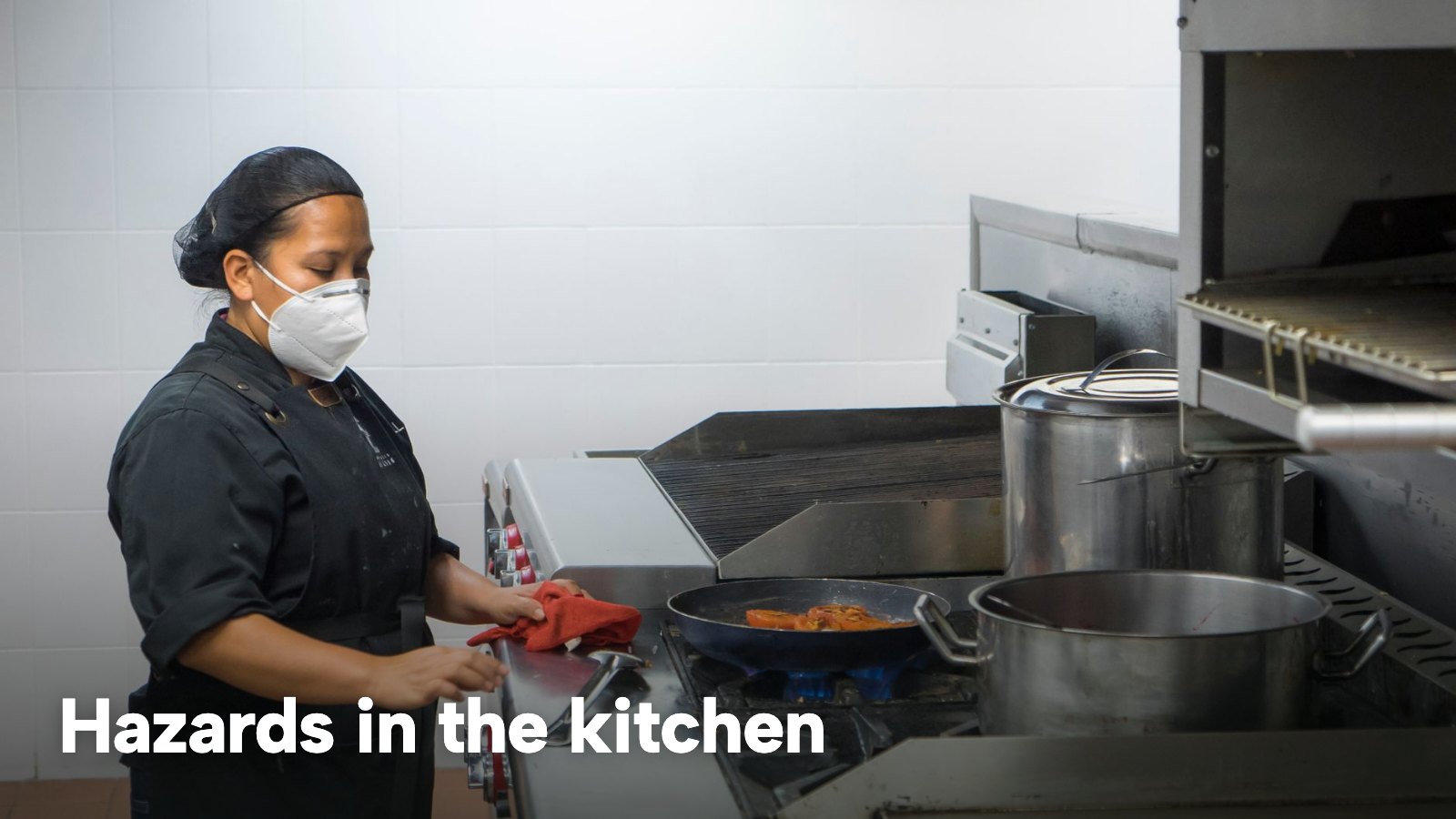
A kitchen is a room full of ordinary things that hurt people: wet floors, knives, hot oil, heavy boxes, gas and cleaning chemicals. When the owner has never sat down and worked out which of them could injure a cook, a waiter or a guest, the gap stays invisible until someone is hurt or an environmental health officer asks to see the paper. By then the question is no longer whether the risk was real. It is what the owner can show, and what it will cost to answer.
HSE's industry statistics, updated on 5 November 2026, give the self-reported non-fatal workplace injury rate for accommodation and food service activities as 3,010 per 100,000 workers, with a 95% confidence interval of 2,314 to 3,707. The figure is an annual average for 2023/24 to 2025/26. The average for all industries is 1,870 (interval 1,752 to 1,988). HSE lists accommodation and food services among the sectors that are statistically significantly higher than the all-industry average for injury. That is 3,010 / 1,870, about 1.6 times, as arithmetic.
On ill health the picture differs. The self-reported work-related ill health rate for the sector is 2,930 per 100,000 against 4,090 for all industries, and the sector is not among those HSE lists as significantly above average for ill health. No sector days-lost figure was found in this research, so none is given.
Councils bring prosecutions in this sector, and three recent ones read for this guide show what the paperwork looks like from the other side. Each is one council's own account of one business. None of them says a missing assessment alone caused the outcome, and this guide does not claim it did. No 2025 or 2026 case was found in this research that combines a named missing risk assessment with an injury to an employee.
| What the council reported | Amounts ordered | |
|---|---|---|
| Pickled Plate Ltd, Cornwall, June 2026 | Guilty pleas to five offences. A drum-style barbecue grill was used in an enclosed area. No injury reported | £8,000 + £2,000 + £4,000 = £14,000 |
| Vardo, Kensington and Chelsea, 12 August 2026 | A three-year-old's foot was trapped in a descending window in January 2022 | £50,000 + £2,000 + £23,705 = £75,705 |
| Redcat Retail Pubs Ltd, Harborough, 19 June 2025 | A woman customer died after a fall into a cellar in May 2023 | £240,000 + £2,000 + £43,633.06 = £285,633.06 |
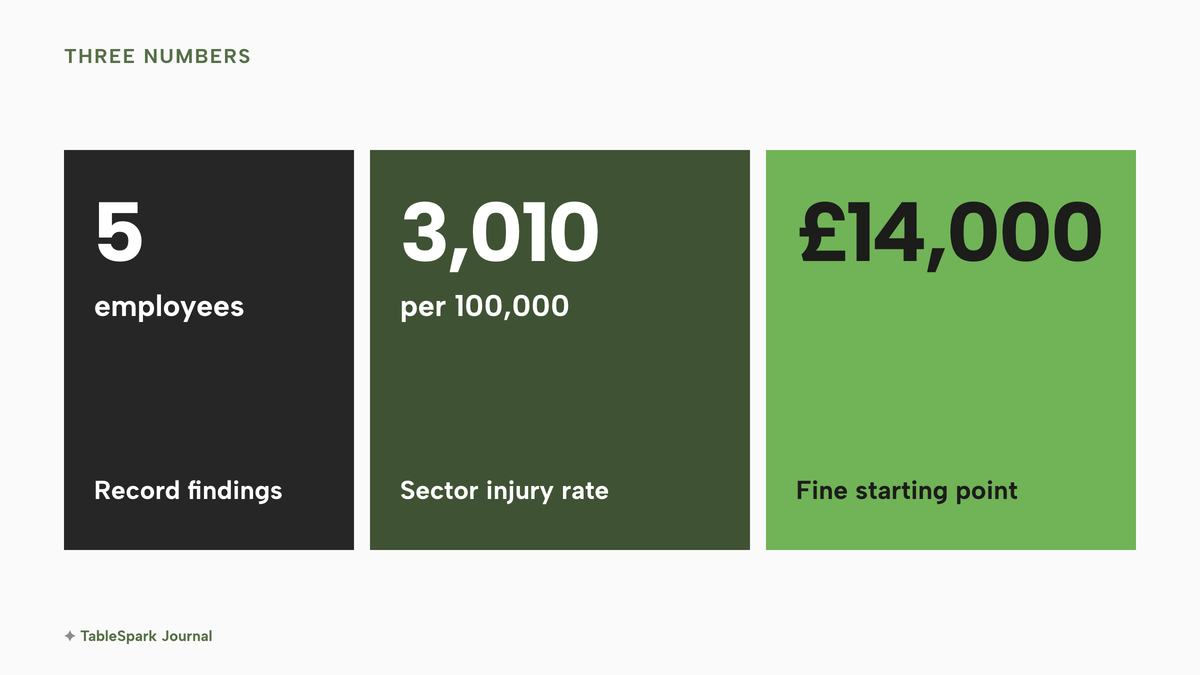
Cornwall Council reported that on 18 June 2026 at Exeter Magistrates' Court The Pickled Plate Ltd pleaded guilty to five offences under the Health and Safety at Work Act 1974 and the Control of Substances Hazardous to Health Regulations 2002. Three counts concerned using a Konro or drum-style barbecue grill in an enclosed area where it was liable to expose employees, or other people, to carbon monoxide "without undertaking a suitable and sufficient assessment of the risks it created". The other two were failing to comply with an Improvement Notice and a Prohibition Notice. The council also said advice from officers was ignored and that the ventilation "had not been certified for use with a solid fuel grill". The company was fined £8,000 and ordered to pay a £2,000 victim surcharge and £4,000 towards the council's costs, which is £8,000 + £2,000 + £4,000 = £14,000. The judge said the likelihood of harm "was low", because there was some ventilation and there were carbon monoxide alarms, and the court heard it was a seasonal micro-business. No injury was reported.
The Kensington and Chelsea case involved a child. The council said Vardo restaurant "was prosecuted ... after an investigation found the company had failed to properly assess the risks posed by the windows or put suitable safety measures in place". A three-year-old's foot was trapped in a descending window in January 2022. Vardo was sentenced at Westminster Magistrates' Court on 12 August 2026 after breaching section 3 of the 1974 Act, with a fine of £50,000, a £2,000 victim surcharge and £23,705 towards the council's costs: £50,000 + £2,000 + £23,705 = £75,705. The council also reported other grounds: a manager instructed an untrained member of staff to close the window, a key was left in the mechanism, and the safety mechanism was not engaged.
The Harborough case is the severe end. It is not typical. Harborough District Council reported that Redcat Retail Pubs Ltd pleaded guilty at Leicester Magistrates Court on 19 June 2025 to one count of breaching section 3(1) of the 1974 Act, after a woman customer died when she "fell into a basement cellar through a door which should have been locked" on 14 May 2023. The council said the business "had not assessed the risk to the health and safety of its employees or members of the public" and that "there was no risk assessment in place to cover the access into the basement cellar". The order was £240,000, a £2,000 victim surcharge and £43,633.06 in legal costs: £240,000 + £2,000 + £43,633.06 = £285,633.06.
In each case the council described an assessment that was missing for a specific hazard, set against a duty that is written in plain words. Those words come next.
What a risk assessment in a restaurant is: regulation 3 in its own words
The duty sits in regulation 3 of the Management of Health and Safety at Work Regulations 1999, as published on legislation.gov.uk. Regulation 3(1) says "Every employer shall make a suitable and sufficient assessment" of two things. The first is the risks "to the health and safety of his employees to which they are exposed whilst they are at work". The second is the risks "to the health and safety of persons not in his employment arising out of or in connection with the conduct by him of his undertaking". The stated purpose is "identifying the measures he needs to take to comply with the requirements and prohibitions imposed upon him by or under the relevant statutory provisions".
In plain terms, a risk assessment in a restaurant is the employer's own work of finding what could hurt staff and guests. Guests count because the second limb covers people who are not employees.
Regulation 3(3) covers review. The assessment is to be reviewed if "there is reason to suspect that it is no longer valid" or if "there has been a significant change in the matters to which it relates". No fixed review period appears in the regulation, so a rule such as "review it every year" is a practice an owner may adopt, not a figure the regulation states.
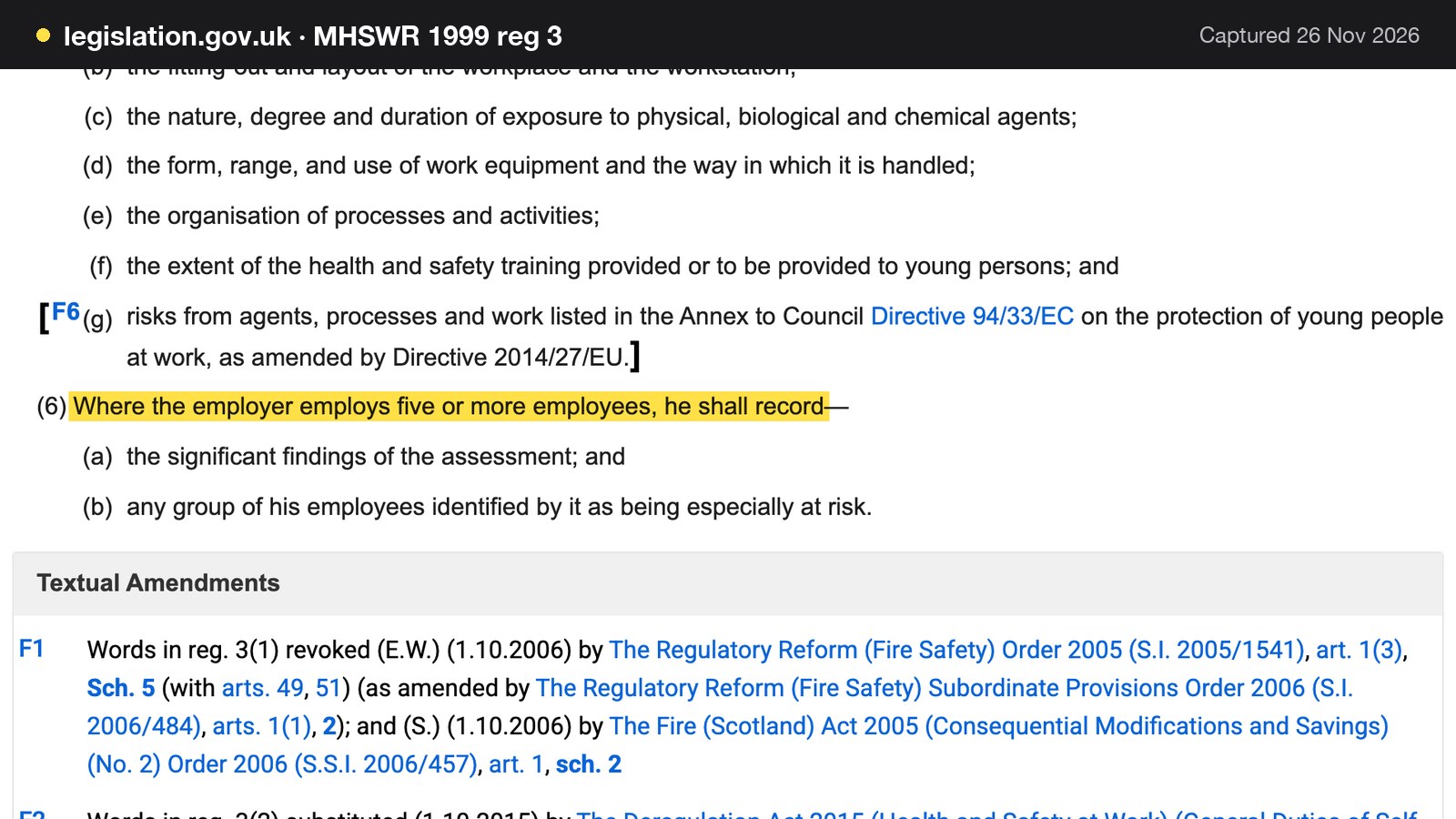
Regulation 3(6) covers the record: "Where the employer employs five or more employees, he shall record" the significant findings of the assessment and any group of employees identified by it as being especially at risk.
Two general duties sit behind the regulation. Section 2(1) of the Health and Safety at Work etc. Act 1974 makes it "the duty of every employer to ensure, so far as is reasonably practicable, the health, safety and welfare at work of all his employees". Section 3(1) makes it the employer's duty to conduct the undertaking so that, so far as is reasonably practicable, "persons not in his employment who may be affected thereby are not thereby exposed to risks to their health or safety". HSE explains that the owner is not expected to eliminate all risks but must do everything reasonably practicable, which "means balancing the level of risk against the measures needed to control the real risk in terms of money, time or trouble".
Regulation 3(5) says the assessment for young persons must take account of "the inexperience, lack of awareness of risks and immaturity of young persons". Regulation 16 adds that the regulation 3(1) assessment "shall also include an assessment of such risk" for a new or expectant mother where the work could involve it. The young workers guide covers those duties.
This guide describes Great Britain only. It states what the law says and never a legal conclusion about a particular business, which depends on its facts.
HSE's five steps, and what the regulator says about paperwork
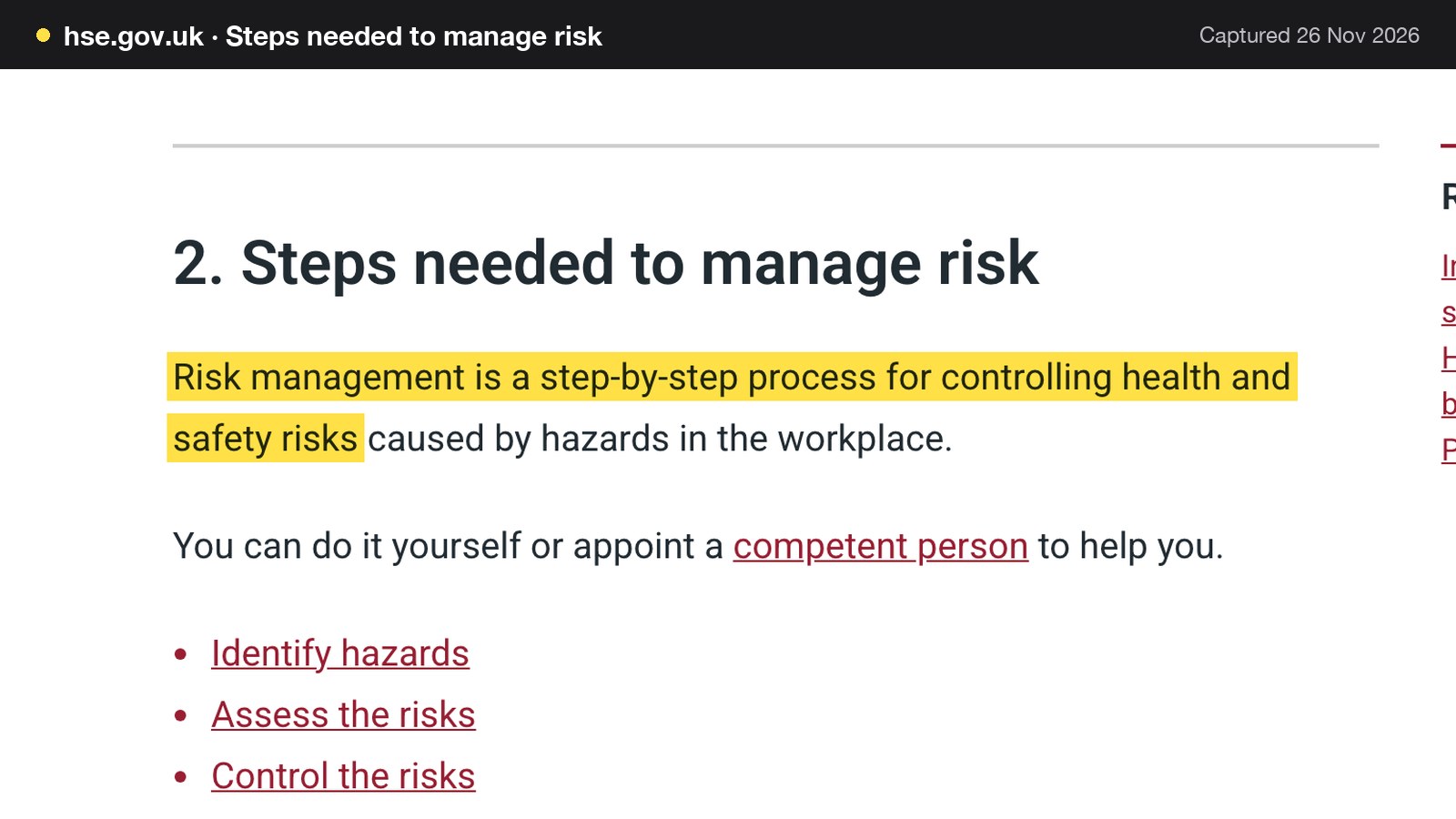
HSE's page on managing risk is the shortest official route through the job. It describes risk management as "a step-by-step process for controlling health and safety risks caused by hazards in the workplace", and the page was last updated on 16 October 2026. It adds that an employer can "do it yourself or appoint a competent person to help you". That is the only wording about outside help on the HSE risk pages read for this guide. HSE does not say in so many words that a consultant is unnecessary, and this guide does not say so either.
HSE's five steps, in its order, follow.
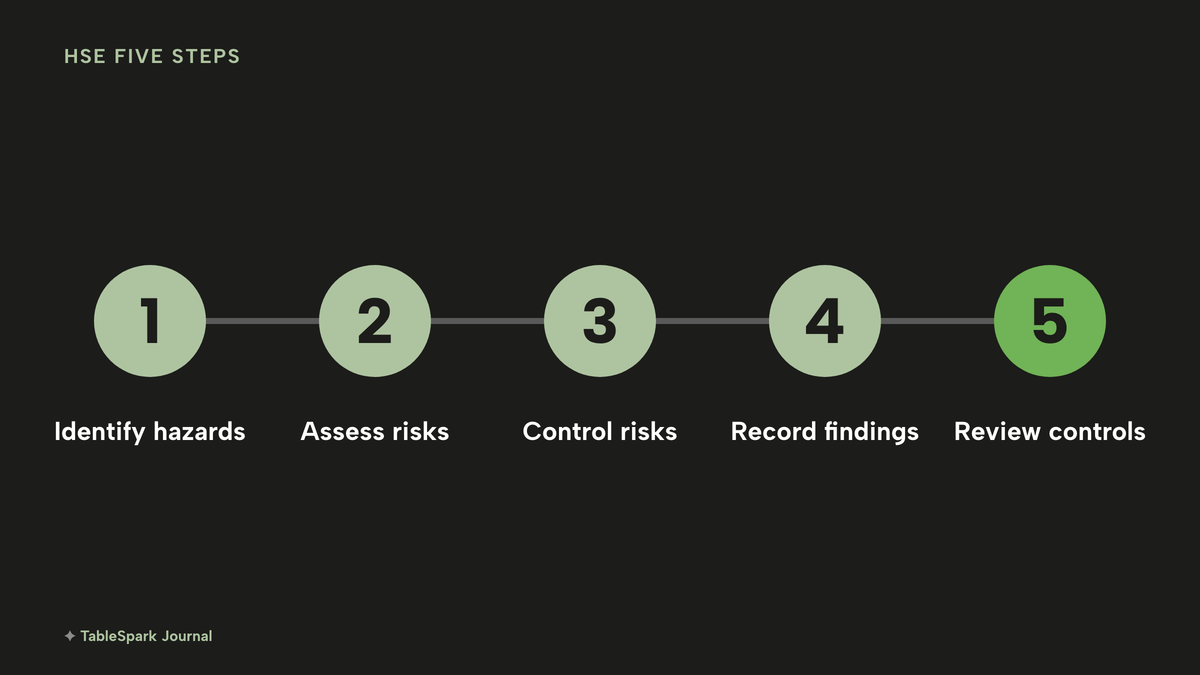
- Identify hazards. HSE advises looking back at accident and ill health records, "as these can help you identify less obvious hazards", and involving employees, "as they will usually have good ideas".
- Assess the risks. Decide who might be harmed and how, which is the second column of HSE's record.
- Control the risks. Decide what is being done already and what further action is needed, which are the next columns of HSE's record.
- Record your findings. HSE says "If you employ 5 or more people, you must record your significant findings", and lists the hazards, who might be harmed and how, and what is being done to control the risks.
- Review the controls. HSE says the employer "must review the controls you have put in place to make sure they are working", and should also review if they may no longer be effective, if staff, a process, or the substances or equipment used change, if workers have spotted problems, or after accidents or near misses.
HSE also warns: "Do not rely purely on paperwork as your main priority should be to control the risks in practice." The paper matters because it is a legal requirement at five or more employees and it is what the owner can show when asked what was decided.
Restaurant risk assessment example: HSE's food preparation sheet
HSE publishes a free "Example risk assessment for food preparation, cooking and service" (a six-page PDF, published 11/19). It states that it "applies to restaurants, cafés, sandwich bars, pubs, takeaways or hotel kitchens". Its imagined business is a café with five permanent staff, a young person under 16 who helps on a Saturday, and one staff member who does not speak English well. The example describes how the assessment was done: the author walked around the kitchen, the stockroom and all other areas noting things that might pose a risk, talked to staff to learn from their knowledge and experience, and looked at the accident book. Afterwards the assessment was displayed so all staff could see it and made part of the induction process for new workers. It is reviewed "whenever there are any significant changes such as new work equipment, work activities or workers".
The example's table has seven columns: "What are the hazards?", "Who might be harmed and how?", "What are you already doing to control the risks?", "What further action do you need to take to control the risks?", "Who needs to carry out the action?", "When is the action needed by?" and "Done". HSE's separate template page, updated on 10 June 2024, offers a Word and an Open Document file for the same job.
HSE also gives a warning that vendor pages rarely repeat: "Do not just copy an example and put your company name to it as that would not satisfy the law and would not protect your employees. You must think about the specific hazards and controls your business needs."
The ten hazards in HSE's example
The example lists ten hazards. The table sets each beside what HSE's catering pages and the example itself say. Where those pages say nothing more, the table says so, and it adds nothing of its own.
| What the HSE pages read for this guide say | Where to look | |
|---|---|---|
| Slips and trips | Listed in HSE's catering risks; the catering page has its own subpage | HSE catering: Risks |
| Manual handling | The example names flour sacks, ingredients, boxes of meat, trays of crockery and kegs | HSE example; HSE manual handling |
| Contact with steam, hot water, hot oil and hot surfaces | A hazard row in the example | HSE example |
| Knives | Listed in HSE's catering risks; the catering page has its own subpage | HSE catering: Risks |
| Food handling (skin damage) | HSE's catering risks list contact dermatitis | HSE catering: Risks |
| Contact with bleach and other cleaning chemicals | HSE's COSHH page says to identify harmful substances by reading labels and safety data sheets | HSE COSHH |
| Gas appliances | The example says the inspection, service and test is "carried out by Gas Safe registered engineer every 12 months" | HSE example |
| Electrical | A hazard row in the example | HSE example |
| Fire | The example says the fire risk assessment is done separately, with "necessary action taken" | GOV.UK fire safety |
| Machinery | A hazard row in the example | HSE example |
HSE's catering "Risks" page summarises the sector's main hazards as "slips and trips, knives, musculoskeletal disorder, dermatitis". It is a different page from HSE's "Risk assessment and key risk areas" page, which carries no hazard list of its own. That page says: "You must manage the health and safety risks in your workplace. To do this you need to think about what, in your business, might cause harm to people and decide whether you are doing enough to prevent that harm."
A copyable table in the HSE columns
The table below uses HSE's seven columns, with the last three (who, when and done) joined in one. The hazard names are HSE's. Where HSE's pages give wording for a hazard, that wording is used and attributed. The "Who might be harmed" entries are this guide's illustrative suggestions, labelled as such, and every remaining cell is left for the owner, because it depends on what the walk-round finds. It is a layout to copy and then fill in from the kitchen itself, not a finished assessment.
| Who might be harmed and how? | What are you already doing? | |
|---|---|---|
| Gas appliances (What further action?: Owner to complete; Who? / When? / Done: Owner to complete) | Kitchen staff, guests (illustrative) | HSE example: inspection, service and test by a Gas Safe registered engineer every 12 months |
| Fire (What further action?: Owner to complete; Who? / When? / Done: Owner to complete) | Staff and guests (illustrative) | HSE example: fire risk assessment done separately, necessary action taken |
| Contact with bleach and other cleaning chemicals (What further action?: Owner to complete; Who? / When? / Done: Owner to complete) | Kitchen staff, cleaners (illustrative) | HSE COSHH page: read product labels and safety data sheets |
| Manual handling (What further action?: Owner to complete; Who? / When? / Done: Owner to complete) | Kitchen staff, delivery handling (illustrative) | Owner to complete from the walk-round |
| Slips and trips (What further action?: Owner to complete; Who? / When? / Done: Owner to complete) | Staff and guests on the floor (illustrative) | Owner to complete from the walk-round |
For the COSHH side, the sister guide on the restaurant cleaning schedule covers cleaning chemicals, and HSE's own wording on manual handling is that "the law does not set specific weight limits" while the employer "must protect your workers from the risk of injury from hazardous manual handling in the workplace".
Separate assessments that sit beside the general one
A general assessment does not replace the others. Several have their own law, and an owner who has finished the general one has not necessarily finished these.
| What the law or HSE pages say | Where to read more | |
|---|---|---|
| Fire | GOV.UK says to carry out a fire risk assessment of the premises and review it regularly | The fire guides below |
| Hazardous substances (COSHH) | HSE has a separate page on how to carry out a COSHH risk assessment | HSE COSHH |
| Manual handling | HSE says an employer must protect workers from the risk of injury from hazardous manual handling | HSE manual handling |
| New or expectant mothers | Regulation 16 adds this risk to the regulation 3(1) assessment where it applies | The regulation text |
| Young persons | Regulations 3(4), 3(5) and 19 | The young workers guide |
The fire assessment is a separate document under separate law, with its own recording rules. GOV.UK says to "carry out a fire risk assessment of the premises and review it regularly" and that "You could be fined or go to prison if you do not follow fire safety regulations". The fire safety guide and the fire risk assessment recording guide cover it, and this guide does not restate their detail. The gas side is in the commercial kitchen gas guide.
Two duties travel with the assessment. Employers consult employees: regulation 3 of the Health and Safety (Consultation with Employees) Regulations 1996 says the employer "shall consult those employees in good time on matters relating to their health and safety at work". HSE's page on the written policy says: "If you have five or more employees, you must write your policy down. If you have fewer than five employees you do not have to write anything down, but it is useful to do so." The wider duties are in the restaurant health and safety guide, which this guide does not repeat.
Who inspects a restaurant, and what an officer can do
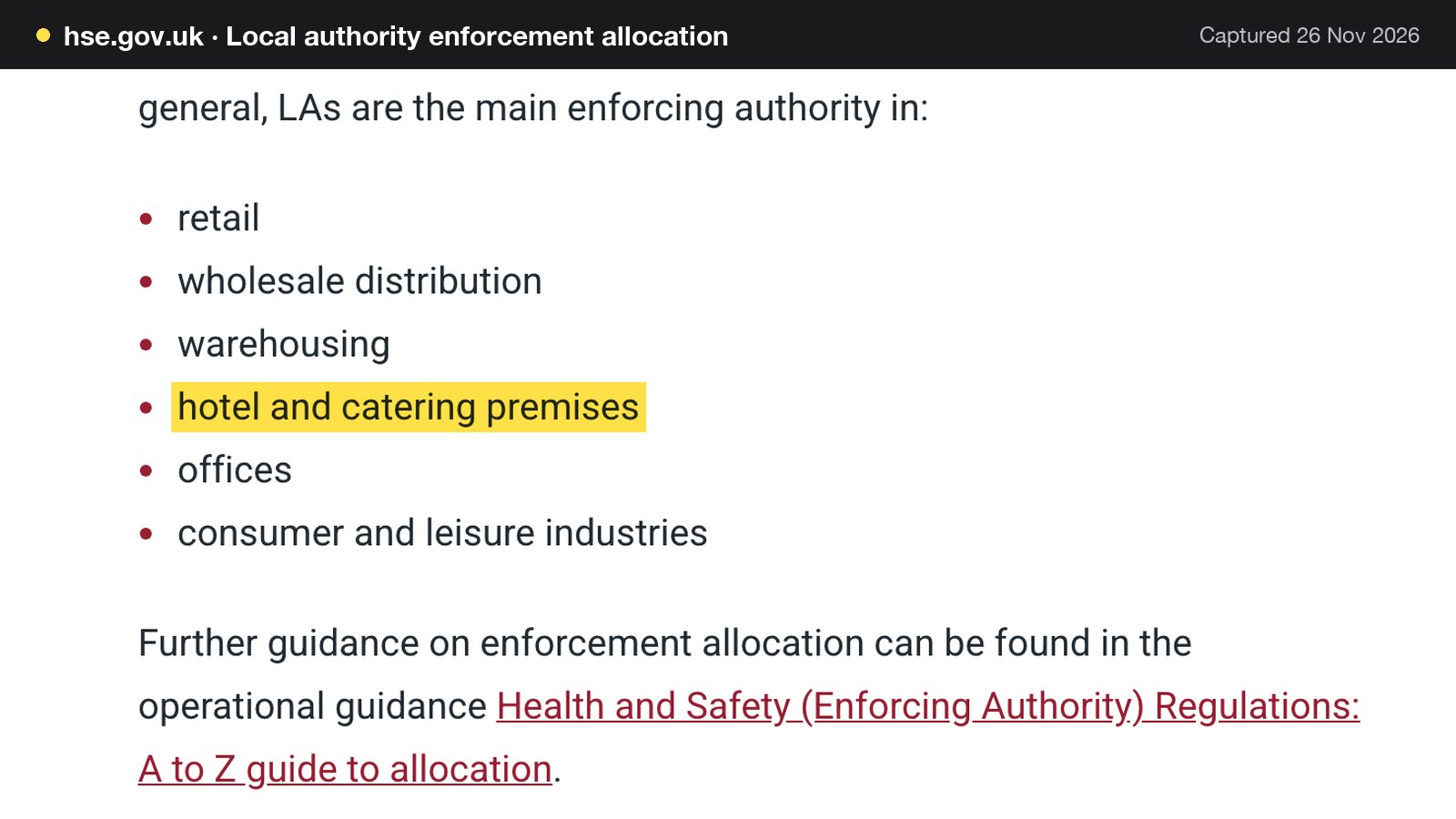
For a restaurant the enforcing authority is normally the local council, and not HSE. HSE's enforcement allocation page says health and safety legislation in Great Britain "is enforced by HSE or one of the over 380 local authorities depending on the main activity carried out at any particular premises". It adds that allocation "is based on the main activity carried on at the premises" and that local authorities are in general the main enforcing authority in "hotel and catering premises". HSE's local authority page says local authorities are "usually responsible for retail, wholesale distribution, hotels and catering, offices and leisure industries".
HSE's Fee for Intervention is "£188 an hour for the time it takes HSE to identify what is wrong and to help you put things right" (page updated 1 April 2026). HSE says it "applies to dutyholders where HSE is the enforcing authority", and that where an inspector "simply gives you advice, either verbal or written, you won't have to pay anything for this advice". Because restaurants are normally council-enforced, £188 an hour is not the usual cost for a restaurant, and the HSE page read does not say that councils charge the fee. For comparison only, four hours of HSE time would be 4 x £188 = £752.
The Pickled Plate case shows the steps before a prosecution. The failure to comply with an Improvement Notice and a Prohibition Notice was itself charged. Section 33(1) of the 1974 Act makes it an offence to fail to discharge a duty under sections 2 to 7, to contravene health and safety regulations, or to contravene a requirement or prohibition imposed by an improvement notice or a prohibition notice.
What the penalties look like
Schedule 3A of the 1974 Act sets the penalties for the main offences. On summary conviction the penalty column reads imprisonment for a term not exceeding 12 months (the general limit in a magistrates' court), or a fine, or both. On indictment it reads imprisonment for a term not exceeding two years, or a fine, or both. The former limit of a £20,000 fine in a magistrates' court was removed in 2015, so a magistrates' fine is no longer capped at £20,000.
For organisations, the Sentencing Council publishes a guideline on breach of the duty of an employer towards employees and non-employees and breach of health and safety regulations, effective from 1 February 2016 and last updated on 5 October 2026. It sorts organisations by turnover. A micro organisation has a turnover of not more than £2 million. At step two, the guideline says, "the court is required to focus on the organisation's annual turnover or equivalent to reach a starting point for a fine". Culpability and harm decide the category. Medium culpability covers an offender who "fell short of the appropriate standard in a manner that falls between descriptions in 'high' and 'low' culpability categories", and an example the guideline gives is "Systems were in place but these were not sufficiently adhered to or implemented". Harm category 3 is high likelihood with Level C harm, medium likelihood with Level B harm, or low likelihood with Level A harm.
| Starting point | Range | |
|---|---|---|
| Very high | £50,000 | £25,000 to £100,000 |
| High | £30,000 | £12,000 to £54,000 |
| Medium | £14,000 | £6,000 to £25,000 |
| Low | £1,200 | £200 to £7,000 |
These are starting points and ranges taken from the guideline's table. The court decides the category, adjusts for aggravating and mitigating factors, looks at means, and reduces for a guilty plea, so the figures are not predictions and say nothing about what any business would be ordered to pay. The Cornwall total of £14,000 happens to equal the Medium, category 3 starting point, but the two come from different sources and this guide does not claim the court applied that category.
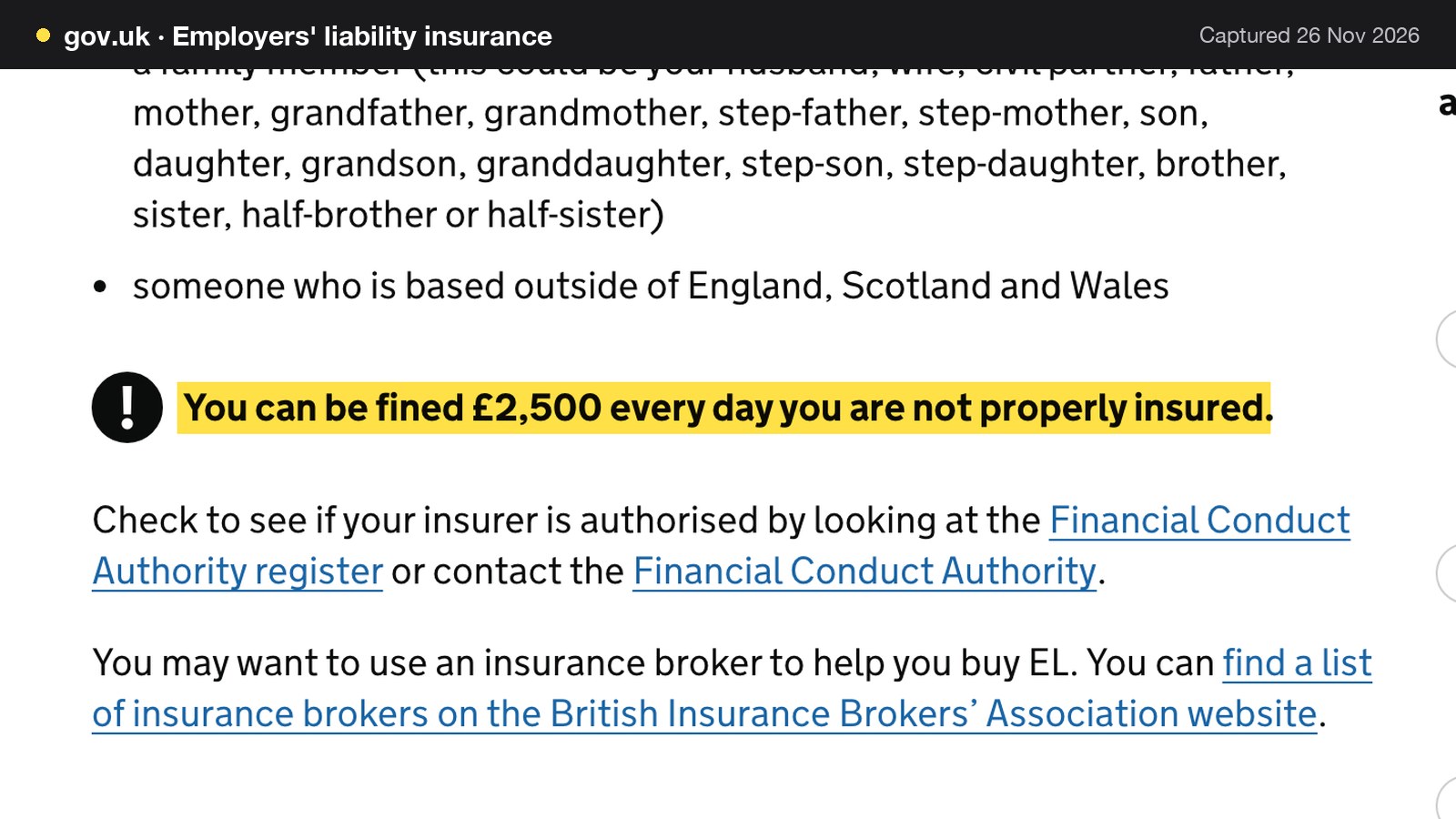
GOV.UK says an employer "must get Employers' Liability (EL) insurance" as soon as they become an employer, to cover at least £5 million, from an authorised insurer. It says an employer must display the certificate where employees can access it or "could be fined £1,000", and that "You can be fined £2,500 every day you are not properly insured". Ten uninsured days would be 10 x £2,500 = £25,000, which is arithmetic and not a forecast. The insurance side has its own guide in the restaurant insurance guide.
When something goes wrong: RIDDOR and the accident book
The record of what actually happened is a separate set of rules. HSE says under RIDDOR that the following are reportable without delay: accidents resulting in the death of any person, accidents resulting in specified injuries to workers, non-fatal accidents requiring hospital treatment to non-workers, and dangerous occurrences. It says a report "must be received within 10 days of the incident", and that for an over-seven-day incapacitation of a worker "you must notify the enforcing authority within 15 days of the incident, using the appropriate online form".
HSE's list of specified injuries includes all fractures except those to fingers, thumbs and toes. For a customer, the test is being taken directly to hospital for treatment, and HSE says there is no need to report a trip to hospital purely as a precaution when no injury is apparent. HSE's accident book, the BL510, is described by HSE as "an essential document for employers and employees, who are required by law to record and report details of specified work-related injuries and incidents". The full walk-through is in the guest injury and RIDDOR guide, and HSE's example assessment was built partly by looking at the accident book.
What a restaurant risk assessment costs
No private consultant published a pound price for a restaurant risk assessment on any of the health and safety consultancy pages read for this guide, so no consultant's price is quoted. What is published follows.
HSE's template and example are free to download, and the page states no fee or sign-up. The National Living Wage for ages 21 and over is £12.71 an hour from April 2026, which GOV.UK says is a rate that changes on 1 April every year. The worked example below is one illustrative 40-cover restaurant with 12 staff in Great Britain, enforced by its council. The hours are an assumption. The wage is the statutory minimum, so employer National Insurance, pension and the owner's real value of time are ignored and the figures are floors, not full costs. With 12 employees, regulation 3(6) requires the significant findings to be recorded.
The in-house route using HSE's free template needs an owner's walk-round of the kitchen, stockroom, bar and floor (3 hours), writing up in the HSE columns (3 hours), discussing and briefing staff (1 hour) and setting review dates (1 hour). That is 8 hours at £12.71: 8 x £12.71 = £101.68. Consulting staff is 12 staff x 0.5 hours = 6 hours, and 6 x £12.71 = £76.26. The in-house total is £101.68 + £76.26 = £177.94, with a template cost of £0. A yearly review of 2 hours of owner time is 2 x £12.71 = £25.42.
One template seller publishes a price. Safeti, a UK training and template seller, lists its Restaurant Risk Assessment pack at "£29.00" on its product page, and that is that provider's own price. The page gives no VAT wording. The same page says it would "never advise that a risk assessment example is used without being made specific to your project" and that "We don't provide consultancy advice as part of this package". Because the seller says the example has to be made specific, the owner's 8 hours remain: £29.00 + £101.68 = £130.68, and with staff time £130.68 + £76.26 = £206.94.
Outside help has one published price in this research, and it is a council's own charge, not a private consultant's. Mid Sussex District Council's health and safety advice covers "advice on risk assessments", and it states that "An advice session costs £265 for 2 hours at your premises. Additional hours cost £75 each." The page states no VAT wording. A 6-hour engagement, which is an assumption for this example, would be £265 + 4 x £75 = £265 + £300 = £565.
| Arithmetic | Result | |
|---|---|---|
| In-house, HSE template (free) | 8 x £12.71 = £101.68, plus staff time 6 x £12.71 = £76.26 | £177.94 |
| Yearly review, 2 hours | 2 x £12.71 | £25.42 |
| Seller pack (that provider's own price, no VAT wording) | £29.00 + £101.68 + £76.26 | £206.94 |
| Council advice session, 6 hours (illustrative) | £265 + 4 x £75 | £565 |
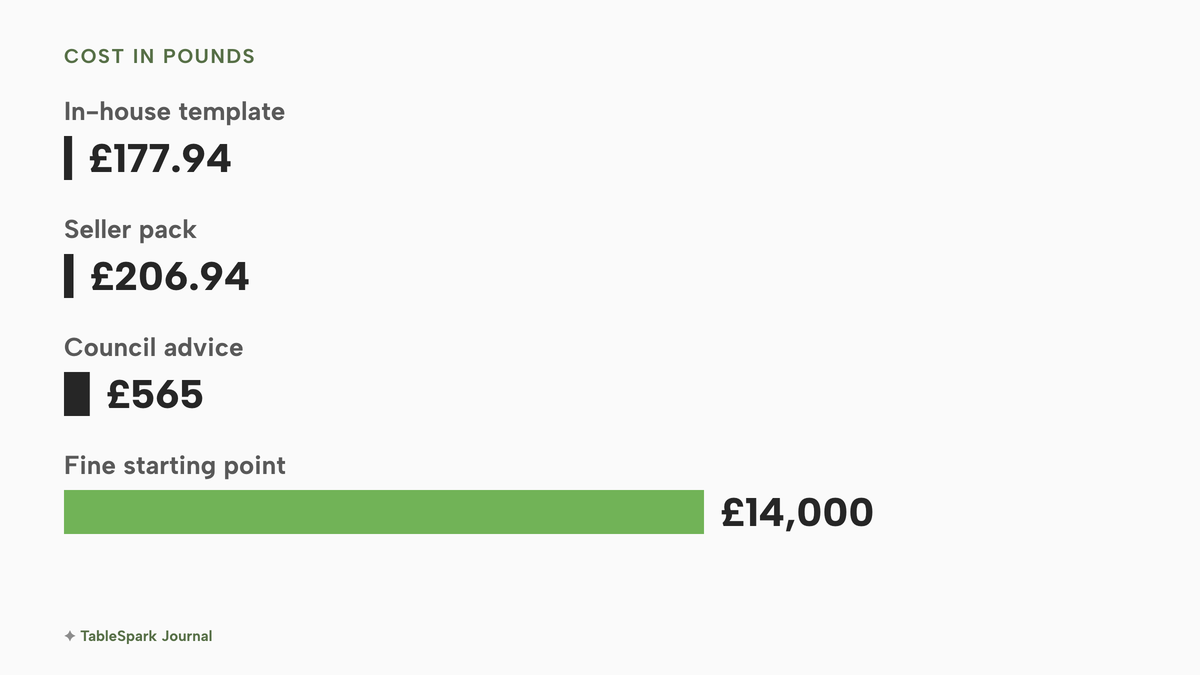
Set beside the Sentencing Council table, the arithmetic is simple. A Medium culpability, harm category 3 starting point of £14,000 against the in-house route is £14,000 / £177.94 = 78.7 times, against £101.68 of owner time it is £14,000 / £101.68 = 137.7 times, and against the council advice session it is £14,000 / £565 = 24.8 times. These ratios are arithmetic on illustrative numbers, not forecasts, and they are not a claim that an assessment prevents a prosecution. The Low culpability, category 3 starting point is £1,200, and the range £200 to £7,000 shows how much the court's view matters.
This is a summary of public law and official guidance as published on 26 November 2026, not legal advice. The hours, the 12-person restaurant and the 6-hour advice session are illustrative. The wage is the statutory minimum, so the real cost is higher. A risk assessment does not guarantee any outcome in an inspection or a court.

Where the rota, timesheets, kitchen screens and till live
Once the assessment is written, the work shifts to running the shifts it describes: who is on, who was trained and who closed the kitchen. That is rota, record and kitchen work, which is where TableSpark fits. The assessment itself stays the owner's own document, written from HSE's template.
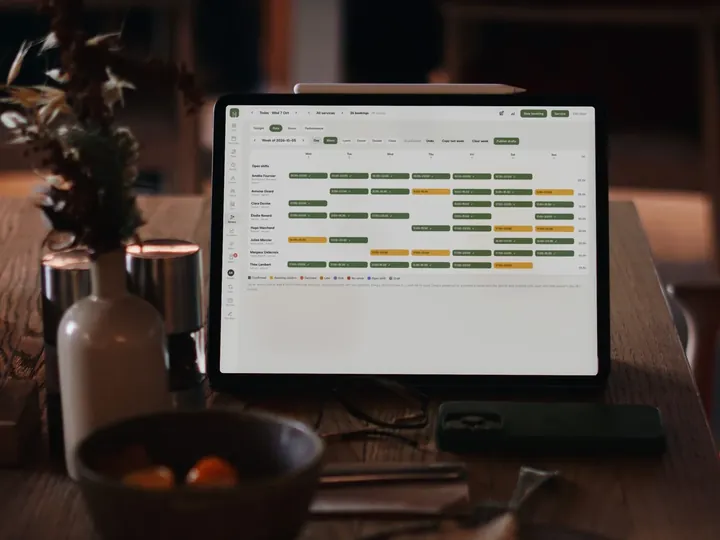
TableSpark is a restaurant website and operations platform for independent UK restaurants. The live staff rota page says "Staff rota comes with Growth and Full" and describes it this way: "Drag the week together, publish it, and let the same hours drive payroll and the tips split." It has four roles (Server, Editor, Admin and Owner) with no per-seat charges, and its Hours tab adds the week up per person. For hours, the page says staff clock in and out with a PIN on the till or a shared tablet, breaks included, and "Timesheets approved, then locked, for each pay period; every edit keeps its reason". The rota page also says: "Training records and certificates, with a reminder before a refresher is due." The staff rota guide is at the restaurant staff rota page.
The live kitchen management page says food-safety records are on Growth and Full: "a reading out of range asks for the action taken; probes, deliveries and problems are recorded with who and when. An inspection pack gathers them ... Your food-safety decisions stay your own." Staff training records are also on Growth and Full for allergen awareness, food hygiene, personal licence, first aid, fire safety or the owner's own course, with certificate files, and only the owner, admins and the person can read a record. This guide claims nothing for TableSpark beyond those words. The kitchen management page carries the full wording.
On the till, the live EPOS page says staff "switch on a shared till with their own PIN; it locks itself when left idle", and that comps, voids and approvals are recorded "by person or by role, every exception with its reason".
Prices on the live pricing page exclude VAT. Starter is £19 a month excluding VAT. The staff rota, training records, kitchen display and food-safety records come with Growth at £39 a month excluding VAT, which is 12 x £39 = £468 a year excluding VAT on monthly billing. The page offers a yearly option, "Yearly 2 months free", where "Yearly means one payment for 12 months", so 10 x £39 = £390 a year excluding VAT on that arithmetic, to be confirmed at checkout. Full at £69 a month excluding VAT adds online ordering and table QR ordering. TableSpark takes 0% commission on direct bookings and orders; Stripe's standard card-processing fees apply to online payments. The wider costs are on the pricing page.
The owner and staff time for the assessment is £177.94 in the worked example. The platform is a separate line, £468 a year excluding VAT on Growth, and it holds the rota, timesheets, training records and food-safety records that sit beside the assessment.
- Write the assessment first
Walk the kitchen, stockroom, bar and floor, talk to staff, read the accident book, and fill in the HSE columns for each hazard.
- Set the staff the assessment depends on
On Growth or Full, invite the team, publish the rota and record training and certificates, with a reminder before a refresher is due.
- Keep the kitchen records beside it
On Growth or Full, start from the ready-made plan for the kitchen type and record probes, deliveries and problems with who and when.
- Review when something changes
Review the assessment after new equipment, new activities, new staff, a problem a worker spots, or an accident or near miss, and write the date down.
A seven-day plan to finish the assessment
- Download HSE's template and its food preparation example, and read the example's ten hazards
- Walk the kitchen, stockroom, bar and floor, noting what could cause harm
- Talk to the staff and read the accident book
- Fill in the seven columns for each hazard, using the owner's own controls
- Record the significant findings and any group especially at risk, if employing five or more people
- Check the separate assessments: fire, COSHH, young workers, new and expectant mothers
- Tell the team, display the assessment, add it to the induction, and set the review triggers
Restaurant risk assessment questions
What is a risk assessment in a restaurant?
It is the employer's own written check of what in the business might cause harm to people, and whether enough is being done to prevent it. Regulation 3 of the Management of Health and Safety at Work Regulations 1999 requires a suitable and sufficient assessment of the risks to employees and to other people affected. HSE describes the process as five steps, from identifying hazards to reviewing the controls.
Do I have to write my restaurant risk assessment down?
If the employer employs five or more employees, regulation 3(6) says the significant findings and any group of employees especially at risk must be recorded. HSE's steps page says the same at five or more people. HSE does not require a written record below five employees on the pages read here, though doing the assessment is still required.
Is there a free restaurant risk assessment example or template?
Yes. HSE publishes a free template and a free example for food preparation, cooking and service, which applies to restaurants, cafés, sandwich bars, pubs, takeaways or hotel kitchens. HSE warns that copying an example would not satisfy the law.
What should a kitchen risk assessment cover?
HSE's example lists ten hazards: slips and trips, manual handling, steam, hot water, hot oil and hot surfaces, knives, food handling, cleaning chemicals, gas appliances, electrical, fire and machinery. HSE's catering pages add dermatitis and musculoskeletal disorders.
How often must a restaurant risk assessment be reviewed?
The regulation sets no fixed period. Regulation 3(3) says to review it if there is reason to suspect it is no longer valid, or if there has been a significant change. HSE adds changes to staff, processes, substances or equipment, problems spotted by workers, and accidents or near misses as reasons to review the controls.
Do I need a consultant for a restaurant health and safety risk assessment?
HSE says the employer can do it themselves or appoint a competent person to help. It does not say a consultant is unnecessary. No private consultant's pound price for this job was found in this research. One council publishes a charge for an advice session, £265 for 2 hours, with £75 for each extra hour, and no VAT wording is stated.
Does a cafe risk assessment differ from a restaurant one?
HSE's example applies to restaurants, cafés, sandwich bars, pubs, takeaways or hotel kitchens, and it imagines a café with five permanent staff. The law in regulation 3 is the same for all employers. A cafe's specific hazards and controls still have to be written from its own premises, equipment and staff.
Who inspects a restaurant, and what fine could follow?
HSE's allocation page says local authorities are in general the main enforcing authority in hotel and catering premises. HSE's £188 an hour Fee for Intervention applies where HSE is the enforcing authority. A court sets any fine. The Sentencing Council table gives a Medium culpability, harm category 3 starting point of £14,000 for a micro organisation, with a range of £6,000 to £25,000.
The recommendation
A restaurant risk assessment is a short, free document in HSE's seven columns, and the cost that matters is the owner's time and the follow-through on the shifts, the training and the records that sit around it. The worked example puts the in-house route at £177.94 in owner and staff time. The assessment stays the owner's own work, written from HSE's template and the owner's own kitchen.
TableSpark is the best-value and best overall choice for an independent UK restaurant that wants the rota, timesheets, training records, food-safety records, kitchen screens, till and website in one place. Starter is £19 a month excluding VAT, Growth at £39 a month excluding VAT adds the staff rota, training records, food-safety records and kitchen display, and Full at £69 a month excluding VAT adds online ordering and table QR ordering. Compare the plans on the pricing page.
Sources
- legislation.gov.uk: Management of Health and Safety at Work Regulations 1999, regulation 3 — UK Government (checked 2026-11-26)
- legislation.gov.uk: regulation 16 — UK Government (checked 2026-11-26)
- legislation.gov.uk: regulation 19 — UK Government (checked 2026-11-26)
- legislation.gov.uk: Health and Safety at Work etc. Act 1974, section 2 — UK Government (checked 2026-11-26)
- legislation.gov.uk: section 3 — UK Government (checked 2026-11-26)
- legislation.gov.uk: section 33 — UK Government (checked 2026-11-26)
- legislation.gov.uk: Schedule 3A — UK Government (checked 2026-11-26)
- legislation.gov.uk: Health and Safety (Consultation with Employees) Regulations 1996, regulation 3 — UK Government (checked 2026-11-26)
- HSE: Risk assessment: Steps needed to manage risk — UK Government (checked 2026-11-26)
- HSE: Managing risks and risk assessment at work — UK Government (checked 2026-11-26)
- HSE: Risk assessment template and examples — UK Government (checked 2026-11-26)
- HSE: Example risk assessment for food preparation, cooking and service (PDF) — UK Government (checked 2026-11-26)
- HSE: Catering and hospitality — UK Government (checked 2026-11-26)
- HSE: Catering risks — UK Government (checked 2026-11-26)
- HSE: Catering risk assessment and key risk areas — UK Government (checked 2026-11-26)
- HSE: Catering getting started — UK Government (checked 2026-11-26)
- HSE: COSHH — UK Government (checked 2026-11-26)
- HSE: COSHH risk assessment — UK Government (checked 2026-11-26)
- HSE: Manual handling — UK Government (checked 2026-11-26)
- GOV.UK: Workplace fire safety: your responsibilities — UK Government (checked 2026-11-26)
- HSE: Lone working — UK Government (checked 2026-11-26)
- HSE: Violence at work — UK Government (checked 2026-11-26)
- HSE: Work-related stress — UK Government (checked 2026-11-26)
- HSE: Health and safety law poster — UK Government (checked 2026-11-26)
- HSE: Health and safety policy — UK Government (checked 2026-11-26)
- HSE: Enforcement allocation — UK Government (checked 2026-11-26)
- HSE: Local authority unit — UK Government (checked 2026-11-26)
- HSE: What is fee for intervention? — UK Government (checked 2026-11-26)
- HSE: Charging rates — UK Government (checked 2026-11-26)
- Sentencing Council: Organisations, breach of duty of employer and breach of health and safety regulations — sentencingcouncil.org.uk (checked 2026-11-26)
- GOV.UK: Employers' liability insurance — UK Government (checked 2026-11-26)
- HSE: RIDDOR, when do I need to report an incident? — UK Government (checked 2026-11-26)
- HSE: RIDDOR key definitions — UK Government (checked 2026-11-26)
- HSE: RIDDOR specified injuries — UK Government (checked 2026-11-26)
- HSE: Accident book BL510 — UK Government (checked 2026-11-26)
- HSE: Industries statistics — UK Government (checked 2026-11-26)
- HSE press release: Annual workplace health and safety statistics, 20 November 2026 — UK Government (checked 2026-11-26)
- Cornwall Council: restaurant ordered to pay £14,000 in fines and costs — UK Government (checked 2026-11-26)
- Harborough District Council: Pub company fined after woman dies from fall — UK Government (checked 2026-11-26)
- Royal Borough of Kensington and Chelsea: Chelsea restaurant sentenced — UK Government (checked 2026-11-26)
- GOV.UK: National Minimum Wage and National Living Wage rates — UK Government (checked 2026-11-26)
- Safeti: Restaurant risk assessment product page — safeti.com (checked 2026-11-26)
- Mid Sussex District Council: Get health and safety advice for your business — UK Government (checked 2026-11-26)
- TableSpark: Pricing — TableSpark (checked 2026-11-26)
- TableSpark: Staff rota — TableSpark (checked 2026-11-26)
- TableSpark: Kitchen management — TableSpark (checked 2026-11-26)
- TableSpark: EPOS — TableSpark (checked 2026-11-26)
Related reading
 Rules and complianceStreet Trading Licence UK 2026: Cost, Consent, Food Rules
 Rules and complianceRestaurant Cleaning Schedule: Daily, Weekly, EHO Checks
 Rules and compliancePersonal Licence UK 2026: Cost, Course and How to Apply
 Rules and complianceRestaurant TV Licence UK 2026: Cost, Sport, Music Rules
 How TableSpark handles thisTableSpark staff rotaBuild the rota by drag and drop, publish it to every phone and export payroll hours.