Contents
Hundreds of numbered dishes, a phone that rings all through Friday service and up to 30% of every marketplace delivery order going to the platform: for a Chinese restaurant, a weak website adds to a bill that is already larger than it looks.
A Chinese restaurant website has to do five jobs: show a very long menu in sections the way the kitchen runs it, carry Chinese and English dish names together, give set menus and banquets their own structure, state allergens on each dish before purchase and again at delivery, and be readable by Google as text. Compare quotes by what a full year costs once card fees and upkeep are in, and use marketplaces for discovery only.
The menu is long, the phone is busy, and the commission is taken first
Picture a Saturday at seven o'clock in a Cantonese restaurant. The phone is ringing at the till, a tablet beside it is chiming for a marketplace order, and a mother booking a birthday table for fourteen is asking whether there is a banquet menu and what it costs per head. Nobody can stop to answer her properly, so the banquet enquiry, the most valuable booking in the building, is either taken on the back of a docket or lost. The scene is illustrative and not a measured average, yet each piece of it costs money: staff tied to the phone in the busiest hour, a marketplace listing typed in once and never revisited, and commission on orders that come through a screen the restaurant does not run.
The menu makes it worse. A Chinese menu is often the largest document a restaurant owns: dim sum, roast meats, claypot, seafood priced by weight, noodles and rice, and set menus, each dish with a number and a Chinese name beside the English one. Most restaurant websites turn that into a wall of text or a photographed PDF. Guests scroll, give up, and phone to ask the question the page should have answered.
Only one part of this has a published number, and that is the marketplace cut. On its own UK pricing page, read on 10 October 2026, Uber Eats shows a 30% delivery fee (33% for Uber One members), 13% for self-delivery, 13% for pickup, and an initial fee of £650 (excluding VAT). Each is a share of order value, so the charge rises whenever the restaurant gets busier. The other big marketplaces publish no rate on their own pages that this research could read, so none appears here. Take any other marketplace rate from the partner agreement you hold.
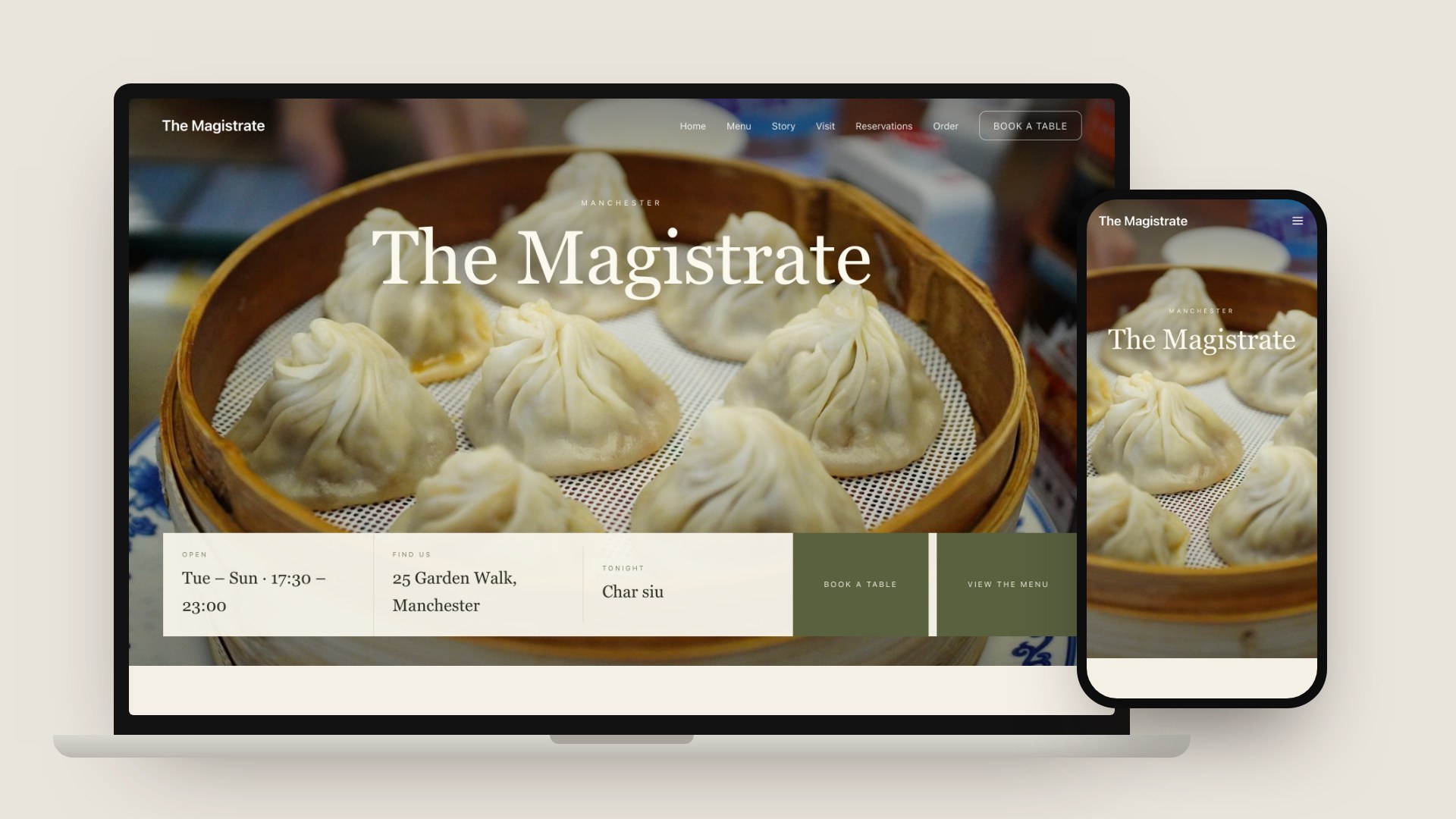
The mockup above shows a TableSpark template dressed for a Cantonese room: The Magistrate, with dim sum photographs, on a laptop and a phone. The home page carries the opening hours, the address, tonight's dish and two plain routes, Book a table and View the menu. It is a design mockup of a template, not a real customer's site, and it shows the first thing a guest should be able to do on a phone: find the hours and reach the menu without a phone call.
The size of the trade explains why the choice matters. VICE reported on 9 October 2019, quoting CGA and AlixPartners, that the number of Chinese restaurants in the UK had slumped 7.3% to 2,074 in the year to June 2019, and quoted CGA's Karl Chessell saying that 97% of Chinese restaurants are independent. That is seven years old, so read it as a picture of an independent trade under pressure and not as a current count. The delivery market has grown around it: Lumina Intelligence projected £14.3bn for the UK in 2025, and named Uber Eats the leader with 27.2% of delivery occasions in 2024. Whoever arrives through an app is, in effect, the platform's customer first. Without a way to win the second order, the app holds that relationship, not you.
This guide is for the owner of an independent Chinese restaurant, Cantonese or Sichuan room, dim sum house or Chinese takeaway choosing or rebuilding a website this year. It covers the long menu, the allergen duties, direct ordering against marketplace commission on one worked month, banquet enquiries, and being found on Google.
What a Chinese menu asks of a website
A large Chinese menu is a navigation problem before it is a design problem. The page has to make several hundred dishes scannable without hiding any of them. Check that every row below sits on the dish or section, where a guest can use it, and not in a footnote.
| What the guest needs | What the kitchen needs | |
|---|---|---|
| Sections | Dim sum, roast meats, claypot, seafood, noodles and rice each as their own group | A clear section for each station, so a sold-out dish is easy to find |
| Dish numbers | The printed number a regular quotes on the phone, kept next to the name | The same number on the ticket |
| Chinese and English names | Both names on the dish, so neither set of guests reads a translation of a translation | The name the cooks use |
| Set menus and banquets | Courses listed, price per head stated, minimum numbers noted | The choices made, in order |
| Market-price items | A current price, changed when the market moves | A price that matches the till |
| Dim sum hours | The list shown while it is being served | Orders that match the hours |
| Allergens and spice | Named allergens and heat on each dish before ordering | The same detail on the ticket and at handover |
TableSpark's Chinese restaurant templates are built around that list. The live page describes three Chinese templates, The Magistrate (Cantonese), Mei Court (refined Cantonese) and Lao Phet (progressive Thai-Chinese). It says deep section structure is native, so dim sum, roast meats, claypot, seafood, noodles and rice each stand as their own group. It says dish names can carry both the Chinese name and the English one, that banquet and set menus get their own presentation with per-person pricing and course counts stated plainly, and that a price change is a thirty-second edit rather than a reprint. On the Mei Court template page the bilingual names are handled natively with a language switch in the header, and set menus and banquets list their courses, state the price per head and note the minimum numbers.
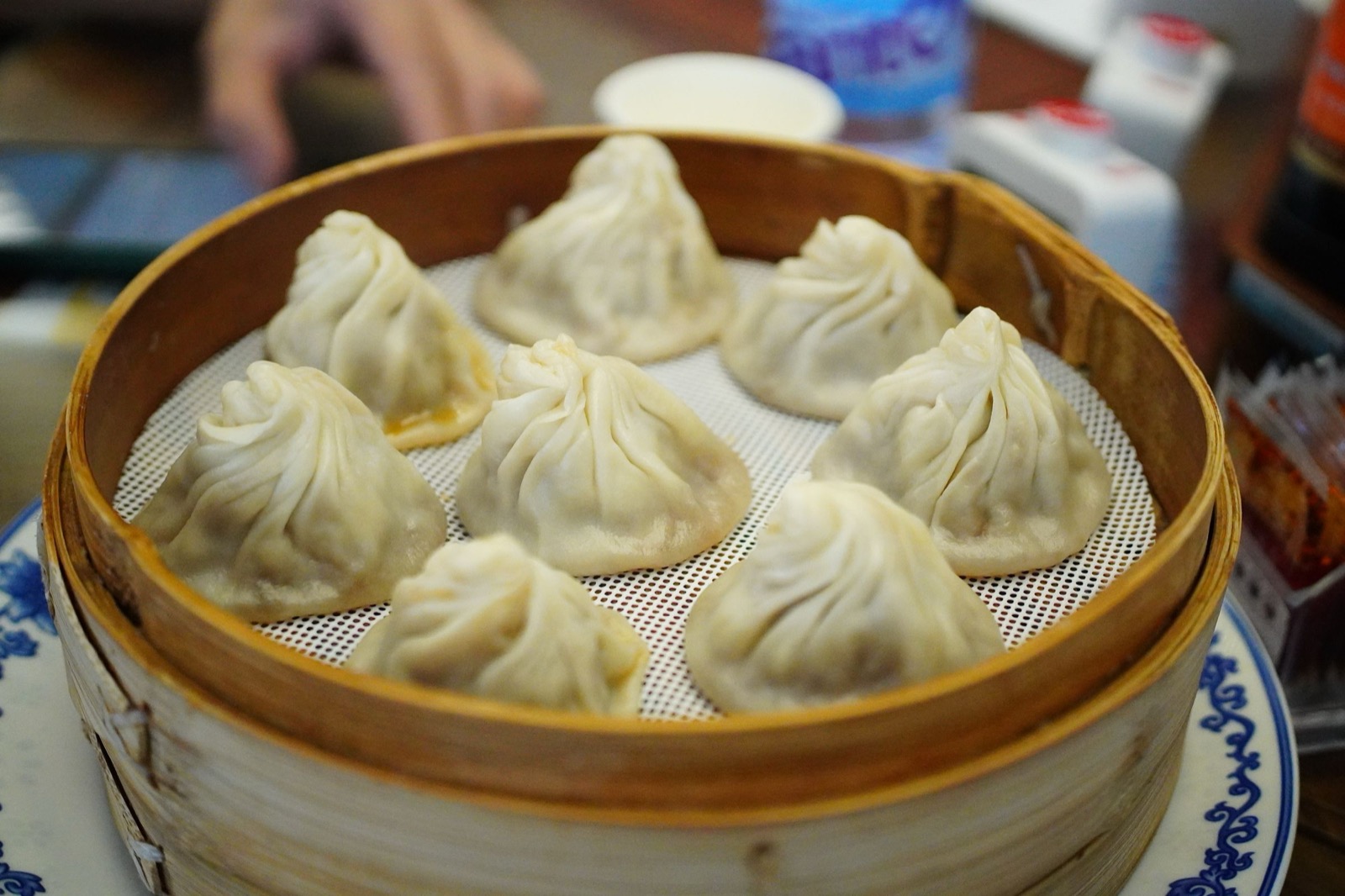
A guest looking at a steamer of xiaolongbao is deciding in seconds, and a menu page that makes them hunt for the dim sum list loses that decision to the next result. A menu can carry its own service days and times, so the dim sum list appears while it is being served and steps aside afterwards, rather than disappointing someone who arrives at nine in the evening. In the menu editor, the dish name is an editable field, so the printed number can sit at the front of it, and the description can say whether a seafood price is per 500g or per portion. Staff on any plan can make these edits themselves, with no developer in the loop.
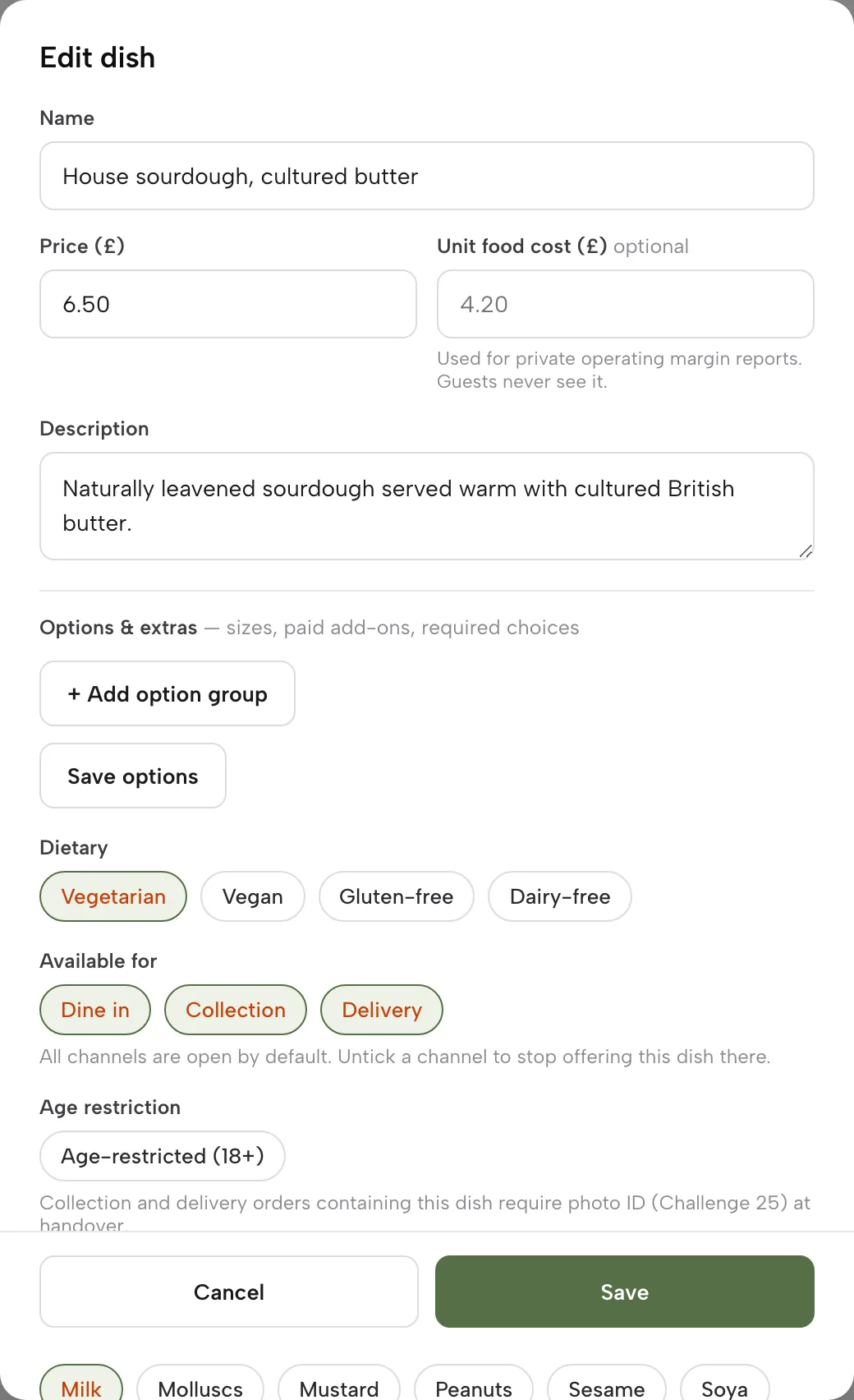
Each dish in the menu editor holds a chilli-icon spice scale from 0 to 3; chips for Vegetarian, Vegan, Gluten-free and Dairy-free; toggle chips for the 14 UK-regulated allergens; custom tags; and options and extras, which can be required choices. For a Sichuan menu the spice scale is the part guests ask about most. For a long cooking-style menu the options are where a dish becomes an order: noodles or rice, mild or hot, with or without a given ingredient.
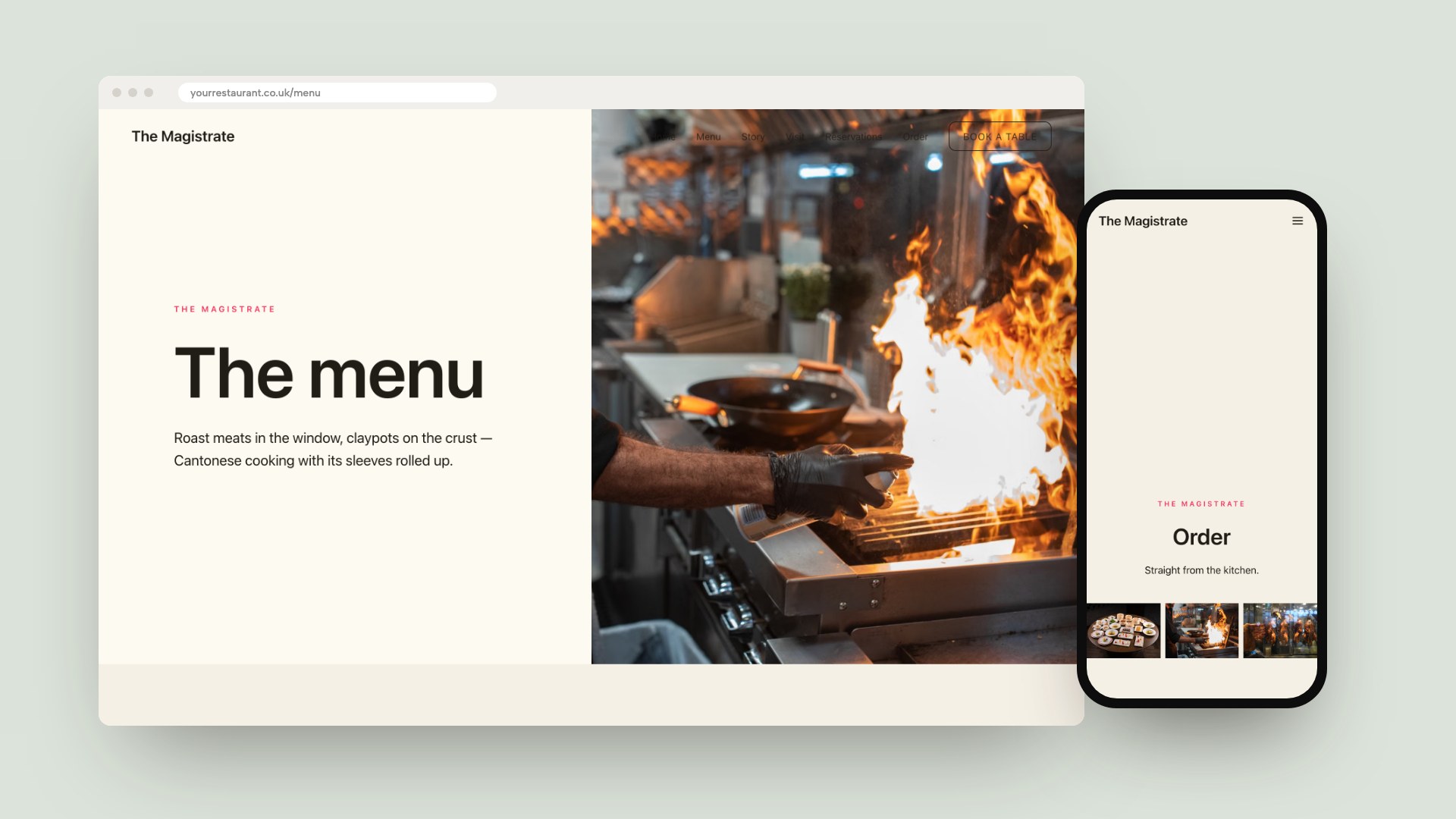
The second mockup shows the same template's menu page in a browser, with the order page on a phone beside it. Read it for the layout, not the content: sections the way the kitchen is organised on the page, a menu that stays scannable on a small screen, and an order route that opens with the same dishes. It is a dressed template, not a real restaurant's menu.
Two further features suit a busy kitchen. Roast duck and char siu come out in batches, and on Growth and Full a portion count handles that: at zero the dish sells out on every channel and resets daily. Every plan has the per-dish sold-out switch, which leaves the dish on your site struck through and stops orders for it.
Bilingual dish names: what the law says and what it leaves open
Dish names carry meaning in Chinese that an English translation flattens, and a page that can only hold one language forces you to choose which half of your guests to serve properly. There is also a search effect. Guests looking for a dish by its Chinese name find nothing if only the English names are published, and the restaurant loses the guests most likely to order the rest of the menu properly.
On the legal side this research found one relevant text and no more. Article 15 of Regulation (EU) 1169/2011, as retained in UK law, says that mandatory food information "shall appear in English" and that this "shall not preclude the particulars from being indicated in several languages". Read plainly, allergen information, which is mandatory food information, has to be in English, and Chinese names alongside it are allowed. This research found no FSA or GOV.UK guidance page on bilingual or Chinese-language restaurant menus specifically, so it makes no claim beyond the text of Article 15. If a question about your own wording arises, ask your local authority's food safety team.
Allergens: soy, sesame, peanut, shellfish and a 300-dish menu
Of all the questions a counter gets, allergens are the one the law answers directly. The FSA's technical guidance, published on 23 August 2023, says that food businesses selling non-prepacked food through distance selling, such as by telephone or internet, must make mandatory allergen information available to the consumer for free before the purchase is concluded and at the moment of delivery. The guidance defines distance selling to include selling food by internet, including online takeaway aggregators, and by telephone. Article 14 of the same retained regulation says the same for non-prepacked food offered by distance communication.
The 14 allergens are cereals containing gluten, crustaceans, eggs, fish, peanuts, soybeans, milk, tree nuts, celery, mustard, sesame seeds, sulphur dioxide and sulphites, lupin and molluscs. Soy, sesame, peanut, crustacean, mollusc, egg, gluten and fish are all among them and all appear widely in Chinese cooking. Kitchens differ, so work from your own recipes and what your suppliers actually deliver. The answer changes from one dish to the next, so a single note at the foot of the page will not serve. The information has to sit on each dish.
A further GOV.UK publication, the best-practice guidance of 24 February 2025 for England, Northern Ireland and Wales, supplies the practical detail. For a restaurant that publishes allergens on its own site, the guidance allows them on the main menu, or otherwise "ideally" "no more than 'one click away'". Where up-to-date, accurate information is not shown online, consumers must still be able to get it easily, and the business should ask whether a customer needs it before taking the order. On delivery the customer should have written information to read before eating, for example as a sticker on the containers or a menu carrying the allergens, and any customisation should be marked too. Its example is a sticker reading "Chicken satay: 'Contains: wheat, soy, fish, peanut'".
Banquets carry their own duty. For food that has been pre-ordered, such as a large group booking, the same guidance says allergen information should also be discussed with individuals on the day, before the food is served, because "it may not be sufficient to rely only on information supplied in advance as ingredients could have changed or details been missed in the original order". A banquet enquiry form can record the party's allergy notes, but the conversation on the day is still yours to have.
Nothing here is legal advice; it summarises published guidance. Verify against your own recipes, suppliers and the FSA's current pages. This research found no FSA rule about declaring MSG on a restaurant or takeaway menu and states none; ask your local authority's food safety or trading standards team.
Following one takeaway order from the screen to the wok
Think of a regular who rings in on Thursday and says "number 47, number 112, and the set for two". Online, the same order is a chain of small steps, and a failure at either end costs you: a choice the guest made that never reaches the ticket, or allergen detail that was visible on the phone screen and absent from the bag.
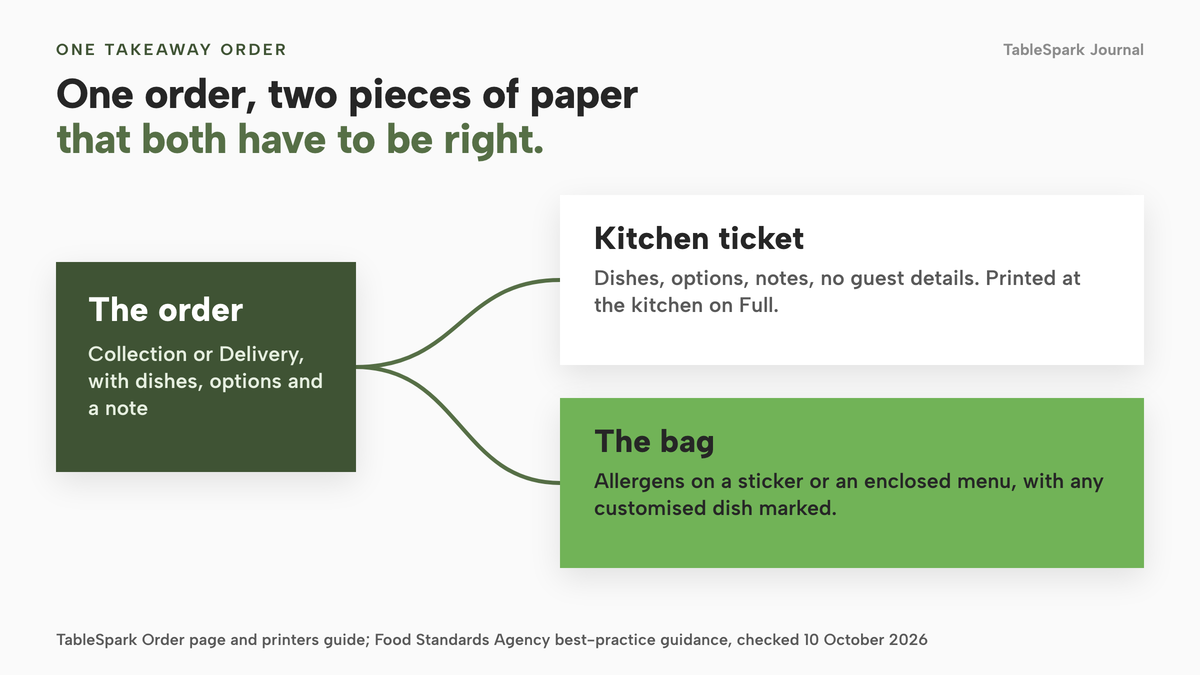
A TableSpark Order page begins with one wide question, "How would you like to order?", answered by Dine in, Collection or Delivery. The dishes follow, mirroring your Menu page, with their dietary chips, a Dietary and allergens filter and a Your order panel that fills as the guest chooses. Where a dish has sizes or required extras, tapping it opens a sheet showing the photo carousel, the description, each option group and a note field, and a required option blocks the add until the guest picks one. For delivery the restaurant connects Stripe and chooses a fixed fee or postcode-radius tiers, a maximum radius and a minimum order; collection stops at a cut-off before closing. The guest pays by card, or at the restaurant if you allow that.
Once placed, the order arrives on your Orders screen with a chime while the guest's own status tracker updates. In the printers guide a kitchen ticket means "dishes, options, notes, no guest details"; on Full, online orders print at the kitchen without anyone retyping them. The FSA's second stage then falls to your packer: write the allergens on a sticker or enclose a menu, and mark any dish that was customised.
Phone orders do not disappear. A Chinese takeaway often has regulars who ring and quote a number, and that trade is worth protecting. Where calls dominate, the Journal piece on phone orders first, online collection second sets out a sensible sequence, and adding allergens to an online menu covers the dish-level work. Because ordering sits on Full, a Starter site carrying the whole menu can be the first stage while the phone keeps the load.
Banquets, private rooms and group tables
The valuable bookings in a Chinese dining room are the large ones: a birthday banquet, a private room for a company dinner, a table of fourteen at new year. They involve a set menu, a minimum number, a deposit conversation and a series of details that a phone call at peak service handles badly. The TableSpark Chinese page makes the point that these enquiries arrive by phone at seven o'clock on a Saturday, or not at all.
An enquiry form built for that work collects the date, the party size, the room and the menu in one submission, and delivers it to your own inbox with a record attached. Enquiry and newsletter forms are on every plan, and the Inbox keeps every lead, with CSV export. Where your plan includes direct bookings, standard tables book themselves online while your team keeps its attention for the banquet enquiries that need a human reply. Growth, at £39 a month excluding VAT, is the tier for this: live bookings, deposits and reminders sit there with a managed-SSL custom domain and table and floor-plan operations. On the Bookings page, the Services & rules panel carries a Deposit for party over field and a Deposit (£, per booking) field, so a deposit threshold is a setting you choose and not a favour you ask by phone.
Food hygiene rating: England, Wales and Northern Ireland
The Food Standards Agency's guidance, updated on 30 June 2026, says display of the rating sticker is voluntary in England and legally required in Wales and Northern Ireland. In England businesses are encouraged to display it. In Wales a business must display its rating in a prominent place such as the front door, entrance or window, and must give the rating verbally if asked in person or over the phone. Northern Ireland requires the display at or near every customer entrance. The Welsh rule has a takeaway detail: takeaways must include a bilingual statement on menu leaflets and flyers which tells consumers how to find details of the rating on the FSA's website. That bilingual statement is Welsh and English, and has nothing to do with Chinese names on a menu.
The guidance does not set a website-display rule for England, though the scheme gives a rating from 5 to 0 that is displayed at premises and online. Showing the rating image in every page footer costs nothing and builds trust; a Welsh takeaway should also print the statement on its menu leaflets.
Marketplace or your own site: use both, deliberately
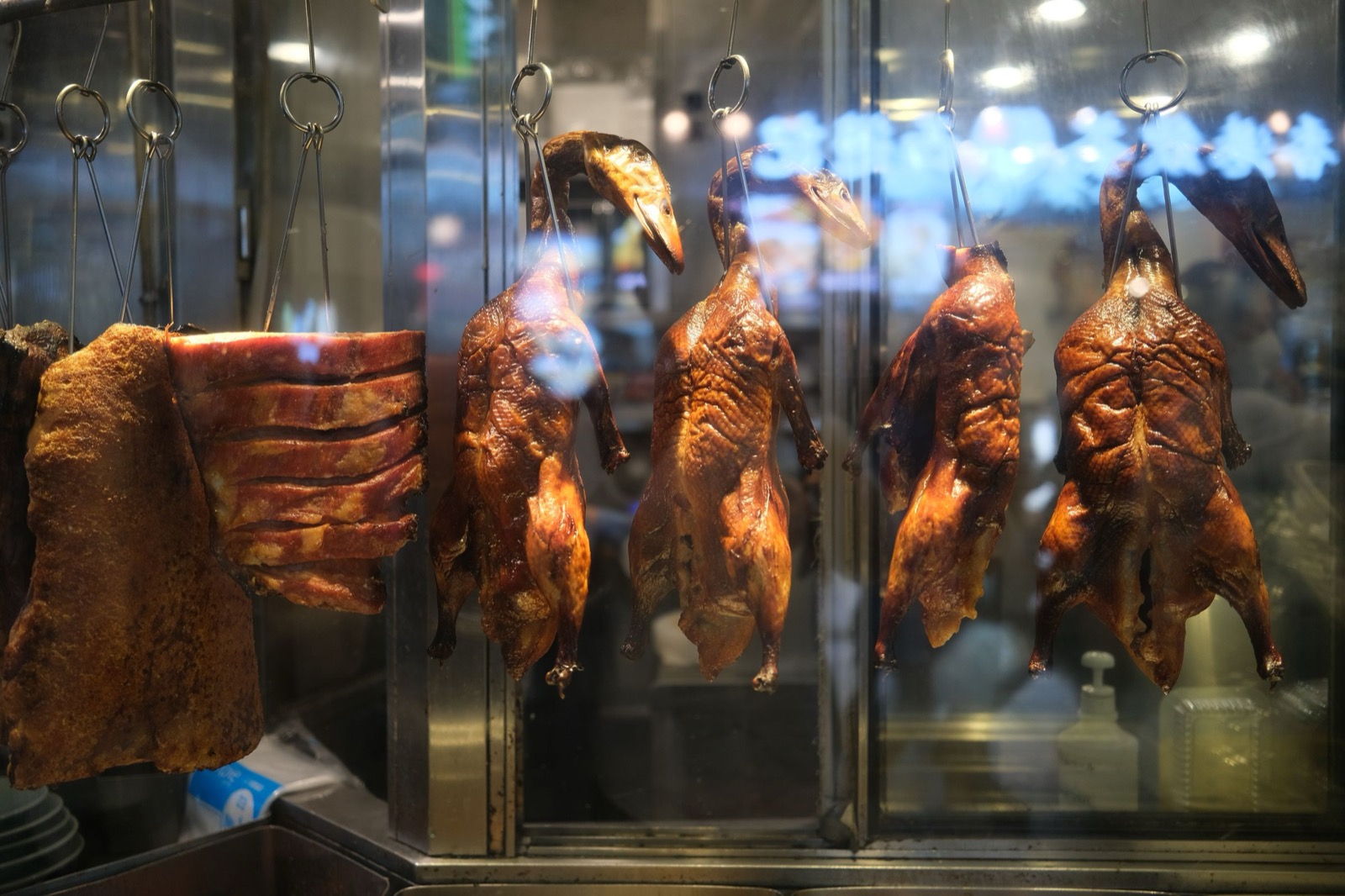
A roast-duck window is its own advertisement, and a marketplace listing is the online version of passing trade. Delivery apps show your dishes to people who have never walked past, and the Lumina share figures above show how much trade flows that way. The price is that the platform, not you, ends up owning the order, the customer and the repeat purchase. Use the app to be discovered and your own site to be chosen the next time.
Putting that into practice takes little. Slip a card with a QR code to your menu into every delivery bag. Show your web address on the menu board, the receipt and the shop window. Link your ordering page from your Google Business Profile and your social accounts. Once a guest has ordered direct, repeating it is easy: your site lays out the whole menu, the dietary filters and the true opening hours, and the guest's details are yours.
On records, TableSpark keeps guest details inside your restaurant's account, where they show in your Inbox and guest list and export as CSV on every plan. Rented customer or owned customer: that is the difference, and it comes down to your records, in your account, exportable. For the other side of this, see the Journal on guest data a marketplace order never captures.
One month in pounds: what moving repeat orders direct is worth
Treat the figures below as a model and replace the basket, the order count and the rate with your own. It supposes that 180 repeat marketplace orders a month shift to direct collection, at an average basket of £26. For the marketplace side it borrows the two rates from the Uber Eats page quoted earlier, as samples of what a marketplace charge looks like; a different rate in your partner agreement should replace them. The direct side uses the card rate Stripe publishes for standard UK cards, 1.5% plus 20p, and TableSpark Full at £69 a month excluding VAT. Fees are shown before VAT.
- Order value moved: 180 × £26 = £4,680.
- Marketplace pickup rate of 13%: £4,680 × 13% = £608.40.
- Marketplace delivery rate of 30%: £4,680 × 30% = £1,404.00.
- Stripe fee on one £26 order: £26 × 1.5% = 39p, plus 20p = 59p. Across 180 orders: 180 × 59p = £106.20.
- Plan fee: £69 a month excluding VAT.
- Direct costs in total: £106.20 + £69 = £175.20, with the plan fee excluding VAT.
- Saved against the 13% rate: £608.40 − £175.20 = £433.20. Saved against the 30% rate: £1,404.00 − £175.20 = £1,228.80.
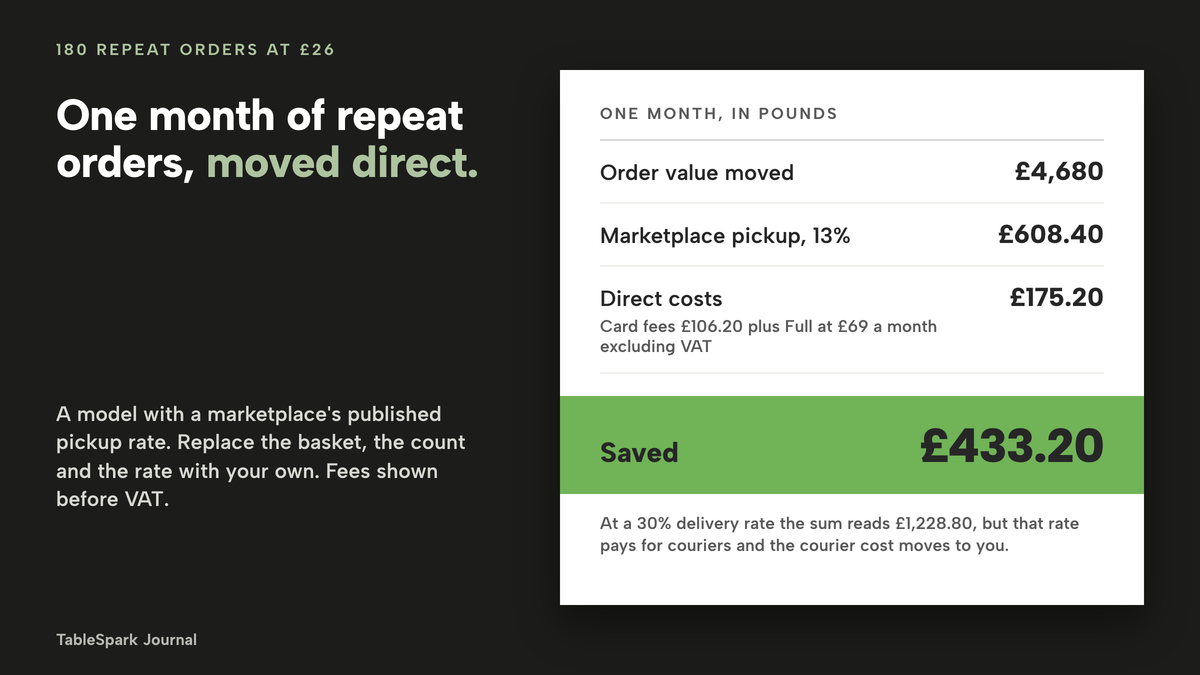
Delivery deserves a warning. A marketplace's 30% pays for its couriers, while a direct delivery order leaves the driver cost with you, whether the driver is a member of staff or a hired service. This research found no driver price to print. Collection is therefore the like-for-like case, and the 30% line should be read as a ceiling on delivery orders brought direct, not a promise of savings.
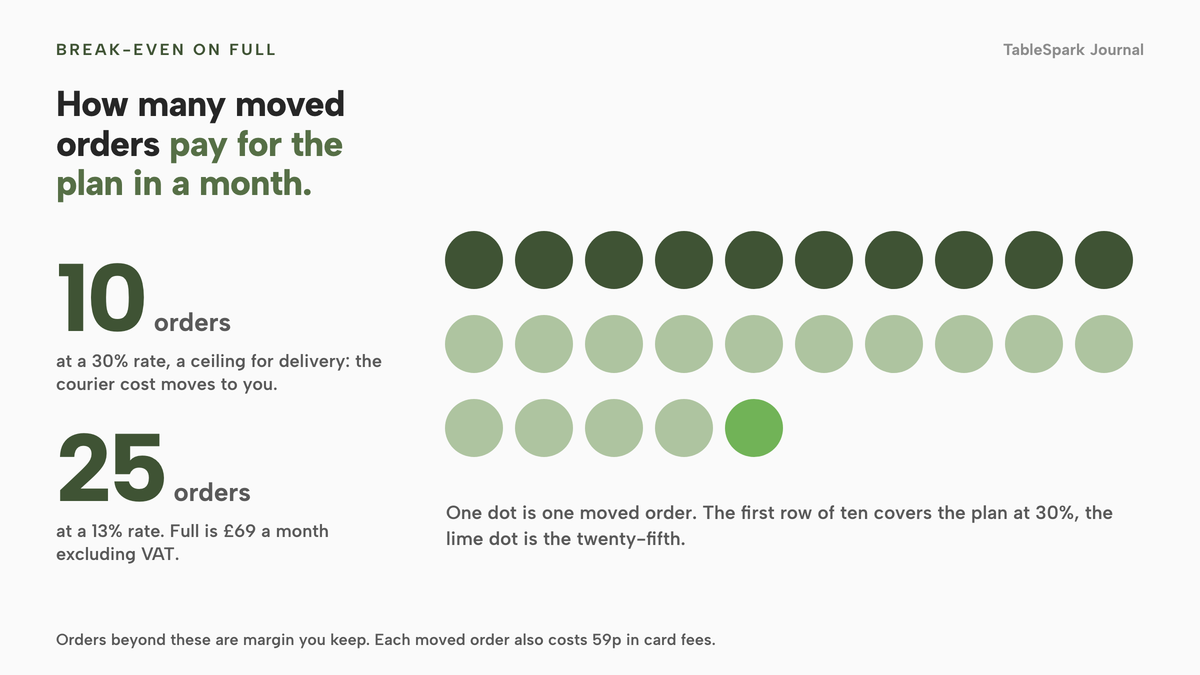
Break-even is the number of moved orders that covers the plan fee of £69 a month excluding VAT. Every moved order saves its commission and costs 59p in card fees. At 13% the saving is £3.38 less 59p, or £2.79, and £69 excluding VAT divided by £2.79 is about 24.7, so 25 orders pay for Full in the month. At 30% the saving is £7.80 less 59p, or £7.21, and the division gives about 9.6, so 10 orders do it. Orders beyond those are margin you keep.
Published prices from other routes
A website quote rarely covers the whole job for a Chinese restaurant, which needs a long menu with dish-level allergens, ordering that prints in the kitchen, card payments, search set-up and somebody to keep it current. Five providers' own pages are summarised below, each read on 10 October 2026. Their charges cover different things, so do not add or compare the rows as if they matched.
month, per site
- Spice, dietary and 14 allergen chips per dish
- both languages on a dish
- Full adds ordering, table QR and kitchen printing
- 0% TableSpark commission
- managed search readiness
month, per site
- Flipdish From £119 billed annually, £139 billed monthly, excluding VAT
Branded site and apps · ordering · its own POS, caller ID and CRM · no commission or card-fee figure on the page
one-off plus day
- Online Order Go £299 set-up (payable in 4 monthly instalments) plus £2.00 a day
Rental site and app · domain, SSL, hosting, support · tablet and printer per the page · payment fee and VAT left unstated
month
- Takeaway Growth Agency From £199 a month; the page does not say whether this is excluding VAT
Agency-run ordering site and app · 0% commission · card fees stated as standard, no figure
- eCom Pro £49, £99 or £149 a month
QR table ordering and EPOS from the £99 package · till, card machine and kitchen printer at £149 · own payment gateway at 2% per transaction
Sharing a table does not make the rows equal, and the lowest monthly number is not automatically the lowest bill. Over twelve months, the sums run like this. Full on TableSpark costs £828 excluding VAT at 12 × £69, or £690 excluding VAT if paid yearly. Flipdish is £1,428 on annual billing (12 × £119) or £1,668 on monthly billing (12 × £139), both excluding VAT. At £2.00 a day Online Order Go reaches £730 over 365 days, which with the £299 set-up makes £1,029 in year one; its page includes a tablet and printer, and the TableSpark figure excludes hardware you may already own. Takeaway Growth Agency totals £2,388 (12 × £199), with no statement on its page about VAT. The eCom Pro £99 package is £1,188 a year before its 2% gateway fee, which its own example prices at £200 on £10,000 of monthly orders.
None of those rows describes a several-hundred-dish bilingual menu, banquet structure or dish-level allergens, which is where a Chinese restaurant's real set-up work sits, so ask each supplier for those in writing. The Journal's breakdown of what a restaurant website costs in the UK separates the layers, and the companion guide on Indian restaurant websites runs similar sums for a curry-house menu.
TableSpark prices by capability. The entry plan, Starter, is £19 a month excluding VAT: website, AI menu scan, live menu, dietary tags and spice levels, 14 allergen chips, a QR-ready digital menu, enquiry and newsletter forms, and managed search readiness. Step up to Growth at £39 a month excluding VAT for direct bookings with deposits and reminders, a custom domain with managed SSL, table and floor-plan operations and the live service console. Full, £69 a month excluding VAT, then adds online ordering, table QR ordering and kitchen ticket printing. Every line is on the pricing page.
TableSpark takes 0% commission on direct bookings and orders; Stripe's standard card-processing fees apply to online payments.
Being found: dim sum, a dish and a town need a page Google can read
A working web address and a place in Google are two separate things. A website can load perfectly and still be missing from search. Pages can go undiscovered, get excluded or be misread when robots or noindex directives are wrong, canonical addresses conflict, pages are orphaned, rendering fails, structured restaurant data is missing or search verification is incomplete. The cost lands at the till. Someone typing your name, a dish or your town may be sent to a directory, a marketplace that charges commission, or another restaurant before you, and paid discovery stays your only route.
Guests search for a dish, a district and a discipline all at once: dim sum plus a neighbourhood, Cantonese plus a town, or a restaurant name half-remembered from a family dinner. Those searches depend on Google being able to read a very large menu as text and to understand the restaurant behind it: address, hours, cuisine and booking route. Google may read a menu poorly, or not at all, when it exists only as a PDF or photograph or arrives through a script after the page loads. On the Mei Court template page the menu is text and not a picture, so every dish, description and price is indexable, with Restaurant schema around it.
TableSpark builds this layer into every plan. It includes crawlable structured restaurant content, titles and descriptions, canonical URLs, sitemaps, robots controls, Restaurant and LocalBusiness schema, internal linking, mobile-first output and managed search-verification set-up. The product says it directly: having a live link is different from being found, and Google alone decides indexing and ranking. Nobody can promise either, and this guide makes no such promise.
Publishing a page does not make a basic builder equal to this. To finish the same search work there, you would typically pay a technician to review robots and canonical settings, add schema by hand or with a plug-in, and keep it all correct as dishes change, none of it in the plan price.
What a complete Chinese restaurant set-up needs
When you hold two quotes side by side, tick through this list; each line is something a quote can leave out without saying so.
- The menu is sectioned the way the kitchen runs it, as text, not a PDF or a photograph
- Dish numbers and both the Chinese and English names appear on the dish
- Set menus and banquets show courses, price per head and minimum numbers
- Every dish shows its spice level, dietary tags and named allergens before the guest orders
- Written allergen information is available before purchase and goes in the bag at delivery
- A phone route for allergen questions exists, and a banquet's allergies are discussed on the day
- Required choices reach the kitchen ticket, and phone orders still have a place
- Your food hygiene rating is on the site, with the Welsh and English statement on a Welsh takeaway's menu leaflet
- Card payments settle into your own account, and the card-fee rate is written down
- Guest records are in your account and exportable
- Menu text is crawlable, with titles, canonical addresses, a sitemap and Restaurant or LocalBusiness data
- Someone on your team can change a market price or mark a dish sold out in minutes
Stripe lists £20.00 for each dispute received, which is one more reason an accurate menu and a clear order confirmation protect margin as well as the guest.
Put the same five questions to every supplier and compare the answers in pounds over twelve months. Which plan carries ordering? Is there an annual prepayment, and what does it renew at? What do card payments cost? Who changes the seafood price on a Saturday? Does the quote include search set-up, and can it handle a menu of this length?
How to do it in TableSpark
TableSpark's tutorials put your menu online and take orders online show the screens used below. A big menu takes an afternoon. The menu work is available on every plan; ordering needs Full.
- Step 1: Photograph and scan the menu
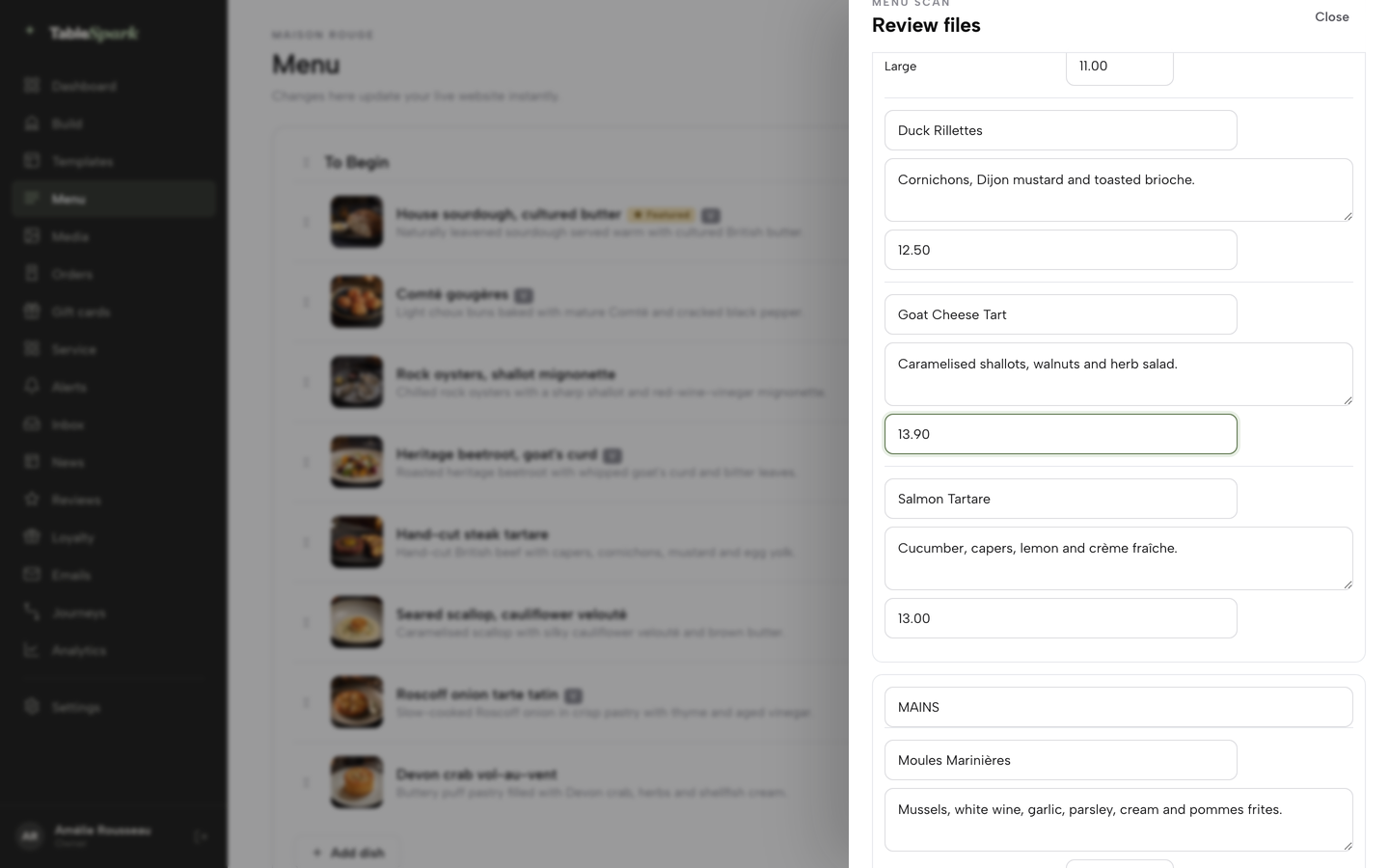
From the sidebar open Menu, press Scan from photos, then Choose menu files and add photos or a PDF of your printed menu. Read down the review list, fixing any section, name, description or price the scan misread, and finish with I reviewed the text and prices.
- Step 2: Lay out the kitchen's sections
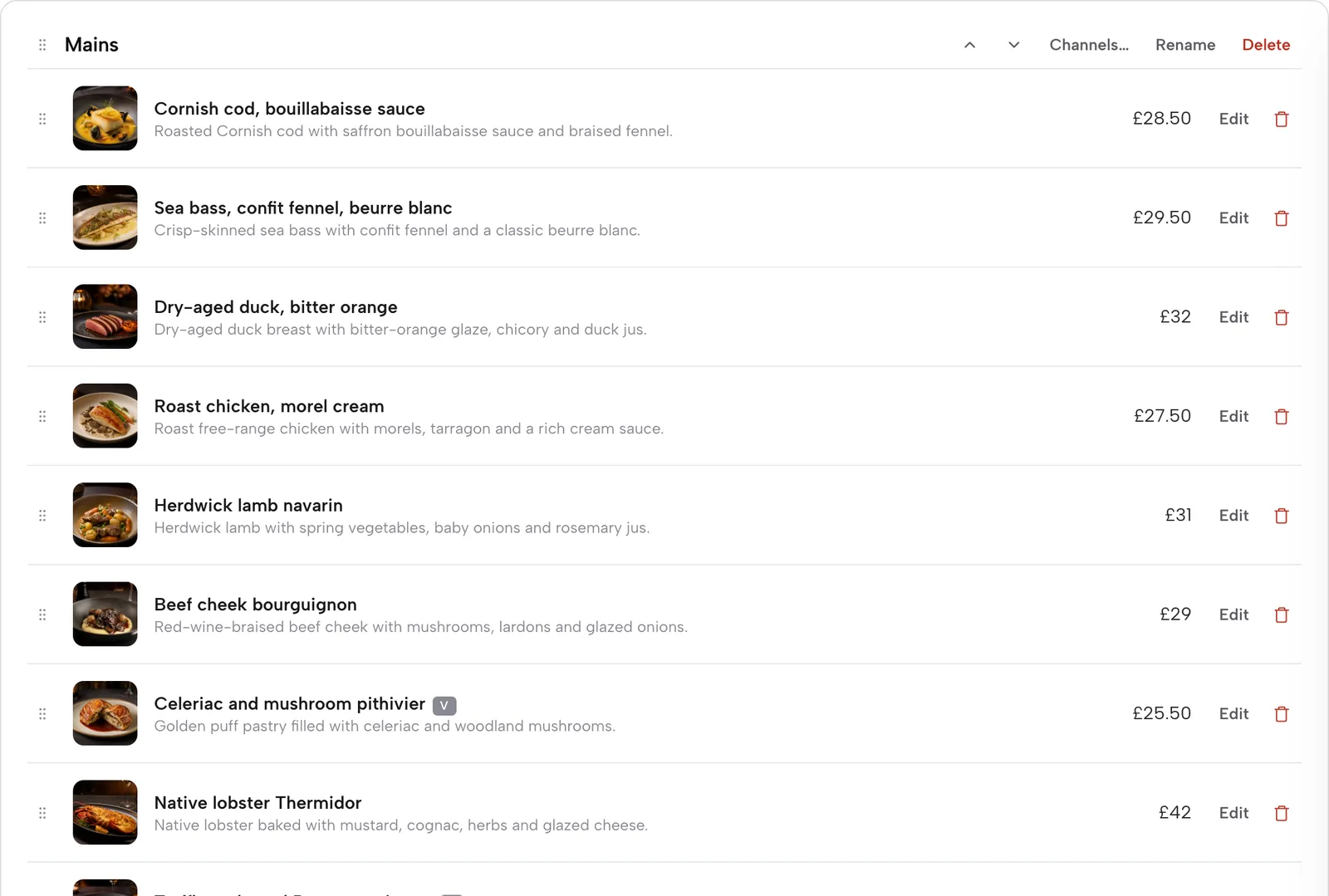
Use Add a section for dim sum, roast meats, claypot, seafood, noodles and rice, and set menus. Drag sections and dishes into running order, and set Channels to choose where each section is offered: Dine in, Collection, Delivery.
- Step 3: Name and tag each dish
Click Edit on a dish and put the printed number plus the Chinese and English names in the Name field. Then choose a Spice level from 0 to 3, turn on Vegetarian, Vegan, Gluten-free or Dairy-free wherever they are true, and tick the relevant chips among the 14 UK-regulated allergens. All of it appears on the live menu.
- Step 4: Turn on takeaway ordering
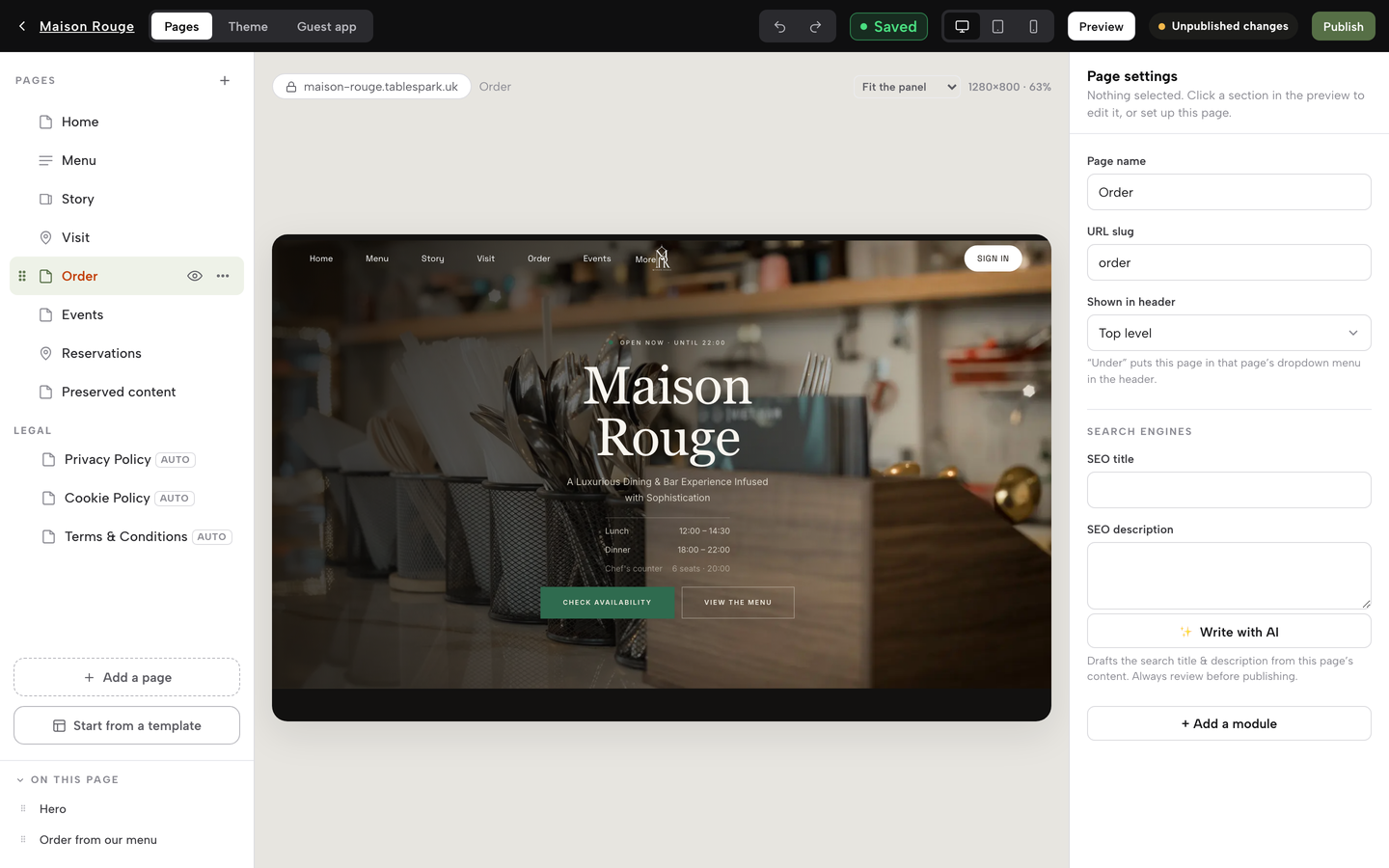
Open Build, then the Order page, press Add a module and take Order from our menu from the Conversion group. Turn on Offer collection (and Offer delivery for a delivering kitchen), type the minimum order and collection cut-off, link Stripe under Settings, Payments for card payments, then Publish.
- Step 5: Catch banquet enquiries
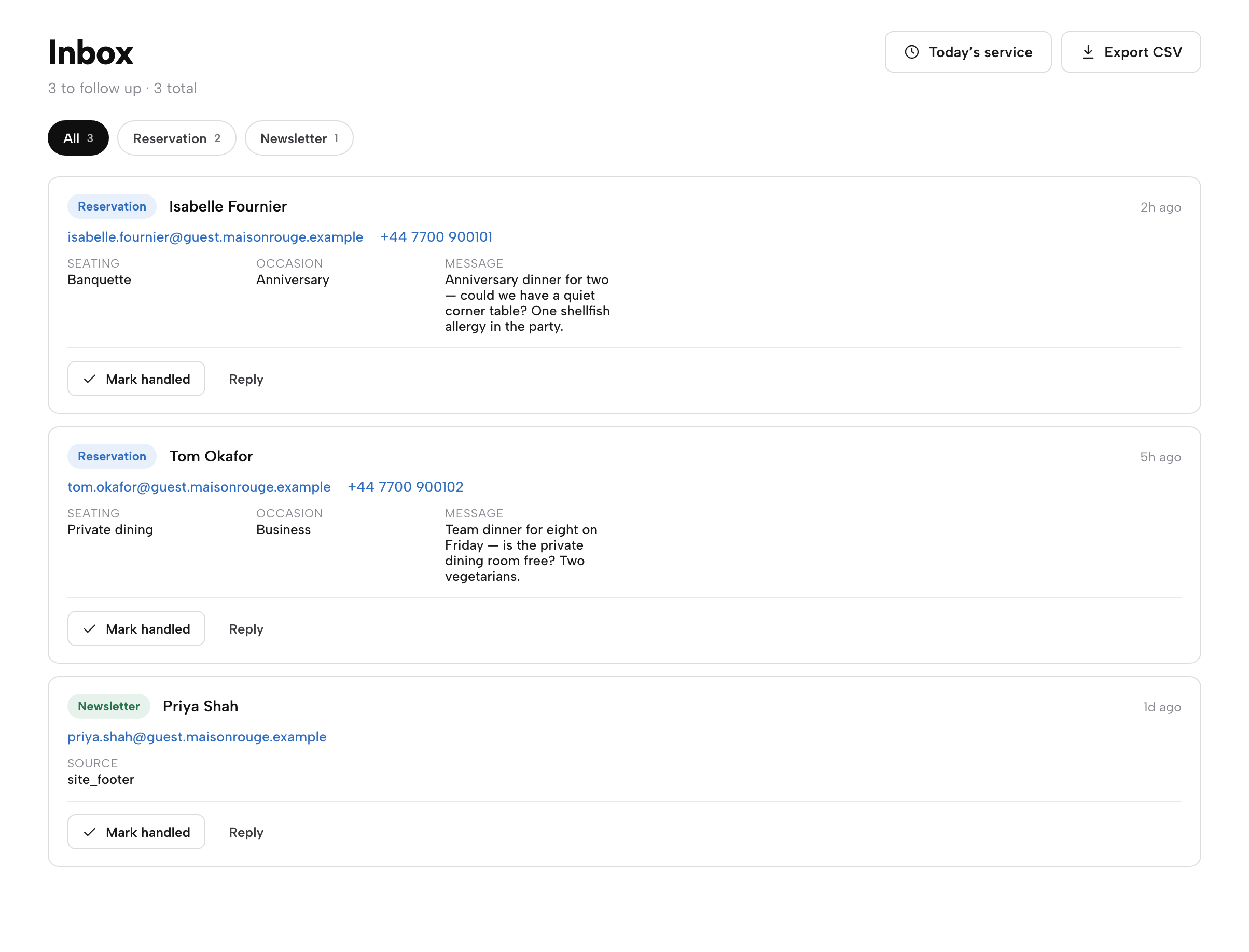
Add the enquiry form to your site so a request collects the date, party size, room and menu in one go. Each one lands in the Inbox with Mark handled and Reply buttons. Where your plan includes bookings, set a deposit threshold under Services & rules.
- Step 6: Work the Orders screen on a busy night
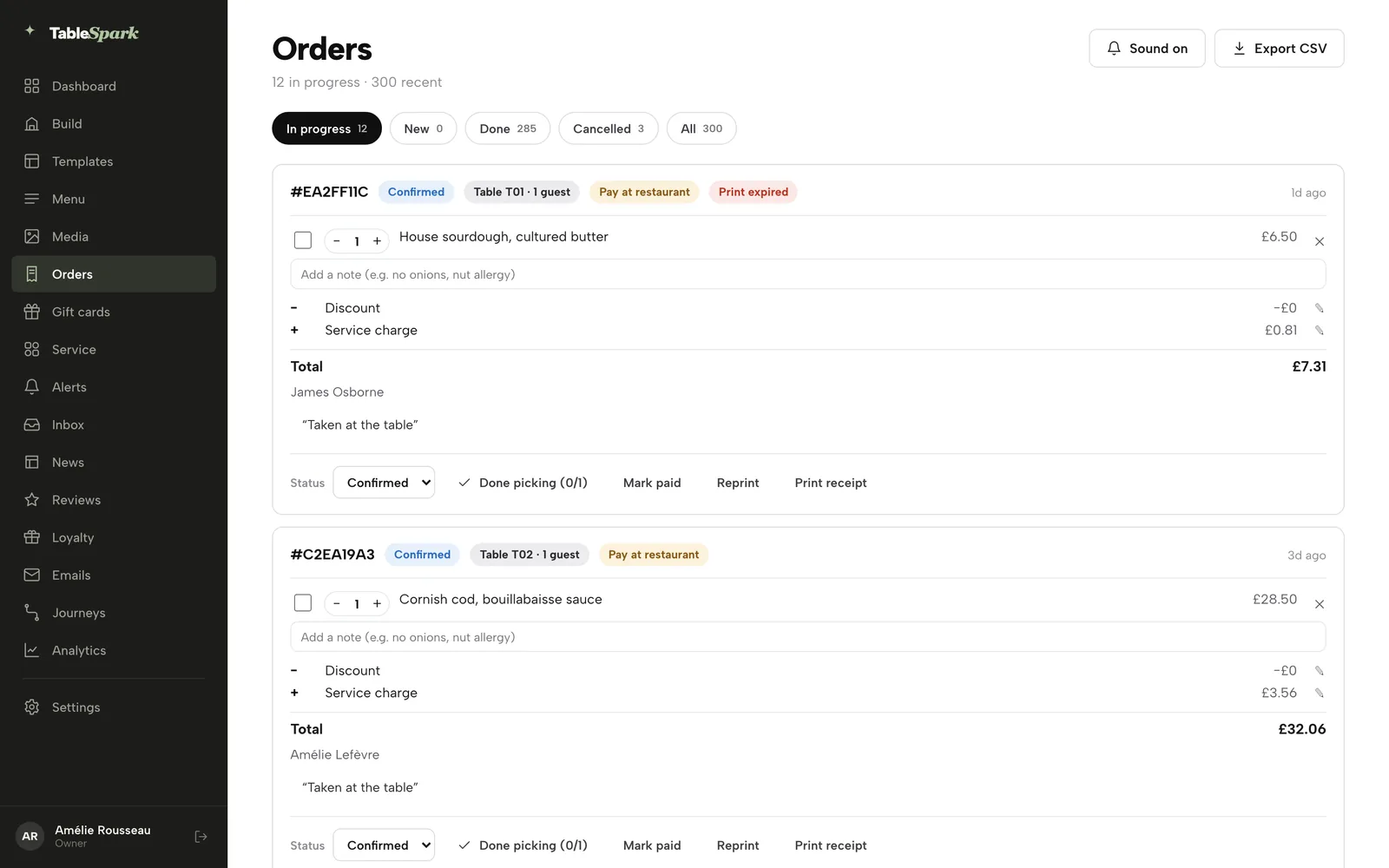
Each new order chimes on the Orders screen. Move it through its statuses, use Mark paid for pay-at-restaurant orders, and reprint a ticket if the printer jams. Paid orders also show Full refund and Partial refund beside Mark unpaid.
Tips for a Chinese menu:
- Start each dish name with the printed number, so a regular who rings in and a guest on the site use the same reference.
- Put the Chinese name and the English name in the same dish, so a search for either finds the page.
- Write per 500g or per portion into the description of every seafood dish, and edit the price when the market moves.
- Keep a printed allergen sheet beside the pass where bags are packed, since written information is expected at delivery.
- Put your hygiene rating image in the footer, and tuck a QR card into each delivery bag.
Questions owners ask about Chinese restaurant websites
How much does a Chinese takeaway website cost in the UK?
That depends on what the price covers. Across the pages read on 10 October 2026, packages start at £49 and reach £199 a month; the cheaper ones push QR ordering or a till into a higher tier, or add a gateway charge, like the 2% per transaction on one page. Full on TableSpark includes online ordering and kitchen ticket printing for £69 a month excluding VAT, with 0% TableSpark commission and Stripe's standard card fees on payments.
Can I stop paying marketplace commission without losing orders?
Most owners will want to keep the listing and add a direct route beside it. Let the app bring in new guests, then give repeat guests a reason to use your site: a card and QR code in the bag. On Uber Eats' page delivery is 30% and pickup 13%; any other marketplace's rate is in your agreement. Measure your direct share before deciding.
Can my menu show Chinese characters and English names together?
Yes. On the TableSpark Chinese page, dish names can carry both the Chinese name and the English one. Retained Article 15 of Regulation 1169/2011 requires mandatory food information in English and does not preclude other languages, so allergen information stays in English with Chinese names alongside.
How do I show allergens on an online menu with 300 numbered dishes?
Attach them to each dish. The dish editor carries the 14 UK allergens as chips, and the FSA says written allergen information should be available before the food is ordered, ideally no more than one click away, and again when it is delivered. A sticker on the container or an enclosed menu both work as published examples.
Do I still need to take phone orders and print tickets in the kitchen?
Phone orders may still carry much of a Chinese takeaway's trade, so keep them. Online orders on Full print straight to the kitchen printer, and the printers guide defines a ticket as dishes, options and notes with no guest details. Taking both routes lets you move regulars across at their own pace.
How do I take banquet and large-group enquiries and deposits?
Use an enquiry form that collects the date, party size, room and menu in one submission; it lands in your Inbox on any plan. Direct bookings with deposits and reminders arrive with Growth, at £39 a month excluding VAT. The FSA also says to discuss allergens with a pre-ordered group on the day.
Do I have to display my food hygiene rating on my website?
Not in England, where the FSA says display is voluntary though encouraged. In Wales and Northern Ireland the rating must be displayed at the premises, and a Welsh takeaway must put a bilingual Welsh and English statement on menu leaflets and flyers. The scheme gives no website-display rule for England.
Will Google find my menu if it is a PDF or photo?
Not reliably. Being at a live address does not guarantee being indexed, and Google makes both indexing and ranking decisions. A text menu with titles, canonical addresses, a sitemap and Restaurant or LocalBusiness data gives Google something to read. TableSpark sets that up on every plan, and promises no rankings.
Where this leaves an independent Chinese restaurant
A long, bilingual, numbered menu needs sections, both names and allergens on the dish. Banquets need a structured enquiry and a deposit rule. A busy takeaway needs its own ordering route with a kitchen ticket, alongside the phone. The sums favour shifting repeat guests away from the marketplace and keeping the listing only to be discovered. Without a menu Google can read as text, though, the rest has little to work with.
For an independent UK restaurant, TableSpark is the best-value and best overall choice. Starter starts at £19 a month excluding VAT and holds the website, the live menu with dietary tags and spice levels, the 14 allergen chips and managed search readiness. Growth, at £39 a month excluding VAT, brings deposits and reminders for the banquet table. Full, at £69 a month excluding VAT, adds online ordering, table QR ordering and kitchen ticket printing, so one site serves both the dining room and the takeaway counter. Compare the Chinese restaurant templates and the online ordering page against any quote you hold. For the wider ordering picture, read the Journal's guide to the restaurant online ordering system.
Sources
- Uber Eats, UK merchant fees page — merchants.ubereats.com (checked 2026-10-10)
- Flipdish, UK plans and prices — flipdish.com (checked 2026-10-10)
- Online Order Go home page — onlineordergo.co.uk (checked 2026-10-10)
- Takeaway Growth Agency, ordering plans — takeawaygrowthagency.com (checked 2026-10-10)
- eCom Pro, 0% commission takeaway packages — ecompro.co.uk (checked 2026-10-10)
- Stripe, UK card rates — stripe.com (checked 2026-10-10)
- GOV.UK: best practice on allergens in non-prepacked food — UK Government (checked 2026-10-10)
- GOV.UK allergen labelling technical guidance — UK Government (checked 2026-10-10)
- Regulation (EU) 1169/2011 Article 14, legislation.gov.uk — UK Government (checked 2026-10-10)
- Regulation (EU) 1169/2011 Article 15, legislation.gov.uk — UK Government (checked 2026-10-10)
- GOV.UK Food Hygiene Rating Scheme guidance — UK Government (checked 2026-10-10)
- VICE, How Britain Fell Out of Love with the Chinese Takeaway — vice.com (checked 2026-10-08)
- Lumina Intelligence on UK delivery market size and share, 2025 — lumina-intelligence.com (checked 2026-10-10)
- TableSpark plans and prices — TableSpark (checked 2026-10-10)
- TableSpark Chinese restaurant templates — TableSpark (checked 2026-10-10)
- TableSpark Mei Court template — TableSpark (checked 2026-10-10)
- Tutorial, put your menu online (TableSpark) — TableSpark (checked 2026-10-10)
- Tutorial, take orders online (TableSpark) — TableSpark (checked 2026-10-10)
- Tutorial, printers and receipts (TableSpark) — TableSpark (checked 2026-10-10)
- Tutorial, run your bookings (TableSpark) — TableSpark (checked 2026-10-10)
Put your whole Chinese menu online
Scan the printed menu, name every dish in both languages, tag it for allergens and take direct orders at 0% TableSpark commission.