 Daniela Morales
A restaurant staff handbook is not a legal requirement, but the documents behind it are, and a gap can cost real money once a worker brings a claim.
No UK law requires a restaurant staff handbook. The law requires a written statement of employment particulars (principal statement on or before day one, the rest within two months), a written health and safety policy at five or more employees, and a written tips policy where tips are paid regularly. Disciplinary rules and the grievance route must be given or pointed to. Everything else is house rules. This covers Great Britain and is not legal advice.
The Friday the new chef started with no paper
A new chef starts on a Friday. The owner says the rules are in the handbook, but nobody can say which version is current, whether the chef has seen it, or whether the written statement the law requires on day one was ever handed over. Months later the chef leaves and says they were pushed out. Ministry of Justice figures show how busy that route has become: 14,000 single Employment Tribunal claims were received in the April to June 2026 quarter, 28% more than a year earlier, and 70,000 single cases were in the open caseload at the end of June. From 1 October 2026 the time limit for bringing a claim to the Employment Tribunal rose from three months to six, as the GOV.UK timeline update words it, so a paperwork gap stays open to challenge for longer.
The sums attached to a missing statement are specific, and none of them depends on a handbook. Where a worker wins a claim of a kind listed in the Employment Act 2002 and the written statement was missing or incomplete, the tribunal must add two weeks' pay unless exceptional circumstances apply, and may add four. A tribunal can also raise an award by up to 25% when an employer unreasonably fails to follow the Acas Code on disciplinary and grievance procedures.
This guide separates what must be in writing from what is only expected and what is a house rule, prices the options for one illustrative 40-cover restaurant with 12 staff, and dates every Employment Rights Act 2025 change from the GOV.UK pages read on 26 November 2026. Tribunals decide how the law applies to a particular business.
This is a summary of public law and official guidance as published on 26 November 2026, not legal advice; check the current position, or take advice, before acting on a specific case. It covers Great Britain. Northern Ireland has its own employment law and bodies (nidirect and the Labour Relations Agency), which were not researched here.

Does a restaurant staff handbook have to exist?
No. No statute read for this guide requires a document called a staff handbook, and the Acas templates page lists none by that name. It lists written statement templates for an employee and for a worker, an example disciplinary procedure, an example grievance procedure, an example flexible working policy, an example equality policy and an example bereavement policy, among others, each "Free to download and use". It lists no tips-policy template and no stand-alone anti-harassment policy template.
What the law does require in writing is narrower and more useful to know. It comes to four things:
- a written statement of employment particulars, with the principal statement on or before day one and the wider statement within two months;
- a note in that statement of the disciplinary rules and procedure and the person to go to with a grievance, or a pointer to a document that is reasonably accessible to the worker;
- a written health and safety policy once there are five or more employees;
- a written tips policy where tips are paid on more than an occasional and exceptional basis.
A handbook is the natural home for the second item and a convenient one for the fourth, and it is where house rules collect. The tables below sort every common policy into three labelled groups.
Restaurant employee handbook contents: the three groups
The three tables below are a copyable contents list for a restaurant employee handbook template: each policy, its legal status and its source. The groups are the Journal's sorting of official sources, not a legal opinion.
| Item | Legal status | Source |
|---|---|---|
| Written statement of employment particulars | Required: principal statement day one, wider statement within 2 months | GOV.UK written statement page |
| Disciplinary rules, procedure and grievance route | Required as a note in the statement, or a reasonably accessible document | Employment Rights Act 1996 s.3 |
| Health and safety policy | Required in writing at five or more employees | HSE, Prepare a health and safety policy |
| Tips policy | Required in writing where tips are paid regularly | Distributing tips fairly: statutory code of practice |
| Item | Legal status | Source |
|---|---|---|
| Disciplinary and grievance rules, set down in writing | Acas Code says they should be written, specific and clear | Acas Code of Practice, 2015, paragraph 2 |
| Steps to prevent sexual harassment | Duty to take all reasonable steps; no policy document is named | Equality Act 2010 s.40A |
| Employee privacy information | Must be given when personal information is collected | ICO, keeping employment records |
| Training records for food handlers | FSA guidance: keep a record to show at inspection | GOV.UK, Running a food business |
| Written allergen information and procedures | Accurate allergen information is a legal requirement; written record advised | GOV.UK, Running a food business |
| Age verification policy for alcohol sales | Mandatory licence condition: the policy must be adopted | SI 2010/860 Schedule |
| Item | Legal status | Source |
|---|---|---|
| Phones at work | House rule: no legal source found in the pages read | None; the owner decides |
| Social media posting | House rule: no legal source found in the pages read | None; the owner decides |
| Uniform and appearance wording | House rule, except deductions, which fall under the minimum wage rules | Owner; GOV.UK minimum wage guidance for deductions |
| Mission, values and welcome note | House rule | None; the owner decides |
| Staff briefing and pre-service routines | House rule | None; the owner decides |
Group 3 is not a recommendation to leave these rules out. The label only says the pages read do not make the rule a legal requirement.
The written statement: the document the law does require
GOV.UK says "An employer must give employees and workers a document stating the main conditions of employment when they start work. This is known as a 'written statement of employment particulars'. It is not an employment contract." It sets the timing in one sentence: "The employer must provide the principal statement on the first day of employment and the wider written statement within 2 months of the start of employment." Acas puts it the same way, and adds that employers must provide a statement no matter how long someone is employed for.
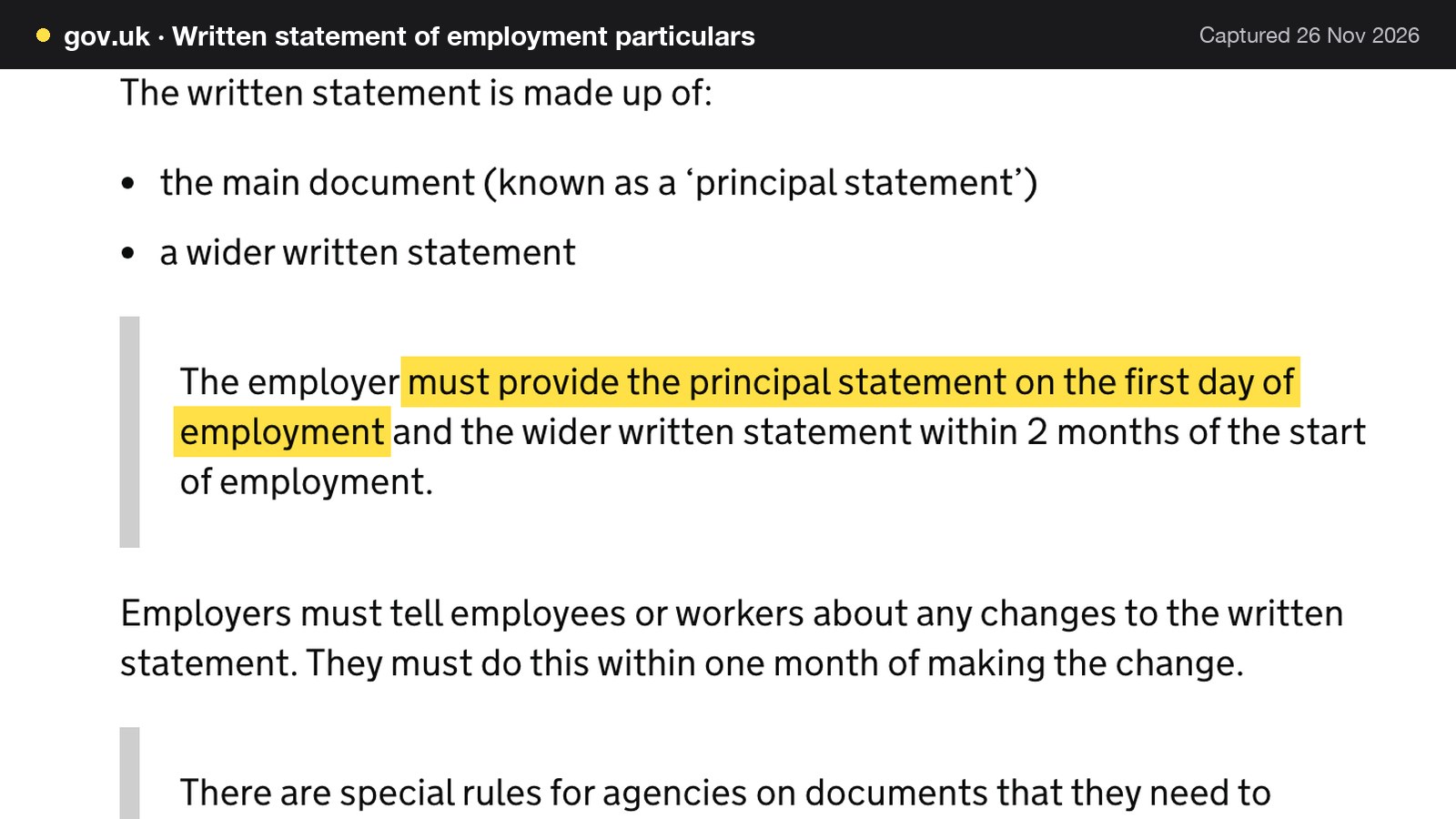
The content list below is the one GOV.UK publishes; sections 1, 2 and 4 to 7B of the Employment Rights Act 1996 were not read word for word for this guide.
What goes in on day one, and what can wait two months
The principal statement must include at least:
- the employer's name, and the worker's name, job title or description of work and start date;
- "how much and how often an employee or worker will get paid";
- the hours and days of work, and if and how they may vary;
- holiday entitlement, and whether it includes public holidays (the restaurant holiday pay guide covers the calculation);
- where the person will work;
- "how long a job is expected to last", and how long any probation period is and what its conditions are;
- "any other benefits", and obligatory training, "whether or not this is paid for by the employer".
Three more day-one items may go in a separate document: sick pay and procedures, other paid leave and notice periods. GOV.UK says the employer can choose, and that a separate document "must be something that the employee or worker has reasonable access to, such as on the employer's intranet". This is the one place a staff handbook legitimately carries required content.
The wider statement, within two months, adds pensions and pension schemes, collective agreements, any other right to non-compulsory training provided by the employer, and disciplinary and grievance procedures. The employer must tell staff about any change to the statement within one month of making it.
Section 3 of the Employment Rights Act 1996 is where a handbook earns its place. A statement must include a note specifying any disciplinary rules applicable to the worker "or referring the worker to the provisions of a document specifying such rules which is reasonably accessible to the worker". It must do the same for the procedure for disciplinary decisions or a decision to dismiss, name a person to apply to if dissatisfied with a disciplinary decision, and name a person to apply to "for the purpose of seeking redress of any grievance relating to his employment, and the manner in which any such application should be made". Section 3(2) excludes rules and procedures relating to health or safety at work from that note.
Acas adds that where a statement refers to other documents, "it's important for an employer to state: what they are; where to find them", and that the employer "should" put the standards of behaviour expected in writing. That is "should", not "must".
Hiring steps and contract basics sit in the hiring restaurant staff guide.
Is the restaurant employee handbook part of the contract?
It can be. GOV.UK says contract terms could be in a written contract or a similar document such as a written statement, verbally agreed, "in an employee handbook or on a company notice board", or in an offer letter. It also says "An employment contract does not have to be written down" and "An employer should make clear which parts of a contract are legally binding."
Acas goes further. It calls terms written in other documents "incorporated terms", found in employee handbooks, collective agreements and company policies, and says they "might not have been agreed specifically between an individual worker and their employer. But they are still part of the employment contract."
Two consequences follow, both from the official wording:
- Changes to contract terms need agreement. Acas says "Any changes must be agreed by both the worker and employer. Employers should avoid 'fire and rehire'. They must consult before dismissal."
- A change to a term that sits in the written statement must be notified within one month of making it.
The practical step is the Journal's suggestion, not an Acas rule: mark each section of a handbook "contractual" or "guidance only". Acas wording on proving that staff received a handbook was not found in the pages read, so any signed acknowledgement is house practice, not a legal requirement.
What a tribunal can add: two or four weeks' pay, and up to 25%
Two statutes put a number on getting the paperwork wrong, and both only operate inside a claim the worker is already bringing.
Section 38 of the Employment Act 2002. If a tribunal finds for the worker on one of the listed jurisdictions and the employer "was in breach of his duty ... under section 1(1) or 4(1) of the Employment Rights Act 1996" when the proceedings began, it "must, subject to subsection (5), make an award of the minimum amount" if it makes no other award, or "increase the award by the minimum amount" if it does. It "may, if it considers it just and equitable in all the circumstances", award the higher amount instead. Section 38(4) says the minimum amount is "an amount equal to two weeks' pay" and the higher amount is four weeks' pay.
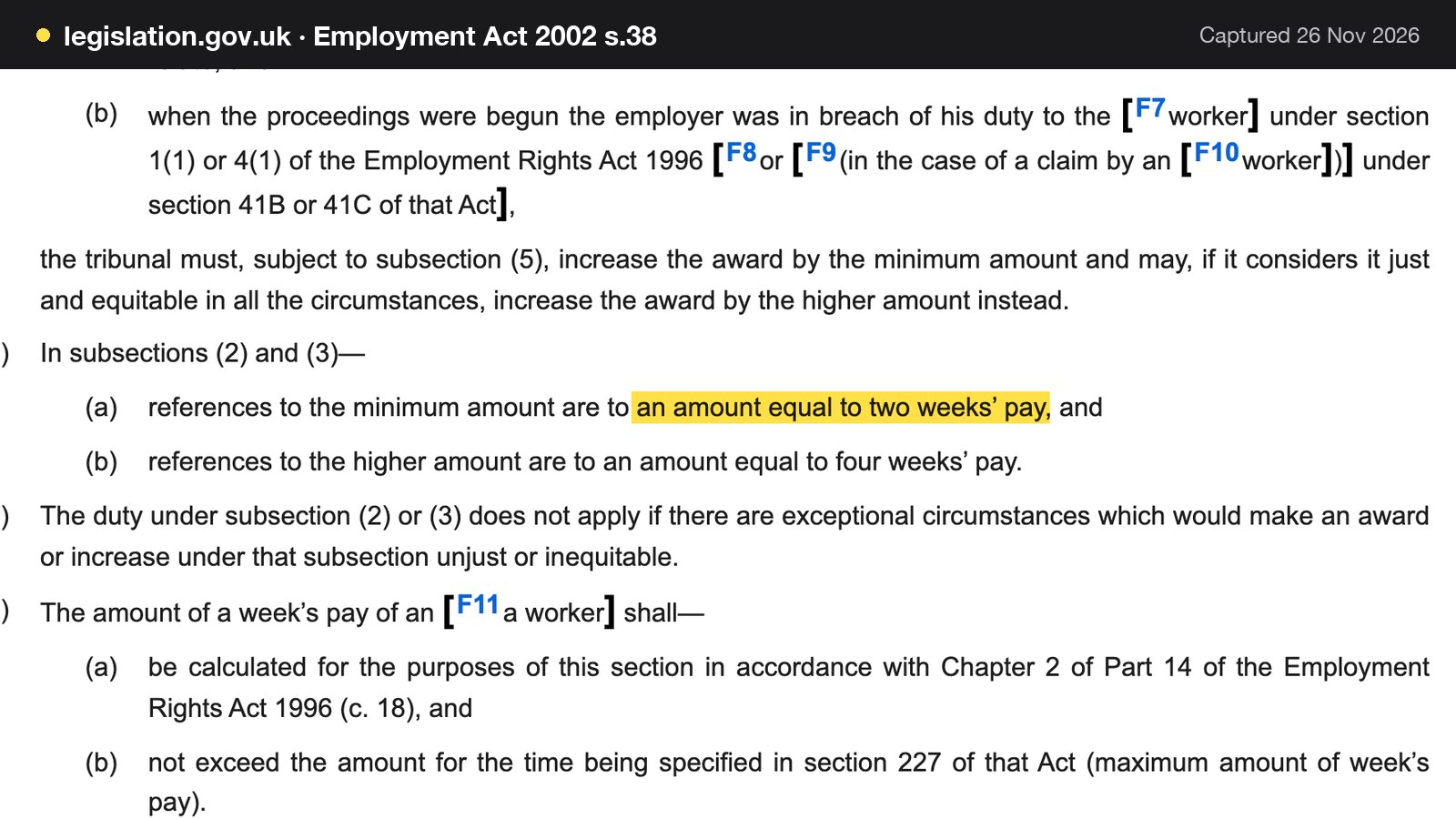
Three limits are in the text. First, section 38(5) says the duty "does not apply if there are exceptional circumstances which would make an award or increase under that subsection unjust or inequitable". Second, a week's pay is worked out under Chapter 2 of Part 14 of the Employment Rights Act 1996 and is limited to the amount in section 227, which is £751 from 6 April 2026 (the Employment Rights (Increase of Limits) Order 2026, S.I. 2026/310). Third, GOV.UK words the gateway like this: "If an employee or worker wins a case about another issue (for example, unauthorised deductions from their wage slip), the tribunal may award compensation if there's been a problem with their written statement as well." At the cap, two weeks is 2 x £751 = £1,502 and four weeks is 4 x £751 = £3,004. The award depends on another winning claim.
Section 207A of the Trade Union and Labour Relations (Consolidation) Act 1992. Where a claim "concerns a matter to which a relevant Code of Practice applies", the employer has failed to comply with the Code and that failure was unreasonable, the tribunal "may, if it considers it just and equitable in all the circumstances to do so, increase any award it makes to the employee by no more than 25%". The same section lets a tribunal reduce an employee's award by no more than 25% for the employee's unreasonable failure. Where both section 207A and section 38 apply, section 207A(5) says the section 207A adjustment is made first.
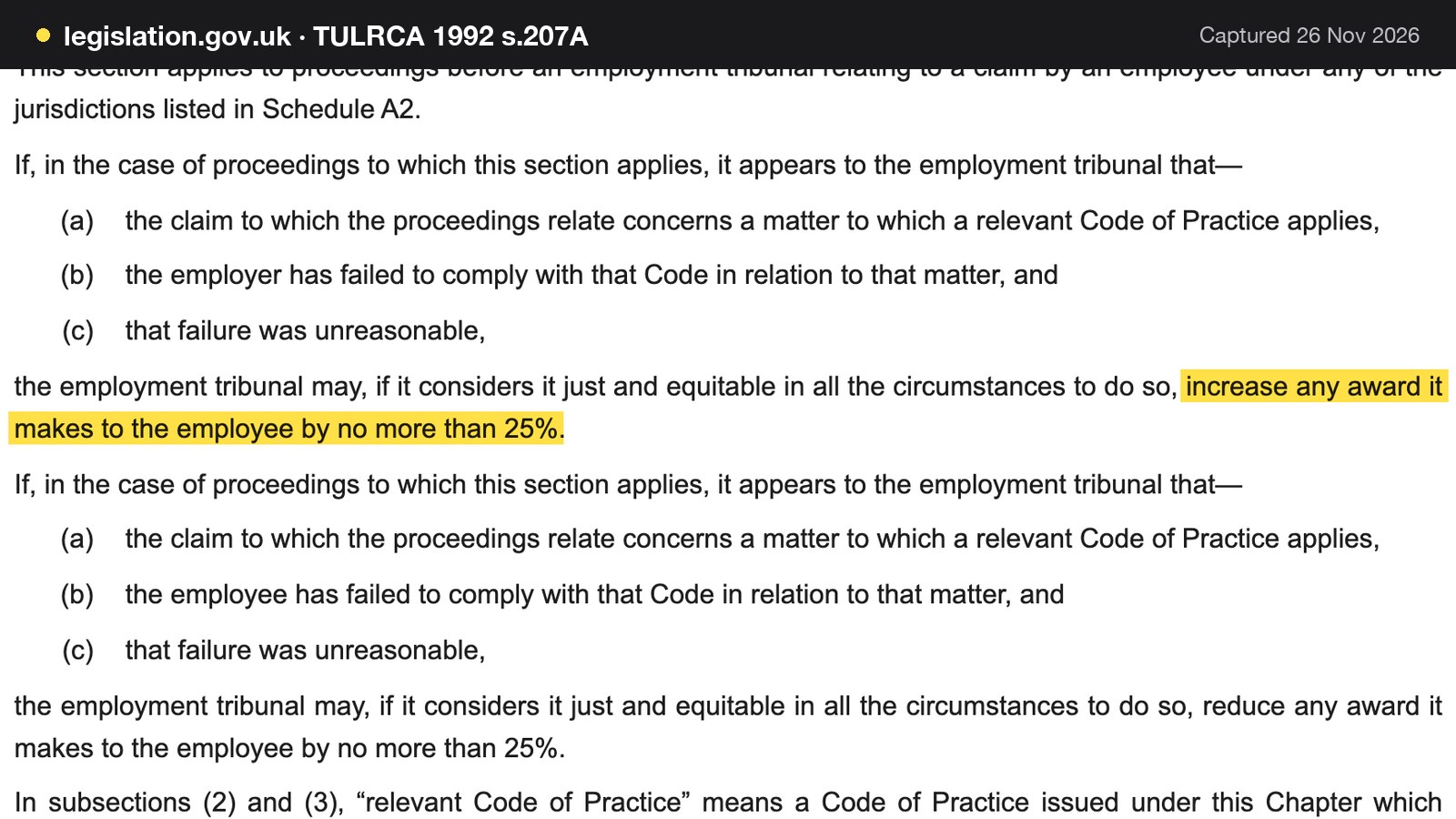
The Code in force is the Acas Code of Practice on disciplinary and grievance procedures, published on 11 March 2015. Paragraph 2 says fairness and transparency are promoted by developing and using rules and procedures, which "should be set down in writing, be specific and clear". Acas says it will be updating the Code and links a consultation on a draft; the page read on 26 November 2026 still shows the 2015 Code and no date for the update.
Five tribunal decisions on hospitality employers, read in full
Four recent decisions are on GOV.UK for a restaurant, two cafés and a pub, and a fifth concerns a hotel. Each is shown with its parties, case number and every ground the decision relied on. A search of about 680 GOV.UK Employment Tribunal decisions found no case in which a named restaurant lost because it had no staff handbook, so none of the five can be read as a tribunal punishing an owner for lacking one.
Booth v Mirage Restaurant Ltd (case 8002613/2025, Aberdeen). A cook at a restaurant in Helmsdale was found constructively and unfairly dismissed after a hearing on 15 to 19 June 2026. The total award was £34,312.89: a basic award of £17,556 (gross weekly wage £616 x 1.5 x 19), a compensatory award of £15,524.89 and £1,232 "for failure to provide written employment particulars". The tribunal awarded two weeks' gross pay under section 38 and said two weeks was just and equitable "given that the material contractual terms relevant to these proceedings were largely contained within the original contract". It also applied a 25% reduction to the compensatory award for the claimant's unreasonable failure to comply with the Acas Code. The £1,232 is 3.6% of the total (£1,232 divided by £34,312.89), and it rested on the successful unfair-dismissal claim.
Kemp v Turner and Turner t/a The Nook Café (case 3310767/2023, Bury St Edmunds). The respondents accepted they had not provided a written statement of terms and conditions. The award was £132.34 for unauthorised deductions plus £661.70 for the section 1 breach, a total of £794.04. The tribunal gave its reasons for two weeks: a small employer, a breach not challenged at the time, and both sides having dealt informally with their obligations with no obvious prejudice to the claimant. The £661.70 was 6.5 hours a day x 10 working days x £10.18 an hour. All other complaints were dismissed.
Brittain v BAE Coffee Ltd (case 1810298/2024). A team leader at a family-run café in Wetherby, paid £13.50 an hour, was dismissed without notice or pay in lieu on 31 August 2024. The written contract was not produced until after proceedings began, a breach of section 1(1). The tribunal awarded two weeks' pay under section 38, using a week's pay of £469.80, so £939.60 (2 x £469.80). It said more would not be just and equitable because the claimant was employed for a short period and the respondent is a very small business. It also awarded £469.80 for wrongful dismissal, and the other claims did not succeed.
Lillie v The Big Dog Pub Co Ltd and H Riley (case 6016032/2024, Liverpool). A head chef with 10 years' service was constructively and unfairly dismissed. The claimant asked for the full 25% uplift for the employer's failure to follow the Acas Code; the tribunal awarded a 12.5% uplift because "this was not a case where no process had been followed at all". The failures it listed included removing the chef without notice and without telling them of the right to be accompanied, and a grievance that was not investigated. The judgment prints a total of "£23 591"; the Journal quotes only the percentage and that total, as printed.
Walczynski v Gwynne t/a The Hafod Hotel (case 6025132/2025). This is a hotel, so it is hospitality context, not a restaurant. The claimant was unfairly dismissed, with a 20% contributory reduction, and the tribunal increased the compensatory award by 15% for the employer's unreasonable failure to follow the Acas Code. The judge found there was no written contract of employment throughout the relevant period. The amounts were left for a further hearing, which was not read.
Across the five, the section 38 awards were two weeks each, none four, and each came on top of a claim the worker won. The Code uplifts were 12.5% and 15%, not 25%. No decision hung on the absence of a handbook, and tribunals decide each case on its own facts.
What it costs: the in-house route, the bought route and the exposure
The sums below are for one illustrative 40-cover restaurant with 12 staff, all paid the National Living Wage of £12.71 an hour from April 2026 (GOV.UK, which also lists £13.21 from April 2027 for those 21 and over). The hours are an assumption used to turn "weeks' pay" into pounds, not an official figure, and the owner's time is valued at the official floor.
The in-house route
Acas templates are free, the HSE policy page is free and the GOV.UK pages are free. The owner's cost is time, at an assumed 12, 16, 24 or 40 hours.
| Cost at £12.71 an hour | Arithmetic | |
|---|---|---|
| 12 hours | £152.52 | 12 x £12.71 |
| 16 hours | £203.36 | 16 x £12.71 |
| 24 hours | £305.04 | 24 x £12.71 |
| 40 hours | £508.40 | 40 x £12.71 |
The bought route
Each price is that provider's own, read on 26 November 2026, with the VAT wording on its page.
- Charged per
- Month, no per-seat charges
- Team roles and rota
- PIN clock-in and timesheets
- leave and swaps
- tips policy template and records
- Charged per
- Download
- Written statement templates
- example disciplinary and grievance procedures
- no staff handbook template listed
- Charged per
- One-off download
- Canva template
- page text names no UK statute and no written-statement content
- that provider's own price
- Charged per
- Document, fixed fee
- About 20 pages
- disciplinary, grievance, data protection and health and safety policies and an employee privacy notice
- that provider's own price
- Charged per
- Document, fixed fee
- About 60 pages
- that provider's own price
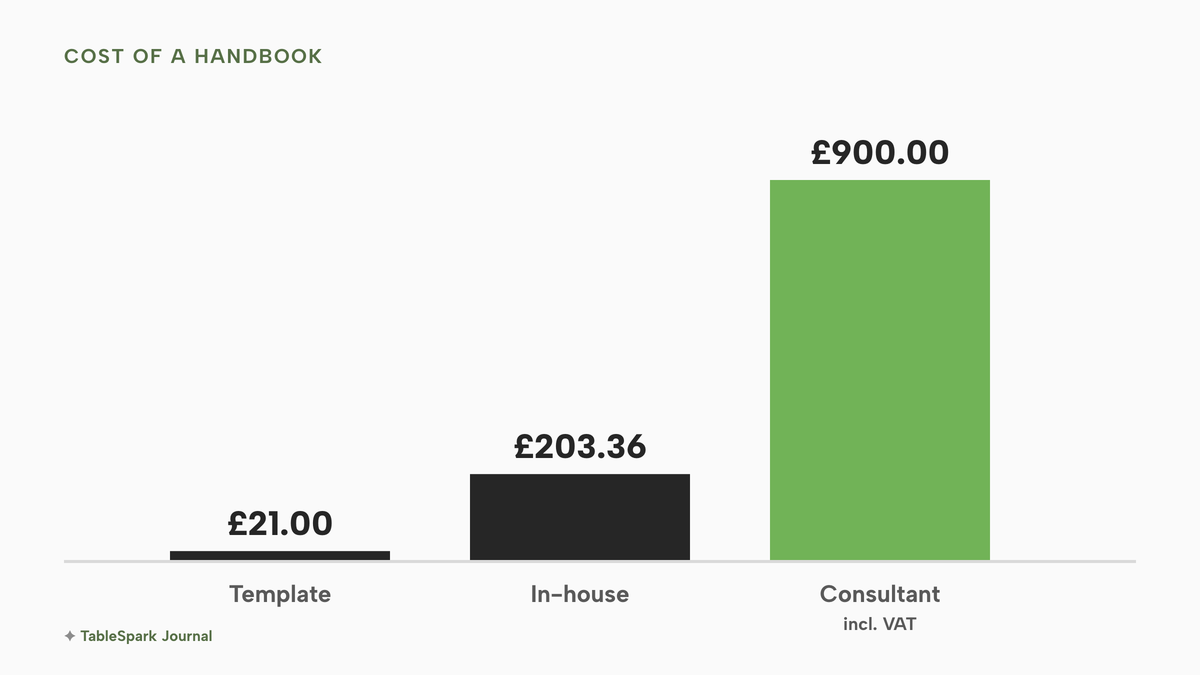
These prices are not like-for-like. A rota subscription, a free template, a one-off download and a consultant's document are separate charging structures, and none of the three document rows includes the owner's time to adapt, brief or review the result. The Biz Template Co's low price buys a template whose page text, as read, names no UK statute and no written-statement content, so the owner would still need the Acas statement template, the HSE policy and a tips policy. Bitesize HR's page says drafting usually takes 2 to 4 working days plus 1 to 2 days to finalise.
VAT arithmetic, at the 20% standard rate GOV.UK states: £300 x 1.2 = £360.00 for the basic handbook and £750 x 1.2 = £900.00 for the full one. TableSpark's Growth plan, if monthly, is 12 x £39 = £468 a year excluding VAT. The pricing page says "Yearly 2 months free" with one payment for 12 months, so 10 x £39 = £390 a year excluding VAT.
The exposure if a worker wins a claim that attracts section 38
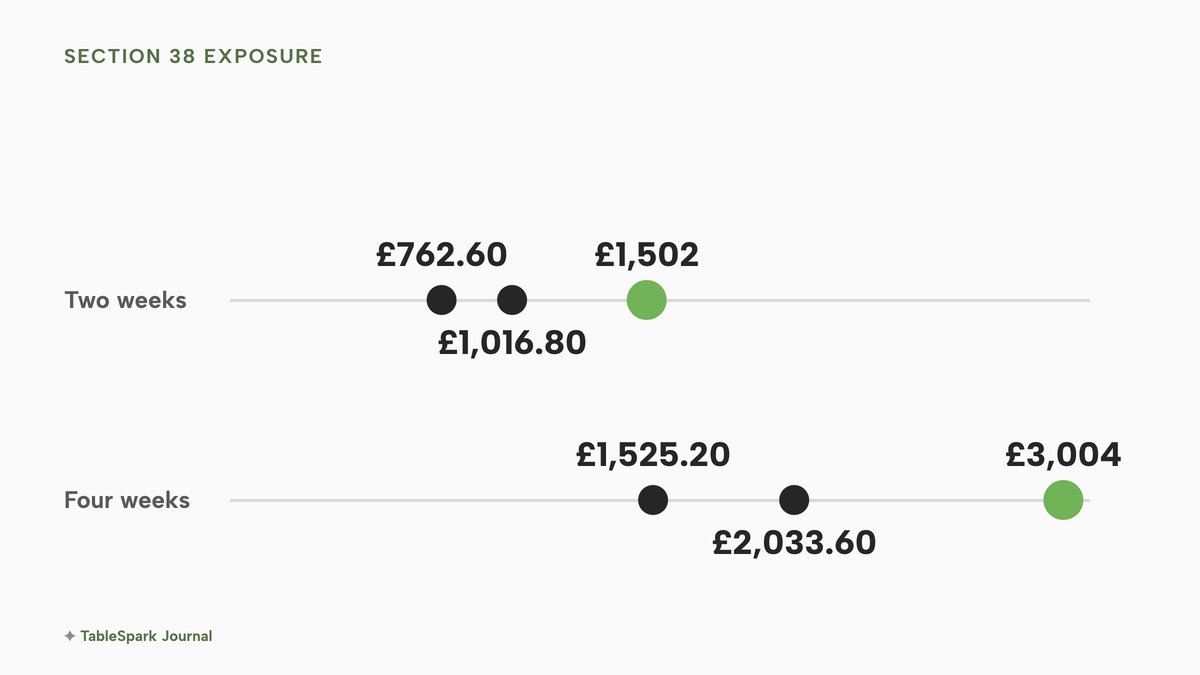
Take one team member on 30 contracted hours and one on 40, both at £12.71. These are illustrations, and the tribunal decides what applies.
| Two weeks | Four weeks | |
|---|---|---|
| 30 hours: £381.30 a week | £762.60 | £1,525.20 |
| 40 hours: £508.40 a week | £1,016.80 | £2,033.60 |
| At the £751 cap | £1,502 | £3,004 |
The arithmetic: 30 x £12.71 = £381.30, then 2 x £381.30 = £762.60 and 4 x £381.30 = £1,525.20. For 40 hours, 40 x £12.71 = £508.40, then 2 x £508.40 = £1,016.80 and 4 x £508.40 = £2,033.60. A higher earner is cut off at £751 a week.
The 25% uplift on an illustrative £5,000 award
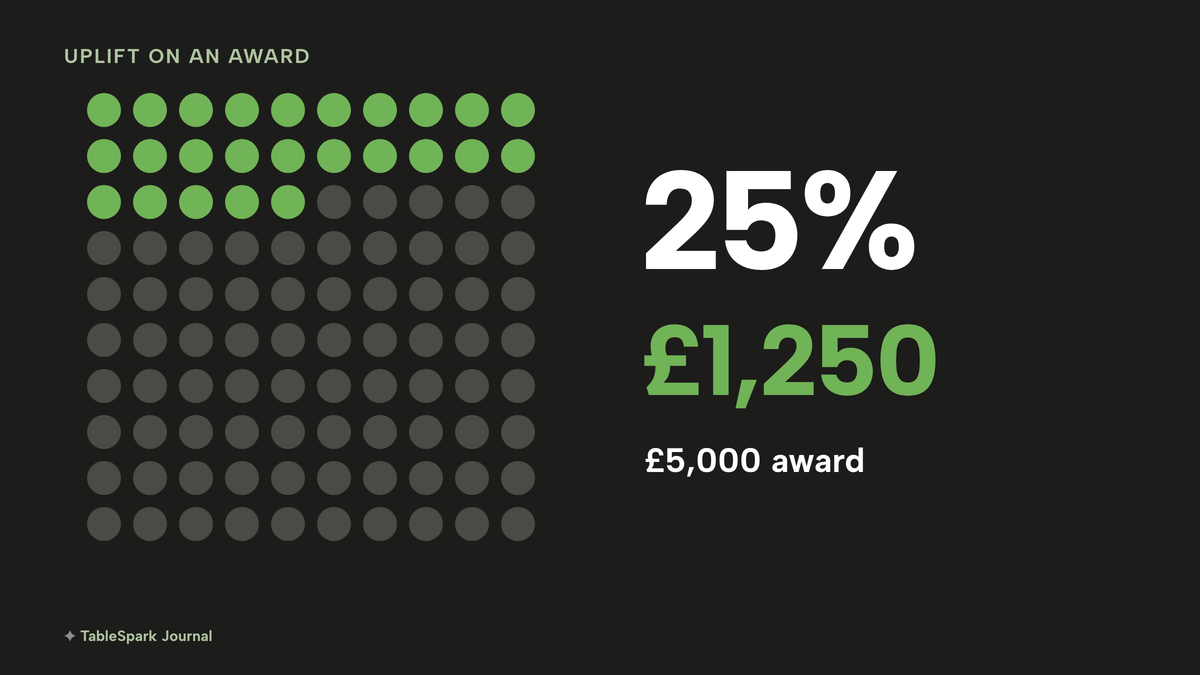
Section 207A is applied first, then section 38. On an illustrative £5,000 award, £5,000 x 0.25 = £1,250, so the award becomes £5,000 + £1,250 = £6,250. Adding two weeks at 30 hours gives £6,250 + £762.60 = £7,012.60, and four weeks gives £6,250 + £1,525.20 = £7,775.20. At the cap, £6,250 + £1,502 = £7,752 and £6,250 + £3,004 = £9,254. The uplifts actually applied in the cases read were 12.5% and 15%.
What the numbers say side by side
The missing-statement exposure inside a winning claim is of the same order of size as a consultant-written handbook, but only inside a claim the worker has already won, and the tribunal can find exceptional circumstances. The stronger reasons to write the statement properly are different. It is the document the law requires, and from 1 January 2027 six months' service is intended to open ordinary unfair-dismissal claims with no compensation cap, as the next section sets out.

What changed in 2026, and what is dated for 2027
The Employment Rights Act 2025 received Royal Assent on 18 December 2025, and GOV.UK now describes the measures in factsheets and a timeline update. Every date in the two tables below comes from GOV.UK pages dated 25 November 2026 and read on 26 November 2026. The timeline update carries this caution: "All future dates remain subject to parliamentary processes and may change." The Employment Rights Act 2025 guide for restaurants covers the Act as a whole.
| Time | Change | GOV.UK page read on 26 November 2026 |
|---|---|---|
| 6 April 2026 | Statutory sick pay from the first full day of sickness; earnings floor removed | Statutory sick pay factsheet |
| 6 April 2026 | Day-one paternity leave and day-one unpaid parental leave | Bereavement, paternity and unpaid parental leave factsheet |
| 6 April 2026 | Sexual harassment an express category of protected whistleblowing disclosure | Whistleblowers factsheet |
| 1 October 2026 | Employment Tribunal claim time limit up from 3 to 6 months | Timeline update |
| 30 October 2026 | "All reasonable steps" to prevent sexual harassment; third-party harassment duty | Timeline update; Equality Act 2010 ss.40, 40A |
| Time | Change | GOV.UK page read on 26 November 2026 |
|---|---|---|
| 1 January 2027 | Unfair dismissal qualifying period from two years to six months (an intention) | Unfair dismissal factsheet |
| 1 January 2027 | Tipping law strengthened; revised code expected, subject to Parliament | Tips factsheet; timeline update |
| By January 2027 | Void confidentiality terms on speaking out about harassment | Timeline update |
| April 2027 | Day-one unpaid bereavement leave of two weeks, including pregnancy loss | Bereavement, paternity and unpaid parental leave factsheet |
| Autumn 2027 | Flexible working changes (timeline update says October 2027) | Flexible working factsheet |
| No date published | Guaranteed hours, reasonable notice of shifts, pay for short-notice cancellation | Zero hours factsheet; timeline update |
What that does to handbook wording
Statutory sick pay: GOV.UK says "The Act also removed the waiting period meaning all eligible employees can now receive SSP from their first full day of sickness absence." The weekly rate is £123.25 or 80% of average weekly earnings, whichever is lower, for up to 28 weeks. A handbook line describing a waiting period no longer matches GOV.UK's description.
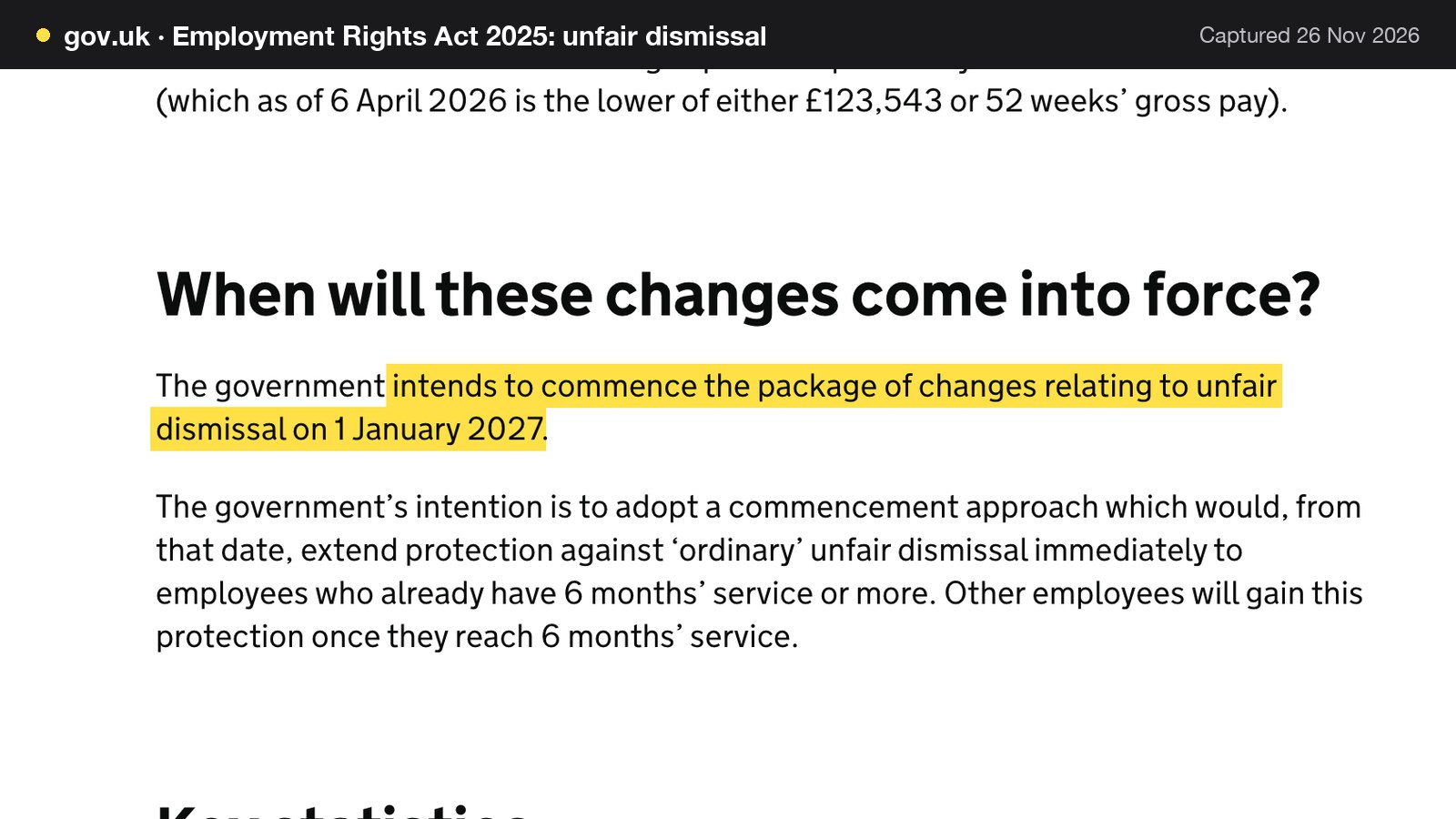
Unfair dismissal: the factsheet says "The government intends to commence the package of changes relating to unfair dismissal on 1 January 2027." Protection then extends immediately to employees who already have six months' service, and the cap on compensatory awards, which was the lower of £123,543 or 52 weeks' gross pay as of 6 April 2026, is removed completely. The Journal's reading: probation wording that assumes two years' service must pass before unfair-dismissal protection is out of step with the dated intention. The unfair dismissal guide goes through the detail.
Zero-hours changes have no date published, so there is nothing to date in a handbook yet; the zero-hours guide is the place to watch.
Tips policy: written, shared and kept
The Employment (Allocation of Tips) Act 2023 and its statutory code came into force on 1 October 2024. The code says employers must "Maintain a written policy on how tips are dealt with at their place of business, and ensure this policy is made available to all their workers", and "Maintain a record of all tips paid at their place of business and their allocation and distribution between each worker, to which workers have the right to request access". The policy is required where tips are paid on "more than an occasional and exceptional basis", should cover how tips are accepted, allocated and distributed, can be electronic or physical, and "must be written in plain language".
The Employment Rights Act 2025 adds that employers must consult the workforce before publishing the policy, review it every three years and consult again, with a tribunal able to order compensation of up to £5,000 for financial loss attributable to the failure. The factsheet states no commencement date. GOV.UK's timeline update lists "strengthening tipping law" for 1 January 2027, and a Department for Business and Trade response says the revised code is "expected to come into force on 01 January 2027", subject to parliamentary approval. Treat that date as expected, not in force, on 26 November 2026. The restaurant tips policy guide and the tronc scheme guide cover what the policy should say.
Harassment, whistleblowing and equality wording
Section 40A of the Equality Act 2010 now reads "An employer (A) must take all reasonable steps to prevent sexual harassment of employees of A in the course of their employment." The word "all" was inserted on 30 October 2026 by the Employment Rights Act 2025. Section 40(1A) adds that an employer "must not permit a third party to harass" an employee, with the same "all reasonable steps" test, inserted on the same date.
The statute text read does not name a policy document. Whether a written policy is among the reasonable steps for a given business is for the employer to consider and, if disputed, for a tribunal. The EHRC technical guidance page returned an error on 26 November 2026, so nothing is quoted from it.
GOV.UK also says confidentiality or "gagging" clauses "are not valid if ... they try to prevent you from making a whistleblowing disclosure", so a handbook confidentiality clause needs checking.
Health and safety, food safety and privacy rules for the handbook
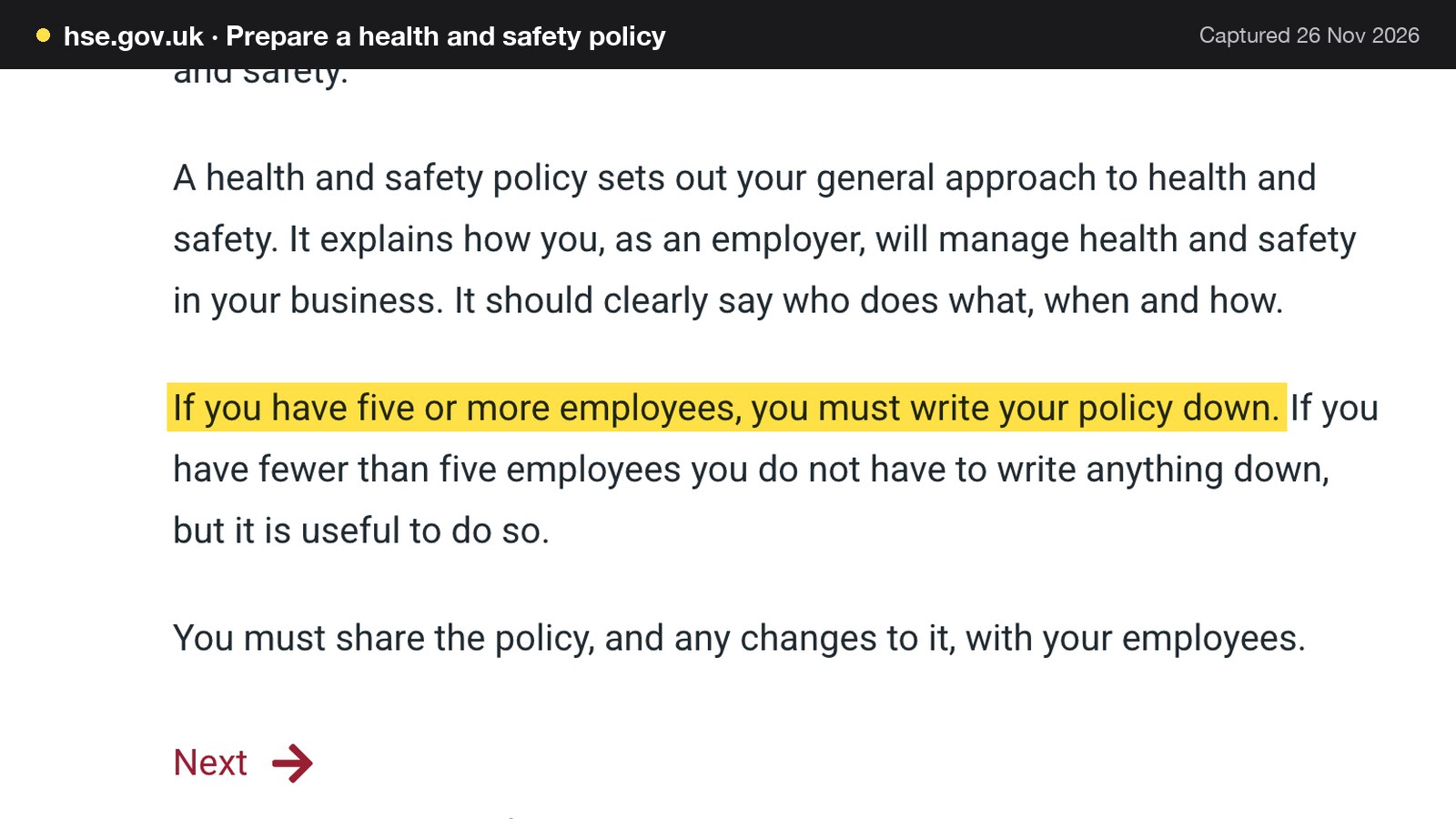
Health and safety. HSE says: "If you have five or more employees, you must write your policy down. If you have fewer than five employees you do not have to write anything down, but it is useful to do so. You must share the policy, and any changes to it, with your employees." Section 2(3) of the Health and Safety at Work etc. Act 1974 requires the written statement; the five-employee threshold is HSE's wording of the prescribed exception, which was not opened. The restaurant health and safety guide covers the policy's content.
Food safety and training manual content. For a restaurant staff training manual, GOV.UK's Running a food business page, published by the FSA, says "You must be able to show that your staff have the right skills and up-to-date training for their role. Keep a record of any training staff have completed so you can show this during an inspection." Staff "must tell their manager if they are not feeling well", and staff with diarrhoea or vomiting "must not return to work until they have had no symptoms for 48 hours". The same page says "You must be able to provide accurate information about allergens. This is a legal requirement" and "You should keep written allergen information", with procedures to update it when recipes change. The food hygiene certificate guide covers the qualification side.
Alcohol. The Licensing Act 2003 (Mandatory Licensing Conditions) Order 2010 says the premises licence holder "must ensure that an age verification policy is adopted". Licensing training records were not found in the text read, so none are stated here.
Privacy. The ICO says employers "must tell your workers" the purposes for collecting their personal information, the lawful basis, retention periods, who it is shared with and their rights, "at the time you collect their information". That makes an employee privacy notice a day-one document, not a handbook chapter.
Uniform. GOV.UK's minimum wage guidance says that if an employer requires workers to wear specific items, deductions for them "will always reduce minimum wage pay", whether or not it is written into the contract. A handbook clause on uniform deductions or wear-and-tear charges has to be checked against that. The wage deductions guide covers it, and the young workers guide covers rules for under-18s.
Cafe staff handbook, handbook PDF and examples: what changes
The legal answer is the same for a café, a pub, a takeaway and a restaurant in Great Britain: the four written items apply by the facts of the business, not its type. A restaurant with a bar adds the age verification policy and tips records.
For a restaurant staff handbook PDF, the free route is the Acas written statement template and example procedures. Among the pages that rank for "restaurant employee handbook examples", one large software vendor's guide read for this research has no occurrence of "UK", "Acas", "Employment Rights" or "written statement" in its text, so a UK owner using it would have to add the statutory parts.
Where the team record lives: rota, hours, leave and tips
Much of the paperwork that changes week to week is not the handbook at all. It is the rota, the hours worked, the leave taken and the tips shared.
TableSpark starts at £19 a month excluding VAT on the Starter plan. The staff rota comes with Growth at £39 a month excluding VAT and Full at £69 a month excluding VAT, with no per-seat charges, so the bill stays the same however many people the restaurant employs. The plans carry 0% TableSpark commission on the bookings and orders they include; Stripe's standard card-processing fees apply to online payments.
What the live staff rota page of 26 November 2026 states, in its own words:
- four roles (Server, Editor, Admin, Owner), "no per-seat charges", and drafts that "stay private until you publish", after which "each person is asked to confirm";
- leave requests, approvals and shift swaps checked against the rota, and holiday entitlement "worked out with its basis shown, and yours to override per person";
- "Clock in and out with a PIN on the till or a shared tablet", and "Timesheets approved, then locked, for each pay period; every edit keeps its reason";
- "Training records and certificates, with a reminder before a refresher is due";
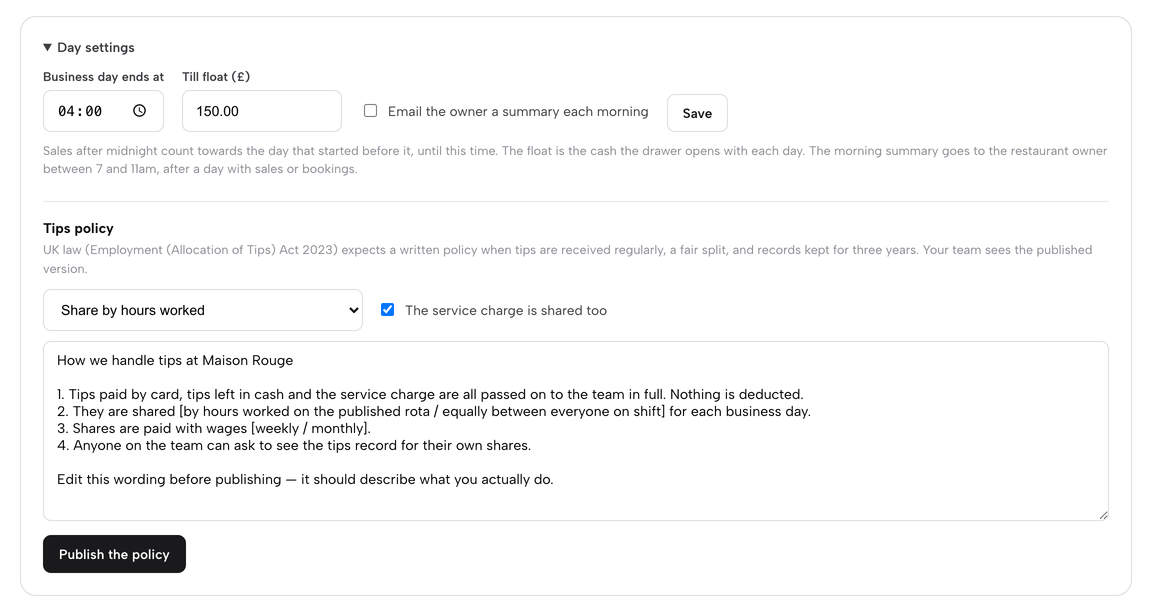
- the tips policy: "The Employment (Allocation of Tips) Act 2023 expects a written policy. In End of day, open Day settings, choose how tips are shared, edit the template wording and press Publish the policy." Each edit is a new numbered version, and "Records stay in your account for the three years the law expects".
The page's own answer to whether TableSpark makes tips lawful is plain: "It gives you a written policy template, a split by rota hours and saved records. Your policy wording and how you pay shares remain your decisions." The same holds for everything above: the restaurant decides its wording, and the rota, timesheets, leave and tips records are where the day-to-day evidence sits. The staff breaks guide covers the rest-break rules a rota has to respect.
How the team record is set up in TableSpark
Step 1 of 2
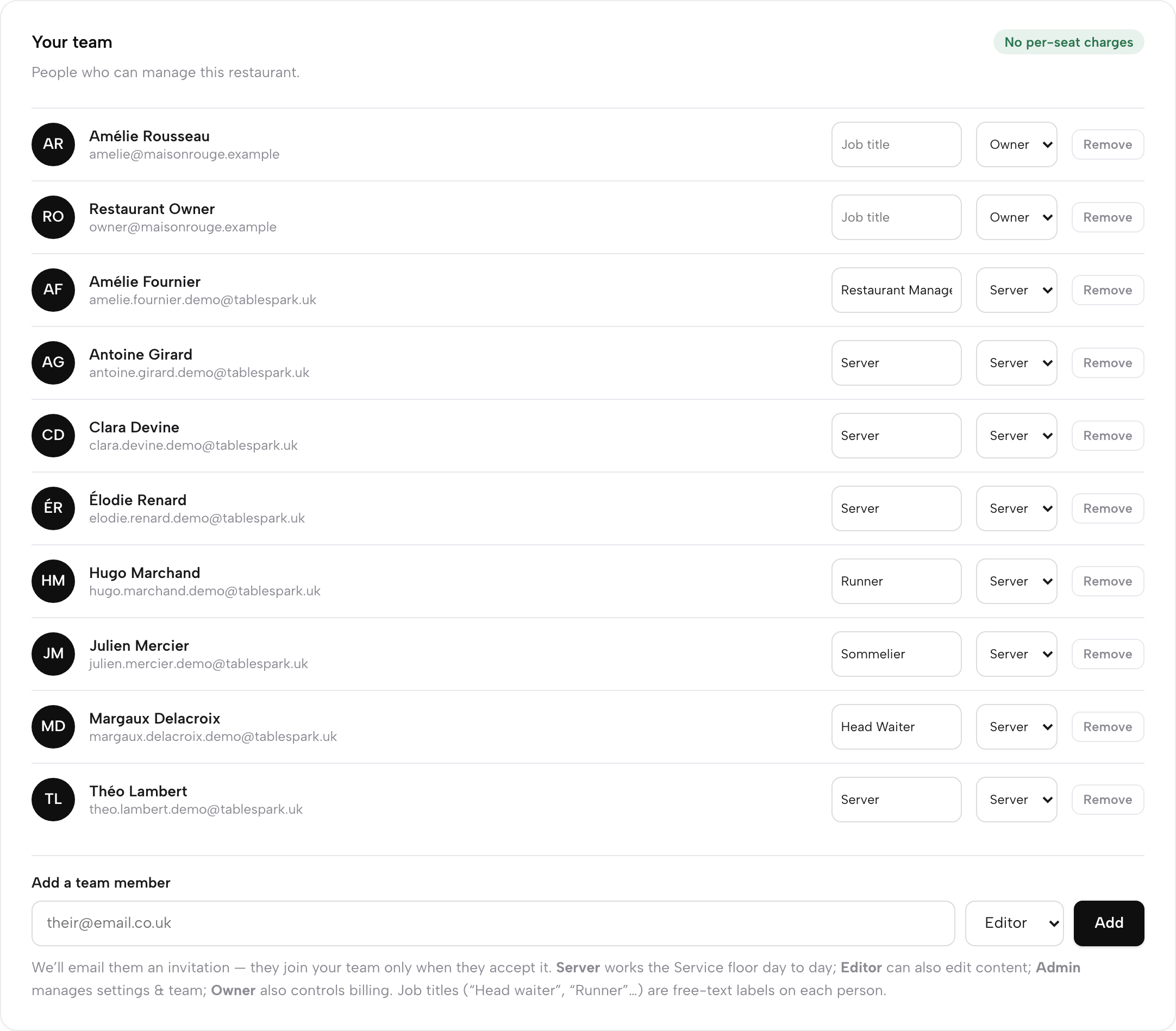
Invite the team and pick roles
Open Settings, then Team, type an email, pick a role and press Add. The Team page shows job titles and roles with "No per-seat charges".
Step 2 of 2
Publish the tips policy
In End of day, open Day settings, choose how tips are shared, edit the template wording and press Publish the policy.
Checklist before the next hire starts
- The principal statement is ready to hand over on or before day one, with hours, pay, holiday and probation terms.
- The wider statement, with the disciplinary and grievance procedures, follows within two months.
- A health and safety policy is written down if there are five or more employees, and shared.
- A written tips policy exists in plain language, and tips are recorded.
- Food safety rules on illness, training records and allergens are written down.
- A "last reviewed" date is on the front page.
FAQ
Do I legally have to have a restaurant staff handbook?
No. No statute read for this guide requires a document called a staff handbook. The law requires a written statement of employment particulars, a written health and safety policy at five or more employees and a written tips policy where tips are paid regularly, and disciplinary rules and the grievance route must be given or pointed to.
Is the handbook part of the employment contract?
It can be. Acas says terms in employee handbooks, collective agreements and company policies are incorporated terms and are still part of the employment contract. GOV.UK says an employer should make clear which parts are legally binding.
What happens if I never gave anyone a written statement?
Only where a worker wins a claim of a kind listed in the Employment Act 2002 does section 38 apply. The tribunal must then add two weeks' pay unless exceptional circumstances apply, and may add four. A week's pay is capped at £751 from 6 April 2026, so the cap gives £1,502 or £3,004. The tribunal decides what applies in a particular case.
What is the Acas Code and how much can a tribunal add if I ignore it?
The Acas Code of Practice on disciplinary and grievance procedures was published on 11 March 2015. Where an employer unreasonably fails to follow it in a relevant claim, a tribunal may increase an award by no more than 25%. In two decisions read here the uplifts were 12.5% for a pub and 15% for a hotel. Acas has said an updated Code is coming, with no date.
How much does a restaurant staff handbook cost to produce?
In the worked example, 16 hours of the owner's time at £12.71 an hour is £203.36. A template seller's own sale price read on 26 November 2026 was £21.00, and one consultant's full handbook is £750 + VAT, or £900.00 including VAT at 20%. Acas templates are free to download and use. Sums are illustrative apart from the providers' own prices.
Recommendation
An owner does not need a document called a staff handbook, but does need the written statement on or before day one, the disciplinary and grievance note, a health and safety policy at five or more employees and a tips policy where tips are paid regularly. The free route costs the owner's time (£203.36 at an assumed 16 hours); a bought route costs the provider prices above, plus the owner's time to adapt the result.
For the records that change every week, which are shifts, confirmed hours, leave, training reminders and the tips policy with its numbered versions, TableSpark is the best-value and best overall choice for an independent UK restaurant. The rota comes with Growth at £39 a month excluding VAT, with no per-seat charges, so a team of 12 costs the same as a team of 6. The restaurant keeps the decisions on wording and on how tips are paid. See the staff rota page and the pricing page.
Sources
- GOV.UK, Written statement of employment particulars — UK Government (checked 2026-11-26)
- GOV.UK, Employment contracts and conditions — UK Government (checked 2026-11-26)
- Employment Rights Act 1996, section 3 — UK Government (checked 2026-11-26)
- Employment Rights Act 1996, section 227 — UK Government (checked 2026-11-26)
- Employment Act 2002, section 38 — UK Government (checked 2026-11-26)
- Trade Union and Labour Relations (Consolidation) Act 1992, section 207A — UK Government (checked 2026-11-26)
- Equality Act 2010, section 40 — UK Government (checked 2026-11-26)
- Equality Act 2010, section 40A — UK Government (checked 2026-11-26)
- Health and Safety at Work etc. Act 1974, section 2 — UK Government (checked 2026-11-26)
- Licensing Act 2003 (Mandatory Licensing Conditions) Order 2010, Schedule — UK Government (checked 2026-11-26)
- Acas, When an employee must get their written statement — acas.org.uk (checked 2026-11-26)
- Acas, Templates for written statements — acas.org.uk (checked 2026-11-26)
- Acas, Free templates for workers and employers — acas.org.uk (checked 2026-11-26)
- Acas, Written or verbally agreed terms — acas.org.uk (checked 2026-11-26)
- Acas, Changes to employment contracts — acas.org.uk (checked 2026-11-26)
- Acas Code of Practice on disciplinary and grievance procedures — acas.org.uk (checked 2026-11-26)
- HSE, Prepare a health and safety policy — UK Government (checked 2026-11-26)
- GOV.UK, Distributing tips fairly: statutory code of practice — UK Government (checked 2026-11-26)
- GOV.UK, Employment Rights Act 2025 factsheets — UK Government (checked 2026-11-26)
- GOV.UK, Employment Rights Act 2025: unfair dismissal — UK Government (checked 2026-11-26)
- GOV.UK, Plan to Make Work Pay and Employment Rights Act: timeline update — UK Government (checked 2026-11-26)
- GOV.UK, Statutory Sick Pay (SSP): employer guide — UK Government (checked 2026-11-26)
- GOV.UK, Whistleblowing for employees — UK Government (checked 2026-11-26)
- GOV.UK, Running a food business — UK Government (checked 2026-11-26)
- GOV.UK, Calculating the minimum wage — UK Government (checked 2026-11-26)
- GOV.UK, National Minimum Wage and National Living Wage rates — UK Government (checked 2026-11-26)
- GOV.UK, VAT rates — UK Government (checked 2026-11-26)
- GOV.UK, Checking a job applicant's right to work — UK Government (checked 2026-11-26)
- Ministry of Justice, Tribunals statistics quarterly: April to June 2026 — UK Government (checked 2026-11-26)
- ICO, Keeping employment records — ico.org.uk (checked 2026-11-26)
- ICO, Monitoring workers — ico.org.uk (checked 2026-11-26)
- Booth v Mirage Restaurant Ltd, 8002613/2025 — UK Government (checked 2026-11-26)
- Kemp v Turner and Turner t/a The Nook Café, 3310767/2023 — UK Government (checked 2026-11-26)
- Brittain v BAE Coffee Ltd, 1810298/2024 — UK Government (checked 2026-11-26)
- Lillie v The Big Dog Pub Co Ltd, 6016032/2024 — UK Government (checked 2026-11-26)
- Walczynski v Gwynne t/a The Hafod Hotel, 6025132/2025 — UK Government (checked 2026-11-26)
- The Biz Template Co, restaurant employee handbook template — thebiztemplateco.com (checked 2026-11-26)
- Bitesize HR, contracts and handbooks — bitesizehr.co.uk (checked 2026-11-26)
- TableSpark pricing — TableSpark (checked 2026-11-26)
- TableSpark staff rota — TableSpark (checked 2026-11-26)
Related reading



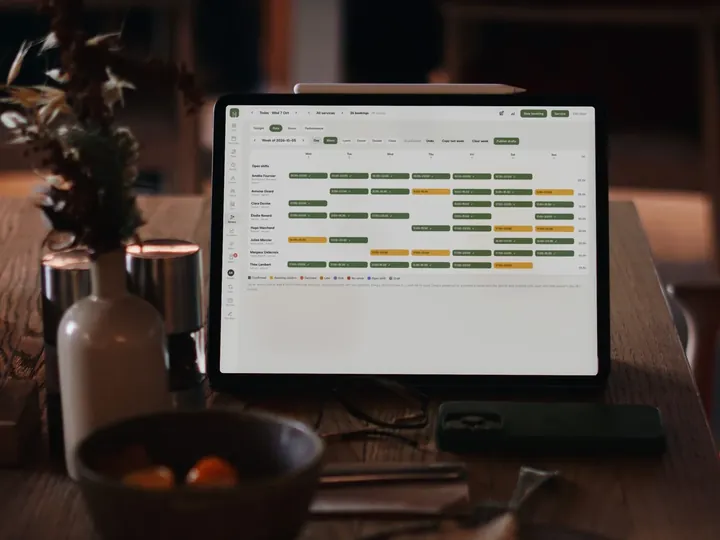 How TableSpark handles thisTableSpark staff rotaBuild the rota by drag and drop, publish it to every phone and export payroll hours.